The Bedfordshire Regiment in the Great War

1915 War Diary appendices
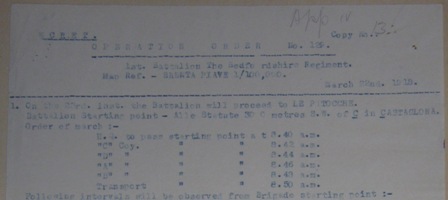
[Note that all remarks in squared brackets are my own additions and not part of the original text]
January 1915.
MESSAGES AND SIGNALS Sender's Number Day of Month Bd. 61 28 Jan 15 Report re test parade of Battalion in Divisional reserve.
1. Exact hour message received 9.55 AM. 2. Orders issued 10.3 AM. 3. Battalion ready to move off 10.50 A.M. Transport ready to move off with rations for 29th 11.50 A.M. 4. Rations carried Remainder of days ration & iron rations except men of last draft. Ammunition carried 200 rounds Report made to Lt.Colonel Daly personally. C.C.Onslow [Cranley Charlton ONSLOW, CB, CMG, CBE, DSO], Major, Comdg. 2 Bedf.R. Officer Commanding, 2nd Bn. Bedfordshire Regt.
The Battalions in Divisional Reserve will fall in at once ready for action as a test parade. Report when ready to march off. It should be stated also: - (1) The exact hour at which this message is received. (2) When orders were issued. (3) When the Battalion was ready to move off. (4) What rations and ammunition are carried. The G.O.C. wants a careful record made of above. A.C.DALY, Lt.Colonel A.A.& Q.M.G., 7th Division. 28/1/1915
[This was among the appendices and appears to be a copy of a personal letter from a divisional officer to his wife, detailing the New Army ot possibly Territorial Force division he was serving in. Although it cannot relate to the 2nd Battalion who were a Regular Division, it is worth including here]
January 31st 1915.
My dear. I think it is possible or even probable that you hold the idea (which I fear is rather prevalent out of England) that the New Armies are a sort of ridiculous joke which cannot for a very long time be considered seriously. And as I think that it causes a lot of mischief that such an idea should be in existence I am proposing to give you my idea of what they are worth as far as my knowledge of them goes. And although I daresay you won't think that is worth much, it is just as well that every part of our forces should consider the views of other portions.
The Division was formed on about September 15th and was an off-shoot of the Division, so that we have now had about 4 months training. I have been with it since its birth, first as D.A.A. & Q.M.G.; then I was changed over to G.S.O.2. I will sketch the history and progress of this Division as far as I can and I believe it is not very different to other divisions.
I see frequently and know pretty well the General Officers Commanding and Staff of the other divisions at Aldershot which are four in number, and as far as I can make out they are in much the same state as we are. The infantry of the Division consists of x x x. These have all reached the same stage of training, viz: - They completed some 10 weeks recruit training, 6 weeks company training, a recruits course of musketry, and are now in the middle of battalion training. All the training has been carried out under pretty peculiar conditions. For instance, we have had no rifles (except very old D.P. ones unfit to fire) till the end of December, no uniform except the convict blue, a scarcity of boots, no hats, no equipment, no transport; in fact devilish little anything. In spite of that the progress made has been remarkable.
During the last few weeks things have begun to come in and we have now a proportion of service rifles, service dress and greatcoats and decent boots for all. Horses, wagons - so far no web equipment (and I cannot hear when it is coming); there is a certain amount of the old buff pattern.
Of course battalions vary to a certain extent but every battalion in the division can do a route march of 16 to 18 miles and one hears the battalion commander discussing the reason for one man falling out. Not having equipment, they cannot go out in marching order but it shows that they are fairly fit and that their march discipline is good, that they can plug along for 16 or 18 miles without feet casualties.
The thing that strikes one more than anything is the extreme anxiety of all ranks to learn. If one goes up to a battalion doing, say, outposts and questions an individual man who is doing sentry or something he on his own he will probably finish up the conversation by saying "Thank you very much for telling me"!! This may sound peculiar to you, but I can assure you that the discipline, which is what we have gone for most of all during the whole time, is excellent. For instance, there are now quartered at Aldershot between 130,000 and 140,000 men, Up till Xmas there had been a total of 43 deserters, which is pretty good considering they are all newly enlisted men.
As regards artillery, we have been very badly hampered by lack of guns. Our divisional artillery has only had old S.African 15-prs. and old French guns to train with. I'm thankful to say that our first instalment of new guns came in today. Harness has been non-existent, but I daresay you know about that. It is all right now and I suppose you know where it has come from. However, in spite of all that the training has gone ahead well, and our C.R.A., who is a first rate man, is most sanguine.
The officers have nearly all gone through a short course at Shoeburyness and also a course at Farnboro' in air service and artillery co-operation and we have taught most of the men to ride and drive decently and about 5% have been through a telephone and buzzer course.
The R.E. are first class. I should say they are as good in practice as most of the old regulars. We have a very good C.R.E. and he has a good proportion of regular officers and some excellent civil engineers under him.
Then we have the Signal Company, which is excellent.
Cyclist Company - not long formed - but coming along well.
Divisional Train rather behindhand owing to lack of harness and vehicles, but under a really good regular officer.
R.A.M.C. being separately trained. Cavalry - nil. I suppose they will make the Cyclist Cos. act as our Divisional cavalry; it is stronger than the old establishment, viz: -7 platoons.
But we are told that we may possibly be given a squadron of yeomanry or Reserve Cavalry as well. It doesn't appear, though, as if cavalry was much good to one at present, tho' of course it will be if we ever get a move on.
The general question of officers is a difficult one, but taking them all round they are a first rate lot. Of course there are a few rather ancient warriors, but I am glad to say we have got rid of most of them. Then all units have an excellent lot of O.T.C. boys who are really first class subalterns.
Our greatest difficulty at present is the training of specialists, especially machine gun sections. We have got no machine guns and all we can do is to get the officers and N.C.O's put through courses and get together the personnel of the sections and lecture them. I believe, however, that guns will be to hand shortly.
Transport sections, sanitary squads, stretcher bearers, are now being trained all right.
Re signallers; we had an order early on in the proceedings to only train men in semaphore. We ignored this, however, and as far as our Division is concerned, have made them train a minimum of 16 and maximum of 32 per battalion in Morse, the idea being, not that they will use flag, lamp or helio much, but that they will be indispensable for supplementing the signal service in reading and sending on the buzzer. I should be glad of a tip from you as to whether you think this is sound or waste of time. It is entirely my own idea and a good many people oppose it.
The keenness of all is quite marvellous. It is unfashionable to grumble. I head [sic] of a case where one man got fed up and said he wouldn't do any more. He got 14 days field imprisonment and when he came out was very nearly killed by his platoon for having disgraced them!
I fear I have sat up late and rather let my pen run away with my favourite hobby. But I'm keener about this show than anything I've ever had to do with in my life so you must forgive me. There is nothing that can kill it except ridicule and if it is in your power to put in a word with anyone you hear throwing cold water on the New Army I wish you would use it.
Just one more thing. In musketry our whole Division averaged higher in the Territorial Standard Test (which was part of our recruits course) than my old Terriers in London, and they were the best shooting battalion of Territorials in the London District, and remember all their musketry had to be taught them with obsolete drill pattern rifles. I think all the lessons and tips contained in the various little pamphlets, "Notes from the Front", etc. issued by the General Staff, have been valuable and that all have done their best to put to a good use the lessons contained therein.
Of course we don't know at present how we are going to be used. I hope, however, that as far as possible they will keep our existing formation intact. As soon as we are complete in everything it would be good work if we came over and completed our training in France. What would be really of priceless value would be the taking over to Flanders for a few days at a time small parties of Staffs and Commanding Officers, who would then pick up a lot of useful tips. So far only one small party of about 6 have gone over from Aldershot.
February 1915
Officer Commanding, 2nd Bn. Bedfordshire Regt.
(1) The attached Copy of orders for a practice attack on an entrenched line, are forwarded for perusal. Each Battalion when it next comes into Brigade Reserve will carry out this practice.
(2) On the afternoon of the day after it comes out of the trenches, each Company will practice the attack in conjunction with Bombthrowers. The Officer Commanding Grenade Company will place two Sections of Bombthrowers at the disposal of the Officer Commanding Battalion for this purpose.
(3) On the following day the Battalion attack will be carried out at a time which will be notified from Brigade Head Quarters.
(4) Officer Commanding Battalion will forward to Brigade Head Quarters on the evening of the day before the attack takes place a detail of the arrangements made with regard to the special parties referred to in para. 7(a) and (b) of The Instructions. The Officers Commanding 2nd Highland Company R.E. Grenade Company, Signal Section and Brigade Machine Gun Officer will also forward a detail of the instructions issued by them with regard to R.E. Bombthrowers, Signal Parties and Machine Guns respectively.
W.DRYSDALE, Captain. Brigade Major 21st Infantry Brigade. FLEURBAIX. 14th Feb.1915.
21st INFANTRY BRIGADE OPERATION ORDER No. 100. FLEURBAIX. 14.9.1915.
SITUATION.
(1) The Germans are holding a line of trenches marked on the map in red, and facing South East. The 21st Infantry Brigade is holding a line facing them, along the line of the RUE DU BOIS with 2 Battalions in the trenches and 2 in reserve. INTENTION.
(2) It is intended to attack that portion of the enemy's line marked "A-B" tomorrow at ARTILLERY.
(3) The Artillery of the Division will bombard this part of the trenches, commencing at to prepare for the attack
(4) The following troops will carry out the attack: - Commander. 2nd Bn. 2 Sections 2nd Highland Coy. R.E. 6 Sections Grenade Company. 2 Machine Guns. This column will be deployed ready to attack at at which hour the Commander will join the Brigadier at CROIX BLANCHE. ASSAULT.
(5) The column will advance to attack at an hour which will be specified to the Commander by the Brigadier, on the spot. Special instructions for the Conduct of the attack are issued herewith. AMMUNITION.
(6) 300 rounds S.A.A. will be carried on the man, and arrangements have been made for the establishment of a Reserve of 100 rounds a man, 1,000 Hand Grenades at CROIX BLANCHE. PACKS.
(7) Packs and great-coats will not be carried. They will be collected in one place in billets, and arrangements made for them to be brought up when required. TOOLS & SANDBAGS.
(8) each man will carry 4 sandbags rolled up and attached to his belt. Every third man will carry a shovel. RATIONS.
(9) An extra day's ration will be carried by each man. FIELD AMBULANCE.
(10) The 21st Field Ambulance will send forward one Bearer Sub Division to CROIX BLANCHE. COMMUNICATION
(11) The Officer Commanding Brigade Signal Section will arrange for telephone communication to be established with Brigade Headquarters from the trench "A-B" as soon as it is captured, and also for visual signalling and orderlies in case telephones are cut. TRANSPORT.
(12) All transport will remain in its present position. BRIGADE HEADQUARTERS. (13) Brigade Headquarters will be at CROIX BLANCHE after.
Captain Brigade Major 21st Infantry Brigade
INSTRUCTIONS FOR THE CONDUCT OF THE ATTACK.
ARTILLERY COOPERATION.
(1). Artillery of the Division have instructions to prepare for the attack by keeping down hostile Artillery fire bombarding the enemy's trenches and machine gun emplacement and cutting gaps in his wire. These gaps are to be at about 25 yards interval.
INFANTRY SUPPORT. (2). The Companies occupying our trench on the flanks of the attack will support it by bringing a heavy rifle and machine gun fire to bear on the enemy's trench and machine gun emplacements opposite them.
RECONNAISSANCE. (3). Reconnaissance has ascertained that the ground between us and the enemy's trench is flat and heavy going. There is one Stream to be crossed which is shown on the map. It is from 6-8 feet wide and will require bridging. There is a wire obstacle about 30 yards from the enemy's trench 3 yards wide.
PREVIOUS ARRANGEMENTS. (4). No.2 Battalion holding this section of our trenches opposite A-B will to-night make the following arrangements: - (a) Cut gaps in our wire at 25 yards interval all along, each gap to be 5 yards wide. (b) Cut notches for steps in their parapets in this section all along at 2 yards apart and drive a picket into the top of the parapet above each step to assist a man to get out quickly. (c) To establish a reserve of 100,000 rounds of S.A.A. and 1000 hand Grenades at CROIX BLANCHE. (d). To detail two platoons to be stationed at CROIX BLANCHE for the purpose of carrying up ammunition and R.E.stores to the trenches as soon as it is captured and secured.
METHOD OF ATTACK.(5). The Attack. (a) The attack will be carried out in lines of sections at 25 yards interval and 50 yards distance with 3 Companies in the front line and one in support as shown in the attached diagram X. The 2 Sections R.E. will accompany the support. 3 Sections of Bombthrowers will be with the leading Section of the front line, one section to each Company and 3 Sections will be with the support. (b) Deployment. The Column will deploy with the 2 leading platoons of each Company in the front line in the fire trench. The 2 remaining platoons in the communication trenches and the Support Company and R.E. in the Support trench. As soon as the front trench is vacated by the 2 leading lines the section forming the next 2 lines will move up into it and get into position opposite the gaps ready to advance when the line in front has moved forward 50 yards. the deployment will be completed by and care will be taken that the leading files of each section in the front line are in position opposite the gaps in our wire entanglements at that hour. (c) Advance. The Sections when they advance will move through the gaps in their own wire and straight on the gap in the enemy's wire opposite them. the leading files in each section in the front line will carry 2 planks for use in bridging the Stream. These planks will be found in our trench opposite each gap in the wire. The two leading men in each leading section will carry wire cutters. The planks when placed in position across the stream will be left there for the use of the Sections in rear. As soon as each line has advanced 50 yards the next line will vacate the trench and follow. On reaching the enemy's wire, if the gap is not complete the Bombthrowers will keep down the enemy's fire by throwing bombs into the trenches while the wire cutters clear a passage.
SUPPORTS. (6) The Company in support will follow in the same formation with 2 platoons in rear of each flank company in the front line. The leading platoon on each flank in the Support Company will be responsible for the protection of the flanks of the attack and will each have one section of Bombthrowers attached to it. The R.E., Machine Guns and reserve Section Bombthrowers will follow in the rear of the Centre Company.
DEFENCE OF THE TRENCH WHEN CAPTURED. (7). (a) Covering Parties. As soon as the trench is captured, men will be sent forward for 40 yards along Communication trenches to the front and to the flanks to form a covering party. As soon as the Support comes up, the leading flank platoon will move along the trenches with their Bombthrowers to clear it and so protect the flanks. (b) Preparation for defence. Every effort will at once be made to prepare the captured trench for defence from the enemy's side and to block communication trenches and place traverses in trenches to guard the flanks. Special parties should be detailed beforehand for each of these purposes. The R.E. will detail parties to assist the infantry in each task and will also commence at once to dig two Communicating trenches from each flank of the captured trench back to our trench line. (c) Machine Guns. Machine Guns should be placed in position as soon as possible so that they can afford protection by fire to cover the infantry and R.E. working on the defences. (d) Wire obstacles should be put up as soon as possible. The R.E. will take wire for this purpose.
Captain, Brigade Major 21st Infantry Brigade. FLEURBAIX. 14th February 1915.
Officer Commanding 21st I.Bde. Bedf.Regt. 132/G
1. The following points noted by the Brigadier at his inspection of the attack this morning are passed for information.
(a) The wire cutters were very slow at cutting the wire. Some of them did not appear to know how to do it. They should practice this as it is most important that the wire should be cut quickly.
(b) A good many of the bombs were thrown short of the trench. There is room for much improvement in this. Very few of the bombs went into the trench.
(c) Several different ways of carrying the shovel were adopted. The best way appears to be to fix the shovel vertically behind the centre of the back underneath the equipment straps with the blade up.
(d) The quickest way to get the planks laid across the ditch is to put them up on end on the near side and let them drop into position across the ditch
(e) Infantry parties should be detailed to help the R.E. dig Communication trenches back from the captured trench
(f) The wiring party did their work well and quickly. It is a great advantage to a Battalion to have a party trained in this rapid wiring and arrangements will be made to have parties from each battalion trained when it comes into Brigade Reserve.
(g) Some of the infantry working parties, especially the flank parties to block the trenches were slow in getting to work. The procedure should be as follows. As soon as the trench is captured a few men with bayonets and some bomb throwers should be sent along to the flank to clear it for a distance of 40 yards. The trench should then be double blocked, a parapet being made across it at the left point of attack and another at 40 yards out so that any enemy coming along the trench to throw bombs into the captured trench must expose himself getting over the parapet. The same procedure should be adopted with regard to the enemy's communicating trenches which should be double blocked in the same way.
W.DRYSDALE, Captain, Brigade Major 21st Infantry Brigade. 18th February 1915.
Officer Commanding 2nd Bn.Bedfordshire Regiment.
The following points observed by the Brigadier at the last two attack practices are brought to your notice.
COVERING PARTY. It appears to be a mistake to put out a covering party in front when the trench has been captured, unless there is a suitable ditch or trench in which it can take cover. Covering fire when the work of transferring the parapet is going on can best be given by Machine Guns which should be emplaced as soon as possible.
COMMUNICATION. It is impossible for the telephone operators to drag the wire along over wet ground without assistance. The Officer Commanding Battalion should detail 6 men to report to the Officer Commanding Signal Section at the place of deployment to assist them in laying the wire.
WIRE. The wire obstacle is not at present a great enough one and is too easily crossed at any point. Arrangements are being made to get it increased so that it will be difficult to cross except where gaps are cut. In order to facilitate repairing the wire, places will be marked where the gaps are to be cut and the wire should not be cut except where marked.
W.DRYSDALE, Captain, Brigade Major, 21st Infantry Brigade. 24.2.1915.
O.C.Coys. For information. C.C.Onslow [Cranley Charlton ONSLOW, CB, CMG, CBE, DSO], for Capt. Adjt. 2/Bedf/R. 25.2.15 SECRET 2nd Bn.Bedfordshire Regt.
Forwarded. Defence Scheme should be amended accordingly.
W.DRYSDALE, Capt. B.M. 2nd Inf.Bde. Fleurbaix. 25.2.15.
Alterations to nomenclature of Redoubts and Support Points occupied by 7th Division.
(1) FIRST LINE. Old designation New designation A. 1.A. Works on RUE DU BOIS in No.2 1.X. B. 1.B. C. 1.C. D. 2.D. E. 2.E. F. 3.F. CONVENT REDOUBT 3.G. H. 4.H. I. 4.I. J. 5.J. "Y" Farm. 5.Y. K.. 5.K. L. 6.L. M. 6.M. CULVERT FARM 6.Z.
(2) SECOND LINE. (i.e. Works behind G.H.Q.Line) Former designation New designation Position No.1 17 M.12.b. No.2 18 M.6.d. No.3 19 N.1.a. No.4 20 N.1.b. No.5 21 H.31.b. No.6 22 H.32.a.b. No.7 23 H.26.d. No.8 24 H.27.a. No.9 25 H.27.b. CROIX BLANCHE 26 CROIX BLANCHE CROIX MARECHAL 27 CROIX MARECHAL ELBOW 28 ELBOW.H.28.d. LE CRON BALLOT 29 LE CRON BALLOT
Attack Practice FLEURBAIX February 1915
O.C.Coys. notify Adjt. time & place of Coy.practice. Notify O.C.Bombs. Transport Officer for Transport of 21 coats. Plank men & wire cutters, & men to block flank and comntg. trenches. Wire cutters. A..... B..... C..... D.....
MESSAGES AND SIGNALS.
To: - 21 Infy. Bde. Sender's Number Day of Month B.2.d. 26th.
Will you please inform me what time the Brigadier wishes the attack practice to be carried out tomorrow.
Bedford. 2.30 p.m. please.
7.25 pm. W.DRYSDALE, Capt. B.M.
From O.C. 2/Bedf.R. Time 6.40 P.M. C.C.Foss [Charles Calverley FOSS, VC, DSO], Capt. Adjt.2/Bedf.R. O.C.Companies. For information.
The formation might be practised while in present billets. Please pass O.C. D.Co. to return. C.C.Foss [Charles Calverley FOSS, VC, DSO], Captain. C.B. O.C.D.Coy. S.D.M. O.C.B.Coy. O.C.C.Coy.
March 1915
SECRET. Not to be taken into the Trenches.
DRAFT.
The Infantry attack will be carried out thus: -
On the right - The 21st Brigade Column.
On the left - The 22nd Brigade Column.
Dividing line - General direction marked out by the ditch (blue) between (318) and H of "British", (Map 1/5,000 GSGS No. 2769). The above Brigade Columns will be previously assembled in the shelters immediately behind our front line parapet, and in shelters behind these. The 20th Brigade will occupy such portions of the 7th Division trenches, as are not required by the assaulting columns. Remaining Battalions of the 20th Brigade will form the Divisional Reserve, and will be assembled in previously prepared shelters behind the RUE TILLESLOY, one battalion in square M.12.b West of PICANTIN. The shelters behind the RUE TILLELOY will be connected with the shelters behind the front line parapet by means of communicating trenches.
NOTE. (B) Battalion Yorkshire Regiment. (A) Battalion Bedfordshire Regiment. (C) Battalion Royal Scots Fusiliers. Right (21st Brigade) Column. 21st Inf. Bde. Co. R.E. Mortars. This Column will attack with one battalion (B) against the objective (308), on the general front (309) (318) (frontage about 200 yards). Its task will be to occupy the enemy's trenches each side of (308). Simultaneously, another battalion (a), will attack, left on (310) (309), the points (311) to (315). This battalion (A), will also send parties along the enemy's trenches as far as they can force their way, in the direction of (270) (273) (280). A third battalion, (C), will, wit has little delay as possible, attack and occupy (270) (273) (280), if these points have not been already captured by parties from (A) battalion; and they will occupy and hold these points if they have been already captured. This attack will be made from the direction of (312) and (314). the Indian Corps, attacking MIN DU PIETRE from the cross roads in Square M.23.d. may be expected to move a party in the direction of (270). The fourth battalion, (D), forms the Brigade Reserve. The 20th Infantry Brigade will be prepared to support this column with one battalion, if required. The battalion of the 20th Infantry Brigade, occupying "E" lines, will assist the advance of this column as well as the advance of the left of the Indian Corps, by fire. The artillery support for this column is as follows: - Up to 0-30 Artillery will bombard all the enemy's trenches and points in front of the column. A right barrage of fire will also be placed between points (311) (315), and between point (278) to midway between (274) (275). At 0-30. The bombardment in front of this column will cease on the forward trenches but will continue on the line (314) (308). At 0-40. the bombardment will lift to the points (280) (243) and places about RUE D'ENFER, and the right barrage will move to the right to cover the points (275) (277), (270) (246), or as far in that direction as the operations of the Indian Corps will permit. The Brigadier-General in command of this column has also 2 Mountain Guns and 3 Trench Mortars at his disposal for closely supporting his attacks. One 4.5" Howitzer battery will be specially detailed to assist this column, if required, and an Officer of this battery will be present at the Headquarters of the 21st Infantry Brigade until the column has accomplished the tasks allotted it. At 0-50. the Artillery bombardment will move in the direction of AUBERS, and the right barrage will cease. Left (22nd Nrigade) Column. 22nd Inf.Bde. Co R.E. Trench Mortars.
The 22nd Brigade Column will attack thus: - The right battalion, (E), will attack on the front between the dividing line between the 2 Brigades and point (328) approximately, frontage to begin with about 200 yards and widening to the left as the objective is reached etc, etc.
General Instructions.
1. The Infantry will commence issuing from their trenches at 0-27. 2. The R.H.A. front barrage will search the ground South of the line of attack.
3. All lines or positions captured, are to be at once prepared for defence. Not necessarily throughout their length, in the first instance, but at certain points, so as to ensure their being capable of being held in case of necessity. Special working parties must be previously detailed for this. These must know their business and exactly what they have to so beforehand.
4. Infantry, after reaching their objective, must get out patrols, or outposts, into covered places in all directions, so as to make good their front and flanks. Bombing and sandbagging parties must be sent some way up all trenches leading to direction of enemy. Most careful arrangements must be made for the protection of flanks, and guarding against enfilade fire. Touch must be established with our own troops on right and left. Troops on outer flanks must take special precautions to make such outer flanks good.
5. Infantry must remember that success and safety both lie in pushing on to their ultimate objective. Hesitation gives the enemy the chance of recovering from the artillery bombardment, and time to get up machine guns, man his fortified localities, and even organize counter-attacks. A bold and well sustained advance on the other hand, confuses him and upsets his plans. Everything is to be gained, therefore, by pushing on to the ultimate objective; care being taken that special parties make good every important line or point captured. There is not much harm done, if the allotted task is exceeded, while failure may result if it is not fully carried out.
6. It is very difficult for orders to reach the front line, if fire is severe. The greatest reliance is therefore placed on the bold and intelligent leading of junior officers and of N.C.O's in the front line. If orders cannot reach, and any one is in doubt what to do, he cannot go very wrong if he does his utmost to close upon and defeat the enemy he finds in front of him.
7. Brigadier-Generals Commanding Brigades and Officers Commanding Battalions will remember that the value of artillery ammunition is great, and they will therefore be careful not to make unnecessary demands on the artillery. It must also be impressed on all ranks that every round fired by the artillery, is fired with the intention of getting the infantry on. If the infantry find, therefore, that they cannot get on, and the artillery come to their assistance by bombarding the enemy's position, the infantry must endeavour to get as close as possible up to the enemy during the bombardment. As soon as the artillery fire ceases, the infantry must dash in and capture the enemy's position.
8. In order to assist the co-operation between artillery and infantry, it will be arranged that all bombardments not specifically provided for in a time schedule previously issued will last for 10 minutes; the last 3 minutes of which will be intensive. the Infantry will know that the artillery is going to shoot for 10 minutes, and they will know, from the intensive bombardment, that the end of the artillery preparation is approaching. The close of the intensive bombardment is the signal for the infantry to dash in; but to be able to do this, before the enemy has recovered from the artillery bombardment, the infantry must have worked as close as possible up to the objective during the bombardment, taking care of course not to get within the area of our own fire.
Officer Commanding. Bedf. Regt.
Reference the enclosed Orders and Instructions, will you please prepare detailed instructions for your Battalion and submit them to Brigade Headquarters by 8 p.m. tomorrow night 28th instant. Your orders should be so framed that every individual taking part in the operations will know the exact task assigned to him.
E.R.WYATT. Captain. Brigade major 21st Infantry Brigade. 27th March 1915.
SECRET 21st BRIGADE OPERATION ORDERS No. Reference Map FAUQUISSART 1/5,000 27.3.15.
INFORMATION. 1. An attack is to be made on the enemy's position as follows: (a) An attack from the direction of the MOULIN de PIETRE. (b) An attack from the front FAUQUISSART road to the point of the salient at the E in LIN-E square 13.b. This attack has for its objective the line of trenches 308-329 and thence to include point 280 and the line points 301-344. When this line has been gained a second attack by fresh troops will pass through against AUBERS. The 20th Brigade is holding the line from FAUQUISSART westwards and the 22nd Brigade (Queens Regt.) on the right will attack simultaneously on our left.
INTENTION 2. The 21st Brigade will attack from a front FAUQUISSART road exclusive to a line of poplars along a dyke near the H in BRITISH, frontage 355 yards. The object to be gained is the line of German trench marked 308; TRIVELET FARM points 311, 312, 313 and 314; the trench westwards in front of the 20th Brigade (as far as possible or until the Indian Brigade on our right is met) and the Brickfields at point 280.
ARTILLERY SUPPORT 3. The Artillery support for the Brigade is as follows: - Up to 0-30 the artillery will bombard all the enemy's trenches and points in front of the Brigade. A right barrage of fire will also be placed between points 311, 315 and point 278 to midway between 274, 275. At 0-30 the bombardment in front of the Brigade will cease on the forward trenches but will continue on the line 314, 308. At 0-40 the bombardment will lift to points 280, 243 and places about the RUE D'ENFER and the right barrage will move to the right to cover points 275, 277, 270, 246 or as far in that direction as the operations of the Indian Corps will permit. At 0-50 the bombardment will move in the direction of AUBERS and the right barrage will cease.
ORGANISATION 4. LEFT COLUMN. Commander Lieut. Colonel Alexander. Troops. 2nd Bn. Yorkshire Regt. 4 Machine Guns. 3 Sections Bombers. 2 Mortars, will attack on a front of 240 yards. The left is on the dyke lined with large willows near the H in BRITISH and will connect with the Queens (22nd Brigade); the right will be marked with a board inside the parapet. Objective trench 308 and trench each side. RIGHT COLUMN. Commander Major Onslow [Cranley Charlton ONSLOW, CB, CMG, CBE, DSO]. Troops 2nd Bn. Bedfordshire Regt. 4 Machine Guns, 3 Sections Bombers. 1 Mortar, will attack on a front from the right of Yorks to the FAUQUISSART road. Objective, on the left passing through points 310, 309, trench 308; on right points 311, 312, 313, 314 and thence work down the German trenches towards points 270, 273, 278, 280. 3rd COLUMN. Commander Major Pollard. Troops 2nd Bn. Royal Scots Fusiliers, 4 Machine Guns, 3 Sections Bombers, will follow the right column when it has captured the TRIVELET Wood and from the direction of points 312, 314 attack and occupy points 270, 273, 280 if not already captured by parties of the right column; and will occupy and hold these points if already captured. NOTE. Parties from the Indian Corps attacking from the direction of MOULIN du PIETRE may be expected to move in the direction of 270. RESERVE. 2nd Bn. Wiltshire Regiment. 4 Machine Guns, 3 Sections Bombers, 2nd Highland Coy. R.E. will move up into the main line of trenches when vacated by the Royal Scots Fusiliers.
TIME. 5. The date and time of attack will be communicated later. The attack will commence at 0-27 i.e. 3 minutes before the bombardment is timed to cease.
AMMUNITION. 6. All Ammunition Carts and animals will be brigaded under the Command of Lieut CHAUNCY 2nd Bn. Yorks. Regt. and be parked in the field just N. of the present H.Q. of the 20th Brigade.
TRANSPORT. 7. All Transport will remain in its present positions. transport Officers will report to Lieut CHAUNCY at the above mentioned place.
MEDICAL. 8. The position of the forward dressing station and any Special Medical arrangements will be communicated later.
REPORTS. 9. Brigade Headquarters will be established in the cellar of the house in the bend of the road Square 18.c. A forward observation post will be established in a dug out close to the parapet of the British breastwork about 50 yards on the E of the FAUQUISSART road.
E.R.WYATT. Captain. Brigade Major 21st Infantry Brigade.
SECRET SPECIAL INSTRUCTIONS.
CAPTURED POSITIONS. 1. All lines or positions captured are to be at once prepared for defence. Not necessarily throughout their length in the first instance, but at certain points so as to ensure their being capable of being held in case of necessity. Special working parties must be previously detailed for this. These must know their business and exactly what they have to do beforehand.
PATROLS, ETC. 2. After reaching their objective, Battalions must get out patrols or outposts into places in all directions so as to make good their front and flanks. Bombing and sandbagging parties must be sent some way up all trenches leading in the direction of the enemy. Most careful arrangements must be made for the protection of the flanks and guarding against enfilade fire. Touch must be established with our own troops on the right and left. Troops on the outer flank must take special precautions to make such outer flanks good.
VIGOROUS OFFENSIVE. 3. Infantry must remember that success and safety both lie in pushing on to their ultimate objective. Hesitation gives the enemy the chance of recovering from the Artillery bombardment, time to get up Machine Guns, man his fortified localities and even organise counter attacks. A bold and well sustained advance, on the other hand, confuses him and upsets his plans. Everything is to be gained, therefore, by pushing on to the ultimate objective, care being taken that special parties make good every important line or position captured. There is not much harm done if the allotted task is esceeded while failure may result if it is not fully carried out.
ORDERS. 4.It is very difficult for orders to reach the front line if fire is severe. The greatest reliance is, therefore, placed on the bold and intelligent leading of junior Officers and N.C.O's in the front line. If orders cannot reach and any one is in doubt what to do, he cannot go far wrong if he does his utmost to close upon and defeat the enemy he finds in front of him.
ARTILLERY SUPPORT. 5. It must also be impressed on all ranks that every round fired by the artillery, is fired with the intention of getting the infantry on. If the infantry find, therefore, that they cannot get on, and the artillery come to their assistance by bombarding the enemy's position, the infantry must endeavour to get as close as possible up to the enemy during the bombardment. As soon as the artillery fire ceases, the infantry must dash in and capture the enemy's position. In order to assist the cooperation between Artillery and Infantry it will be arranged that all bombardments not specifically provided for in a time schedule previously issued, will last for 10 minutes; the last 3 minutes of which will be intensive. the Infantry will know that the artillery is going to shoot for 10 minutes, and they will know, from the intensive bombardment, that the end of the artillery preparation is approaching. The close of the intensive bombardment is the signal for the infantry to dash in; but to be able to do this, before the enemy has recovered from the artillery bombardment, the infantry must have worked as close as possible up to the objective during the bombardment, taking care of course not to get within the area of our own fire.
DRESS. 6. No packs or greatcoats will be carried. These will all be stored under special arrangements, which will be notified later, and sent up, as circumstances permit. Every man will carry: - 220 rounds S.A.A., the unexpended portion of the days ration and the Iron Ration.
SHOVELS ENTRENCHING TOOLS, SANDBAGS WIRE CUTTERS. 7. (a) Every 3rd man will carry a shovel. these men will not carry either entrenching tools or sand bags. (b) Every man not carrying a shovel will carry his entrenching tool and 3 sandbags. (c) All wire cutters will be distributed among the front companies of the attack with the exception of 2 per platoon. All men are to be warned that sandbags and shovels are on no account to be thrown away or abandoned.
RESERVES OF AMMUNITION ETC. 8. (a) AMMUNITION AND BOMBS. A forward reserve store has been established in the fort about 100 yards behind the British line just W of the FAUQUISSART road. Whenever ammunition or bombs are required by Battalions a demand will be made for a definite number of boxes of ammunition or bags of bombs. (b) WATER. A reserve supply of water has been stored in tins, buckets, etc, behind the wall of the outhouse at the main Brigade Headquarters. Whenever men are sent to the rear for any purpose, the opportunity should be seized of sending back all the empty water bottles they can carry. These will be filled and returned whenever opportunity occurs. Bottles can be placed in sandbags for easy handling. (c) RATIONS. A reserve has been formed in a farm at the cross roads Square M.17.
GUIDES. 9. Whenever a message is sent for ammunition, rations, packs etc., to be sent up to a unit in the front line, 2 guides should be sent who know the exact position of the unit and the best way there to lead the carrying party. Whenever a unit is relieved by another, 8 guides (2 per Company) under an officer must be sent to show the position of each company.
ORDERLIES. 10. before the commencement of operations each unit will detail 3 intelligent orderlies to remain at Brigade Headquarters. Whenever a commander moves his unit headquarters he will detail another 3 men to go back to Brigade Headquarters from the new position. This will ensure men being at Brigade Headquarters who know where each unit Headquarters is at all times.
FATIGUES. 11. Each until [sic] will detail a party of 10 men, selected from those least fit for duty, to remain at the farm South of the Cross roads M.17. These men will be available to assist in carrying water, rations and filling the water bottles brought back from the front line.
CLEARING THE BATTLEFIELD. 12. Officers Commanding Units are reminded that arrangements should be made, whenever possible. to collect the equipment of our own casualties and all captured arms, etc into heaps in any convenient position from whence they can be conveyed when opportunity occurs. The positions of these heaps should be indicated to Brigade Headquarters.
POSITION OF ASSEMBLY. 13. Prior to the commencement of the attack, Battalions will be drawn up behind the trenches as shown on the attached diagram [not attached].
E.R.WYATT Captain. Brigade Major 21st Infantry Brigade.
Officer Commanding Bedfords
The Bedfordshire Regiment will relieve the Wiltshire Regt. and Royal Scots Fus. in the trenches tomorrow night. The relief will take place at 7 p.m. Officers Commanding Units will arrange the necessary details as regards guides etc, amongst themselves. Company Officers of the Bedfordshire Regiment will go down to the trenches tomorrow morning to make themselves acquainted with the parts they have to take over. Quartermasters will meet the Staff Captain after the "Q" meeting tomorrow morning and will be shown the billets their units will take over. For the night of 29th the localities F.3 and F.4 will each be garrisoned by 1 N.C.O. and 12 men of the Wiltshire Regt. These will be relieved by similar numbers of the R.S. Fus. at 7 p.m. on the 30th.
E.R.WYATT Captain Brigade Major 21st Infantry Brigade. 28th March 1915.
Officer Commanding 2nd Bn. Bedfordshire Regt.
Your guards on ammunition and ration stores in M.17.d. and the patrols along RUE TILLELOY will be relieved by similar guards from the Wiltshire Regt. tonight at 7 p.m. E.R. WYATT Captain Brigade Major 21st Infantry Brigade. 29th March 1915.
OPERATION ORDER NO. by MAJOR C. C. Onslow [Cranley Charlton ONSLOW, CB, CMG, CBE, DSO]. COMMANDING 2nd Bn. BEDFORDSHIRE REGT. 29th March 1915. Reference Map FAUQUISSART 1/5,000.
INFORMATION. 1. An attack is to be made on the enemy's position as follows: - (a) An attack from the direction of the MOULIN de PIETRE from S.W. of CHAPIGNY. (b) An attack from the front FAUQUISSART road to the point of the salient at the E in LIN-E square 13.b. This attack has for its objective the line of trenches 308-329 and thence to include point 280 and the line points 301-344. When this line has been gained a second attack by fresh troops will pass through against AUBERS. The 20th Brigade is holding the line from FAUQUISSART westwards. The 22nd Infantry Brigade will attack simultaneously on the left of the 21st Infantry Brigade..
INTENTION 2. The 21st Brigade will attack from a front FAUQUISSART road exclusive to a line of poplars along a dyke near the H in BRITISH, frontage 355 yards. The object to be gained is the line of German trench marked 308; TRIVELET FARM points 311, 312, 313 and 314; the trench westwards in front of the 20th Brigade (as far as possible or until the Indian Brigade on our right is met) and the Brickfields at point 280.
ARTILLERY SUPPORT 3. The Artillery support for the Brigade is as follows: - Up to 0-30 the artillery will bombard all the enemy's trenches and points in front of the Brigade. A right barrage of fire will also be placed between points 311, 315 and point 278 to midway between 274, 275. At 0-30 the bombardment in front of the Brigade will cease on the forward trenches but will continue on the line 314, 308. At 0-40 the bombardment will lift to points 280, 243 and places about the RUE D'ENFER.
ORGANISATION 4. The Brigade will attack in two columns, a third column to support the right column and a Reserve. the left column will be composed of the 2nd Bn. Yorkshire Regiment; the right column will be composed as follows: - Commander Major Onslow [Cranley Charlton ONSLOW, CB, CMG, CBE, DSO]. Troops 2nd Bn. Bedfordshire Regt. 4 Machine Guns, 4 Sections Bombers. 1 Mortar. It will attack on a front from the right of Yorks to the FAUQUISSART road about 115 yards. Objective, on the left passing through points 310, 309, trench 308. On right points 311, 312, 313, 314 and thence work down the German trenches towards points 270, 273, 278, 280.
TIME. 5. The date and time of attack will be communicated later. the attack will commence at 0-27 i.e. 3 minutes before the bombardment is timed to cease.
TASKS AND ORGANIZATION. 6. ORGANIZATION. "C" Company, and one section Grenade Throwers. Task; advancing with left on ditch from British trench to 310, through 309 to trench 308, which it will make good, assisting in the attack on 314. ORGANIZATION. "D" Company, one section Grenade Throwers and No. 1 and 2 machine Guns. Task. Points 311, 312, 313 all of which will be placed in state of defence. Officer Commanding Company will tell off definite parties for each part of the task. 1 Platoon will also be detailed: - 2 Sections one for 270 and one for 274. 1 Section for new communication trench midway between 313 and 275. 1 Section in support if these are required. Each section will have some Grenade Throwers. ORGANIZATION. "B" Company, 2 Sections Grenade Throwers and No. 3 and 4 Machine Guns. Task. to take 314 and 315. One Platoon to be detailed: - 1 Section to 276. 1 Section up new trench to 277 and then to 273. 1 Section up new trench to 277. 1 Section in Reserve or through 315 to 278 if there is a trench there. Alternative Task. To help "C" Company if necessary. ORGANIZATION. "A" Company. Reserve. Company in trench 309 ready to move in any direction Company in trench 310 ready to move in any direction It will be organized and detailed in exactly the same way as "B" Company so that if "B" Company has to assist "C" Company to fulfil its task it can take on "B" Company's task without confusion. Instructions for Mortar later.
AMMUNITION. 7. All Ammunition Carts and animals will be brigaded under the Command of Lieut CHAUNCY 2nd Bn. Yorks. Regt. and be parked in the field just N. of the present H.Q. of the 20th Brigade.
TRANSPORT. 8. All Transport will remain in its present positions. transport Officers will report to Lieut CHAUNCY at the above mentioned place.
MEDICAL. 9. The position of the forward dressing station and any Special Medical arrangements will be communicated later.
REPORTS. 10. The Commanding Officer will be with "A" Company in trench 310 there about 312.
SPECIAL INSTRUCTIONS. 2nd Bn. Bedfordshire Regiment.
CAPTURED POSITIONS. 1. All lines or positions captured are to be at once prepared for defence. Not necessarily throughout their length in the first instance, but at certain points so as to ensure their being capable of being held in case of necessity. Special working parties must be previously detailed for this. These must know their business and exactly what they have to do beforehand.
PATROLS, ETC. 2. After reaching their objective, Battalions must get out patrols or outposts into places in all directions so as to make good their front and flanks. Bombing and sandbagging parties must be sent some way up all trenches leading in the direction of the enemy. Most careful arrangements must be made for the protection of the flanks and guarding against enfilade fire. Touch must be established with our own troops on the right and left. Troops on the outer flank must take special precautions to make such outer flanks good.
VIGOROUS OFFENSIVE. 3. Infantry must remember that success and safety both lie in pushing on to their ultimate objective. Hesitation gives the enemy the chance of recovering from the Artillery bombardment, time to get up Machine Guns, man his fortified localities and even organise counter attacks. A bold and well sustained advance, on the other hand, confuses him and upsets his plans. Everything is to be gained, therefore, by pushing on to the ultimate objective, care being taken that special parties make good every important line or position captured. There is not much harm done if the allotted task is esceeded while failure may result if it is not fully carried out.
ORDERS. 4.It is very difficult for orders to reach the front line if fire is severe. The greatest reliance is, therefore, placed on the bold and intelligent leading of junior Officers and N.C.O's in the front line. If orders cannot reach and any one is in doubt what to do, he cannot go far wrong if he does his utmost to close upon and defeat the enemy he finds in front of him.
ARTILLERY SUPPORT. 5. It must also be impressed on all ranks that every round fired by the artillery, is fired with the intention of getting the infantry on. If we find, therefore, that we cannot get on, and the artillery come to our assistance by bombarding the enemy's position, we must endeavour to get as close as possible up to the enemy during the bombardment. As soon as the artillery fire ceases, the infantry must dash in and capture the enemy's position. In order to assist the cooperation between Artillery and Infantry it will be arranged that all bombardments not specifically provided for in a time schedule previously issued, will last for 10 minutes; the last 3 minutes of which will be intensive. the Infantry will know that the artillery is going to shoot for 10 minutes, and they will know, from the intensive bombardment, that the end of the artillery preparation is approaching. The close of the intensive bombardment is the signal for us to dash in; and to be able to do this, we must have worked as close as possible up to the objective during the bombardment, taking care of course not to get within the area of our own fire.
DRESS. 6. No packs or greatcoats will be carried. These will all be stored under special arrangements, which will be notified later, and sent up, as circumstances permit. Every man will carry: - 220 rounds S.A.A., the unexpended portion of the days ration and the Iron Ration.
SHOVELS ENTRENCHING TOOLS, SANDBAGS, WIRE CUTTERS. 7. (a) Every 3rd man will carry a shovel. These men will not carry sandbags or entrenching tool. (b) Every man not carrying a shovel will carry his entrenching tool and 3 sandbags. (c) All wire cutters will be distributed among "C" and "D" Companies except 2 per platoon to "A" and "B" Companies. All men are to be warned that sandbags and shovels are on no account to be thrown away or abandoned.
RESERVES OF AMMUNITION ETC. 8. (a) AMMUNITION AND BOMBS. A forward reserve store has been established in the fort about 100 yards behind the British line just W of the FAUQUISSART-TRIVELET Road. If ammunition or bombs are required, a demand for a definite number of boxes of ammunition or bags of bombs, must be made. (b) WATER. A reserve supply of water has been stored in tins, buckets, etc, behind the wall of the outhouse at the main Brigade Headquarters. Whenever men are sent to the rear for any purpose, the opportunity should be seized of sending back all the empty waterbottles they can carry. These will be filled and returned whenever opportunity occurs. Bottles can be placed in sandbags for easy handling. (c) RATIONS. A reserve has been formed in a farm at the cross roads Square M.17.
GUIDES. 9. When a message is sent for ammunition, rations, packs etc., to be sent up to a unit in the front line, 2 guides should be sent who know the exact position of the unit and the best way there to lead the carrying party.
FATIGUES. 10. 10 men, selected from those least fit for duty, to remain at the farm South of the Cross roads M.17. These men will be available to assist in carrying water, rations and filling the water bottles brought back from the front line.
CLEARING THE BATTLEFIELD. 11. Officers Commanding Companies are reminded that ammunition should be collected from our casualties. Rifle and Equipment of our own casualties and all captured arms should be collected into heaps. The position of these heaps should be notified to Battalion Headquarters.
POSITION OF ASSEMBLY. 12. Prior to the commencement of the attack, Battalion will be formed up as practised on night of 28th March 1915. METHOD OF ADVANCE. 13. At 0-27 (i.e. 3 minutes before the bombardment is timed to cease) the "C" and "D" Companies will advance as follows Company of "C" Company extended 1 Platoon "D" Company extended distance 25 yards. 1 platoon "D" Company extended distance 25 yards. Company "C" Company extended distance 50 yards. Thus: - Company "C". 25 yds. 1 platoon "D" Coy. 50 yds. Company "C" 25 yds. 1 platoon "D" Coy. 25 yds. 1 platoon "D" Coy.
ORDERS CORRESPONDENCE. 14. All operation orders to be destroyed and correspondence to be destroyed or left behind.
15. Prisoners captured to be disarmed and sent to the rear with smallest possible escort; which will be detailed. Men to be reminded that if they fall into enemy's hands they must only give Regimental Number and Their Name. On no account are they to give enemy any information about troops, casualties, guns or proposed operations.
16. All sections detailed for clearing trenches should be clearly detailed and every man will have his mission clearly explained by Officer Commanding Company, so that no confusion arises in case the commander becomes a casualty. These sections will carry flags to mark their position.
SECRET. Officer Commanding 2nd Bn. Bedfordshire Regt.
Officers Commanding Units and Company Commanders of the leading companies in the coming operations will carefully reconnoitre the methods of clearing our own parapets and our own trenches in front of it and will report by the evening of 1st proximo that they are adequate and will not be a source of delay to the advance. They will state if anything more is required.
E.R. WYATT Captain, Brigade Major 21st Infantry Bde. 31st March 1915.
Circular memorandum No. 15. T.C.131. Secret.
1. It is most important for our General Plans, and for the Security of our Artillery Observing Stations and forward batteries, that the ground behind our lines at RUE TILLELOY, as far back as the RUE BACQUEROT should resume the quiet atmosphere which prevailed there before the action at NEUVE CHAPELLE.
2. To stop Promiscuous and unnecessary traffic, the following regulations have been made. (a) No motors or Horses, or Horse drawn vehicles are to proceed by daylight beyond (i.e. in the direction of the enemy) the line of control posts established at or near the RUE DU BACQUEROT. (b) Transport wagons, and wagons containing Material, are not to proceed South of the Railway between the hours of 6 A.M. - 6 P.M. (c) Working parties, or bodies of troops sent to the Trenches are to go both in and out under cover of night. (e) parties of Officers visiting the Trenches must have passes, emanating from Divisional or Brigade H.Q. Brigadier General Comd'g R.A., 7 Division, officers Comd'g Brigades of Artillery, or the C.R.E. Similarly, parties of men who have, of necessity to move between RUE DE BACQUEROT and the Trench line by day, must have Passes from one of the above Authorities also. In the case of Officers or others who have to go continually into the above mentioned area, the Pass can be a [blank] (f) parties, whether of Officers or otherwise, proceeding South of the RUE DU BACQUEROT must keep as much as possible under cover from view, and must avoid using the road leading towards the RUE TILLELOY, South of the Stream running from M.18.c. to N.7.b.; or the roads leading from the RUE TILLELOY into the trenches.
3. Naturally, these regulations are not intended to apply to Actual tactical emergency.
4. The Divisional general desires that Officers of all Arms will assist him in securing a greater atmosphere of quiet in the portion of our area designated above: and is sure that all Officers will see the importance of obtaining this object, and will help to produce it.
(Sd.) F. GATHORNE HARDY Lt.Col. General Staff 7 Division. Div.H.Q. 31.3.15.
April 1915
Officer Commanding. 2nd Bn. Bedfordshire Regt.
The Brigadier wishes experiments carried out on these lines and the men practised in the use of wire netting for this purpose. He wishes a report, with any remarks you may have to offer, as soon as possible. Wire netting for practise will be issued to Units tomorrow. Practise may be carried out on any of the entanglements in front of defended localities or trenches in the neighbourhood. Damage if any, should be repaired at once if possible or reported to Brigade Headquarters for repair by the R.E. Copies of any instructions which may be issued to the troops regarding this method of crossing wire entanglements are not to be taken into the trenches.
(Sgd.) E.R.Wyatt Captain, Brigade Major 21st Infantry Brigade. 7th April 1915. Not to be taken into the trenches
USE OF RABBIT WIRE IN CROSSING WIRE ENTANGLEMENTS SYSTEM
The system of crossing wire entanglements by means of rabbit wire is as follows:-
Rolls of wire netting are thrown across the obstacle and form a species of bridge over which the men following can cross. Experiments go to show that it is quite easy for men to cross in this way. The wire netting forms a convenient bridge over the space between the strands, on which the men can place their feet. To obtain the best result it is advisable that the wire should not be cut at all. It does not matter whether the wire is taut or slack.
SIZE OF ROLLS. The length of netting will vary according to the width of the obstacle to be crossed, and is limited by the amount one man can conveniently carry. 30' has been found by experiment to be the maximum an average man can carry and throw into position. This length would enable a depth of 8 yards to 9 yards to be bridged. Each length or roll has a wooden post or stay at each end to which the wire is fastened. The wire is then rolled tight thus placing one stay in the centre and one at the outside. The most suitable netting is the standard size of 2'6" or 3' wide, with a 1" mesh and made of No.16 or 18 wire.
METHOD OF USE. On reaching the obstacle, the man carrying the roll holds it with both hands - with one hand he holds the outer stay and with the other, with a motion somewhat similar to "putting the shot" or "bowling" leaves [heaves?] the toll over the obstacle. By holding the outer stay the roll is thus caused to unwind as it flies through the air. The actual throwing requires a certain amount of practice in order to ensure its unfolding completely and reaching the other side. The wire must be thrown between the posts. Once it has fallen on to the entanglement it will not be possible in the heat of action to alter its position owing to the barbs on the entanglement. men must, therefore, be well practised in order that they can ensure throwing it accurately at the first attempt.
TYPES OF ENTENGLEMENT TO BE CROSSED. This method of crossing wire has been found most successful with the apron fence double and single, and with the chevaux de frise (the most common form used by the Germans) double and single. With the aeroplane type of wire entanglement it has not proved successful owing to the projecting posts causing the wire to hang perpendicularly and their failing to provide a slope up which the troops can run. From what I saw to-day with the Canadian Division, I consider this form of crossing wire entanglement, with the exception mentioned above, a most satisfactory method. Its chief use appears to me to be crossing of secondary lines of entanglements behind the first line of trenches which may be encountered by the further advance, and against which an accurate artillery fire cannot be brought to bear. It would also be most useful in crossing the first line, should the artillery fail to cut this.
Officer Commanding Bedf. Regt.
The C in C has postponed his inspection until 4 p.m. on Monday. Fresh orders as regards time and place will be issued shortly.
(Sgd.) E.R.Wyatt. Captain. Brigade Major 21st Infantry Brigade. 9th April 1915.
Officer Commanding. Bedf.R.
The Brigade will parade on the open space near the A in LA GORGUE square L.33 on Saturday the 19th instant at 2-30 p.m. for inspection by the C in C. The brigade will be formed up as follows: To MERVILLE. Bedfords. R.S.Fus. Yorkshire Wiltshires Grenade Signal Section Section
DRESS. Full Marching Order.
FORMATION. Battalions will form up in close column of Companies, by the centre, with 6 yards distance between Companies. Officers will take post in review order.
MACHINE GUNS. No machine guns will be taken on parade. All machine gunners will parade in the ranks of their respective Battalions.
ADJUTANTS AND MARKERS. Adjutants and 2 Markers per unit will meet the Brigade Major on the ground at 1-15 p.m.
FRONTAGE. Units will send in to Brigade Headquarters by 10 a.m. tomorrow the approximate frontage the unit will require. Units will pass the Bridge over the LAWE [?] in LA GORGUE at the following times: - Signal Section 1-10 p.m. Grenade Section 1-15 p.m. Wiltshire Regt. 1-20 p.m. Yorkshire Regt. 1-25 p.m. R.Scots Fus. 1-35 p.m. Bedfordshire Regt. 1-40 p.m.
(Sgd.) E.R. Wyatt. Captain, Brigade Major 21st Infnatry Bde. 8th March 1915.
Officer Commanding. Bedf.R.
My No.365/G of 8/4/1915 reference orders for parade on Saturday for inspection by C in C. The diagram showing the formation of the Brigade should be reversed and should be: R.Scots Fus. Bedfords Wiltshires Yorkshires Signal Grenade Section Section
(Sgd.) E.R.Wyatt Captain, Brigade Major 21st Infantry Brigade 9/4/1915.
Officer Commanding. Bedf.Regt.
Reference orders regarding Saturday's inspection by C in C, as the time of the inspection has been advanced, the times given for each Battalion to cross the LA GORGUE bridge will be 15 minutes earlier, i.e. Signal Section 12-55 p.m. Grenade Section 1 p.m. Wiltshire Regt. 1-5 p.m. Yorkshire Regt. 1-10 p.m. R. Scots Fus. 1-20 p.m. Bedfordshire Regt. 1-25 p.m. 2. All officers will wear Web Equipment and parade dismounted.
(Sgd.) E.R. Wyatt. Captain. Brigade Major 21st Infantry Brigade. 9th April 1915.
Officer Commanding Bedf.R.
The Brigade will parade on the open space S. of the road in Square G.26.b., facing the road, for inspection by the C in C at 4 p.m. on Monday 12th instant. Yorks Bedfords Wilts R.S.F. Grenade Camerons Coy -Signal -Section -
FORMATION. Battalions will form up in close column of Companies, by the centre, with 6 yards distance between Companies and 20 yards between Battalions
OFFICERS. Officers will take post in review order 5 paces in front of the leading Company of their Battalion, the Commanding Officer 5 paces in front of the line of Officers. They will salute when the Brigade is ordered to present arms.
DRESS Full Marching Order. All Officers will parade dismounted and wear Web Equipment.
MACHINE GUNS. No machine guns will be taken on parade. All machine gunners will parade in the ranks of their respective Battalions.
ADJUTANTS AND MARKERS. Adjutants and 2 Markers per unit will meet the Brigade Major on the ground at 2-15 p.m.
TIME. Units will move to the parade ground by the PONT de la MEUSE and through ESTAIRES and will pass the PONT de la MEUSE at the following times: - Signal Section 2 p.m. Grenade Company 2-5 p.m. Camerons will follow the Grenade Company. R.Scots Fus. 2-15 p.m. Wiltshire Regt. 2-25 p.m. Yorkshire Regt. 2-35 p.m. Bedfordshire Regt. 2-45 p.m. 10th April 1915.
(Sgd.) E.R. Wyatt. Captain, Brigade Major 21st Infnatry Bde. 8th March 1915.
Parade. Inspection by C in C.
The Battalion will parade, as part of the Brigade, on the open space S. of the road in Square G.26.b, Sheet 36, facing the road, for inspection by the C in C at 4 p.m. tomorrow Monday 12 instant. Formation The Battalion will form up in close column of companies by the left at 6 yards distance between companies. Officers; Officers will take part in review order 5 paces in front of the leading company. The C.O. will be 5 paces in front of line of officers. they will salute when the Brigade is ordered to present arms & remain at the salute till the Brigade is ordered to slope arms. Dress Full Marching Order. All officers will parade dismounted & wear Web equipment. Machine Guns. No machine guns will be taken on parade. All Machine gunners will parade in the ranks of their Companies. Stretcher Bearers Signallers Will parade in supernumerary rank of their companies. Assembly. The Battalion will march to the ground in the order A, B, C D Companies. Head of A Company will pass PONT DE LA MEUSE at 2.45 p.m. But will not debouch into the Main road until the Yorkshire Regt has passed the Cross roads. Square L.39.b. Sheet 36.A.
(Sgd.) C.C. Foss [Charles Calverley FOSS, VC, DSO]. Captain. Adjutant. 2 Bedf.R.
Officer Commanding R.S.Fus.
With reference to orders for the parade tomorrow for the C in C's inspection. It is now expected that the C in C will arrive on the ground at 3-30 p.m. In consequence all the times for units to cross the PONT de la MEUSE will be half an hour earlier i.e. Signal Section 1-30 p.m. instead of 2 p.m. etc etc etc Bedfordshire Regt. 2-15 p.m. instead of 2-45 p.m. 11th April 1915.
(Sgd.) E.R. Wyatt. captain, Brigade Major 21st Infantry Brigade.
Officer Commanding Bedf. Regt.
Reference parade this afternoon
1. Officers will not wear packs; and will not carry sticks or wear gloves.
2. Men will not carry bandoliers of extra ammunition.
3. Stretchers will be taken on parade. 12th April 1915
(Sgd.) E.R.Wyatt. Captain, Brigade Major 21st Infantry Brigade.
Operation Order No.6 21st BRIGADE ORDER No.31. 13th April 1915.
1. The Brigade will relieve the 22nd Brigade in the Trenches (E and F lines) on Wednesday the 14th instant at 7.45 p.m.
2. The relief will be carried out as follows: - 4th Camerons will take over E lines to a point 100 yards E of FAUQUISSART road (marked by a small dyke) and will relieve the Royal Warwicks. Royal Scots Fusiliers thence to the point of the Salient exclusive. They will occupy the two redoubts on the line and Forts F.2 and F.3. They will relieve the South Staffords. Wiltshire Regiment. from the Salient inclusive to connect with the 8th Division and also occupy Fort F.S. (near Battalion* H.Q.). They will relieve the Royal Welch Fusiliers. Bedfordshire Regiment will be billeted about Fort D'ESQUIN. orkshire Regiment will be billeted about Road junction M.6.d. Grenade Company will be billeted in LAVENTIE. Orders as to time of taking over billets will be issued separately.
3. The following is the distribution of Machine [Guns] Right Section. 5 guns i.e. 2 of 4th Camerons and 3 of Bedfordshire Regiment. Centre Section. 7 guns i.e. 4 of R.S.Fus. and 3 of Yorkshire Regt. Left Section. 5 guns i.e. 4 of Wiltshire Regiment and 1 of Yorkshire Regt. Special guides are detailed to show where three guns should be placed see para 4. 21 Emplacements for M.G. have been made. Officers Commanding Sections will be responsible that these are not made use of for any other purpose.
4. Guides will meet Battalions at 7-30 p.m. as follows: - 4th Camerons. 21 guides i.e. 1 per platoon and 5 for machine guns at Cross Roads M.17. R.S.Fusiliers. 13 guides i.e. 6 for the Battalion and 7 for machine guns at cross roads M.12.c. Wiltshire Regt. 21 guides i.e. 1 per platoon and 5 for machine guns at Road junction M.6.d.
5. Wiltshire Regiment Starting Point Brigade Headquarters 6-10 p.m. Route Ple CROIX - dotted road in Sq.G.32 a & b. - LAVENTIE M.5.a. Royal Scots Fusiliers Starting Point 6.15 p.m. Route Follow Wilts to LAVENTIE & thence via Fort D'ESQUIN 4th Camerons Starting Point Battalion Headquarters 6.15 p.m. Route Pt BAIS-LE DRUMEZ LA FLINQUE. Yorkshire Regiment Starting Point 6.25 p.m. Route To follow Wilts. Bedfordshire Regiment. To move independently.
6. Officers Commanding Units and Company Commanders will go down to the trenches before taking over to make themselves acquainted with the ground and any changes that have occurred since the Brigade was last in them.
7. All stores left in the trenches by the 22nd Brigade will be taken over by Officers Commanding Sections. A guard of 1 N.C.O. and 3 men Bedfordshire Regiment will relieve a similar guard on the stores in the farm close to the cross roads M.17 at 6 p.m.
8. An Officer per Company and 1 N.C.O. per platoon will be left by the 22nd Brigade for 24 hours after the relief to show the detail of arrangements in the trenches to the 4th Camerons.
9. Brigade Headquarters will move to LAVENTIE on the morning of Thursday 15th instant. Reports up to 7 a.m. on 15th instant will be sent to 22nd Brigade Headquarters.
(Sgd.) E.R. WYATT Captain Brigade Major 21st Infantry Brigade
By Major C.C.Onslow [Cranley Charlton ONSLOW, CB, CMG, CBE, DSO] Ref.Map 1/40000 Sheet 36. Comdg 2 Bedf.R. 14 April 1915.
1. Move. The Battalion (less 3 M.Guns) will move into billets about Fort D'ESQUIN to-day. and will be in Brigade Reserve to remainder of Brigade holding the trenches in E & F lines.
2. Route. The Battalion will march in order A.B.& C.D. Coys Stretcher Bearers 1 M.Gun via Ple CROIX through LAVENTIE to billets. S,P. Head of A Co. will pass Level Crossing S. of P in Ple CROIX at 4.45 p.m. to-day.
3. Transport Transport personnel and material will remain in present billets. Special instructions have been issued already with regard to transport for move.
4. Machine Guns. Special orders have been issued to M.G.O.
5. Guard. O.C. B.Co. will detail a guard of 1 N.C.O. & 8 men to relieve a similar guard on stores in the farm close to cross roads M 17 at 6 p.m. This is in addition to usual billets guards.
6. Billeting parties. Will meet Quarter Master at F in Fort d'ESQUIN at 4 p.m. to-day.
(Sgd.) C.C.Foss. Capt Adjt. 2 Bedf.R.
Orders for M.G. Section 2 Bedf.R.
1. The 21 Inf.Bde. is relieving 22 Bde in the trenches tonight. at 7.45 p.m.
2. Line The right section of the line will be held by 4 Camerons & 5 M.Guns (2 4 Camerons & 3 2 Bedf.R.) Right Section includes E Lines to a point 100x East of FAUQUISSART Road (Marked by small dyke).
3. Guides 3 guides will be at Cross Roads M 17 at 7.30 p.m. tonight for your 3 M.Guns.
4. remaining gun & team will billet with Battn near FT d'ESQUIN. A representative for guides will meet Quarter Master at 4 p.m. today a [sic] Road junction near F in Ft d'ESQUIN to take over billets.
5. You will be under orders of O.C. 4 Camerons while they are in the trenches. You will arrange with him where he wishes you to place your guns.
6. You will remain in trenches with 4 Camerons & make your own arrangements with our Quarter Master with regard to rations etc of your men.
(Sgd.) C.C.Foss [Charles Calverley FOSS, VC, DSO] Captain Adjutant. 2 Bedf.R. By orderly 10.25 a.m. 14/4/15.
Operation Order No.7. by Major C.C.Onslow [Cranley Charlton ONSLOW, CB, CMG, CBE, DSO] Comdg 2 Bedf.R. 18 April 1915. Ref Map Sheet 36
Operation 1. The Battalion will relieve their portion of the E & F line of Trenches at present held by 4 Camerons [sic] Highlanders & A & B Coys 2 R.S.Fus at 8 p.m. tonight. b. Companies will hold the line from Right to left A - B - C. D Cos. c. D Co will relieve A & B Cos 2 R.S. Fus. C, B, & A Cos will relieve 4 Cameron Highlanders.
Move 2. Companies will pass the cross roads at LA FLINQUE as under. A Co. 7.20 p.m. B Co. 7.30 p.m. C Co 7.40 p.m. D Co. 7.50 p.m.
Stores 3. All VERY Pistols, Periscopes, Rifle rests & other Trench Stores will be taken over & receipts given. A duplicate should be kept for reference.
Machine guns. 4. Machine guns are at present in the trenches & will remain there. The Machine gun emplacements are not to be interfered with. b/ The Machine gun & team will proceed to dugouts rear Battn. H.Q.
Reports 5. O.C. Coys will report to the Co. by phone or orderly when relief is completed & touch has been obtained on both flanks.
(Sgd.) C.C. Foss [Charles Calverley FOSS, VC, DSO]. Captain. Adjutant. 2 Bedf.R.
O.C. C.Co.
There are some boxes of ammunition in a small fort near FAUQUISSART Church. You will send patrols out each night to ascertain that a/ The ammunition has not been tampered with. b/ Fort is intact & in a sanitary condition. To nights [sic] patrols should report how many boxes there are.
(Sgd.) C.C. Foss [Charles Calverley FOSS, VC, DSO] Captain. Adjutant. 2 Bedf.R. 2.50 p.m. 18/4/15.
21st INFANTRY BRIGADE OPERATION ORDER No.51 18th April 1915.
OPERATION. 1. The Battalions in the Trenches will be relieved at 8 p.m. tonight as follows: - (a) The Bedfordshire Regiment will relieve the Cameron Highlanders and "A" and "B" Companies Royal Scots Fus. (b) The Yorkshire Regiment will relieve the Wiltshire Regt. and "C" and "D" Companies Royal Scots Fusiliers. Officers Commanding relieving Battalions will arrange for their Company Commanders to acquaint themselves with the frontage of their Companies, during daylight. The Royal Scots Fusiliers will continue to hold redoubts F.2. and F.3. The Wiltshire Regiment will hold redoubt F.5.
GUIDES. 2. One Guide per platoon from the Wiltshire Regiment and "C" and "D" Companies Royal Scots Fusiliers will report to the Yorkshire Regiment Headquarters, Road junction M.6.d. at 7-30 p.m. tonight. No guide will be sent to the Bedfordshire Regiment. One N.C.O. per Company will be left for 24 hours by the Battalions relieved by the Yorkshire Regiment.
STORES. 3. All VERY Pistols, Periscopes, Rifle Rests and Trench Stores will be handed over to relieving Battalions and receipts obtained.
GUARDS 4. The Cameron Highlanders will furnish the following guards: - One N.C.O. and 6 men on the store just South of Cross Roads M.17. One N.C.O. and 3 men over 22nd Brigade Store M.12.c. near the Southern end of the unfinished road. Relief to take place at 6 p.m.
MACHINE GUNS 5. Machine Guns will remain as at present 21 Emplacements have been made. These are not to be used for other purposes.
BILLETS. 6. Billet orders are being issued separately.
(Sgd.) George Crossman. Captain. Brigade Major 21st Infantry Brigade
7th Div. 528/G. 21st Brigade.
The 1st West Riding Brigade - consisting of the 5th, 6th, 7th and 8th battalions, West Yorkshire Regiment is to be attached to the 7th Division for instruction in trench warfare. For this purpose selected parties of officers and Non-Commissioned Officers will be attached to the 21st Brigade on the 19th and 20th, each party for 24 hours. Each battalion will send a party consisting of 8 officers, 9 platoon sergeants, 4 Company sergeant majors and 1 battalion sergeant major, with possibly one or two additions. The parties from the 4th [sic] and 6th battalions will be attached to the Yorkshire Regiment and those from the 7th and 8th battalions to the Bedford Regiment. These battalions may have to hold this portion of the trenches at an early date and should be carefully instructed in all details of trench life. Officers and Non-Commissioned Officers should, if possible, be placed for instruction with individuals responsible for carrying out similar duties to themselves. Officers and Non-Commissioned Officers, during their attachment, will be instructed generally in all the principles of trench warfare such as the construction and maintenance of trenches, siting of loopholes, employment of machine guns and snipers, erections of obstacles, drainage, and sanitation. They will be further instructed particularly in the exact topography of the portion of the trenches their units will occupy. The details of the siting of the enemy's trenches opposite, so far as they are known, should be pointed to them, especially places from which snipers' or machine gun fire may be expected, places from which saps have been, or seem likely to be commenced, etc. The method of carrying out reliefs, and the routes followed, must be carefully explained to Officers and Non-Commissioned Officers, and it must be ensured by actual experiment that they can find their way in and out of the trenches in the dark. They must also be shown the best methods of bringing up rations, water, ammunition, R.E. Stores, and all other trench requirements. These parties will arrive at 21st Brigade Headquarters at 5.30 p.m. on the 19th and 20th provided with one blanket, 1 waterproof sheet and rations for 24 hours. Conducting parties and transport for their kit should meet them there, and conduct them to their respective battalions. Div.Hd.Qrs.
Sd F.Gathorne Hardy Lieut.Colonel. 18th April 1915. General Staff, 7th Division.
Officer Commanding Bedfords.
For your information and necessary action. Which Bns. come today will be notified later. Transport will be arranged by me.
(Sgd.) George Crossman. Captain, Brigade Major 21st Infantry Bde. 19th April 1915.
21st INFANTRY BRIGADE. Action of Reserve Battalions of 21st Infantry Brigade in case of attack Reference LILLE Sheet 36 1/40000.
In the case of an attack on the trenches occupied by the 21st Brigade, the Battalions billeted in the vicinity of M.g.d. will support the Battalion occupying the left of the line held by 21st Brigade. The Battalion billeted between FORT D'ESQUIN and LA FLINQUE will support the Battalion occupying the right of the line held by the 21st Brigade. The Battalion billeted in the main LAVENTIE - AUBERS road (S of CHURCH) will form the Brigade Reserve (in the hands of B.G.C.). The Battalions in local reserve will be prepared to turn out at the shortest notice, with waterbottles filled. ACTION. In the event of sudden emergency or communication with Brigade Headquarters failing, Officers Commanding Battalions will act at once as circumstances demand, reporting their action by cyclist orderly immediately to Brigade Headquarters. It is essential that Officers Commanding Battalions should study the ground in the vicinity of their billets, with a view to moving their Battalions by day or night, to the support of the garrison in the trenches. (Sgd.) George Crossman. Captain, B.M. 21st Infantry Brigade. 19th April 1915.
CONFIDENTIAL.
Reference Confidential Circular memorandum No.14 of 24th March, 1915, paragraph (b), the responsibility of the 7th Division will only include defended localities 10.11.12.13.14 and 17. Localities 18 and 19 are outside the area. Please amend accordingly. (Sgd.) Ian Stewart, Maj. for Lt.Colonel, General Staff, 7th Division. Div.H.Q. 30th March, 1915
2 Bedfordshire Regt Operation Order No.8. 21 April 1915.
Operation 1. The Battalion will be relieved by part of 20th Inf.Bde. at 9 p.m. tonight.
Relief 2. A. B. C. and 1 platoon of D Company will be relieved by Grenadier Guards The three left platoons of D Company will be relieved by 6th Gordon Highlanders.
Guides. 3. One guide per platoon and one guide per machine gun will meet their relief at 8.30 p.m. Grenadier Guards at Cross Roads M.17.d. 6 Gordons at Cross Roads M.12.c.
Stores 4. All Bombs, VERY Pistols, Periscopes, Battalion and Company stores will be brought away. Trench tools and Reserve ammunition and rockets will be handed over & receipts taken.
Billets 5. The Battalion will move by Companies to billets, after relief, in factory G.26.c.
Transport 6. The following transport will be at M.17 at 7.45 p.m. tonight. 1 Cooks wagon A & B Cos. 1 Cooks wagon C & D Cos. 1 Blanket wagon B & C Cos. 1 M.O. Cart. Stretcher bearers.
(Sgd.) C.C. Foss [Charles Calverley FOSS, VC, DSO] Captain Adjutant. 2 Bedf.R.
21st BRIGADE OPERATION ORDER No.52. 20th April 1915.
OPERATION. 1. The Brigade will be relieved by the 20th Brigade at 9.p.m. 21st instant.
RELIEF. 2. The Grenadier Guards will relieve the Bedfordshire Regiment less the left 3 platoons. Half Bn. 6th Gordon Highlanders will relieve the left 3 platoons of the Bedfordshire Regiment and "C" Company Yorkshire Regiment. The Scots Guards will relieve the remainder of the Yorkshire Regiment. Forts F.2. F.3 and F.5 will be taken over by parties from the relieving Battalions. One guide per Platoon will meet their reliefs at 8-30 p.m. Grenadier Guards at Cross Roads M.17.d. 6th Bn. Gordons at Cross Roads M.12.c. Scots Guards. at M.6.d.6.5.
GUARDS. 3. The Guards at M.17.d., RUE MASSELOT and Road Junction M.4.c. will be relieved by 20th Brigade at 6 p.m. Guards as follows will be taken over from 20th Brigade at 6 p.m.:- 1 N.C.O. and 3 men. Point 300 yards East of Cross Roads LAVENTIE by the Royal Scots Fusiliers. 1 N.C.O. and 3 men Road Junction M.4.b. LAVENTIE by Cameron Highlanders. 1 N.C.O. and 3 men in each of Forts 10, 11, 12, 13, 14, 17 RUE BACQUEROT by the Wiltshire Regiment.
STORES. 4. All Bombs, VERY Pistols, Periscopes and Battalion Stores will be brought away. Trench Tools and reserve Ammunition will be handed over.
BILLETS. 5. Billeting Orders have been issued to Quartermasters. The Royal Scots Fusiliers and Wiltshire Regiment will not march off till 7 p.m.
BOMBERS. 6. Grenade Sections will withdraw with the Battalions t owhich they are attached.
(Sgd.) George Crossman. Captain. Brigade Major, 21st Infantry Brigade.
To BEDFORDS.
Sender's Number B M 43. Day of Month 28.4.15. Move at once AAA Orders follow. O.C. Coy. Please note.
(Sgd.) C.C.Foss [Charles Calverley FOSS, VC, DSO] Capt. Adjt. 2 Bedf.R. 10.40 a.m. Noted A Coy.
21st Brigade Operation Order No.53. April 28th 1915. Reference 1/40,000 Map.
1. INTENTION. The Brigade will march at once. Route via Road junction G.32.b. N. - ESTAIRE [sic] and Road junction L.22.d.
2. ORDER OF MARCH. Units (in fours) will pass the level crossing N. end of LAVENTIE as follows. Signal Section. 12 noon Grenade Company 12- p.m. Cameron Highlanders 12-1 p.m. Yorkshire Regiment. 12-5 p.m. the wilts Regiment will join the Column as it passes the road junction G.26.c. and follow the Yorkshire Regiment. The Bedfordshire Regiment and R.S.Fus. in the order named will join the column in rear of the Wiltshires as it passes the entrance to their billets G.26.c.
3. TRANSPORT. Transport including ammunition Mules will move in the above order in rear of the Bedfordshire Regiment. Lieut. CHAUNCY, Yorkshire Regiment is appointed Brigade Transport Officer. All surplus stores that cannot be carried will be left in a suitable place in billets and a guard of unfit left over them.
4. BILLETS. Billeting parties will meet the Staff Captain at VIEUX BERQUIN. 5. REPORTS. reports will be sent to the Signal Section.
(Sgd.) George Crossman. Captain. Brigade Major 21st Infantry Brigade. issued at 11-30 a.m.
To O.C. Companies.
Sender's Number Bd. Day of Month 28 April Companies will be ready to march in order H.Q. A - B - C - D Co. M.Gun Sect as 12.30 p.m. today AAA Head of A Co to be at Entrance gates of billets at hour named AAA Battalion follows. 2 Wilts Regt. From Adjt. 2 Bedf.R. Time 12.10 p.m.
(Sgd.) C.C.Foss [Charles Calverley FOSS, VC, DSO] Capt Adjutant 2 Bedf.R.
May 1915
2nd Bedfordshire Regt: Operation Order No.9. Ref.Map HAZEBROUCK 1/100,000. 3rd May 1915
Operation. 1. The Battalion will take part in a Brigade Route March this afternoon.
Route 2. Starting point. Road junction 200 yards N. of STRAZEELE. Route. ROUGE CROIX - Cross roads East of B. in CAESARE BECQUE - Five road junction mile N. of BORRE - Cross roads mile S.E. of ROUGE CROIX. Thence to Billets independently.
Order of March 3. D-A-B-C. M.Guns. Head of D.Co. will pass gate of Transport field at 2.55 p.m. A.Co. & M.Guns will join column at Brigade Starting point.
Transport. 4. Normal order of march. The head will pass the Brigade starting point at 3.20 p.m.
C.C. Foss [Charles Calverley FOSS, VC, DSO] Captain, Adjutant, 2 Bedf.R.
21st INFANTRY BRIGADE OPERATION ORDER No.54. 3rd May 1915. Reference 1/100,000 Map HAZEBROUCK.
OPERATION 1. The Brigade will Route March this afternoon.
ROUTE 2. Starting point Road Junction 200 yards N. of STRAZEELE. Route ROUGE CROIX - Cross Roads East of B in CAESARE BECQUE - Five road junction mile N. of BORRE - Cross Roads mile S.E. of ROUGE CROIX - thence to Billets independently.
ORDER OF MARCH. 3. Battalions will pass the Starting Point as follows: - Grenade Company 3 p.m. Bedfordshire Regiment 3.1 p.m. Royal Scots Fusiliers 3.6 p.m. Wiltshire Regiment 3.10 p.m. 1/4 Cameron Highlanders 3.14 p.m. The Yorkshire Regiment will join the Column in rear of the 1/4 Camerons at ROUGE CROIX.
TRANSPORT. 4. Normal order of march. The head will pass the starting point at 3.25 p.m.
GEORGE CROSSMAN, Captain, Brigade Major, 21st Infantry Brigade.
2nd Battn.Bedf.R. Operation Order No.10. Ref.Map 1/100000. 4th May 1915
OPERATION 1. The Battalion will march to ESTAIRES tonight.
ROUTE. 2. Starting point. Road junction S.E. exit from STRAZEELE - MERRIS - Cross roads at OULTERSTEEN - thence southwards by the road running along the COURANT de la METEREN BECQUE - ESTAIRES.
ORDER OF MARCH. 3. The Battalion will follow the Grenade Company in order A-B-C-D Co. M.Guns. head of Battalion will pass starting point at 7.22 p.m.
TRANSPORT. 4. Transport less Train will follow the Battalion.
C.C. Foss [Charles Calverley FOSS, VC, DSO], Captain, Adjutant, 2 Bedf.R.
21st INFANTRY BRIGADE OPERATION ORDER No.55 Reference Map 1/100,000. 4th May, 1915.
INTENTION. 1. The Brigade will march to ESTAIRES to-night. Route Starting point Road Junction S.E. exit from STRAZEELE - MERRIS - Cross Roads at OULTERSTEEN - thence southwards by the road running along the COURANT DE LA METEREN BECQUE - ESTAIRES.
ORDER OF MARCH. 2. Units will pass the starting point as follows: - Signal Section and Brigade Headquarters 7.20 p.m. Grenade Company 7.21 p.m. Bedfordshire Regiment 7.22 p.m. Yorkshire Regiment 7.30 p.m. Cameron Highlanders 7.40 p.m. Wiltshire Regiment 7.48 p.m. The Royal Scots Fusiliers and 21st field Ambulance in the order named will join the Column in rear of the Wiltshire Regiment at the Road Junction E.S.E. of STRAZEELE on the STRAZEELE - MERRIS Road. The Train will move under orders of Officer Commanding Train in rear of 21st Field Ambulance. S.A.A. Section 35th F.A.Bde. will move in rear of the train.
TRANSPORT 3. Transport will move in rear of units.
BILLETS 4. Separate instructions have been issued to Billeting parties.
REPORTS. 5. To Signal Section.
GEORGE CROSSMAN, Captain, Brigade Major, 21st Infantry Brigade.
21st INFANTRY BRIGADE OPERATION ORDER No.56. 5th May 1915 Reference Maps. 1/10000. FAUQUISSART - AUBERS. 1/40000. Sheet 36.
INTENTION. 1. The 21st Infantry Brigade will relieve parts of the 20th and 25th Brigades in the Trenches to-night.
RELIEF. 2.(a) The Royal Scots Fusiliers will relieve the 2nd Bn.Gordon Highlanders. A Battalion of 1st West Riding Brigade will relieve the Scots Guards. The Royal Scots Fusiliers will rendezvous at the level crossing LAVENTIE at 7.45 p.m. where they will be joined by a battalion of 1st West Riding Brigade. At 7.50 p.m. this column. Royal Scots Fusiliers leading will move to the Cross Roads M.22.b. where they will be met by guides from the 20th Brigade at 8.45 p.m. (b) Battalion Wiltshire Regiment will relieve Battalion 1st London Regiment. the Cameron Highlanders will relieve the Royal Irish Rifles. The Wiltshire Regiment will rendezvous at Cross Roads M.6.d. at 8 p.m. where they will be met by guides from the 1st London Regiment. The Cameron Highlanders will follow the Wiltshire Regiment from their billets and rendezvous at the Cross Roads M.12.c. where they will be met by guides from the Royal Irish Rifles.
STORES. 3. All Masks, Flannel, etc. will be taken over from units relieved and the position of bicarbonate pails will be ascertained and explained to every man. Battalions will as rapidly as possible supplement the means for resisting gasses [sic].
POSTS. 4. Battalions will take over all fortified posts and guards held by units which they relieve. A state showing forts, guards and posts taken over will be rendered to reach this office by 5 a.m. tomorrow.
BILLETS. 5. Battalions will take up billets according to orders issued separately.
Command. 6. the G.O.C's 21st Infantry Brigade and 1st West Riding Brigade will assume command of their section when relief is completed. the right section under G.O.C. 1st West Riding Brigade will consist of line held by 1 battalions of 1st West Riding Brigade (approximately C lines) and battalion of 1st West Riding in CAMERON LANE and 1 battalion 21st Infantry Brigade on LA BASSEE road in support. The remainder of the front and troops of 1st West Riding Brigade and 21st Infantry Brigade in support will be under command of G.O.C. 21st Infantry Brigade.
HEADQUARTERS. 7. 21st Infantry Brigade Headquarters will be in LAVENTIE M.4.b. 1st West Riding Brigade Headquarters in RUE PARADIS M.3.d.
GEORGE CROSSMAN, Captain, Brigade Major, 21st Infantry Brigade.
21st INFANTRY BRIGADE OPERATION ORDER No.57. Reference Map 1/40000, Sheet 36. 6th May 1915.
INTENTION. 1. During the night 7th/8th the following reliefs and moves will take place.
RELIEF. 2(a) The Royal Scots Fusiliers will be relieved by Troops of the 1st West Riding Brigade and will withdraw to the keeps on RUE BACQUEROT, M.17.d. Eight guides will be sent to meet the 1/8th West Yorkshire Regiment at Cross Roads M.22.b. at 8.30 p.m. Relief will take place at 9 p.m. (b) The Battalion Wiltshire Regiment in the Trenches will be relieved by the 1/4th Cameron Highlanders, and will move into dugouts M.12.b. Provision of Guides and handing over of Forts, etc. to be arranged direct between Commanding Officers of these Battalions. relief to take place at 9 p.m. (c) The Yorkshire Regiment will move, starting point Cross Roads M.17.d. at 1 a.m., via the RUE BACQUEROT to dugouts in H.31.c. The Bedfordshire Regiment will move, starting point Cross Roads in M.9.d. at 1 a.m., via LA FLINQUE and RUE BACQUEROT to dugouts in H.31.c. No troops of the Brigade will be allowed on the SAILLY FROMELLES Road.
MEETING. 3. Adjutants will meet the Brigade Major tomorrow as follows: - Bedfordshire Regt. and Yorkshire Regt. Cross Roads H.31.c. at 10 a.m. Wiltshire Regt. Road Junction M.12.a. at 10.5 a.m. Royal Scots Fusiliers. Cross Roads M.1.7.d. at 10.10 a.m.
GEORGE GROSSMAN, Captain, Brigade Major 21st Infantry Brigade.
NOTES. OPERATIONS OF 1st ARMY.
1. Helios must be taken. Battalions must arrange to have signalling lamps brought up at night.
2. Orderlies will be found by Battalions as follows: - During active and moving operations 3 orderlies per Battalion, who know the actual position of their Battalion Headquarters. At each change of Headquarters new orderlies as soon as the new position is settled, old ones sent back at first opportunity. Someone should be left at old Headquarters to redirect messengers. When a Battalion is ordered to prepare for an attack, Signalling Officer of N.C.O. should report with 2 men (not necessarily signalling) to Brigade Headquarters to take off the wire operators, etc.
3. All guards left over great coats etc. should have three of four days rations left with them.
4. The LAHORE Division are using a yellow flag 16 inches square to mark the advance of troops.
5. The Cameron Highlanders will have ready at the eastern end of their trenches a carrying party for work under the R.E. when required.
6. The Transport Officer of the Cameron Highlanders is appointed Brigade Transport Officer for these
Operations. 7. No wheeled transport will accompany the Battalions tonight: Cookers may be taken up to Battalions after 3.30 a.m. tomorrow, they will not use the SAILLY-FROMELLES Road.
GEORGE CROSSMAN, Captain, Brigade Major 21st infantry Bde. 7.5.15.
2 Bn. Bedf.R. Operation Order No.11. Ref.Sheet 36 1/40000. 8th May 1915
INTENTION. 1. The Battalion will move into Dugouts early tomorrow morning near Cross roads H.31.a.
ROUTE. 2. Starting point Cross roads at PONT DU HEM M.15.d. at 12.30 A.M. 9 May. Route X Roads M.9.d. - LA FLINQUE RUE BACQUEROT - X Roads H.31.c.
ORDER OF MARCH. 3. B, C, D, A. Companies M.Gun Sect.
TRANSPORT. 4. No wheeled Transport to accompany Battalion.
HOT MEAL. 5. Hot soup 10 p.m. tonight. Tea will come up in cookers after 3.30 A.M. 9 May.
BILLETS. 6. To be cleaned & tidied before dark this evening.
ORDERS. 7. No notes or orders to be taken into the field..
C.C.Foss [Charles Calverley FOSS, VC, DSO], Captain, Adjutant, 2 Bedf.R.
21st Infantry Brigade Operation Order No.58. reference 1/100000. HAZEBROUCK. and for starting point only 1/40000. 10th May 1915.
INTENTION. 1. the Brigade will move to-night to the neighbourhood of ESSARS via PONT DU HEM - road running West immediately South of DU in PONT DU HEM - Cross roads North of second I in VIEILLE CHAPELLE - LA COUTURE - LE TOURET. This road will be blocked by the Divisional Cyclists.
ORDER OF MARCH. 2. Units will pass the starting point (a) Cross Roads M.9.d. as follows: - Signal Section and Brigade Headquarters 11.35 p.m. Grenade Company 11.36 p.m. Bedfordshire Regiment 11.37 p.m. Yorkshire Regiment 11.42 p.m. (b) Starting point Cross Roads M.16.b. Royal Scots Fusiliers 11.37 p.m. Cameron Highlanders 11.41 p.m. Wiltshire Regiment 11.45 p.m. The Highland Field Company R.E. will follow the Wiltshire Regiment joining the column as it passes the Cross Roads M.9.d. at 12.10 p.m.
TRANSPORT. 3. Normal order of march.
BILLETS. 4. parties will meet the Staff Captain at Road Junction immediately South of the T in LE TOURET.
FALLING OUT. 5. Each Battalion will leave a reliable N.C.O. and the Wiltshire Regt. one officer to march in rear of the Column and bring on stragglers at the pace of the slowest. The Officer will march the whole party. Men are to be instructed to wait for this party and on no account to try to find their own way.
REPORTS. 6. Reports to Signal Section.
GEORGE CROSSMAN, Captain, Brigade Major 21st Infantry Brigade.
21st INFANTRY BRIGADE OPERATION ORDER No.59 11th May 1915.
RELIEF. 1. The Bedfordshire Regiment will take over Trenches A and B Section D(1) Lines from the 31st [sic] Batt.London Regiment tonight. Guides will meet them at the Road Junction RUE DU BOIS and RUE L'EPINETTE X.18.c. at 8-15 p.m. All trench stores will be taken over. Two Platoons of the 21st London Regiment will be left with the Bedfordshire Regiment till 2 p.m. tomorrow to explain details as to certain R.E.Stores.
BILLETS. 2. the Yorkshire Regiment will take over Billets in the RUE L'EPINETTE from 24th Bn.London Regiment and will be in Brigade Reserve. The Cameron Highlanders will move to Billets in RUE L'EPINETTE. The Quartermaster of the Camerons will meet the Staff Captain at Road Junction in X.18.c. at 6.30 p.m. Remaining Battalions will remain in their present position.
HEADQUARTERS 3. Brigade Headquarters will after 6 p.m. be at CSE DU RAUX. X.17.c. Completion of moves will be reported.
GEORGE CROSSMAN, Captain, Brigade Major 21st Infantry Brigade.
GENERAL PLAN OF ATTACK OF 7th DIVISION.
1. The following is a brief summary of the proposals for the attack on the German position in the neighbourhood of LA QUINQUE RUE.
2. The front on which the attack will be launched is between N.1. and P.5. A continual bombardment will be maintained between now and the day of the assault on this front and on the flanks between M.3. and M.1. on the South, and P.5. and Q.2. on the North, while by means of rifle and maxim gun fire, the repair of any damage done during the day will be rendered impossible at night.
3. It is proposed that this assault should be launched at 3.15 a.m. proceeded by a fairly intense bombardment from 2.45 a.m. to 3.15 a.m. to culminate the continual bombardment which will by then have lasted 48 hours.
4. The assault will be made by two Brigades in the front line, the 22nd Brigade on the right, whose objective will be the enemy's front trenches between N.1. and a point roughly 400 yards North of that, and the 20th Brigade on the left who will attack between a point 100 yards South of P.2. and P.5. The further objective of these Brigades will be, for the 22nd Brigade, the line M.3. M.5. M.6. and M.9. and for the 20th Brigade the line M.9. P.18.
5. For this assault the Brigades will be formed up in the following way: - The 22nd Brigade to the West and 20th Brigade to the East of Indian Village. the 22nd Brigade will have two battalions behind the front parapet for a distance of 300 yards on either side of the road leading from the BREWERY up to Farm COUR D'AVOINE. they will have two other battalions in the old trench immediately in rear of this, while the 5th Battalion of this Brigade will be in support trenches some 500 yards further back. The 20th Brigade form up with two battalions behind the front parapet immediately opposite the point of assault. A further Battalion will be in the 2nd line trench immediately in rear of the right battalion of this assaulting column, while the supporting battalion to the left assaulting battalion will be in the trenches about DEAD COW FARM and PRINCES ROAD, and will move up to its position as the leading battalion vacates it. The fifth battalion of this Brigade will be about post No.14. The 21st Brigade shall be in Reserve just East of the RUE DE L'EPINETTE.
6. Four guns are being placed in our front parapet to bring enfilade fire to bear on the enemy's line at close range.
21st Infantry Brigade 7th Div.G.A.710
The Details for the forthcoming operations have not yet been definitely settled, but the general plan is that the 7th Division shall break the enemy's front between N.1. and P.5. and extend an advance to an approximate line M.2. M.5. M.6. M.9. N.15. while the 2nd Division breaks the enemy's front between R.4. and V.1. and advances to the line P.18. Q.18. R.13. V.4. To carry out this plan the 22nd Brigade will break the enemy's front between N.1. and a point approximately 150 yards north of N.4. and advance and extend its line to the front M.2. M.6. M.9. while the 20th Brigade breaks the line between a point 150 yards south of P.2. and P.5. The 20th Brigade will then advance and extend to the front M.9. P.18 and assist the 2nd Division to capture farm COUR D'AVOINE. To carry out this operation a much longer and more severe bombardment than those recently employed will be carried out, and the Right flank between M.1. and M.3. and the Left flank between P.5. and Q.2. covered by a barrage of high explosive as well as shrapnel. There are many points which require consideration, Many of the attacks in the recent operations failed owing to inability to maintain a steady stream of reinforcements from the rear. On the other hand a congestion of troops in a small area may prove a source of unnecessary loss. Both these sides require consideration. The exact positions to the flanks which should be reached by the bombing parties must be previously determined and this is determined on the left to some extent by the necessity of joining hands with the 2nd Division, while on the right it is indicated by the presence of a strong hostile trench forming a flank defence and running through M.5. The importance of previously detailed bombing parties for specific tasks cannot be exaggerated. It is important that these bombers should not be mixed up in the first rush of the assault. The position of the Reserve Brigade requires careful consideration, and its lines of advance must be reconnoitred. The necessity for a thorough reconnaissance by Company Commanders or senior N.C.O's cannot be underestimated. Time is now short. B.G.C. Infantry Brigades should therefore submit not later than 4.0 p.m. tomorrow, 12th instant, a detailed scheme accompanied by a sketch, and also a statement showing exactly what work in the way of Engineers or other services is required. It would be of assistance if the latter requirement could be submitted earlier, so as to be able to detail the necessary fatigue parties before dark. Should any reconnaissance in front of our present trenches be required, a period of qui-essence from rifle and Artillery Fire will be arranged for between 8.0 p.m. and 11.0 p.m. tomorrow evening so as to enable these patrols to move to the front.
F.GATHORNE HARDY, Lt.Col. General Staff 7th Division.
To: OPERATION ORDER No.15 Operation Orders by Lt.Col.C.C. Onslow [Cranley Charlton ONSLOW, CB, CMG, CBE, DSO] Comdg. 2 Bedf.Regt.
Re inspection of 7th Division by Genl.Joffre C.in C. Allied Armies in France.
1. The head of the Battn. in Order A.B.C.D.Coys. will pass the Road Junction Sq.W.7.A. passing A Company's Billets at 1 p.m. Signallers and Machine Gunners in Ranks with their Companies.
2. On arrival on Inspection Ground in Sq.V.13. The Battn. will form up in Quarter Column on a Frontage of 80 yds. leading Battn. in Brigade. Officers to take part in Review Order.
3. Dress Marching Order without packs. Officers to wear Web Equipment.
4. Watches will be Synchronised at Battn. Hd.Qrs. This Morning Passed to Coys. at 9.20 a.m. O.C.Coys. please Initial
H. Cressingham [Hugh CRESSINGHAM], Capt. A.Adjt. 2 Bedf. Regt.
SPECIAL ORDER 26th May, 1915.
General Joffre, Commander-in-Chief of the Allied Forces in France, has announced that he will, tomorrow, confer on the 7th Division the honor [sic] of Inspection. The inspection will take place in the vicinity of BAS RIEUX. (a) The Royal Artillery and Northumberland Hussars (less 1 troop acting as mounted escort and to which special instructions have been given) will be drawn up in a field in V.13.D. under arrangements to be made by the Brigadier General Commanding Royal Artillery. (b) The Royal Engineers, 7th Divisional Cyclist Company, 20th, 21st and 22nd Infantry Brigades and R.A.M.C. will be drawn up in a Field in V.13.B. Troops mentioned in (b)
DRESS. Drill order without packs. Officers will be dismounted. No vehicles will accompany the troops. Brigade majors (or Staff captains) with Brigade Markers will meet the A.A. Q.M.G., at the Inspection Field at 2.15 p.m. Troops will arrive on the ground as follows: - (1) 20th Infantry Brigade, 55th Company R.E., and detachment 23rd Field Ambulance marching via BUSNES - L'ECLEME track leading W. through V.8.B. to the N.E. entrance of Inspection Field where the head of the column will arrive at 2.15 pm. (2) 22nd Infantry Brigade, 54th Company R.E., Detachment 55th Field Company R.E. and 7th Divisional Cyclist Company marching via LILLERS to N.W. entrance of Inspection Field where the Head of the Column will arrive at 2.35 p.m. (3) 21st Infantry Brigade, 2nd Highland Field Company R.E., and Detachment 21st Field Ambulance marching via GONNEHEM and BUSNETTES to S.E. entrance of Inspection Field where the Head of the Column will arrive at 2.55 p.m. The Infantry, after being drawn up in their allotted places, will fix bayonets and the troops will "stand at ease" and "stand easy". As the Inspecting Officer approaches the following whistle signals will be given by the Divisional Commander. 1st WHISTLE. Brigade Commanders and O.C.Cyclist Company, R.E. and R.A.M.C., will call their Commands to attention. 2nd WHISTLE. Brigade and R.E.Commanders will give the command "Slope Arms". 3rd WHISTLE. Brigade and R.E.Commanders give the command "General Salute - Present Arms". 4th WHISTLE. Brigade and R.E. Commanders give the command "Slope Arms" and the Brigadier Generals Commanding 21st and 22nd Brigades will further give the command "Order Arms" "Stand at Ease". General Joffre will then walk down the line. The massed pipers will play.. The 20th Infantry Brigade will remain at the Slope until the Inspecting Officer has passed the right flank of the 22nd Brigade when it will "order arms" and "Stand Easy". The 22nd Infantry Brigade will come to the "Slope" as the Inspecting Officer approaches the left flank of the 20th Brigade, and so on till the Inspecting Officer has passed each Brigade. Troops may "Stand East [sic] but there must be no talking. After the Inspection General Joffre will return to the Saluting Base. As he arrives there the Divisional Commander will blow his whistle and the troops will stand properly "at ease". The Divisional General will then again blow his whistle which will be the signal for troops to remove their head-dresses. 3 Cheers will be given for General Joffre taking the time from the Divisional Commander. The troops will then replace their head-dresses, unfix bayonets and remain at the "stand at ease" position preparatory to the march past in fours in the following order: - Cyclists Royal Engineers 20th Brigade 22nd Brigade 21st Brigade R.A.M.C. Leading direct to billets as the Inspection field is cleared. As soon as these troops have marched past, General Joffre will inspect the Squadron Northumberland Hussars, and the 7th Division Royal Artillery. The A.P.M. will make the necessary arrangements for controlling traffic in the area adjacent to where the Inspection will be held.
A.C.DALY, Lt.Colonel, A.A. & Q.M.G., 7th Division.
NOTE. With reference to paragraph 3, instead of a whistle a 'G' will be sounded on a bugle.
21st INFANTRY BRIGADE ORDER 27th May 1915. Reference to 7th Division Special Order issued herewith.
1. Adjutants with Brigade Markers will meet the Brigade Major at V.13.b.7.1. at 2-5 p.m. today.
2. Officers may be mounted as far as V.13.b.7.1. where horses will be left.
3. Battalions will pass the Road Junction V.18.a.4.8. as follows: - Cameron Highlanders 1.30 pm via Cross Roads V.5.b. Wiltshire Regiment 1.32 pm via GONNEHEM Royal Scots Fusiliers 1.36 pm via Tow-path, DOUCE CRME FME. Cross Roads V.5.b. Yorkshire Regiment 1.30 pm via GONNEHEM Bedfordshire Regiment 1.43 pm via GONNEHEM High. Coy.R.E. 1.46 pm via GONNEHEM 21st Field Ambulance 1.47 pm via Cross Roads V.5.b.
4. The Brigade will be drawn up in mass, Battalions being in Quarter Column on a frontage of 60 yards, in order of seniority from the front. Officers will take post in Review Order.
5. Watches will be compared with the Brigade Signal Office time.
GEORGE CROSSMAN, Captain, Brigade Major 21st Infantry Brigade
AFTER ORDER Owing to part of the programme being cancelled all times will be advanced 30 minutes. That is to say for 1.30 p.m. read 1 p.m. and so on.
July 1915
SECRET 7th Division No.320 (G) 3rd July 1915 G.S.7th Div.No.C/123/G.
The following copy of instructions to Divisions in 1st Corps dated 2nd May, 1915, is forwarded for information and guidance: -
The enemy's trenches are to be watched carefully with a view to the immediate detection of the ejection of asphyxiating gases or of any indication of such action on the part of the enemy. Lookouts should be posted especially to watch any hosepipes or localities suspected of containing the means of emitting gases. Arrangements should be made for rapid communication between these lookouts and the Artillery, so that the latter can get immediate warning. A heavy fire is then to be brought to bear immediately on the localities indicated, both with a view to the destruction of the gas making instruments and to the dispersion of the gas itself.
Sd. R.Whigham. Brig-General General Staff 1st Corps
To Bedfords
Sender's Number B.M.2 Day of Month 7 The Brigade will be moving from its present Billets on Friday night and on Saturday will take over Trenches from the Indians aaa The R S F and Yorkshires will be the first for the trenches.
21st Bde. George CROSSMAN Capt. B M
SPECIAL BRIGADE ORDER 7th July 1915. Reference Special Divisional Order.
1. An Officer per Battalion with Brigade markers will meet the Brigade Major as follows: - Bedfordshire and Yorkshire Regiments, road junction T.6.d. at 8 a.m. Royal Scots Fusiliers and Cameron Highlanders T.6.d.Central at 8.15 a.m.
2. Battalions will march so as to pass the road junction C.32.a. as follows: - 2nd Bn Yorkshire Regt 8 a.m. 2nd Bn Bedfordshire Regt 8-5 a.m. 2nd Royal Scots Fusiliers 8-10 a.m. 1/4 Cameron Highlanders 8-14 a.m. The Bedfordshire and Yorkshire Regiments will march on their markers via C.31 and T.6 and the Royal Scots Fusiliers and Cameron Highlanders via O.32 and U.1
3. Battalions will be formed up extended to approximately 1 paces on both sides of the road. Company Commanders will be on the North and other Officers on the South side of the road. Battalion Commanders on the Western flank. Companies will present arms as the car of the Secretary of State for War approaches and return to the order after he has passed. Battalions will be as strong as possible except that the Grenade Company and learning Bombers will not parade. Machine Guns will not be on parade but teams will be in the ranks.
GEORGE CROSSMAN Captain Brigade Major 21st Infantry Brigade.
21st INFANTRY BRIGADE OPERATION ORDER Copy No.2 All reference to 1/40000 map and 1/10000 Trench Map 8th July 1915.
1. INTENTION. The Brigade will march tomorrow afternoon to the neighbourhood of VIEILLE CHAPELLE and will during the night of July 10/11th take over the trenches from LA QUINQUE RUE (exclusive) to V.1. (inclusive) from the Dehra Dun and GARHWAL Brigades. Orders as to March and Billeting Areas will be issued separately.
2. RELIEF. (a) The Yorkshire Regiment will relieve the 4th Bn Seaforth Highlanders and 1st Bn. Seaforth Highlanders in A and B sections from LA QUINQUE RUE to Q.7 (inclusive). the 2nd Bn Royal Scots Fusiliers will relieve the 6th Jats in C sections from Q.7. (exclusive) to R.5 (exclusive). The 1/4 Cameron Highlanders will relieve the Battalion of the Garhwal Brigade holding R.5 (inclusive) to V.1. (inclusive). (b) All guards, posts, defended works held by the Battalions relieved will be taken over. (c) The Bedfordshire Regiment will be in Brigade Reserve on the road running through X.11. (d) The Officers from Battalions to take over A, B and C sections will report to Headquarters Dehra Dun Brigade, VIEILLE CHAPELLE at 10 a.m. on July 10th where guides will be awaiting them to conduct them to the trenches. Those to take over from the Garhwal Brigade will report at the Headquarters of that Brigade, LA COUTURE, at the same time. All details for the relief will be arranged direct between Commanding Officers concerned.
TRENCH STORES. Trench stores such as Bombs, Gas Signalling Gongs etc. will be taken over, and report rendered by 10 a.m. July 11th as to what is taken over.
GUIDES. The relief will commence at 9.30 p.m. at which hour guides will meet Battalions at the Headquarters of the Battalions they are going to relieve.
REPORTS. Completion of relief will be reported to Brigade Headquarters at VIEILLE CHAPELLE
GEORGE CROSSMAN Captain Brigade Major 21st Infantry Brigade
Adjt.Bedford Regiment
There will be a signal office at a point just under the R of Rue de Chavattes on the road running through XII. This office will, if present arrangements still seem suitable, be a general exchange, run by brigade operators and thro' it communication will by request be possible with units in the firing line, guns and bde H.Q. There are other H.Q. at two points on the same road north of this office and if you take over one of these H.Q. you will be tapped on to the line running from this exchange to Brigade H.Q. Other arrangements may be made if it seems more suitable, but notice will be given. If it can possibly be avoided no company stations should be put on these lines, we will endeavour to provide some separate system for company lines if they are required.
F.G.HOBSON Lt. Sigs 21st Bde
SPECIAL ROUTINE ORDER by General Sir Douglas Haig, G.C.B., K.C.I.E., K.C.V.O., A.D.C.GEN: Commanding 1st Army Headquarters 1st July 8th July 1915
General Sir Douglas Haig has much pleasure in informing all ranks under his command that Lord Kitchener was greatly pleased with his visit to the 1st Army yesterday. Lord Kitchener was able to personally express his admiration of the troops, not only to Sir Douglas Haig but also several of the Corps, Divisional, Brigade and Unit commanders. To these commanders, and to those troops, of the 1st Army, whom Lord Kitchener was not able to see personally, he desires to send a message of his deep appreciation of their fine work in the trenches. The Secretary of State for War wishes the troops to understand that, although complimentary telegrams are not sent after each of their gallant actions, their daily deeds are closely and earnestly watched, and very warmly appreciated, by all those in authority at home. Steps are to be taken to ensure that this order reached every soldier in the 1st Army.
P.E.F.HOBBS Major General D.A.& Q.M.G. 1st Army
To Bedfords
Sender's Number S C 163. Day of Month 9th Your billeting area is as follows: - Ref Map 36 A Q 24 C Eglise along road running E as far as pt where it cuts R.19 a & b aaa Refilling pt tomorrow BOHEME Q 28 & b 9.5. Transport will accompany Battns. Details as to route and time of march later, but no troops may be WEST of HINGES before 8.30 p.m.
21st Bde H. SHAW Capt.
OPERATION ORDER No.59 by Brigadier General C G Blackader D.S.O. Commanding Garhwal Brigade 9th July 1915. Reference Map 1/40000 BETHUNE Sheet
1. On arrival of the Bedfordshire Regiment and Royal Scots Fusiliers in relief of Garhwal Rifles and 2/8th Gurkhas, they will come under the orders of the G.O.C. Garhwal Brigade as part of the Meerut Divisional Reserve State of readiness - two hours notice.
2. On the word "MEET" the Divisional Reserve will concentrate on road VIEILLE CHAPELLE - R.28.d. - R.35. as follows: - 2nd Leicesters. Head of column facing S E at road junction R.35.a.7.2. M G Section of 2/3rd Gurkhas - in rear of Leicesters. Royal Scots Fusiliers - in rear of M.G.Section 2/3rd Gurkhas. Bedfordshire Regt - in rear of Royal Scots Fusiliers.
3. On arrival of each unit in position an Officer will proceed to road junction R.35.a.7.2. and await arrival of the G.O.C.
J.H.K.STEWART Major. Brigade Major, Garhwal Brigade.
CIRCULAR MEMORANDUM NO.5. 9th July 1915.
The following system of nomenclature has been adopted in the 1st Corps. All Officers are to make themselves acquainted with these lines as far as they concern the Brigade and the nomenclature is to be carefully adhered to in all reports etc. A. (i) The "Divisional Zone" which comprises: - (a) The "first line system of trenches". (b) The "Village Line" viz. CAMBRIN - TOURBIERES - PONT FIXE - LE PLANTIN - FESTUBERT - RUE DE L'EPINETTE - RUE DU BOIS, immediately in rear of the first line system. (ii) the "LE TOURET Line". which comprises the breastworks and supporting points on the general line BEUVRY - LE PREOL[AN] - GORRE - LOISNE - LE TOURET - LA COUT[U]RE. (iii) The "ESSARS Line", comprising the works on the general line ESSARS - MESPLAUX - LES LOBES. (iv) The "Canal Line", viz. the G.H.Q. line from AVELETTE (HINGES) to ROBECQ and ST VENANT. B. Front trench For actual fire trench. Support Trench For second fire or supporting trench about 100 yards in rear of front trench BATTALION reserve trenches For battalion reserves. Brigade reserve trenches For brigade reserves (as required) Communication trenches To be numbered from right to left. Keep Small post close up to support trench. Garrison up to one platoon. Supporting point Works or defended localities anywhere in rear of keeps; garrison from one company to one battalion
GEORGE CROSSMAN Captain Brigade Major 31st [sic] Infantry Brigade
To Captain Foss
Sender's Number Day of Month 10th. When you move down to RUE DE CHAVATTES will you be able to arrange that the house apposite your H Q in which our exchange is, can be left empty for the signal section only
Yrs F G Hobson
To Bedfords
Sender's Number B M 2 Day of Month 10 There are signs of enemy activity on our front aaa Bns should therefore make every endeavour at once to make their positions as strong as possible aaa This refers especially to points behind the front Trench aaa reports should be sent in at once of any deficiency of ammunition or Stores at any point.
11.20 A M GEORGE CROSSMAN Capt. B M 21st Bde
SECRET CIRCULAR MEMORANDUM 6 11th July 1915 (Meerut Division No.G.140.)
1. Advantage should be taken of long standing grass to sap forward at frequent intervals from the front parapet and to establish listening posts in advance of, or under, the front obstacles and just in rear of the cleared grass belt. Patrol reports indicate that the Germans have established such posts, some of which are wired and capable of taking a machine gun. (Meerut Division No.G.179)
2. The Brigades of the 8th Division use coloured rockets as follows in case of night attack: - 24th Brigade Green 25th Brigade Blue 23rd Brigade Red (Meerut Division No.G.66/5)
3. The following signals are used in the Division for giving alarm. They will stand good until altered by order from Divisional Headquarters. (i) BY DAY AND NIGHT. GAS - continuous beating on a gong (shell case) until the alarm is taken up along our front. The gas alarm will be taken up by this Division from a Division on right or left only by order of the Commander of the Company on the flank whence the alarm comes. He will only give the order should it appear to him that the gas cloud is coming near his flank (ii) BY NIGHT. (a) "ENEMY INFANTRY ATTACKING". Green rocket followed immediately by a white rocket sent up from vicinity of point attacked, and repeated once after a two minute interval. (b) "HEAVY ARTILLERY OR TRENCH MORTAR BOMBARDMENT OF TRENCHES". Green rocket followed immediately by a red rocket sent up and repeated in a similar manner. There is no necessity for alarm signal against attack or bombardment by day as artillery forward observation officers can send back the alarm from their observation posts to their batteries quickly enough.
GEORGE CROSSMAN Captain Brigade Major 21st Infantry Bde.
SECRET Officer Commanding Bedfordshire Regt
On going round the trenches this morning the Brigadier noticed the following points which require immediate attention: -
1. In some cases Machine Gun Loopholes are so low that the long grass entirely obstructs the view. In such cases steps must be taken to raise the level of the gun sufficiently to clear the grass.
2. Firing steps were either too high or too low.
3. Loopholes were obstructed with earth. They should daily be inspected to see that they are free from obstruction.
4. Waterholes were dirty. Notices should be put up at all waterholes and the greatest care taken to keep them from being fouled. Urinating in the trenches in [sic] forbidden.
5. Immediate steps are to be taken to see that VERMOREL SPRAYERS are in complete working order and filled. Action in case of gas attack should be practised.
GEORGE CROSSMAN Captain Brigade Major 21st Infantry Brigade 11th July 1915
ATTACK
MESSAGES 1. Messages giving information of an attack on the 7th Division front will consist of "S.O.S." followed by the sector against which the attack is being made. Prefix address to, from, etc. will be omitted e.g. S.O.S. Sector E.
2. The original message must be sent by the order of an officer but will be transmitted at all signal stations and offices at once without further order. The officer or staff to whom the station or office belongs will be informed to whom the message had been repeated e.g. if the message comes to a battalion station fro Massachusetts company it will be at once repeated to all artillery, battalion, company and brigade stations with whom the battalion has direct communication, and the copy handed to battalion commander will be endorsed. Repeated to: - Brigades R.F.A. Brigade, Infantry. Battalions. Companies. Observation Posts, etc.
3. In larger signal offices such as Infantry Brigades and the Division when "S.O.S." comes on a circuit all other work will cease and the superintendent will be responsible that the message is repeated at once on all other circuits and telephone lines. These offices will keep a list hung up in a prominent place showing all offices to whom such a message is transmitted.
4. When this system is being practised the word "TEST" will be inserted between "S.O.S." and the sector.
5. All stations and offices will keep a record of the time when they receive an "S.O.S" message and the times of acknowledgement of the message by offices and stations to whom they transmit it.
H.NEEDHAM Major General Staff, 7th Division 13-7-15
CIRCULAR MEMORANDUM No.6 15th July 1915
1. In all cases where Artillery fire is asked for the following will be contained in the message if possible: (a) Exact position of Infantry who are being shelled (b) Direction from which hostile fire is coming (c) Whether light, medium or heavy shell (d) Time NOTE: - It is useful to know when shelling stops as it may enable the culprits to be definitely located.
2. Night lines of 61st Howitzer Battery R.F.A. are at present arranged as follows: - One gun P.14. One gun P.13. One gun Q.15. One section FERME DU BOIS One gun V.5
3. Gongs for gas alarm are to be in charge of a sentry in the vicinity of an officer and should not, except under exceptional circumstances be sounded without an order from an officer. In the event of an alarm being given it should be taken up by all gongs in that Brigade, but should not be passed on to a neighbouring Brigade without a fresh order from an officer.
4. Communication Trenches will be numbered from right to left as follows: - No.1 KIRKROO No.2 ROPE No.3 FUNNEL No.4 PIPE No.5 FRYS No.6 CADBURYS No.7 EMBANKMENT No.8 PALL MALL No.9 COCKSPUR Battalion Commanders will arrange to have the correct numbers put on all sign boards. The name should be left for the present.
GEORGE CROSSMAN Captain Brigade Major, 21st Infantry Brigade
Operation Order No.20 16 July 1915 Ref Map BETHUNE Combined Sheet
Operations 1. the Battalion will be relieved at 7 pm tomorrow by 2nd Scots Guards who will take over all posts, guards & road patrols found by this Battalion.
Guides 2. One guide for each post will be at Battalion H.Q. at 4 p.m. tomorrow.
Billets 3. (a) After relief has taken place the Battalion will march to the billets now occupied by 1st Grenadier Guards P.24 and Q.19. (b) Billeting parties will meet the Quarter Master at the road junction Q.19 a at 3 p m tomorrow.
Transport 4. (a) the Transport will march at 5 p.m. under 2 Lieut W.E.Figgis (b) 2 Lieut W E Figgis will be in charge of whole of the 1st line transport 21 Inf Bde for this march.
Reports 5. Completion of reliefs will be reported by O.C. Companies concerned to Co at present H.Q.
C.C.Foss [Charles Calverley FOSS, VC, DSO] Captain Adjutant 2 Bedf.R.
21st INFANTRY BRIGADE OPERATION ORDER No.66 Reference BETHUNE 1/40,000 map. 16th July 1915.
1. The following reliefs by the 20th Infantry Brigade will take place during the night 17th/18th July. The 1st Grenadier Guards will relieve the 2nd Bn Yorkshire Regiment. The 2nd Gordon Highlanders will relieve the 2nd Bn Royal Scots Fusiliers and right company of the 1/4th Cameron Highrs. Half Battalion 6th Gordon Highlanders will relieve the remainder of the 1/4th Cameron Highlanders. The 2nd Scots Guards will relieve the 2nd Bn Bedfordshire Regiment at 7 p.m. and take over all posts, guards, and road patrols found by that Battalion.
2. One guide per Company and one per Machine Gun Section to lead relieving units to Battalion Headquarters will report to the Brigade Major at 8 p.m. at Brigade Headquarters.
3. Details as to relief will be arranged direct between Commanding Officers concerned.
4. The Highland Field Coy R.E. and No.10 Trench Mortar Battery will not accompany the Brigade.
5. Battalions will take over billets direct from relieving units as follows: - 2nd Bn Bedfordshire Regt from 1st Grenadier Guards P.24. & Q.19. 1/4th Cameron Highrs. from 6th Gordon Highrs. Q.14.b. and d. 2nd Bn Yorkshire Regt. from 2nd Border Regt. R.18.a. and c. 2nd Bn Royal Scots Fus. from 2nd Gordon Highrs. R.19.a, b and e. 2nd Bn.Wiltshire Regt fro m2nd Scots Guards Q.8. and Q.14.a. Grenade School will be billeted in the North End of QUENTIN Q.16 and mill move there at 5 p.m. As soon as relieved Battalions will march independently as Battalions, to their billets.
6. Completion of relief will be reported to Brigade Headquarters which will be at VIEILLE CHAPELLE until relief is complete at which hour it will move to [blank]
7. Transport will march at 5 p.m. under an officer to be detailed by the Officer Commanding 2nd Bn Bedfordshire Regt.
GEORGE CROSSMAN Captain. Brigade Major 21st Infantry Brigade.
SECRET Officer Commanding 2nd Bn.Bedfordshire Regt.
No further Test "S.O.S." messages are to be sent unless specially ordered by the Division.
GEORGE CROSSMAN Captain Brigade Major 21st Infantry Brigade 19th July 1915
Officer Commanding 2nd Bedfordshire Regiment
1. Transport Bedfordshire Regiment Wiltshire Regiment R.26.c. Yorkshire Regiment Opposite H.Q.house in LES HUITS MAISONS Cameron Highlanders R.32.b. R.S.Fusiliers R/26/a/2. Ammunition Column R.33.c. 4th Brigade A.C.
3. Sick No advanced aid post. Sick are sent by tramway to St VAAST post and collected there by motors and taken to 22nd Field Ambulance in VIEILLE CHAPELLE.
H.F.CHADS Captain Staff Captain 21st Infantry Brigade 22/7/15
OPERATION ORDER No 22 2 Bedf R. 22 July 1915 Ref Map 1/40000 BETHUNE
Operation 1. The Battalion will march to the trenches today and will take over line held by 1st South Staffordshire R as follows Front line A Company on right D Company on left C Company in support B Company in Battn Reserve
Order of March 2. D A C B Companies M Gun Section Companies will be formed up in this order facing West. Head opposite to entrance of Battalion H Q ready to march at 2 p m today. The Battalion will halt for teas at R.19.a.b. The march will be continued about 7 p.m.
Grenade Section 3. A & C Companies sections will join their own companies B Company's section will be attached to D Company. 2 Sections of Camerons will be attached to B Company. Bombs [to] be taken over in the trenches.
Machine Guns 4. Special instructions have been issued to M.G.O.
Tools & Ammunition 5. Will be issued at the long halt.
C.C.Foss [Charles Calverley FOSS, VC, DSO] Captain Adjutant. 2 Bedf.R.
M.G.O. 2 Bedf R.
Special instructions mentioned in O O No 22 22/7/15. 22 July 1915.
1. You will have 5 guns in the front line to be numbered & labelled from right to left. No.5 will be one of the Yorks R.Guns.
2. You will move with Battalion to R.19.ab. but will leave there so as to reach Trainhead M.32.d. at 7.45 p.m.
3. Route ZELOBES (R.27.c.1.5.) - VIELLE CHAPELLE - Cross roads R.28.d. - Road junction R.36.c.0.1 - CROIX BARBEE Train head M.32.d.7.8. BY orderly 9.50 A M
C.C.Foss [Charles Calverley FOSS, VC, DSO] Captain Adjutant 2 Bedf R.
To O C Companies Sender's Number B d 65 Day of Month 22 July 15.
1. Officers Kits to be ready at 12 noon when cart will collect starting from A Company.
2. Dinners to be at 12 noon.
3. Trench Fatigues A & D Coys. Front line C Company between Front line & Reserve. B Co.Carry rations from Train head to remainder of Battalion.
C.C.Foss [Charles Calverley FOSS, VC, DSO] Captain Adjutant. 2 Bedf.R.
SECRET Officer Commanding 2nd Bn.Bedfordshire Regt
Defensive arrangements for 21st Infantry Brigade Area will be as follows: - COPSE POST. A permanent garrison of 20. ORCHARD KEEP. A permanent garrison of 1 Officer & 50 men. BOLEHILL KEEP. A permanent garrison of 25 men as soon as complete. EDWARD POST. A permanent garrison of 1 Officer & 50 men. HENS' POST. The Officer i/c EDWARD POST will be responsible for keeping this work in good repair. In the event of attack it will be occupied by 1 Officer and 50 men from the work at CROIX BARBEE. LANSDOWN POST. To be occupied by one Battalion which will also furnish the garrison of EDWARD POST. In the event of attack this Battalion will leave 2 Officers and 100 men to occupy the work, the remainder being available for local counter attack. CROIX BARBEE. Permanent garrison of 250 men. This detachment will provide the garrison for HENS' POST (1 Officer and 50 men) in the event of attack.
2. Ammunition up to 300 rounds per man, water and supplies for one day, and sandbags will be maintained as a reserve in each of these posts. The above are only to be used in emergency.
3. The permanent garrisons as indicated in para 1 will occupy and hold these posts. They will not be used for counter attacks.
4. Counter attacks will be carried out by the Battalion in LANSDOWNE POST and the Battalion in Brigade Reserve. All Officer [sic] will reconnoitre the ground with a view to counter attack.
5. Communication Trenches will be named not numbered. Circular Memorandum No.6 para 4 dated 15th July 1915 is cancelled.
6. Grass will be kept cut for a distance of 60 yards in front of all trenches and posts.
7. MEASURES FOR IMMEDIATE ADOPTION BY BATTALION GRENADE OFFICERS. (a) 4 men per section to be armed with Rifle Grenades. The remainder with other serviceable Patterns, (W.D., Hales, Mills, Friction). (b) A supply of Gas Pipe Bombs to be in each Traverse. (c) A daily inspection of all bombs to be held.
GEORGE CROSSMAN Captain. Brigade Major 21st Infantry Brigade. 22nd July 1915
Officer Commanding 2nd Bn.Bedfordshire Regt.
In the area at present occupied by the 7th Division, the following bridges over the R.LAWE exist in addition to those shown on the BETHUNE Combined Sheet 1/40,000.
(1) Footbridge over the lock at R.21.d.7.3. For Infantry in single file only.
(2) Footbridge for Infantry in file at R.28.a.3.2. A track leads to this bridge from the road junction R.27.d.6.5. and continues across the R.LAWE joining up with the track in R.28.a.
(3) Trestle bridge for all arms at X.3.a.4.6. A good road not shown on map, joins this bridge with the LOCON - LESTREM Road at R.32.d.1.5. A road leads from this bridge to the road junction X.3.s.3.1.
GEORGE CROSSMAN Captain Brigade Major 21st Infantry Brigade 25th July 1915.
To O C Companies & M.G.O. Sender's Number B d 23 Day of Month 27 July Ref attached S 106 Para 1
A C & D Companies will reconnoitre their parapets today and get to work as soon as possible this evening. Para 2. the platoon of A C & D Cos in support trench will commence this work from front to rear but O C Coys will first be sure the support trench is also a fire trench. Para 4 & 5 M.G.O. will work under instructions of Bde M.G.O. Para 6 O.C. B Co will arrange for this. Para 7 O.C. Companies will report daily by 2 p.m. in same form required by Bde.
C.C.Foss [Charles Calverley FOSS, VC, DSO] Captain Adjt 2 Bedf.R.
SECRET Officer Commanding 2nd Bn.Bedfordshire Regt. S.106
The following measures are necessary on our present line: -
1. The parapet is to be thickened so as to withstand bombardment by shells of heavy calibre. Whenever possible, this work is to be carried out by working in front of the parapet at night. A borrow pit of not less than 22 feet from the crest of the parapet, of broad but shallow type, is to be made, and the earth thus excavated used to thicken the parapet. The borrow pit, so made, is to be filled with low wire entanglement which will be out of sight of the enemy. Where it is not possible to work in front of the parapet the earth for thickening the parapet must be obtained from the rear in this case the wire obstacles in front of the parapet are to be increased. The work is to be completed by 2nd August.
2. All communication trenches are to be made capable of being used as fire trenches. The work should be commenced by making banquettes for small parties of men here and there in the trench, and on each side alternately. The trench should be widened as little as possible at these firing places. A good plan is, if necessary, to cut a shallow recess in the trench wall, to hold four or five men, and to place in this recess, as a banquette, a wooden bench.
3. As soon as the "keeps" now being constructed behind our "support line" are finished, the wire protecting that line is to be opened up in gaps between the keeps so as to admit of counter attack by our reserves. These gaps will be selected by the Brigadier General.
4. Bomb proof shelters for machine guns and their teams are to be made at suitable places in rear of the foremost line. The object of these shelters is to enable the machine gun detachments and the gun itself to remain safe during the hostile bombardment, and yet to be near enough to get up to their firing emplacements or positions in time to repel the hostile infantry assault. These shelters must be sited fairly close to the firing line. Sometimes they can be placed opening out of communication trenches. The Brigade Machine Gun Officer will supervise this work.
5. Machine gun firing emplacements and positions must be made to enfilade both the front and support lines of trenches. In every case these emplacements and positions must be adequately protected by wire. Alternative positions are essential. The Brigade Machine Gun Officer will supervise this work.
6. Wherever any communicating or other trenches connecting with "keeps" "defended posts" or "support trenches" admit of an enemy getting up to such positions under cover, care must be taken that traverses are removed and the communicating or other trench opened out, to allow of fire being brought to bear on such trench from such "keep", "defended post" or "support trench", for a distance of 40 yards, that is to say well outside bombing distance.
7. Battalion commanders will report daily by 4 p.m. commencing on the 28th instant, progress made in the above works (using the attached form) for 24 hours ending midday.
26th July 1915 George Crossman Captain Brigade Major 21st Infantry Brigade
SECRET A.4243.1. Headquarters 1st Corps 1st Corps 2624/47
1. 100 men are required at once from your Corps for duty with gas companies, to assist the chemists who have been specially enlisted for dealing with asphyxiating gases.
2. Intelligent men with experience in trench warfare, who volunteer for the work, should be selected from Regular and Service Battalions.
3. A knowledge of chemistry or a scientific training would be an advantage, but neither is essential. Great care should be taken to select suitable men, as the work required of them is of a very responsible nature.
4. These men will be transferred to the R.E. and given the rank of Corporal with pay at the rate of 2/6d a day with 6d a day Engineer pay.
5. The selected men should be sent at once to report to the Adjutant of the Gas Depot at HELFAUT, and their departure notified by wire to this office, and a nominal roll forwarded as early as possible.
Sd B H COOKE Col.A.A.G. for Adjutant General British Army in the Field G.H.Q. 26-7-15
Officer Commanding 2nd Bn.Bedfordshire Regt.
The Brigade will furnish 11 men for this work. Please forward by noon 28th the names of suitable men who volunteer for this duty. The final selection will be made by the Brigadier and the party will rendezvous at Square in FOSSE Village at 10 a.m. on 29th instant.
GEORGE CROSSMAN Captain Brigade Major 21st Infantry Brigade 27th July 1915
Officer Commanding 2nd Bn.Bedfordshire Regt.
As R E supervision will not in all cases be available, Officers are to be sent down beforehand to arrange how the work is to be carried out.
GEORGE CROSSMAN Captain Brigade Major 21st Infantry Brigade 27th July 1915
DETAIL OF WORK
[table as follows: PARTY - TOOLS - ROUTE - RENDEZVOUS - ARRIVAL - CEASE WORK - DETAIL OF WORK] R.S.F. 50 - 50 shovels 15 picks - FACTORY - Support Trench at top of BOND St. - 9.30 p.m. - 1.30 a.m. - Thicken parapet of Front trench. Report as to possibility of work must be awaited from the R.E. at Rendezvous 50 - 50 shovels 15 picks - LANSDOWNE - Wilts H.Q. - 9.30 p.m. - 1.30 a.m. - Thicken parapet of Front trench. Report as to possibility of work must be awaited from the R.E. at Rendezvous 50 - as required - To straighten LANSDOWNE for 40 yards from entrance to post to prevent bomb attack Yorkshire 100 - 100 shovels 20 picks - FACTORY - Bedford H.Q. - 9.30 p.m. - 1.30 a.m. Prepare support trench as fire trench 20 - 20 shovels 5 picks - FACTORY - Bedford H.Q. - 9.30 p.m. - 1.30 a.m. - Prepare BOND St with firing recesses to fire both ways. 100 - 100 shovels 20 picks - ORCHARD - Wilts H.Q. - 9.30 p.m. - 1.30 a.m. - Prepare support trench as fire trench 40 - 40 shovels 10 picks - ORCHARD - Wilts H.Q. - 9.30 p.m. - 1.30 a.m. - Prepare MOLE ST to fire to left Recesses. Prepare HAZARA to fire to right Recesses Camerons 100 - 100 shovels 20 picks - 9.30 p.m. - 1.30 a.m. - Prepare FACTORY to fire both ways, commencing work at forward end. 100 - 100 shovels 20 picks - 9.30 p.m. - 1.30 a.m. - Prepare ORCHARD to fire to the right. Work to commence at forward end. Bedfords and Wilts will assist parties thickening front parapet and employ all available men in carrying out Para 6. of B.M. letter S.106. These Bns will also provide guides for the R.S.F. and Yorkshire working parties and for these parties to be shewn their work. GEORGE CROSSMAN Capt B M July 27th 1915.
R.S.Fus 50 - 50 shovels 15 picks - FACTORY - Support trench at top of BOND St. - 9.30 p.m. - 1.30 a.m. - Thicken parapet of front Trench 50 - 50 shovels 15 picks - LANSDOWNE - Wilts - 7-30 p.m. - 12-30 p.m. - Thicken parapet of front trench Yorkshires 100 - 100 shovels 20 picks from EDWARD POST - FACTORY - Bedford H.Q. - 7-30 p.m. - 1-30 a.m. - Prepare support trench as fire Trench 100 - 100 shovels 20 picks from LANSDOWNE POST - ORCHARD - Wilts H.Q. - 9-30 p.m. - 1-30 a.m. - Prepare support trench as fire Trench Camerons Will complete work in FACTORY and ORCHARD trenches during the day tomorrow GEORGE CROSSMAN Captain Brigade Major 21st I.Bde. 28th July 1915
2 Bedf.R.OPERATION ORDER No.22 Ref special Trench plan 30 July 1915
Operation 1. the 21 Inf Bde & 22 Inf Bde will rearrange their fronts tonight so that point of junction is BOND Street (inclusive to 21 Inf.Bde.)
Detail 2.(a) A Company will hand over the trench to the right of BOND Street to 1st South Staffordshire Rgt at 9 p m tonight. The Staffords will approach via PALL MALL. (b) The line held by the Battalion will be rearranged as follows. A Company will hold from BOND Street inclusive to VINE Street exclusive. C Company from VINE Street inclusive to COPSE inclusive D Company from COPSE exclusive to present left. The above refer to Fire trench and support trench. (c) No.1 Machine Gun when relieved will take up a position in NEW GUARD Trench between BOND and VINE Streets.
Report 3. O.C.Companies M.G.O. will report when rearrangement is complete.
C.C.Foss [Charles Calverley FOSS, VC, DSO] Captain Adjutant 2 Bedf. R
Officer Commanding 2nd Bn.Bedfordshire Regt.
1. The following instructions refer to airships only and not hostile aeroplanes or captive balloons.
2. Messages should be addressed "ZEPPELINS". 3. Information in all cases should be sent, as far as possible, in the following form: - Zeppelin moving (direction by compass or towards.. ) over (place) at (time). From (...). NOTE: - If map squares are referred to, the number of the sheet must be given as well as the number of the square, but it may often be quicker to indicate the position of the airship by reference to some large town or other important locality.
GEORGE CROSSMAN Captain Brigade Major 21st Infantry Brigade 28 July 1915.
21st INFANTRY BRIGADE OPERATION ORDER No.68 30th July 1915
1. The 21st Infantry Brigade and 22nd Infantry Brigade will to-night rearrange their fronts so that the point of junction is BOND STREET (inclusive to 21st Infantry Brigade).
2. The 2nd Bn.Bedfordshire Regiment will hand over the trench to the right of BOND STREET to the 1st South Staffordshire Regiment. Details to be arranged directed [sic][ between the Commanding Officers of those Battalions.
3. Completion of relief to be reported to Brigade Head-Quarters.
GEORGE CROSSMAN Captain Brigade Major, 21st Infantry Brigade
21st INFANTRY BRIGADE OPERATION ORDER NO.69 Reference 1/40,000 Combined BETHUNE Map. 30th July 1915.
1. The Brigade will be relieved on the night of August 1st/2nd by the SIRHIND Brigade.
2. The Commanding Officers and Company Commanders of relieving Battalions will be at ST VAAST Post at 10 a.m. on August 1st, where guides from the Bedfordshire Regiment and Wiltshire Regiment will meet them. All details as to the relief will be arranged direct between Commanding Officers concerned.
3. All reserve ammunition, bombs (both on the men and in reserve), gongs, fire boxes and other trench stores will be handed over.
4. One guide per platoon and one Officer per Battalion will meet relieving troops at ST VAAST Post as follows: 2nd Bn.Bedfordshire Regiment 8-45 p.m. 2nd Bn.Wiltshire Regiment 9-15 p.m. 2nd Bn.Royal Scots Fusiliers 9-30 p.m. (one guide only)
5. FACTORY and ORCHARD trenches are allotted to the 2nd Bn.Bedfordshire Regiment for the relief. LANSDOWNE CRESCENT and PIONEER trenches to the 2nd Bn.Wiltshire Regiment. The Officer Commanding 2nd Bn Bedfordshire Regiment. will arrange that troops using ORCHARD move in rear of the 2nd Bn.Wiltshire Regiment Headquarters.
6. No 11 Trench Mortar Battery will on relief report to Headquarters GARHWAL Brigade at M.3.d.6.1.
7. Arrangements for relief of Machine Guns will be made between Brigade machine Gun Officers direct. Relief to be complete and Machine Guns clear of RUE DU BOIS by 9-15 p.m.
8. Troops will move to Billets in accordance with attached March Table.
9. Completion of relief will be reported to Brigade Headquarters which will remain in its present position until relief is complete at which hour it will move to V.18.a.5.4.
GEORGE CROSSMAN Captain Brigade Major 21st Infantry Brigade
2 Bedf.R. OPERATION ORDER No.23 Ref.1/40000 BETHUNE Combined Sheet 31st July 1915.
Operation. 1. a. The Battalion will be relieved on the night of the 1/2 August 1915 by a Battalion of the SIRHIND Brigade. b. After relief the Battalion will march to billets near BELLERIVE
Relief 2. a. Company Commanders of relieving Battalion will be at Battalion H.Q. at 10.30 A M tomorrow. b. One guide per platoon will meet relieving Battalion at ST VAAST POST at 8.45 p.m. tomorrow. O.C. B Company will detail an officer to supervise these guides. c. Relief for A & B Companies will use FACTORY and BOND STREET in and VINE STREET out FACTORY out. relief for C & D Companies will use ORCHARD and HAZARA in; COPSE and ORCHARD out. d. All reserve ammunition, bombs, gongs, fire boxes etc will be handed over. Lists to be made out in duplicate & signed by both O C Companies. e. Shovels & picks will [be] brought out.
Machine Guns. 3. Special instructions have been issued to M Gun officer.
Rendezvous 4. The Battalion will rendezvous after relief at road junction S.3.a.
Route 5. RICHEBOORG [sic] ST VAAST - Cross roads in R.26.d - VIELLE CHAPELLE - Cross roads R.20.c. - LE CORNET MALO - RIEZ DU VINAGE - PONT LEVIS in Q 32 a thence to BELLERIVE Billets.
Transport. 6. (a). Transport (less 4 S A A carts, 2 tool carts, and Cookers) will march at 5 p.m. b/ S A A carts & tool carts to be at road junction S 3 a at 10 p.m. c/ Cookers will join Battalion at road junction R 25 b.
Breakfasts. 7. On road near R.25.b.
C.C.Foss [Charles Calverley FOSS, VC, DSO] Captain Adjutant. 2 Bedf.R.
To Bedfords
Sender's Number Bde 45 Day of Month 31 In TEST S O S messages the word TEST will invariably precede the remainder of the message
GEORGE CROSSMAN Captain 21st Bde
August 1915
SECRET Officer Commanding 2nd Bn. Bedfordshire Regt.
Every unit reporting the passage of a hostile airship should furnish also the following information: - (a) Name of individual who saw the airship. (b) Its general appearance. (c) Its estimated height and speed. (d) Whether any noise of engines was heard. (e) Whether any signal lights were fired. The telegraphic report is not to be delayed for inclusion of this information, which should be transmitted by letter to the nearest Squadron R.F.C. with least possible delay.
GEORGE CROSS, Captain, Brigade Major, 21st Infantry Brigade 1st August 1915
1st Corps
The following extract from the translation of a memorandum by the French General Headquarters is forwarded for your information: -
"During a recent attack the Germans created three 'barrages' on a front of about 3 kilometres by means of asphyxiating fumes from shells. 1st on front line. 2nd about the line of Battn. 'Command Posts'. 3rd on the reserves. These 'barrages' were maintained by a systematic fire. the enemy organised the 'barrages' so as to leave lanes free, through which his own troops could attack. The results of the bombardment were as follows: - (a) Destruction of telephone lines and consequent prevention of the exercise of command. (b) Impossibility of maintaining communication by liaison agents, as they could not cross the 'barrages'. (c) The effect produced by the action of the gas"
R.BUTLER, Major General, General Staff, 1st Army. 2nd August 1915
SECRET D.G.M.S. G.H.Q. No.1 280/2(a) 4.8.15. 1st Army No.1324/21/A.Q. 1st Army
In continuation of my D.G. 280/2/A of 16th July, 1915, on the subject of special helmets. Experiments have now proved these to be satisfactory and they will be issued to supplement the present smoke helmets as supplies become available. As the rate of production is restricted, the earliest issues will be to machine gunners only, on indent through Divisional Ordnance Officers, but all troops will be supplied when the output is sufficiently increased, so as to enable each man to have one of the present and one of the new type of helmet available on his person. Indents should, for the present, however, be strictly confined to the requirements of machine gunners.
B.W.CHILDS, Colonel A.A.G. for Adjutant General 3/8/15.
SECRET Headquarters 21st Infantry Brigade
Now that we know what to expect we should be able to guard against this type of bombardment: - (a) By digging in and laddering our wires. (b) By ascertaining by observation, the position of the lanes (c) By use of gas helmets and respirators
F.GATHORNE HARDY, Lt.Colonel, General Staff, 7th Division. 4th August, 1915
SECRET A.G's No.D/9. Headquarters First Army
With reference to my circular letter No. D/5 dated 21.7.15, Major Norton-Griffiths will visit various units which have submitted names of men desirous of being transferred to Tunnelling Companies in order to select the most suitable men. I should be glad if every facility could be given to Major Norton-Griffiths to carry out this duty. B.H.COOKE, Colonel, A.A.G. for Adjutant General, British Army in the Field 5.8.15.
1st Army No.C/247 Headquarters 1st Corps
Forwarded with reference to my No.C/247 dated 23rd July 1915. Every facility should be afforded to Major Norton-Griffiths to carry out the above duty.
P.E.F.HOBBS, Major general, D.A. & Q.M.G.
First Army 6.8.15. 7th Division
The following instructions are issued in order that the training of troops in reserve may be impeded as little as possible, and in order to define more clearly what is required when troops are detailed to be in readiness to move within a given period of notice.
2. The essential point to be remembered is that a portion at any rate of the troops in question must be ready to march off within the period named, & that the remainder are to follow at the earliest possible opportunity. For example a brigade is detailed as divisional or Corps reserve and ordered to be in readiness to move at two hours notice. One Battalion of the Brigade should be "On Duty", of which one Company should be kept at a greater degree of readiness than the remainder. The company should be ready to march off very soon after being called upon. The remainder of the Battalion should be ready to take the road well within the two hours allotted. the remainder of the brigade will not be kept back from its training or usual routine, in order to move exactly within the period of notice laid down, but must, when preparing its daily programme, pay due regard to the length of that period and be prepared to assemble and follow the battalion on duty without delay. If necessary, parties will be left behind to pack the baggage wagons and bring them after the units to which they belong.
3. When the period of notice is in minutes only, training will, if necessary, be suspended & the men kept within a radius which will allow of the unit marching off before the expiration of the period laid down.
4. The expression "Short Notice" means that the wagons are to be packed, horses harnessed but not hooked on, and the men assembled in their billets ready to put on their equipment and fall in at once. At night blanket wagons may be unpacked unless otherwise ordered, parties to pack them being detailed beforehand as in para.2 and horses will be unharnessed.
5. When the troops in reserve are billeted in depth or in scattered billets, and orders are received for the to turn out and to proceed to a given rendezvous, Battalions & even companies should be directed to move off independently to the rendezvous named, an officer being sent ahead to organise the formation or unit as the troops arrive.
S.E.HOLLAND, Major for Brig.Genl. General Staff, 1st Corps.
Brigade in Reserve has one Bn. on duty of which one Coy. will be at "Short Notice".
SECRET Bedfords
The Secret Service report that in a certain number of British units, boys and young men, below military age, who pretend to be refugees are being fed and are allowed to remain in the billets of the unit. It is reported from other sources that in certain cases these children are German Agents. Please submit a list of all children or youths under military age who are with your unit and detain them until they have been examined by Secret Service Agents. R.S.RYAN, Captain, for Lieut.Colonel, General Staff, 7th Division 9th August, 1915
There is a family consisting of an elderly couple and their daughter (about 20) who say they are refugees from Neuve Chapelle. J... O.C. "D" Coy. Can you now inform me if there are any of these in your billets, please. J.W.Hurrell [John William HURRELL, MC], Capt. Adjt. 2/Bedf.R. 10.8.15
To the Adjutant
In No.10 platoon billets there is one young about 18 & one old man who are refugees.
T.V.PEARSON, 2nd Lieut. O.C. 9 Platoon.
21st INFANTRY BRIGADE OPERATION ORDER NO. 70 14th August 1915. Reference 1:40,000 Map, BETHUNE.
1. During the night of August 16th/17th the 21st Infantry Brigade will relieve the 26th Infantry Brigade in C Section of the Trench Line. Battalions will move in accordance with March Table attached.
2. The 2nd Bn. Royal Scots Fusiliers will relieve the 8th Black watch in C.1. The 1/4th Cameron Highlanders will relieve the 8th Gordon Highlanders in C.2. The 2nd Bn. Yorkshire Regiment will relieve the 7th Seaforth Highlanders in C.3. The 2nd Bn. Wiltshire Regiment will relieve the 5th Cameron Highlanders in Brigade reserve. The 2nd Bn. Bedfordshire Regiment will be in reserve at ESTAMINET CORNER.
3. Guides will meet Battalions as follows: - Royal Scots Fusiliers. Battalion guide at West End of Tuning Fork F.4.b.4.2. at 7.50 p.m. and platoon guides at ESTAMINET CORNER F.6.c.3.9 at 8.10 p.m. 1/4th Cameron Highrs. Platoon guides at CROSS ROADS S.25.d.3.5. at 8.10 p.m. 2nd Yorkshire Regiment. Platoon guides at Road Junction S.25.b.6.8 at 8.15 p.m. 2nd Wiltshire Regiment. Platoon guides at X.24.a.9.5. at 8.30 p.m.
4. Machine Guns will be relieved under arrangements to be made direct between Brigade Machine Gun Officers.
5. Details of relief will be arranged direct between Commanding Officers.
6. All trench stores will be taken over.
7. Completion of relief will be reported to Brigade Headquarters which will be at X.28.a.4.8. after 2 p.m. August 16th.
GEORGE CROSSMAN, Captain, Brigade Major, 21st. Infantry Brigade.
Issued to Signal Section at 11.45 a.m. 15/8/15. MARCH TABLE TO REST AREAS
[unit - starting point - time - route] 2nd Royal Scots Fus. - W.1.a.5.6. - 8 a.m. - HINGES - PONT LEVIS - W.11.a. - Road Junction W.6.d. to LOCON - PONT TOURNANT road X.7.d. 2nd Yorkshire Regt. - GONNEHEM V.18.a.3.7. - 8 a.m. - LANNOY - HINGES - AVELETTE to road running S.E. through X.13.a and b and canoed X.13.c. 1/4th Cameron Highrs. - BUSNETTES - 8 a.m. - GONNEHEM - HINGES - AVELETTE to road running S.E. through X.13.c. 2nd Bedfordshire Regt. - Road Junction W.14.b.2.7. - 9 a.m. - HINGES - AVELETTE to E. bank of Canal W.17.b.3.1. to W.17.d.3.1. 2nd Wiltshire Regt. - Road Junction W.8.d.8.2. - 9.30 a.m. - HINGES - PONT LEVIS W.11.a. to E. Bank of Canal X.11.c. and d. Grenade School - Billets - 9.30 a.m. - HINGES to E Bank of Canal North of PONT LEVIS W.11.a.
NOTES 1. All roads near Rest Areas will [be] kept clear.
14th August 1915 GEORGE CROSSMAN, Captain, Brigade Major, 21st Infantry Brigade.
SECRET. To: 2nd Bedfordshire Regt. Sender's Number. S.C.311 Day of Month. 14th
When Seventh Division goes into action the positions of Artillery Brigade Ammunition Columns will be as under 14th Bde. R.H.A. X.14.c.6.3. Supplies Infantry Brigade holding right of 7th Div. front. 22nd Bde. R.F.A. R.32.d.3.3. Supplies Infantry Brigade holding left of 7th Div. front. 35th Bde. R.F.A. X.8.a.9.2. Supplies Infantry Brigade in reserve. 37th Bde. R.F.A. X.14.a. Does not carry S.A.A. 7th Div. Amm. Col. RIEZ-du-VINAGE carries &[sic] grenades and bombs and will on demand send up Grenades and bombs to artillery Bde. Ammn. Cols. whence they can be drawn by units, but no artillery transport is available for these articles.
From: 21st Brigade H.F. CHADS, Captain, S.C. 21st Infy. Bde.
AFTER OPERATION ORDER NO. 70 15th August, 1915.
The Battalion in Brigade reserve will find the following garrisons: - LE PLANTIN E. 1 Platoon. FESTUBERT E. 1 Platoon. LE CAILLOUX Posts. (When constructed) 1 Platoon. The Battalion at ESTAMINET CORNER will find the following posts in the "Village Line". LE PLANTIN 40 men. FESTUBERT 40 men. RUE DE CAILLOUX 20 men. These posts will be occupied on the night of August 16th/17th and a report rendered on 17th by noon as to their condition and whether they have reserve ammunition, rations, water, etc.
GEORGE CROSSMAN, Captain, Brigade Major, 21st Infantry Brigade.
ATTACHMENT.
The 8th Bn. Devonshire Regiment will be attached to the Brigade as follows: - 16th August. One Company to Royal Scots Fusiliers. To be met at LOCON Cross Roads at 11 a.m. 17th August. Battalion Signallers (1 Officer & 17 Other ranks) will reach Brigade Headquarters at 2 p.m. and will be distributed amongst Battalions by the Brigade Signal Officer. M.G. Officers (5) and 34 Machine Gunners reach Brigade Headquarters at 8 p.m. and will be distributed amongst Battalions by the Brigade Machine Gun Officer. 18th August. One Company will reach Brigade Headquarters at 8 p.m. and will be attached to the 2nd Yorkshire Regiment who will send guides to meet it. Battalion Scouts (1 Officer and 17 men) reach Brigade Headquarters 8 p.m. and will be attached to Royal Scots Fusiliers. 20th August. One Company will reach Brigade Headquarters at 8 p.m. and be attached to Royal Scots Fusiliers. 21st August. One Company will reach Brigade Headquarters at 8 p.m. and be attached to 2nd Yorkshire Regiment. NOTES 1. All parties will remain in the Trenches 48 hours.
2. The Brigadier does not wish Companies employed as whole units. He wishes them split up by platoons and sections.
3. Every effort is to be made to afford as much instruction as possible while parties are in the trenches.
4. The necessary guides will be sent to Brigade Headquarters to meet all parties at the hours named.
GEORGE CROSSMAN, Captain, Brigade Major, 21st Infantry Brigade. 15th August, 1915.
PART 2 ORDERS.
1. TRANSPORT. Bedfords. GORRE CHATEAU Wilts. Weeds to be kept clear. Yorks. Take over from 8th Gordons at LE HAMEL. R.S.F. Camerons. In field vacated by 60th R.E. at LE HAMEL
2. MEDICAL. Dressing Station at MARAIS, near FESTUBERT CH. and LE PLANTIN. Indian Village.
3. AMMN. Col. 14th Bde. R.H.A. X.14.c.6.3. 7th Div. Amm. Col. at RIEZ du VINAGE carries bombs and grenades and will on demand send them to Arty. Bde. Amm. Col. whence they can be drawn by units, but no Artillery transport is available for these.
H.F. CHADS, Captain, Staff Captain, 21st Infantry Brigade. 15/8/15.
URGENT To: Bedfords.
Sender's Number. B.M. 50 Day of Month. AAA The Brigade will move at 8 a.m. 16th inst and bivouac in vicinity of LES CHOQUAUX taking over trenches from 26th Brigade that night AAA You will (No troops in occupation) be in ESTAMINET CORNER AAA Guides to meet Commanding Officers will be at 26th Bde H.Q. X 28 a 4.7 at 9.30 a.m. 16th Inst and to meet Company officers at 2 p.m. Same date AAA Some machine guns will be in reserve. Please acknowledge. Estaminet Corner is at F 6 c 3.8
From: 21st Bde. GEORGE CROSSMAN, Capt. B.M. 2/Bedf. R.
Operation Order No. 24. Ref. Map BETHUNE 1/40,000 15th August 1915
OPERATION. 1. the battalion will march into reserve trenches to-morrow the 16th inst at ESTAMINET CORNER F.6.c.3.8.
ORDER OF MARCH. 2. A, B, C, D. companies. The head of A Company to be at the starting point road junction W.7.c. at 8.20 a.m.
ROUTE. 3. LANNOY road junction W.14.b.2.7. - HINGES - AVELETTE to E. bank of Canal W.17.b.3.1. - LES CHOQUAUX - LES GLATIGNIES - LE HAMEL - GORRE - ESTAMINET CORNER. The Battalion will halt about 10 a.m. on the canal bank W.17.b.3.1. moving off again at 7.45 p.m. Dinners and teas will be had during this halt.
TRANSPORT. 4. The transport will follow in rear of the battalion. Officers kit will be ready by 7 a.m.
J.W.Hurrell [John William HURRELL, MC], Captain, A/Adjutant 2/Bedf. R.
TO: O.C. Companies
The 2 Bedf. R. is "On Duty" to-day, B Coy. is detailed as the Company "On Duty" in the battalion. This Company, therefore, will not leave the battalion billeting area to-day.
J.W. Hurrell [John William HURRELL, MC], Capt. A/Adjt. 2/Bedf.R.
SECRET Officer Commanding 2nd Bn. Bedfordshire Regt.
The following are being used as alarm signals by Indian and 4th Corps. Indian Corps: - (I) "Enemy's Infantry attacking" - Green rocket followed immediately by white, repeated once after half minute interval. (II) "Heavy artillery or Trench Mortar bombardment of our trenches" - Green rocket followed immediately by red - repeated as above. 4th Corps: - On the defensive no rockets or flare signals will be used. Occasionally, however, they may be fired solely with the object of misleading the enemy.
GEORGE CROSSMAN, Captain, Brigade Major, 21st Infantry Brigade. 16th August, 1915.
SECRET 21st INFANTRY BRIGADE DEFENCE SCHEME.
The following instructions are issued as a temporary measure. 1. The front line will be held at all costs.
2. If the front of the Brigade is attacked the Battalion in Brigade Reserve will at once occupy the trench from S.21.c.9.6 to S.27.a.6.9 with two Companies who will be available to counter attack any where on the left. This Battalion will also occupy SHETLAND Road, with one Coy.
3. The two Companies in Reserve in C.2 will be prepared to counter attack or reinforce as required.
4. The Battalion in C.1 will at once increase the garrison of GOLDNEYS Keep to one Platoon and occupy BARNETON Road from the reserve Company.
5. If the enemy effects a lodgement in any part of our line he will be bombed out at once by bombers working in from both flanks.
GEORGE CROSSMAN, Captain, Brigade Major, 21st Infantry Brigade 17th August 1915
19th August, 1915 2/Bedf. R. Operation Order No. 25 Ref. Map BETHUNE 1/40,000 [marked "CANCELLED"]
OPERATION. 1. The Battalion will take up new dispositions as follows: - "D" Company will evacuate TUNING FORK E. and hold FESTUBERT E. (1/2 Company less, 2 sections), LE PLANTIN (1 Platoon), LE PLANTINE (1 Platoon), CAILLOUX POST (2 Sections). the above posts with the exception of LE PLANTIN will be taken over from the 2nd Wiltshire Regiment at 7.30 p.m. to-night. "C" Company will relieve "D" Company's Post (1 N.C.O. 6 men) at cross-roads GORRE at 5.30 p.m. and the Guard at WELSH CHAPEL at 6.30 p.m. A and B Companies and the remainder of C. will march independently into billets on the TUNING FORK, F.4.b. F.5.a.b. at 7.45 p.m. to-night.
TRANSPORT. 2. One wagon to be at Bn. Hd.Wrs. F.6.b. at 7.30 p.m. to-night.
TRENCH STORES. Trench Stores, bombs, ammunition, etc. will remain on charge of battalion, and guards left over them
J.W.Hurrell [John William HURRELL, MC], Capt. A/Adjt. 2/Bedf. R.
Officer Commanding 2nd Bn. Bedfordshire Regt.
Herewith 2 copies of "Tracing of enemy works recently noticed" and mentioned in 1st Corps Intelligence Summary dated 11th August 1915.
GEORGE CROSSMAN, Captain, Brigade Major, 21st Infantry Brigade 19th August, 1915.
DEFENCE SCHEME FOR SECTION "Y"
1. Section "Y" is divided into four sub-sections each of which is normally held by one Battalion: - "Y.1" From Point "A.1" (inclusive) to Vermelles - Hulluch Road (exclusive). "Y.2" From Hulluch Road (inclusive) to Boyau 18 (inclusive). "Y.3" From Boyau 17 (exclusive) to Boyau L.1. (exclusive) "Y.4" From Boyau L.1 (inclusive) to Boyau N.1 (inclusive).
2. One reserve Battalion is in Vermelles and one in Noyelles.
3. The front line is to be held at all costs. If any part of the line should be temporarily captured, the remainder will hold on and will assist in its recapture by bombing down trenches and the local reserves will at once counter-attack. A counter-attack made instantly even with a small force is likely to be easier than a much stronger attack made later when the enemy has had time to establish himself.
4. The signal message sent out to signify that the enemy is attacking will be "S.O.S.Y" or "S.O.S.Y.1" (Y.2. Y.3. or Y.4.).
5. In case of attack: - (i) Artillery fire on the enemy's trences will be at once asked for by Company and Battalion Commanders by the signal "S.O.S" &c. (ii) The O.C. Vermelles reserve Battalion will send: - One Company to the dug-outs just short of Le Rutoire Farm. One Company to "Y.2" Headquarters near the Chapel de Consolation. One Company to sidings on North side of Hulluch Alley near where it cuts the reserve trench. One Company to central Keep. these Companies will at once get into touch with the commanders of Y.1. Y.2. Y.3. and Y.4. respectively and will be available under the orders of these commanders for counter-attack or any action that may be necessary. (iii) The Noyelles reserve Battalion will get under arms and be ready to move to Vermelles when ordered.
6. In case of attack on Section "X" (the section on the right of "Y") the O.C. Vermelles Reserve Battalion will send one company to the dug-outs just short of Le Rutoire Farm to act under the orders of the Officer Commanding "Y.1".
7. In case of attack on Section "Z" (the section on the left of "Y") the O.C. Vermelles reserve Battalion will send one company to the Central Keep to act under the orders of the Officer Commanding "Y.4.".
8. In the event of an attack on any portion of "Y" Section. the London Scottish will at once move their Reserve Company from Vermelles up to Battalion Headquarters.
S.T.LUCEY, Captain, Brigade Major, 1st Guards Brigade.
H.Q. 1st Gds.Bde. 20th August 1915. 6/Royal Scots Fusiliers
1. The whole of Section "Y" will be temporarily reorganised tomorrow as under: - There will be four sub-sections instead of three: - Y.1. No change Garrison 1 Battalion. Y.2. From present right of Y.2. to Boyau 18 (inclusive). Garrison 1 Battalion. Y.3. From Boyau 18 (exclusive) to Boyau N.1 (inclusive). Garrison 1 Battalion. Y.4. From Boyau L.1. (inclusive) to Boyau N.1 (inclusive) Garrison 1 Battalion. Headquarters of Y.4 will be in the Quarry. Section Z is divided into three Sub-sections Z.C. Z.1. Z.2. 2. Reliefs. The following reliefs will take place to-morrow: - Black watch will relieve Scots Guards in Y.1. Leading Platoon of Black Watch will arrive at LE RUTOIRE Fm at 5 p.m. Black Watch will move up in parties not larger than 2 Sections at 200 yards interval via Cross Roads in L.18.c.9.7 - VERMELLES - RUTOIRE ALLEY. Further arrangements for relief will be made between Commanding Officers. Scots Guards will billet in NOYELLES. 6th Bn. Royal Scots Fusiliers will move in Y.2. (new) via CHAPEL ALLEY at about 9 p.m. Platoon Guides for this Battalion will be furnished by London Scottish who will meet the Royal Scots Fusiliers Platoons at cross roads in L.11.c.8.3. at 8 p.m. The relief will be from right to left. When the whole of the 6th Royal Scots Fusiliers have taken over trenches in Y.2. the London Scottish and Cameron Highlanders will close into their left and occupy the two new Sub-sections Y.3 and Y.4 respectively. Officers Commanding these two Sub-sections will reconnoitre their two new frontages and make any necessary arrangements regarding the re-adjustment. Transport of the 6th Royal Scots Fusiliers will billet at Sailly Labourse. After the night of 21st/22nd all reference on reports &c. will be made in accordance with the new re-organisation of the line. The 10th Gloucesters will remain in the trenches to-morrow night, with the Battalions to which they are already attached, except in the case of the Scots Guards. This company will be attached to the Black Watch. The following moves will take place on the 22nd. Detailed instructions will be issued to-morrow: - 1 Battalion of the 2nd Brigade will relieve the Coldstream Guards in VERMELLES. 1st Coldstream Guards to billets in 2nd Brigade area. 8th Berks from BETHUNE to relieve the Scots Guards in NOYELLES. Scots Guards to BETHUNE. 10th Gloucesters will leave the trenches and billets in BETHUNE.
S.T. LUCEY, Captain, Brigade Major, 1st Infantry Brigade. 20th August 1915
21st INFANTRY BRIGADE OPERATION ORDER NO. 71 20th August, 1915.
1. During the night of August 21st/22nd the following reliefs will take place: - The Bedfords will relieve the R.S.F. in C.1 and part of C.2. The Wilts will relieve the Yorks in C.3 and part of C.2. The Camerons will relieve their two trench Companies by the two Companies in reserve.
2. All details will be arranged direct between Commanding Officers concerned.
3. Relief set to commence before 8 p.m.
4. Completion of relief to be reported.
5. Working parties will be detailed from the Battalions being relieved
GEORGE CROSSMAN, Captain, Brigade Major, 21st Infantry Brigade
Officer Commanding, 2nd Bn. Bedfordshire Regiment.
The tracings forwarded yesterday showing new German trenches, refer to the new trench map that will shortly be issued. GEORGE CROSSMAN, Captain, Brigade Major, 21st Infantry Brigade 20th August, 1915
Officer Commanding 2nd Bn. Bedfordshire Regt.
The following points which were noticed by the Brigadier on going round the trenches this morning require the attention of Commanding Officers. 1. Men in the front line were often without their equipment on. Equipment is to be worn always by men in the front line.
2. The top of the parapet is to be made irregular.
3. The sides of the trenches are on no account to be scraped to provide dry earth to cover up muddy places.
4. The hours of 11-11.30 a.m. and 1.45-2.15 a.m. are to be "hush" times.
5. Sections of Bombers must be ready equipped with bags for bombers, shovel, etc. so that they can turn out quickly when required.
6. All bits of equipment, old rifles, etc., which may be found must be collected at Battalion Headquarters from where it will be removed as opportunity offers.
GEORGE CROSSMAN, Captain, Brigade Major, 21st Infantry Brigade. 20th August, 1915.
SEVENTH DIVISIONAL ARTILLERY RETALIATION SCHEME
1. If the front C.1. is shelled. Code word "Retaliate C.1" (a) "F" Battery R.H.A. retaliates immediately on trenches opposite. (b) 1 section 58th Battery R.F.A. enfilades RUE D'OUVERT and trenches West of it S.27.c.9.5. - A.3.b.3.6. 2. If the front C.2. is shelled. Code word "Retaliate C.2" (a) "T" Battery R.H.A. retaliated as in 1 (a). (b) 1 section "F" Battery R.H.A. enfilades enemy's trenches in S.27.b. 3. If the South front of C.3. is shelled. Code word "Retaliate C.3. South" (a) 12th or 25th Battery R.F.A. retaliates as in 1(a). (b) 1 section "F" Battery R.H.A. fires as in 2(b). 4. If the East front of C.3. is shelled. Code word "Retaliate C.3. East" (a) 25th or 58th Battery R.F.A. retaliates as in 1(a). (b) 1 section 105th Battery R.F.A. enfilades front trench S.22.a.0.3. - S.22.c.3.8. 5. If the front D.1. is shelled. Code word "Retaliate D.1". (a) 106th or 104th Battery R.F.A. retaliates as in 1(a). (b) 1 section "F" Battery R.H.A. enfilades front trench S.22.a.0.3. - S.22.a.2.6. 6. If the front D.2. is shelled. Code word "Retaliate D.2". (a) 104th or 105th Battery retaliates as in 1(a). (b) 1 section 25th or 58th Battery R.F.A. opens fire on Fe DU BOIS. 7. Action of 7th Siege Brigade (a) 7th Siege Brigade is, or will be, connected by wire to Headquarters of both Infantry Brigades holding the front. (b) If the intervention of Siege Batteries is considered necessary, requests for such fire will be made direct from Headquarters of Infantry Brigades to Headquarters 7th Siege Brigade. (c) If the Orchard in S.21.d. is shelled from the direction of the DISTILLERY in S.17. on receipt of a message "retaliate DISTILLERY" one Siege Battery will shell the DISTILLERY and another Battery will enfilade the enemy's trenches in S.27.b. (d) If any other case where our trenches are being shelled, every effort should be made to report the nature of shell; direction from which they are coming; time between burst of shell and flashes of guns, if visible. One Siege Battery will then retaliate on the enemy's trenches opposite the point of bombardment and another Battery will engage the hostile guns, if they can be located. (e) If the enemy's guns cannot be located, a Siege Battery will retaliate on the enemy's trenches opposite the point of bombardment. 59th Siege Battery zone - from Right of 7th Div. to ORCHARD. 81st Siege Battery zone - ORCHARD to Left of 7th Div.
8. SPECIAL TASKS. I addition to the foregoing, arrangements can be made with No.1 Group H.A.R. through Headquarters 7th Divisional Artillery for further retaliation when required; and with No.1 Group H.A.R. of 7th Siege Brigade or 37th (How.) Brigade R.F.A. for deliberate attack by fire on any strong points, observing stations &c. within the enemy's defences.
SECRET Officer Commanding 2nd Bn. Bedfordshire Regt.
The attached diagrams show the work that it is expected will be done by the dates mentioned. Where the earth cannot be taken from in front of the parapet owing to the proximity of the enemy, it must be taken from a burrow-pit in rear. As it is quite impossible to supply R.E. supervision for this work, Commanding Officers will be responsible that it is carried on systematically. It will be impossible to hold our present line in the winter unless it is above ground and as we are already behind our schedule time for this work the Brigadier relies on Commanding Officers to push the work with the utmost energy. Battalions in the trenches will not be called upon for working parties, and it should be quite possible to keep parties of men continuously working on the front parapet during the night, in addition to the necessary fatigues for wiring and repairs. GEORGE CROSSMAN, Captain. Brigade Major, 21st Infantry Brigade. 21st August, 1915.
1st Relief - Thickening parapet from borrow pit in front - To be completed by 15th August. 2nd Relief - Raise parapet 1 ft place wooden firing step and floor boards - To be completed by 30th August. 3rd Relief - Raise parapet 1 ft. and raise wooden firing step and floor boards wire front borrow pit - To be completed by 15th September. 4th Relief - Raise parapet and parados 1 ft. and complete drainage to existing Trenches to the rear borrow pit - To be completed by 15th October. 5th Relief - Raise parapet and parados 1ft. ditton No.2 Relief - To be completed by 31st October. 6th Relief - Completing parados by 10th November and subsequently forming an inspection or command path with second parados revetted with hurdles The planks and corrugated iron must be placed in position before the earthing up of the 3rd Relief. The brick course must be added before the earthing up of the 4th Relief. When suitable the existing communication trenches will be converted. Passing places and fire recesses to be provided. Commencing August 10th 100 yards of each communication trench should be completed each week. Communication Trench between the support and fire line to be sandbagged and revetted and raised gradually at the same time as the firing and support trenches. Fire recesses should be formed by making banquettes for small parties of men here and there in the trench and on each side alternately. The trench should be widened as little as possible at these firing places. A good plan is if necessary to cut a shallow recess in the trench wall to hold 4 or 5 men and to place in the recess, as a banquette, a wooden bench.
SECRET Headquarters 1st Army Reference G.H.Q. O.A.2/2.E. of 17th June
It has been noticed that some of the Chemical Experts, attached to Armies in connection with the investigation of gases employed by the Germans, have been given or have assumed the title "Gas Adviser, Army". As their functions are quite distinct from those defined for the Gas Adviser appointed at General Headquarters, the assumption of this title is apt to lead to confusion. Moreover, for reasons of secrecy, it is essential that the word "Gas" should be eliminated as far as possible from routine correspondence and from the official titles of individuals or units. the following designations have therefore been decided on, and are to be strictly adhered to: - (a) Gas Adviser at G.H.Q." Lieutenant Colonel C.H.Foulkes D.S.O., R.E. attached G.S., G.H.Q. (b) "Chemical Adviser" the Chemical Experts attached to Headquarters of Armies. (c) "Special Companies R.E" Companies specially formed in connection with the use of gas.
R.WHIGHAM, Brigadier-General, Sub-Chief, general Staff 21st August 1915.
2/Bedf. R. Operation Order 24. Ref. Map BETHUNE 1/40,000. 21 Aug 1915.
Intention. 1. The Battalion will be relieved tonight by 8th Devon Regt & 1 Coy of 9th Devons.
Billets. 2. After relief Companies will march independently via ESTAMINET CORNER to Billets. A & D Coys will march to LE TOURET and B & C Coys to GORRE. Bn H.Q. will be at GORRE.
Guides. 3. 1 Guide from each Platoon of A B & D Coys to be at ESTAMINET Corner at 8-20 P M 1 Guide from "C" Coy to report to OC Coy 4/Camerons in Trench on its left. O C D Coy R S F will also send 1 Guide per Platoon to ESTAMINET Corner at 8-20 P M. O C B Coy will detail an officer to marshall [sic] the Guides at ESTAMINET Corner who will call for instructions at Bn. H.Q. & will report to O.C. 9/Devons when they arrive.
Relief 4. Reliefs from [blank] will move via BARNTON Coy. & reserve will move up via WILLOW Road. On Relief Companies will move out by following Routes: - A and B Coys via BARNTON Road C and D Coys via LOTHIAN Road D Coy R.S.F. via WILLOW Road
Trench Stores. 5. O.C. Coys will make their own arrangements for handing over Posts, Stores, etc. Receipts for stores to be made out in triplicate. One to be handed to relieving Coy. One to be retained by O C Coy. One to be sent to Adjutant by 9 am tomorrow.
Report. 6. O.C. Coys will report to Bn H.Q. when relief is completed as they pass the reserve Trench "C" & "D" Coys by orderly when leaving present position.
Transport 7. Ammunition Carts will be at F.4.b. Posts. 8. O.C. Companies will arrange for rations to be sent to their posts. Position of these posts is being communicated separately. Issued by Orderly at 3.30 p.m.
J.McM. Milling [John McMaster MILLING, MC] Capt. Adjt. 2/Bedf. R.
O.C. Coys Please note where your posts are located. Rations will be sent to them from their Companies.
SECRET
The following posts will be relieved tomorrow morning or early afternoon by 21st Infantry Brigade: - CARETAKERS. "B" 2nd Battalion Gordon Highdrs. - TUNING FORK WEST F.4.b.5.5. 2 Works in GORRE Wood F.3.b. - 1 N.C.O. and 3 men each "A" 2nd Battalion Gordon Highrs - MESPLAUX. North. X.9.a.0.5., MESPLAUX East X.15.b.2.3., MESPLAUX West X.14.a.7.5. - 1 N.C.O. and 2 men each "D" 2nd Battalion Border Regt. LE TOURET Central X.16.central, LE TOURET East X.17.c.5.8., LE TOURET N.E. 22nd I.Bde finds this, LE TOURET North X.10.b.4.4. - 1 N.C.O. and 3 men each "C" Coy. - TUNING FORK East X.30.c.3.3., ROUTE "A" X.29.b.8.8. RUE L'EPINETTE West X.24.a.3.6. - 1 N.C.O. and 3 men each SECRET Officer Commanding 2nd Bn. Bedfordshire Regt. 1. The Gunners wish the Infantry to understand that except when great necessity exists, they do not retaliate when hostile aircraft are up. The battery is located, has to move and retaliation then becomes impossible until it has registered. Retaliation is also avoided at dark when possible. At such time gun flashes are very visible and as surrounding landmarks are also visible batteries can be fairly accurately located. 2. Arrangements have been made with the Artillery to have some guns laid on the German trenches at night. Should the Germans open fire on our working parties these guns will at once fire on the enemy without any request from the Infantry. Only a few rounds will be fired until the enemy's rifle fire stops. All men should be warned off this arrangement. 3. A careful watch should be kept on the German wire to see if it is ever moved in such a way as to suggest preparation for an attack.
GEORGE CROSSMAN, Captain, Brigade Major, 21st Infantry Brigade. 22nd August 1915.
SECRET
With a view to ascertaining whether the Germans are flying our machines with the Allied markings, the right hand wing tip of the MORANE [sic] aeroplane will be painted black for a distance of 1 metre from the tip. This marking will be kept on for a certain number of days and will then be removed. Will you please report whenever a MORANE machine with Allied markings is observed, stating whether it is with, or without, the black marking on the wing tip, place where seen, time and direction of flight. The MORANE aeroplane is a monoplane with wings shaped as in the figure below.
F.GATHORNE HARDY Lt.Col. General Staff, 7th Division. 1st May 1915
Officer Commanding 2 Bedf. Regt.
Reports have been received from the 2nd Army suggesting that German aeroplanes are now marked with red or blue crosses of the shape given below in place of the ordinary black Maltese cross. Will you please report when any hostile aeroplanes with this marking are seen in the Section under your command. Any confirmation of this suggestion should be reported immediately.
GEORGE CROSSMAN, Captain, Brigade Major, 21st Infantry Brigade. 23rd August 1915
SECRET
Officer Commanding 2nd Bn. Bedfordshire Regt. Herewith scheme for defence for "C" Section. This cancels all previous orders. Subsection Commanders will prepare and forward a short scheme for their Subsections, by noon 25th inst. A "Situation" will be sent out shortly and a practice occupation of the trenches held. On receipt of the "Situation" Commanders will carry on without further orders.
GEORGE CROSSMAN, Captain. Brigade Major, 21st Infantry Brigade. 24th August, 1915.
21st INFANTRY BRIGADE DEFENCE SCHEME "C" SECTION
Brigade Headquarters RUE DU CAILLOUX S.20.c.6.2. Consists of line 2,400 yards long divided into C.1. C.2. C.3. Subsections. It is held by 2 1/2 Battalions in the line, with 1 1/2 Battalions in Brigade Reserve in the OLD BRITISH TRENCH. One Battalion (less 1 Coy.) is further back in TUNING FORK BRANCH. This Battalion has one Company holding certain posts. Approximate Strength. In the trenches 1,700 Rifles. Behind the trenches 1,700 Rifles. Total 3,400 Rifles. C.1. SUBSECTION. Headquarters in OLD BRITISH TRENCH close to LOTHIAN ROAD. Garrison 1 Battalion (Holds portion of C.2. Subsection) 6 Machine Guns 1 Trench Mortar. Communication Forward by BARNETON ROAD Rearward by LOTHIAN ROAD until new trench is constructed. Dispositions. 3 Companies in Front and Support Trenches. 1 Company in reserve in OLD BRITISH TRENCH. 2 Sections in GOLDNEYS KEEP. C.2. SUBSECTION. Headquarters in OLD BRITISH TRENCH, 300 yards South of PIONEER ROAD. Garrison. 1 Battalion 6 Machine Guns Communication. Forward by PIONEER ROAD. Rearward by LOTHIAN ROAD. Dispositions. 2 Companies in Front and Support Trenches. 2 Companies reserve in OLD BRITISH TRENCH. 1 Platoon will be posted in two keeps, one on either side of PIONEER ROAD (When constructed) C.3. SUBSECTION. Headquarters. In old BRITSH TRENCH close to SHETLAND ROAD. Garrison. 1 Battalion (Holds a portion of C.2. Subsection) 6 Machine Guns. 2 Trench Mortars Communication Forward by SHETLAND ROAD. Rearward by ARGYLL ROAD Dispositions. 3 Companies in Front and Support Trenches. 1 Company in reserve in Southern end of RICHMOND ROAD. 1 Platoon will occupy two keeps on South side of SHETLAND ROAD when constructed. BRIGADE RESERVE. Headquarters. On OLD BRITISH TRENCH, just South of ARGYLL ROAD. Troops. 1 Battalion TUNING FORK BRANCH. Headquarters. F.6.c.7.3. Troops. 1 Battalion 2 Machine Guns. Dispositions. 2 Companies in INTERMEDIATE LINE. 3 Platoons in Billets F.5.b. 1 Platoon, FESTUBERT E REDOUBT. 1 Platoon RUE DU CAILLOUX. 1 Platoon FESTUBERT KEEP. 1 Platoon LE PLANTIN KEEP. 1 Platoon RUE DU CAILLOUX Posts (when constructed). RESERVE AMMUNITION AND BOMBS. Stores at each Battalion Headquarters in OLD BRITISH LINE. Brigade Reserve Store at WELSH CHAPEL. MEDICAL Collecting Stations. (a) Near LE TOURET E. (b) Lower TUNING FORK ROAD. Dressing Stations (a) INDIAN VILLAGE. (b) LE PLANTIN (c) FESTUBERT. ACTION WHEN ATTACKED. 1. The first line system of Trenches will be held at all costs. Troops will not fall back because their flanks are threatened. 2. If the enemy captures any portion of our trenches the nearest troops will make a counter attack at once. For this purpose Battalion Commanders will move their reserve Companies up to their supporting line immediately a hostile attack commences so as to have sufficient men at hand to do so. Flank attacks by Bombers will be made at once along the captured trench. 3. Sections of Bombers will Support and Reserve Companies are available to counter attack up communication trenches on any enemy who may have penetrated our lines. For this purpose Sections of Bombers are posted near communication trenches. 4. The TUNING FORK BRANCH Battalion (less 1 Company holding posts) will move into the OLD BRITISH LINE and replace the Reserve Company of the Battalion in C.1 and will be prepared to counter attack or form a defensive flank as required. On an attack starting or becoming imminent this Battalion will increase the garrison of FESTUBERT E to 2 Platoons. Three Houses in LE PLANTIN will be occupied as keeps. No.1 20 men. No.8 10 men. No.12 20 men. 5. The Brigade Reserve Battalion in the OLD BRITISH TRENCH will be prepared to counter attack, form a defensive flank or reinforce as required. 6. Should the enemy penetrate the line on either flank of the Brigade the Battalion on the flank threatened will occupy its outer communication trench and form a defensive flank. GEORGE CROSSMAN, Captain, Brigade Major 21st Infantry Brigade. 24th August 1915 SECRET Officer Commanding 2nd Bn. Bedfordshire Regt. 1. The Divisional General directs that Artillery fire is only to be asked for to reply to hostile Artillery fire which is doing damage and not to counteract the German Bombers and Mine throwers who should be repaid in their own coin. 2. In order to minimise, as far as possible, the chance of our own pigeons being shot, shot guns will only be used in the front and support trenches. When our own pigeons are being liberated the "Guns" in that locality will be notified.
GEORGE CROSSMAN, Captain Brigade Major, 21st Infantry Brigade 24th August, 1915
SECRET Officer Commanding 2nd Bn.Bedfordshire Regt.
1. BRIGADE RESERVE AMMUNITION DEPOTS, are established at CAILLOUX FORT WELCH CHAPEL (behind house 19) which may be used whenever required.
2. The Battalion occupying these areas will be responsible for these depots, and will place a guard over them.
3. Whenever the store falls below 100 boxes S.A.A. in either depot, a report should be sent to Brigade Headquarters to that effect.
H.F. CHADS, Captain, Staff Captain, 21st Infantry Brigade 25th August 1915
21st INFANTRY BRIGADE OPERATION ORDER NO. 72 August 25th 1915 Reference 1:40,000 Combined BETHUNE Map.
1. The following reliefs by Battalions of the 20th Infantry Brigade will take place tonight. 2nd Bn. Wiltshire Regt. in C.3. Subsection by the 2nd Gordon Highlanders. 1/4th Cameron Highlanders in C.2 Subsection by the 9th Bn. Devonshire Regiment. 2nd Bn. Bedfordshire Regt. in C.1 Subsection by the 8th Bn. Devonshire Regiment. 2nd Bn. Yorkshire Regt. in Brigade Reserve by the 1/6th Gordon Highlanders. 2nd Bn. Royal Scots Fusiliers by 2nd Bn. Border Regiment.
2. Guides will be supplied as follows: - 2nd Bn. Wiltshire Regt. Platoon guides at Road Junction S.25.b.6.8. at 8.20 p.m. 1/4th Cameron Highlanders Platoon Guides at Cross Roads S.25.d.3.5. at 8.35 p.m. 2nd Bn. Bedfordshire Regt. Battalion guide at West end of TUNING FORK F.4.b.4.2. at 8.30 p.m. and Platoon guides at ESTAMINET CORNER F.6.c.3.9. at 8.40 p.m. 2nd Bn. Yorkshire Regiment Platoon Guides at X.24.a.9.5. at 8.50 p.m. The relief will commence at these hours.
3. All details will be arranged between Commanding Officers concerned; a statement of work in progress will be handed to relieving Battalion and a copy sent to Brigade Headquarters.
4. Machine Guns will be relieved under arrangements to be made direct between Brigade Machine Gun Officers. Relief to be completed by 8.45 p.m.
5. All trench stores will be handed over.
6. On relief Battalions will march direct to Billeting areas which will be communicated separately.
7. Completion of relief to be reported to Brigade Headquarters which on completion move to Road Junction W.6.d.
8. The Brigade will take over the GIVENCHY Section of the line on the night of 28th/29th August from the 5th Infantry Brigade.
GEORGE CROSSMAN, Captain. Brigade Major, 21st Infantry Brigade
NOT TO BE TAKEN TO THE TRENCHES. SECRET DEFENCE SCHEME FOR B SECTION.
1. Sub-Divn. B Section is divided into 3 sub-sections as under: - B.1 Sub-sector. Point where WILLOW Road cuts the front line trench A.9.d.4.3 (excl) to the Shrine A.9.a.7.3 (excl). B.2 Sub-sector. From SHRINE (incl) to A.3.c.3.2. (incl). B.3 Subsector. From A.3.c.3.2. (excl) to A.2.b.9.4. (incl). 2. Dispositions. The normal dispositions in the subsectors are as under: - (a) B.1 Sub-section. Front line - 2 Companies. Support - 1 Company (less two platoons and 2 sections in GUNNER SIDING). Reserve - 1 Company in billets on WINDY CORNER Road. The support company finds the garrisons for the following KEEP and REDOUBTS. (1) The KEEP garrison 1 platoon. (2) HILDER REDOUBT garrison 2 sections. (3) MAIRIE REDOUBT garrison 1 platoon. Machine guns are placed as follows: - Front line - 3 machine guns. Support line - 1 gun in STRATHCONA WALK. 1 gun in PICCADILLY. Redoubts - 2 machine guns in the KEEP. 1 machine gun in HILDERS REDOUBT. 1 machine gun in MAIRIE REDOUBT. (b) B.2 Sub-section. Firing line and support line - 2 Companies. PARK LANE and SCOTTISH Trench - 1 Company (less 2 sections) in close support. Reserve - 1 Company at WINDY CORNER POPPY REDOUBT - 2 Sections. machine guns are placed as under: - Front line - 2 machine guns SCOTTISH TRENCH - 1 machine gun. HERTS REDOUBT - 1 machine gun. MOAT FARM REDOUBT - 1 machine gun. (c) B.3. Sub-section. Firing line and support - 2 Companies LOOP TRENCH - 1 Company Old front fire trench - 1 Company. Machine guns are placed as under: - Front line - 2 machine guns. GRENADIER ROAD - 1 machine gun. N.4 Communication Trench - 1 machine gun (LEES Redoubt). (d) Brigade Reserve. One battalion in LE PREOL. One battalion in LE QUESNOY. 3. Line of Defence. (a) First line. Present fire trench with supporting line STRATHCONA WALK, COVENTRY STREET, PICCADILLY, PARK LANE, SCOTTISH TRENCH, ROSE STREET. (b) Second Line. CAMBRIDGE TERRACE, HATFIELD ROAD, INNER CIRCLE, THE KEEP, NEW CUT, with MAIRIE REDOUBT, POPPY REDOUBT and MOAT in close support. SIDBURY has 2 machine [guns?] found by 2nd Division. (c) Village Line. WINDY CORNER works and LE PLANTIN (South). 4. Action to be taken if B Section is attacked. (a) All troops in B Sector will stand to arms. (b) The sub-sector commander will (1) immediately inform the Artillery (2) Report to Brigade Headquarters by wire and messenger (c) The front line will be held at all costs. Should any portion of the front line be occupied by the enemy the remainder of the line will be held. A local counter-attack will be made to expel the enemy from that part of the line of which he has gained possession. Local supports and reserves will act under the orders of their sub-sector commanders to effect this. (Sub-sector commanders will consider these possible counter-attacks and will make a plan to meet every contingency). (d) Troops to the right and left of the broken line will assist the local counter-attacks by pushing bombing parties down the trenches on the flank of the attackers. (e) If something more than a local counter-attack by the troops actually in the front line is required to dislodge the enemy it will be organised and prepared by the Brigadier. (f) If the front line is broken POPPY REDOUBT, THE KEEP, HILFER REDOUBT and MAIRIE REDOUBT must be tenaciously held so as to form pivots for attack to assist the big counter attack. (g) Brigade Report Centre will be established at FANSHAWE CASTLE A.14.a.0.7. (h) Brigade Reserve. Battalions in Brigade Reserve will fall in at once. The Battalion at LE QUESNOY will move off at once and will halt with its head at the iron footbridge F.10.a.6.4. Commanding Officers of both battalions in Brigade Reserve will report on the first alarm at the permanent Brigade Report Centre F.10.c.9.9. (i) Artillery. Battery Commanders are in close touch with the Officers Commanding Sub-sections. O's C. Sub-sections will send the following message to the Artillery "S.O.S. B.1. B.2. B.3.["] as the case may be. 5. Responsibility for KEEPS. The Battalion in B.1 is responsible for the garrison and stores of MAIRIE REDOUBT, HILDERS REDOUBT and the KEEP. The Battalion in B.2 is responsible for the garrison and stores of POPPY REDOUBT, MOAT FARM, HERTS REDOUBT and WINDY CORNER. The Battalion in B.3 is responsible for the garrison and stores in LEES REDOUBT and LE PLANTIN (South). Garrisons 2 sections and one platoon.
GEORGE CROSSMAN, Captain, Brigade Major, 21st Infantry Brigade. 26th August, 1915. Bedfords.
NOT TO BE TAKEN INTO THE TRENCHES. NOTES ON CRATER FIGHTING.
1. Size of Craters. For the benefit of those who have had no experience of craters formed by mine explosions - both our own and those of the enemy - these notes are intended as a guide. They are all based on actual experience gained whilst in the trenches in the GIVENCHY and CUINCHY Sections of the line. It should be remembered that craters formed by a mine explosion are as a rule not like glorified shell holes, but something totally different, and on a far larger scale. It is difficult to give exact measurements but some that have been seen are fully 50 feet deep with very loose, steep crumbly sides and 30 to 40 yards in length; the circumference of these can only be imagined, until actually seen, and then only an approximate idea can be obtained as the whole cannot usually be seen at once and often only through a periscope. If it is possible to look at them with the naked eye, it can be necessarily only for a moment. these craters, therefore, are something out of the ordinary, and cannot easily be crossed without the assistance of much material and engineer labour, even if it is then possible. As to filling them in with sandbags which has been suggested, this is quite impossible and the idea could only have been originated by someone who had never been near one. 2. Actions when enemy's mines are expected. In many instances the miners working in various shafts can give warning when an enemy mine is about to be exploded, or at any rate when an enemy shaft is approaching or in the vicinity of the trenches. Then is the time to withdraw the garrison for some 60 yards or so on either side, keeping them in support trenches ready to rush in as soon as the explosion takes place. But sometimes warning is impossible, and such instructions should be issued as will ensure certain men in support trenches being ready always to rush in when an explosion does take place. The reason for this action is obvious for two reasons. First because it is probable that the men in the front trench will be so shaken - if they are not destroyed - as to be incapable of any immediate action; and secondly, this being so, it is imperative At least to reinforce the front line trench in case of an attack. It is sometimes the case that in certain parts of the line there is always a possibility of a mine explosion. then, it is generally wise to hold this part of the line very lightly, preferably with outposts only, having men in support trenches ready to move forward at once when the explosion occurs. 3. How to deal with craters. The question now arises, how should these craters, formed by the explosion of the enemy's mines, be dealt with? Naturally much depends on the circumstances but it seems advisable to establish men first of all on the near tip of the crater, and gradually to work round on either flank. It must be borne in mind that it will be impossible to get across the crater, any how those which are being described, and if this is attempted, it is probable that the men who get into the craters will fall victim to the enemy's bombers. Therefore it is suggested that this is not attempted, but efforts should be made to get round the flanks, and patrols be sent out to protect the working parties who would dig a trench round the near lip, with saps forward so as to look down into the crater, and of course communication trenches back to the main line, if necessary. When once men have been established in this position circumstances will be the best guide as to the future procedure. By the above means it is likely that the crater will at least be denied to the enemy. 4. Action when our own mines are exploded. Much the same method should be adopted when one of our own mines is going to be exploded, except that, in this case the actual time of the explosion is known, and men should be withdrawn from the front trenches if necessary at the last possible moment so as not to cause any suspicion to the enemy, if the lines are very close, and placed in communication trenches with definite orders how to act when the explosion takes place. 5. An example. It might be well to give an actual example of exactly what did occur, and arrangements made on the explosion of a mine at GIVENCHY early in August. the enemy had been heard working near our shaft head and it was decided to explode three mines in close proximity to one another in this region. The Officer Commanding the Battalion engaged, having settled with the mining expert as to the best hour for exploding the mine - in this case it happened to be 8.30 p.m. - arrangements were made with the artillery to bring fire to bear, when the explosion took place, on certain enemy communication trenches and fire trenches which it was thought advisable to block by fire. It was arranged to have the trenches cleared on either side for a distance of nearly 100 yards, with the exception of a few men left for the purposes of security, and to deceive the enemy as to what was going on; this was to be completed by 8.15 p.m. and the remainder were to be withdrawn at 8.25 p.m. Two parties of about 12 men each with Bombers were told off to immediately rush forward and seize the near lip of the crater, and patrols from these were detailed to push round on either side if possible and get up to the enemy's trenches to see if they had been damaged, and if so to send back word so that men could be sent up to enter them. Behind these two parties came men with spades and sandbags ready to start digging a trench round the near lip, and back to the main line from both flanks of the crater formed. The distance between the two lines before the explosion of the three mines was roughly 80 yards, but there were other craters close by. The effect of the explosion of the three mines, which was simultaneous, was to form one huge crater fully 60 yards long, and very deep and wide. The northern end joined up with another enemy crater so it was possible to get round this flank, but patrols pushed round the Southern side as far as the enemy's wire which was intact. The enemy did not reply for nearly 20 minutes and then began to fire machine guns, and bombs and a little artillery. The working parties were covered by bombers who continued to throw grenades throughout the night. Under cover of this a trench was dug during the night round the near lip of the crater which bent back to the main line and the occupation of the crater was completed by the digging forward of saps from the trench so as to look into the crater itself. This is only just an instance of what did occur, and may perhaps form some sort of guide to any future operations of this nature. 6. Saps and forward posts. It is usually advisable to consult the mining officer as to how far forward saps and posts should go because they can tell how far their shafts go, and if these posts are pushed out too far to the front they are apt to come within the danger zone of the enemy shafts and therefore liable to be blown up without warning. For this reason saps and forward posts in craters should be held rather lightly until the mining officer reports that his shaft is ahead of them. The idea that when once a crater has been formed no further explosion can take place in it is wrong, for in certainly one case at both GIVENCHY and CUINCHY craters were considerably enlarged by further explosions.
To: Bedfords
Sender's Number S.C. 68 Day of Month 26 You will take over billets from 1/6 Gordons AAA H.Q. Transport and 2 Coys GORRE 2 Coys LE TOURET AAA You will find following caretakers this afternoon AAA List attached AAA Addressed Bedfords repeated Quartermaster
From: 21st Inf Bde H.F. CHADS, Capt. S.C. Battn.Hdqrs. Defence Scheme for Section Y.2. 1. Subsection Y.2. extends from HULLUCH ROAD to BOYAU 18 both inclusive. 2. This point is held by 2 companies and a Platoon. 1 Company less 1 Platoon in the Support Trench 1 Company less 1 Platoon in CURLEY CRESCENT. 1 Platoon in VERMELLES - H.Qrs. at CHAPEL KEEP. 3. The front line is to be held at all costs. If any part of the line should be temporarily captured the remainder will hold on 7 will assist in its recapture by bombing down Trenches and the local reserves will at once attack. A counter attack made instantly even with a small force is likely to be easier than a much stronger attack made later when the enemy had had time to establish himself. 4. The Signal Message sent out to signify that the enemy is attacking will be S.O.S.Y.2. 5. In case of attack - (1) Artillery fire in the enemy's trenches will at once be asked for by Company Commanders by the Signal S.O.S.Y.2. (2) The O.C. VERMELLES Reserve Battalion will send one Company to Y.2. Hdqrs. at CHAPEL KEEP. (3) The Platoon in VERMELLES will at once move up to Battn. Hdqrs at CHAPEL KEEP. G. de B. PURVES. Captain & Adjutant, 6th (Series) Bn. Royal Scots Fusiliers. 27.8.15. WORKING PARTIES 1. The Bedfords, Yorks, R.S. Fus. and Wilts will each send a party of 25 men for work under the 176th Mining Coy. R.E. to report to Headquarters 176th Coy at GORRE, Road Junction F.3.b.5.4. at 2.30 p.m. tomorrow. They are attached to this Company during the time the Brigade is in this line. If possible men should be selected who have experience underground. 2. The following shifts each of 8 hours are required daily: - (a) Orchard Mine. 3 shifts each of 1 N.C.O. and 20 men. (b) Red House Mine. 3 Shifts each of 1 N.C.O. and 12 men. (c) Ducks Bill Mine. 3 Shifts each of 1 N.C.O. and 12 men. (d) Sunken Road Mines. 3 Shifts each of 2 N.C.O's and 20 men. (e) White House. 3 Shifts each of 1 N.C.O. and 12 men. (a) (b) and (c) will be found by the Wilts. Regt. (d) and (e) will be found by the Bedford Regt. The first shifts will start work at 4 p.m. and the N.C.O's in charge of these will report at 5th Brigade Headquarters F.10.b.2.3. at 11 a.m. 28th instant to be shown where their work will be. 3. the Battalion in the LE QUESNOY Billets will furnish a carrying party daily of 1 Officer and 80 men at PONT FIXE A.14.a. at 8 p.m. to report to the R.E. GEORGE CROSSMAN, Captain, Brigade Major, 21st Infantry Brigade 27th August 1915
21st INFANTRY BRIGADE OPERATION ORDER NO. 73 27th August 1915. Reference 1:40,000 BETHUNE Map.
1. During the 28th instant the Brigade will relieve the 5th Infantry Brigade, 2nd Division in "B" Section of the line, and will pass temporarily under the Command of the 2nd Division. 2. The 2nd Bn. Yorkshire Regiment will relieve the Highland Light Infantry in B.1 Sub-section. The 2nd Bn. Royal Scots Fusiliers will relieve the Oxford Light Infantry in B.2. Sub-section. The 1/4th Cameron Highlanders will relieve the Worcester Regiment in B.3. Subsection. The 2nd Bn. Bedfordshire Regiment will relieve the Queens Regiment in Billets at LE QUESNOY. The 2nd Bn. Wiltshire Regiment will relieve the Glasgow Highlanders in Billets at LE PREOL. 3. Platoon Guides will meet Battalions as follows: - Royal Scots Fusiliers at WINDY CORNER at 4 p.m. Yorkshire Regiment at VAUXHALL BRIDGE at 4.30 p.m. Cameron Highlanders at ESTAMINET CORNER at 7.30 p.m. The relief will commence at these hours. 4. Details of relief will be arranged direct between Commanding Officers concerned. 5. All trench stores will be taken over. 6. Machine Guns will be relieved under arrangements to be made direct between Brigade Machine Gun Officers. 7. Battalions will move to the rendezvous in accordance with March Table attached. 8. Transport of the Yorkshire and Wiltshire Regiments will be at LE PREOL an the Bedfordshire Regt. Royal Scots Fus. and Cameron Highrs. at LE QUESNOY. Billeting parties will take over billets and transport lines from Battalions of the 5th Brigade at 11 a.m. 9. Completion of relief will be reported to Brigade Headquarters which at 5 p.m. will move to F.10.a.2.3. GEORGE CROSSMAN, Captain, Brigade Major, 21st Infantry Brigade.
21st INFANTRY BRIGADE MARCH TABLE
[unit - starting point - time - remarks] 2nd Wilts Regt. - Cross Roads X.1.a.c. - 2.45 p.m. - LOCON - PONT TOURNANT - LES GLATIGNIES - GORRE - LE PREOL 2nd Royal Scots Fus. - Road Junction X.8.c.3.2. - 2 p.m. - LES GLATIGNIES - GORRE - ESTAMINET CORNER to WINDY CORNER (Transport to move by route for Yorkshires) 2nd Yorks. Regt. - Cross Roiads X.1.a.c. - 1-50 p.m. - Follow the R.S.Fus. to GORRE and thence via PONT LEVIS and South bank of canal to VAUXHALL BRIDGE 1/4th Cameron Highrs. - Canal Bridge X.13.d.8.9. - 6-15 p.m. - LE HAMEL - GORRE to ESTAMINET CORNER 2nd Bedford Regt. - will move so as to reach their billets at LE QUESNOY at 4.0 p.m. NOTE: Forward traffic will always move by South Bank and rearward traffic by the North Bank of the Canal.
2/Bed.R. Operation Order No. 25 Ref. Map BETHUNE 1/40,000 27 Aug. 1915
1. During the 28th inst the Brigade will relieve the 5th Infy. Bde. 2nd Div. in "B" Section of the line and pass temporarily under the Command of the 2nd Div. The 2nd Bn. Bedf. R. will be in Bde Reserve & will relieve the "Queens Regt" in Billets at LE QUESNOY. 2. The Battalion will pass the Main entrance to GORRE Chateau at 3.40 p.m. tomorrow. Orders of March "B" "C" "D" "A" Coys. 3. Transport will be at LE QUESNOY Billeting parties will meet Q.Mr. at 10 a.m. 4. Orders for Machine Gun Officer will be issued direct by Bde. M.G.O. 5. (a) O.C. Coys will detail the following Working parties: - "A" Co 6 men "B" Co 6 men "C" Co 6 men "D" Co 7 men = 25. The above party will parade at Bn H.Q. at 3.15 p.m. tomorrow - They will be attached to 176 Mining Co R E during the time the this line [sic]. If possible men should be selected with experience underground. (b) The following shifts each of 8 hours are required daily: - To be found by "C" Co: - tomorrow 28th SUNKEN ROAD MINE 3 Shifts each of 2 N.C.O's & 20 men To be found by "B" Co: - tomorrow 28th WHITE HOUSE 3 Shifts each of 1 N.C.O. & 12 men. The first shifts will start work at 4 p.m. and the N.C.O's in Charge of these will report at 5th Brigade H.Q. "F" 10.b.2.3. at 11 am tomorrow 28th inst to be shown where their work will be. (These N.C.O's will meet at Bn H.Q. at 10.30 am tomorrow. The first shifts will parade at Bn H Q at 2 P.M.[)] O C Coys will arrange for Packs of all the N.C.O's, also men of the 1st Shift to be carried to new billets by Transport or carried. (c) O.C. "A" Company will detail a carrying party of one officer and 80 men with a proportion of N.C.O's to be at PONT-FIXE "A".14.a. at 8 P M 28th to report to the R.E. 6. O.C. Coys will report to the Adjutant when they have completed the taking over of their new billets. This proceeding will always be adopted when the Bn takes over Bde Reserve Billets. To: BEDFORDS Sender's Number B.M. 42 Day of Month 28th Please detail a party of 20 men to be at WINDY CORNER at 7.45 am tomorrow to report to 5th Coy R.E AAA. No tools AAA Please detail this party daily till further orders AAA From: 21st BRIGADE To: O.C. D.Co. Day of Month. 28.8.15 Your Coy. will be on duty for 24 hours - 4 P M today to 4 P M tomorrow - This means that your Coy is held at "SHORT Notice". The attached is forwarded for your information. Please return. During this period also, your company will be the Anti-Air-Craft Company. J.McM.Milling [John McMaster MILLING, MC], Capt. Adjt. 2/Bedf/R.
To: BEDFORDS
Sender's Number B.M. 55 Day of Month 29th From 8 A M tomorrow you will take over all the mining shifts found by the Wilts and referred to in paper attached to operation order no 73 AAA Guides from the Wilts will report at your H.Q. at 5 A M 30th inst to guide the 3 shifts for work at 8 A M AAA Please detail a party of 20 men for work under R E 5 field coy to be at WINDY CORNER at 8.30 P M tomorrow and until further orders AAA They are for work as carrying party
From: 21st Bde 21st INFANTRY BRIGADE OPERATION ORDER NO. 74 29th August 1915.
1. During the night of August 30th/31st the 1/4th Cameron Highrs. will be relieved by a battalion of the 58th Infantry Brigade. 2. Platoon Guides and one guide for Machine Gun will meet the relieving battalion at ESTAMINET CORNER at 7.30 p.m. 30th instant at which hour the relief will commence. 3. All details will be arrange direct between Commanding Officers. 4. Trench Stores will be handed over, also a statement of work in progress a duplicate of which statement will be forwarded to this office. 5. Machine Guns will be relieved under orders which will be issued by the Brigade Machine Gun Officer. 6. On relief the Cameron Highlanders will be billeted in PREOL to which place they will withdraw via WINDY CORNER and North Bank of Canal. 7. Completion of relief will be reported to Brigade Headquarters. GEORGE CROSSMAN, Captain, Brigade Major, 21st Infantry Brigade
21st INFANTRY BRIGADE OPERATION ORDER NO. 75 30th August 1915
1. The 2nd Bn. Wiltshire Regiment will relieve the 5th Cameronians in A.8. Subsection of the line tonight. 2. All details will be arranged direct between Commanding Officers concerned. 3. Relief will commence at 3 p.m. and completion will be reported to Brigade Headquarters. 4. Machine Guns will be relieved under the orders of the Brigade Machine Gun Officer which will be issued direct to Battalions. GEORGE CROSSMAN, Captain. Brigade Major, 21st Infantry Brigade.
2/Bed. R. Operation Order No. 26 Ref. Map. BETHUNE 1/40,000 31.8.1915
1. The Battalion will relieve the Royal Scots Fusiliers in the trenches tomorrow 1-9-15. 2. Company Commanders will be at WINDY CORNER at 12 noon tomorrow where guides will meet them. 3. Companies and H.Q. will march down independently to arrive at WINDY CORNER at the following hours: H.Q. & D Company 2.30 p.m. B Company 2.45 p.m. C Company 3.0 p.m. A Company 3.15 p.m. 4. Trench Stores will be taken over & receipts given. Lists of Stores on charge to be sent to Adjutant on following day. Grenade Officer to send a List of Bombs on Charge. 5. Completion of relief to be reported to Adjutant. Issued by Orderly at J.McM. Milling [John McMaster MILLING, MC], Capt. Adjt.
2/Bed. R. 21st INFANTRY BRIGADE OPERATION ORDER NO. 31st August 1915
RELIEF 1. (a) Reliefs will be carried out as follows: - September 1st the 2nd Bn. Bedfordshire regt. will relieve the 2nd Royal Scots Fus. in B.2. (b) Platoon guides from the R.S. Fus. will be at WINDY CORNER at 2.30 p.m. at which hour relief will commence. (c) All details of the relief will be settled direct between Commanding Officers. (d) The 2nd Royal Scots Fus. will take over the billets occupied by the 2nd Bn. Bedfordshire Regt. MINE FATIGUES 2. The Cameron Highlanders will take over all the mining shifts furnished by the Bedford Regt. commencing with the 8 p.m. shifts September 1st. Guides from the Bedford Regt. will report at Cameron Highrs. Headquarters at 5.30 a.m. to-morrow to lead the 1st shifts to their work. The Royal Scots Fus. will furnish the carrying party of 1 Officer and 80 men reporting to the 176th Mining Coy. Store PONT FIXE A.14.a. at 8 p.m. daily GEORGE CROSSMAN, Captain. Brigade Major, 21st Infantry Brigade
September 1915
21st INFANTRY BRIGADE OPERATION ORDER NO.77 2nd September 1915.
1. During September 3rd the 21st Infantry Brigade will be relieved by the 5th Infantry Brigade and will withdraw to BETHUNE. During the morning of September 4th the 21st Infantry Brigade will move to Billets in and around GONNEHEM. 2. The Glasgow Highlanders will relieve B.1. Subsection and will arrive at VAUXHALL BRIDGE at 3.30 p.m. The 2nd Worcester Regt. will relieve B.2. Subsection and will arrive at VAUXHALL BRIDGE at 5 p.m. The 1st Queens Regt. will relieve B.3. Subsection and will arrive at ESTAMINET CORNER at 3.15 p.m. where a battalion guide from the 2nd Bn.Bedfordshire Regiment will meet them. Platoon guides will not be required. the 2nd High.Light Infy. will take over billets in LE PREOL from the 1/4th Cameron Highlanders who will withdraw by the road F.13.a. and b. and F.8.c. The 2nd Oxford & Bucks Light Infantry will take over billets in LE QUESNOY from the 2nd Royal Scots Fusiliers who will withdraw by the road South of CANAL and RAILWAY. 3. Relief of Machine Guns will commence from the road junction A.8.c.5.0. at 11 a.m. 4. Mining fatigues will be taken over by the 7th Bn.Liverpool Regt. from 4 p.m. 3rd Sept., Guides from the Camerons will be at Brigade Headquarters at 10.45 a.m. to show N.C.O's in charge of 1st Shifts the way to their work. All Trench Stores and Bombs will be handed over. 6. On arrival in BETHUNE the Brigade will be in Divisional Reserve. Battalion "in readiness" 1/4th Cameron Highlanders. 7. Billeting areas in BETHUNE and for September 4th have been communicated separately to Billeting parties. 8. Completion of relief will be reported to Brigade Headquarters which will after 6.30 p.m. move to No.51 RUE LEON GAMBETTA, BETHUNE. GEORGE CROSSMAN, Captain, Brigade Major, 21st Infantry Brigade.
2/Bedf.R. Operation Order No.27. Ref.Map BETHUNE 1/40,000.
1. During September 3rd the Battalion will be relieved by the 1st Bn. QUEENS Regt., in B.3. Sub-Section and will withdraw to BETHUNE. 2. "A" Company will provide one guide to be at ESTAMINET CORNER at 3.15 P.M. - PLATOON GUIDES will not be required. 3. Machine Guns. Relief will commence at 10.30 A.M. under separate arrangements. 4. All Trench Stores and Bombs will be handed over and receipts taken. 5. Water Carts and Cookers will leave WINDY CORNER at 1.30 P.M. & C.O's and Officers MESS CART will leave WINDY CORNER at 2.30 P.M. these will all proceed and join the Transport at LE-QUESNOY. 6. 4 S.A.A.Carts will be on the N.Bank of the CANAL near WESTMINSTER BRIDGE for carriage of 2 Bandoliers per man. These will follow in rear of Battalion. 7. The Battalion will form up on the N.side of CANAL with the head of the first Company relieved at WATERLOO BRIDGE. 8. On arrival in BETHUNE the 21st Infy.Bde. will be in Divisional Reserve. 9. Billeting area's in BETHUNE and for SEPT.4th have been separately communicated. 10. On being relieved O.C. Companies will report at Bn. H.Q. as they pass. W.Sharpe [William SHARPE, MC], Lieut. A/Adjt. 2/Bedf.R.
SECRET 7th D.A. No. B.M./596. G.S. 7th Div.No. C/210/G. DEFENCE AND RETALIATION. Reference AUCHY-LENS Sheet 1/10,000.
1. The front of the 7th Division extends from Point K. (G.4.d.2.3.) on the left to the HULLOCH [sic] Road on the right. It is held in front line by two battalions, the dividing line being about halfway between F.3. and F.4. (G.10.b.7.1). 2. The right sector will be covered by the 14th Brigade R.H.A. and 104th Battery R.F.A. under Lieut-Colonel H.H.Tudor, R.H.A. The left sector will be covered by the 35th Brigade R.F.A. under Lieut-Colonel J.S.Ollivant, D.S.O., R.F.A. 3. Each group will have one F.O.O. at the Headquarters of the Battalion which it covers. 4. The general scheme in case of attack will be to bring the fire of two batteries to bear on the enemy's front line and one of the communication trenches in rear. O's.C. groups will arrange night lines accordingly and register as soon as possible. 5. The enemy's front will be divided into two zones. (a) Right zone - HULLUCH Cross Roads to the Pope's Nose G.11.a.9.6. both inclusive. (b) Left zone - from G.11.a.9.6. to G.5.a.3.5. both inclusive. 6. One battery 37th Brigade R.F.A. will cover the whole front of the two battalions. A F.O.O. from the Brigade to be at Headquarters of the Brigade which is finding the Battalions in the firing line. 7. O's.C. groups and 37th Brigade R.F.A. will inform the Infantry Commanders concerned of the measures taken for covering the defence of their front. 8. Retaliation will be carried out on the same principles as on the FESTUBERT Front. H.W. WYNTER, Major. R.A. a/Brigade Major 7th Divisional Artillery 3rd September, 1915.
2/Bedf.R. Operation Order 28. Ref.1/40,000 BETHUNE Map. 3.9.1915.
1. The Battalion will march to billets at BELLERIVE via OBLINGHEM 2. BRIGADE Starting Point Railway crossing E.4.a. 7.30 a.m. Battalion S.P. CANAL BRIDGE E.5.d.1.4. at 7 A.M. Order of March H.Q. B.C.A.D.Coys. M.G.Section. Transport will march in rear of Battalion. 3. Kits will be collected at 6 A.M. 4. Sick Inspection at BN.H.Q. at 6.0 a.m. 5. Q.M.Sergts. will meet Q.Mr. at BELLERIVE at 8 A.M. W.Sharpe [William SHARPE, MC], 2/Lieut. A/Adjt.
2/Bedf.R. 21st INFANTRY BRIGADE OPERATION ORDER No.78 Reference 1:40,000 BETHUNE Map. 3rd September 1915
1. The Brigade will march to Billets around GONNEHEM tomorrow. Areas have been communicated to Billeting parties separately. Route via OBLINGHEM and thence direct to billets. 2. Battalions will pass the starting point, Railway crossing E.4.a. as follows: - 2 Yorks. Regt. 7 a.m. 2nd Bedf.Regt. 7.30 a.m. 2nd Wilts. Regt. 8.0 a.m. 1/4th Cameron Highrs. 8.30 a.m. 2nd R.S.Fus. 9.0 a.m. Grenade School 9.30 a.m. 3. Arrival in Billets will be reported to Brigade Headquarters which after 9 a.m. will be in GONNEHEM V.8.a.5.4. GEORGE CROSSMAN, Captain, Brigade Major, 21st Infantry Brigade.
Officer Commanding 8th Devonshire Regt.
Forwarded for your information. This letter should be handed over to relieving units. C.C.Foss [Charles Calverley FOSS, VC, DSO], Captain, Brigade Major, 20th Infantry Brigade. Bde.H.Qrs. 4th September 1915. SECRET 35th Howitzer Battery Night Lines. Right Section. 2 Guns. HULLOCH CROSS Roads. G.11.d.9.3. Centre Section. 2 Guns. G.11.b.7.2. Junction of German Communication Trenches. Left Section. 1 Gun. G.11.b.3.4. Junction of German Communication Trenches. 1 Gun. G.11.b.2.8. Junction of German Communication Trenches. F.O.O. of this Battery is at Brigade Headquarters from 8 p.m. to 7 a.m. If Battalions wants [sic] this Battery to fire at night the Section should be referred to. Thus "20th Infantry Brigade". "Howitzers required. AAA Right Section". Bde.H.Qrs. 4th September, 1915. C.C.Foss [Charles Calverley FOSS, VC, DSO], Captain, Brigade Major. 20th Infantry Brigade.
Officer Commanding 2nd Bn.Bedf.Regt.
Officers and troops in billets within the ordinary shell area of the enemy's guns are to see that the arrangements for their troops taking cover in cellars or dug-outs on the occasion of hostile artillery fire on the billets they are in, are complete and well known to every one concerned. These precautions are especially to be observed in taking up new billets inside the zone of shell fire. There is no doubt that hostile aeroplanes early on the morning of 4th instant were able to locate gun positions and infantry billets and shelters in or about VERMELLES. There is to be no unnecessary movements about these places. Except when duty demands the contrary, troops are to be kept under shelter during the hours of light. Sentries over billets, shelters, artillery positions &c., are to be placed to see this order is carried out Aeroplane look-outs are to be posted on every occasion where troops are necessarily employed in the open, and arrangements made for such troops to take cover on the signal from the look-out that aeroplanes are about. The Officer or N.C.O. in command of the body of troops on the spot is responsible that this is done. Any aeroplane is to be regarded as suspicious, and precautions taken, until the distinguishing mark clearly shows it to be a friendly machine. Lately, hostile aeroplanes have been especially active very early in the morning and late in the afternoon. These are the times when men are outside billets, washing etc., and getting ready for work. Such preparations are to be made as much as possible under cover, and when this cannot be done, the aeroplane look-outs are to be especially alert. Nothing is to be gained by neglecting these precautions, and the plans of our commanders may easily be upset if the presence of troops, in certain places, is observed by the enemy. GEORGE CROSSMAN, Captain, Brigade Major, 21st Infantry Brigade. 5th September, 1915.
SECRET Officer Commanding 2nd R.Warwick Regt.
1. Information has been received from a fairly reliable source that the enemy have concentrated a Division in the neighbourhood of LENS with a view to a possible attack. The Divisional general does not desire to make too much of this, but at the same time wishes to ensure that all precautions are taken without delaying the forward work in hand. 2. All infantry stationed or working in our front line system from LABOURSE (inclusive) Eastwards are under the orders of the G.O.C. leading Brigade (at present the 20th Brigade). 3. Troops of the Brigade which has its headquarters at E.29.b. (at present the 22nd Brigade) will be prepared to get under arms rapidly on receipt of instructions from Brigade Headquarters. 4. The necessity of adhering rigidly to the orders laid down with regard to smoke helmets is emphasized. 5. Should the enemy attack and be driven back, an immediate counter-offensive on our part is likely to be highly successful in capturing the enemy's position. The initiative for this must come from the front lines which alone can act sufficiently rapidly. The Lines further back are to support, in their own initiative, the front lines as quickly as possible. 6. All working parties will have arms handy and are to know their duties in case an attack develops. Officers Commanding working parties from troops not in the leading Brigade will be ordered to report at the leading Brigade Headquarters in advance of their men to receive instructions on this point. E.G.L. THURLOW, Major, Brigade Major, 22nd Infantry Brigade September 6th 1915.
Secret 7th Division. 1st Corps No.493 (G) 6th September 1915.
In continuation of 1st Corps No.493 (G) dated 22nd August: - In order to minimise the danger of "buzzer" sounds and conversations by telephone being overheard in German trenches, the Corps Commander directs that the following precautions are to be at once carried out: - All officers, and the N.C.Os. and men who are employed on signals and telephone work, are to be made fully aware of the importance of rigid adherence to the procedure ordered. Te means of avoiding the danger are two-fold: - (a) To bring the earth of the telephone back to a safe distance i.e. not less then [sic] 250 yards from the nearest German trench, and (b) Where (a) is impossible, not to pass information along the telephone which may be of value to the enemy. It is of primary importance that all ranks, officers and N.C.Os. working with telephones should exercise the strictest guard over all information they send over the telephone, unless they have been informed by a signal officer that the telephone system on which they are working is safe. Signal officers will be instructed to visit the advance telephones in the trenches and to inform the formations concerned and the operators whether the telephone is safe from German hearing or not. A.S.COBBE, Brig.Genl. General Staff, 1st Corps.
DEFENCE SCHEME OF "Y" 2. SECTION Reference Map 1/10,000 and BETHUNE Combined Sheet 1/40,000 Sub-Division.
1. "Y"2. Section is divided into 2 Sub-sectors as under. "Y" 2.A. Sub-Sector from HULLUCH-VERMELLES Road inclusive to F.3. Communication trench (inclusive). "Y" 2.B. Sub-Sector from thence to the track running from CHAPELLE de CONSOLATION to figure 8 in FOSSE No.8. inclusive. Dispositions. 2. The normal dispositions are - (a) In "Y" 2.A. Sub-Sector. Front system. Two Companies. Support. One Company. One Company in CURLEY CRESCENT. Machine Guns are placed as follows: - New Front Line. Three Support One, which is to fire down main VERMELLES - HULLUCH Road. (b) In "Y" 2.B. Sub-Sector. Front Line. 3 Platoons. Support 10 Platoons Reserve 3 Platoons in CURLEY CRESCENT Machine Guns are placed as follows. (c) The supporting Battalion is in VERMELLES and is responsible for garrisoning the following Keeps: - Junction Keep. 2 Platoons. Chapel Keep. 2 Platoons. Inglis Keep. 1 Platoon. Clarkes Keep. 1 Company. Ingus Keep. 1 Platoon. of which the two former will be permanently garrisoned, half of which garrison at a time is available for work. Also the line running South through JUNCTION KEEP to CHAPEL KEEP. It will also be responsible for the defence of STAMSFELD Road and GORDON ALLEY. (d) Brigade Reserve. 2 Battalions in NOYELLES lines. 1 Battalion in LABOURSE. LINES OF DEFENCE. 3. (a) First Line. Present fire trench with supporting lines. (b) Second Line. CURLEY CRESCENT. (c) Third Line. JUNCTION KEEP - CHAPEL KEEP (d) Fourth Line. VERMELLES, including INGUS KEEP - INGLIS KEEP - CLARKES KEEP. MACHINE GUNS 4. One Machine Gun of the Battalion holding Sub-Sector "Y" 2.A. will be placed in such a position as to fire down the main VERMELLES - HULLUCH Road. Emplacements in the new front line will be immediately made and occupied, so as to bring a cross fire to bear along the whole front. WORKING PARTIES. 5. Working and Carrying Parties will always carry rifles and one bandolier of ammunition unless otherwise ordered and must show their duties in case an attack develops. ACTION IF ATTACKED. 6. (a) The Sub-Sector Commanders will immediately inform Artillery and Brigade Headquarters. (b) All troops in "Y" 2 Section will stand to arms. (c) The first line will be held at all costs. The new 2nd and 3rd lines as they become available will be used for supports. Should any portion be occupied by the enemy the remainder of the line will be held, and a local counter-attack made to expel him from that part of the line of which he has gained possession. Local supports and reserves will act under the orders of their Sub-Section Commanders to this effect, and these commanders will consider any such counter-attacks and make plans to meet every contingency (d) Troops on right and left of the broken line will assist the local counter-attacks by pushing bombing parties down the trenches on the flanks of the attackers. (e) If something more than a local counter-attack is required to dislodge the enemy it will be organised and prepared by the Brigadier. (f) If the front system of trenches is broken through, JUNCTION KEEP and CHAPEL KEEP must be held so as to form pivots for attack to assist the larger counter-attack. (g) The Brigade Reserve will fall in at once, and the Battalion occupying trenches the North side of NOYELLES will move immediately and half under cover of the Railway in G.8.b. between HULLUCH and CHAPEL ALLEYS. The Battalion holding the trenches on the South Side of NOYELLES will stand by for further orders. (h) Commanding Officers of both these Battalions will report to Brigade Headquarters on first alarm. Officers Commanding Sub-Sectors must remain in closest touch with the Artillery, and use it to assist in the beating off of the attack in such a way as may be seen best to them at the time. (i) If the enemy be driven back it is the duty of Officers Commanding Sub-Sectors to follow him up, as this probably offers the best chance of penetrating into his trenches. The initiative for this must come from the front line, with the greatest possible rapidity and energy. The lines in rear will immediately support any action of this nature. (j) The Battalion in LABOURSE will assemble at Brigade Headquarters in NOYELLES. (k) All troops, other than the Battalion already told off for the defence of keeps, etc., who occupy billets in VERMELLES will assemble at the BREWERY under the orders of the TOWN COMMANDANT. BRIGADE HEADQUARTERS. 7. Brigade Headquarters are at present situated in the CHATEAU at NOYELLES. C.C. Foss [Charles Calverley FOSS, VC, DSO], Captain, Brigade Major, 20th Infantry Brigade 7th September 1915.
[7.9.15] NOT TO BE TAKEN INTO THE TRENCHES PAPER"B" GENERAL PRINCIPLES FOR THE ATTACK
1. The enemy is to be beaten on a certain length of front and driven out of it and must not be allowed time to reform in rear of the captured trenches. For this a violent and continuous action is required. The keynote of all the work, both as regards details and the general idea, is offensive action. When once the enemy's front system of trenches is broken, delay is usually the chief cause of failure and heavy casualties. Commanders must, however, bear in mind that, once the enemy's line is broken, it is the intention to follow up by such action as will cause a general retirement of a great part of the enemy's line. Thus the operations will be continued during a considerable period. Supports and reserves. 2. Bearing the above in mind, it is of the highest importance that all commanders should consider carefully the handling of their reserves to maintain the forward movement. Under the existing conditions, only one definite offensive blow can be expected from one body of infantry, and, therefore, fresh troops must be pushed through those making the first attack to develop the success won. Troops heavily engaged during the day should not ordinarily be expected to continue the offensive on the following day, but should be either actually relieved or arrangements made for fresh troops to pass through them. the Organization of reserves in depth should be made with this object. Supporting and reserve troops must be close up from the commencement of the operations, so that they can follow close on the heels of the troops in front. Commanders of such troops must clearly understand the objective and their role, and use their initiative. Ample cover must be provided for the reserve troops well forward, with good and sufficient communication trenches. Direction boards must be put up to prevent mistakes in the existing labyrinth of trenches. The Infantry Attack. 3. Infantry Commanders must know the time table of artillery fire, and regulate their progress and time their assaults in accordance with it. The attack on the front trenches will probably not be equally successfully all along the line. Support must be given at once to the units which have been successful to enable them to press on. Where unsuccessful a new attack must be organised from a flank where the line has been broken. If a certain body of infantry fails to gain its own particular local objective, there is no reason why the troops on either flank should be held up. Every body of infantry must push on and thereby facilitate the task of the troops on the right and left. The whole operation can be regulated with the greatest precision. Parties of infantry should be detailed beforehand for the capture of the several localities at definitely stated times in accordance with the artillery time table. The accuracy of the photographic maps permits of this being done. We must not wait to be counter-attacked, but must follow up our attack at once. Infantry must push on, and field guns, trench mortars, machine guns, etc., must be pushed forward in close support of the attacking infantry to batter down houses, etc. The responsibility for supporting the attacking infantry in this way rests with Infantry Commanders, and special guns will be allotted to them for this purpose. Localities must be seized promptly to act as supporting points to further advance, but only the necessary number of men will be left to entrench each of these points. All ground gained will be secured (F.S.R.Part I, Sec.105 (5)). Artillery. 4. The artillery objective is not only the wire entanglements and front trenches, but the whole position, with a view to destroying the hostile infantry, actually and morally; (i.e. second line, communication trenches, shelters, etc., must be systematically dealt with). The task of the artillery is: - (a) The support of the infantry during its attack. (b)To gain superiority of fire over the hostile artillery. The artillery fire must be time-tabled and registered as far behind the enemy's front line trenches as possible, with due regard to range and accuracy. The guns must be registered beforehand on all the objectives and tactical localities as far forward as possible. Similarly, the barrages of shrapnel must be arranged beforehand. These will be gradually expanded as infantry advances. The nature of the artillery support required by the infantry depends on the local conditions of the fight. Some field or horse artillery guns must be ready to push forward rapidly in support of the infantry as the latter get beyond the support of the remaining guns. (Field Artillery Training, Sec.156(4)). Special Parties. 5. Special parties must be detailed for work subsidiary to the attack, such as bomb parties, sandbag parties, bayonet parties, entrenching tool parties. These parties must all be conversant with their various duties. The idea of the offensive must be inculcated in the grenadier parties, so that their efforts are directed to bombing so as to assist the movement to front and flank, rather than to mere defensive work and blocking approaches. Special attention must be given to repairing roads, and detachments of R.E., with infantry working parties attached, must be organized and in position to follow up the attack for clearing away obstacles and mending roads, to allow free passage for troops. Special parties for extending and maintaining the telephone wires must also be organized beforehand (see para.7). R.E.Stores and Materials. 6. Advanced depots of R.E.stores must be established close up behind our own lines at short intervals along the front of the attack. The depots should contain material for entanglements, sandbags, trench-bridging materials, tools, etc. Parties of R.E. with infantry must be specially detailed to move forward with these stores to secure positions gained. The experience of NEUVE CHAPELLE gives a good indication of the nature and quantities of stores required for any given length of line, and estimates should be framed accordingly wit regard to the length of the probable successive lines likely to be required to be placed in a state of defence. Communications. 7. In order that the offensive may be continued without interruption and be suited to the changing conditions of the fight, the several commanders must be kept in close touch with the situation; hence communications must be carefully organised beforehand and adequate means of getting information back from the front provided. Wherever possible communications should be triplicated and arrangements made to carry on communications by flags, lamps, etc. when wires are broken. This is of the first importance, and all commanders will give this matter their close attention. The ground over which the attack is to pass and the localities to be attacked can in most cases be seen and studied, so far as is possible, therefore, arrangements should be made beforehand between what points communication by flag or otherwise is to be established as the attack progresses. the position of commanders must be carefully thought out and suitably protected points organized for commanders near their troops. Telegraph and telephone wires must be buried up to our front trenches, and arrangements made to push wires on as soon as possible after the attack has passed beyond them. Staff officers must be pushed well forward with the object of collecting information and keeping commanders regularly informed of the situation. With this object in view, positions of observation and dugouts should be made, and special communications established beforehand with these places. Special attention must be given to instructing signal companies in their duties and action during an advance, and all preparations must be made with a view to the forward movement being sustained. Divisional Cavalry and Cyclists. 8. Divisional Cavalry and Cyclists must be kept handy to push on rapidly as opportunity offers, to anticipate the enemy in occupying houses and other tactical points, and so facilitating the advance after the enemy's main lines of defence have been broken.
SECRET General Staff 7th Division 22nd Infantry Brigade.
The G.O.C. wishes all Officers to study the ground in their front so that they may be able at all times, to identify features and villages and other permanent marks. It is only by such a study that they can assist the Artillery in directing their fire. The relative positions of such places as HAISNES, DOUVRIN, HULLUCH, WINGLES and VENDIN-le-VIEIL are of importance. In addition, particular attention should be paid to the enemy's front defensive line, so that they may be able to easily identify and report on strong places, junctions of communication trenches, etc. The panoramic sketches which have been issued will be of great assistance in these reconnaissances. F. GATHORNE HARDY, Lieut-Col. General Staff 7th Division. September 8th 1915.
20th Infantry Brigade G.S. 7th Div.No. 811(G)
From receipt of this order, CHAPEL ALLEY will be used for forward traffic only for the right battalion, and GORDON ALLEY and HULLUCH ALLEY - East of its junction with GORDON ALLEY - for forward traffic only for the left battalion. STANSFELD Road and HULLUCH ALLEY - West of its junction with STANSFELD Road - for the backward traffic of both battalions. All ranks must be informed and steps taken by the G.O.C. leading Brigade to see this order is strictly adhered to. DIV H.Qrs. 8th September, 1915. F.GATHORNE HARDY, Lieut-Colonel General Staff 7th Division.
Officer Commanding Warwicks
The following telegram received from 7th Division begins: - G.40 8.9.15. "All troops must use the greatest precautions against observation when moving about the area now occupied by the Division AAA They must move in small parties and must avoid moving over high ground as much as possible" Ends. "7th Division" Forwarded for information and necessary action. C.C.Foss [Charles Calverley FOSS, VC, DSO], Captain, Brigade Major, 20th Infantry Brigade 8th September 1915
SECRET 7th Division 1st Corps 494 (G)
Calibration of Four 8" Howitzers (possibly 6) and Four 9.2" Howitzers will be taking place at 2.0 p.m. on 9th instant. Target: - No.8 FOSSE - Rounds 20. (possibly 26), fired slowly. As retaliation on FOSSE No.9 is possible, will you warn all concerned. A.S.COBBE, Brigadier-General, General Staff, 1st Corps. 8th September 1915
Sender's Name: B.M.775 Day of Month: 8 Sept.
1. You will move from LABOURSE to the billets on the south end of NOYELLES, at present occupied by 1st S.Staffordshire Regt., to-morrow 9 September. 2. All details as to the taking over of the billets to be arranged between you and O.C. South Staffords. 3. Special precautions to be taken to prevent detection of the move by the enemy. 4. Please acknowledge. 6. [sic] A Battn. of the 21st Inf.Bde. will arrive in LABOURSE about 5 p.m. tomorrow, kindly arrange to have an officer to hand over Defence Scheme & show them the billets in LABOURSE if necessary. From 20 Inf.Bde. C.C.Foss [Charles Calverley FOSS, VC, DSO], Captain B.M. 20 Inf.Bde.
Officer Commanding 2 Bedf.R.
At 1 p.m. to-morrow 9th instant the general Officer Commanding 22nd Infantry Brigade will assume Command of all Battalions from LABOURSE Eastwards. C.C.Foss [Charles Calverley FOSS, VC, DSO], Captain, Brigade Major, 20th Infantry Brigade. 8th September 1915
20th Infantry Brigade G.S.7th Div.No.811(G)
From receipt of this order, CHAPEL ALLEY will be used for forward traffic only for the right Battalion, and GORDON ALLEY and HULLOCH [sic] ALLEY - East of its junction with GORDON ALLEY - for forward traffic only for the left battalion. STANSFELD ROAD and HULLOCH ALLEY - West of its junction with STANSFELD Road - for the backward traffic of both Battalions. All ranks must be informed and steps taken by the G.O.C. leading Brigade to see this order is strictly adhered to. F.GATHORNE HARDY, Lieut-Colonel, General Staff, 7th Divn. 8th September 1915
2/Bedf.R. Operation Order No.29 Ref.Map BETHUNE 1/40,000 9th Sept. 1915
OPERATION 1. The Battalion will take over billets on the S. end of NOYELLES L.11.d. from the 1st S.Staffordshire Regt. today. ORDER OF MARCH 2. C.B.D.A.Coys.M.G.Sec.companies will march by Platoons at 200 Yards intervals. There will be 10 minutes interval between Companies. The first platoon of "C" Coy. will march at 2 P.M. Signallers will march with first Platoon of C.Coy. and STRETCHER Bearers in rear of "A" Coy. ROUTE. 3. SAILLY-LABOURSE L.3.b. along main road to NOYELLES. Special precautions to be taken to prevent detection of the move by the Enemy. TRANSPORT. 4. Transport will remain as at present. Orders will be issued separately as regards Officer Kits. BILLETING PARTIES. 5.(a) Bilelting Parties will meet the Q.Mr. at NOYELLES CHURCH at 11.30 a.m. (b) Major. J.C. Monteith [John Cassells MONTEITH] will hand over the Bn. Billets in LABOURSE to the incoming battalion of the 21st Bde. about 5 p.m. today. RECONNAISSANCE. 6. O.C.Companies will make arrangements that Officers acquire a good knowledge of the Trenches and ground in this area. COMMAND. 7. At 1 p.m. today the General Officer Commanding 22nd Infantry Brigade will assume Command of all Battalions from LABOURSE Eastwards. TRAFFIC. 8. In Y.2.Section CHAPEL ALLEY will be used for forward traffic only for the Right battalion and GORDON ALLEY and HULLUCH ALLEY, East of its Junction with GORDON ALLEY for forward traffic only for the left Battalion. STANSFELD ROAD and HULLUCH ALLEY - West of its Junction with STANSFELD ROAD - for the Backward traffic of both battalions. The Map with reference to above can be seen at Bn.H.Q. All ranks must be informed and steps taken to see this order is strictly adhered to. J.W.Hurrell [John William HURRELL, MC], Capt. Adjt.2/Bedf.R.
SECRET Officer Commanding 2nd Bedf.Regt.
The Brigadier wishes Commanding Officers to impress upon all ranks the importance of showing the utmost zeal and energy in any work they may be doing. Battalions have always done well when detached from the Brigade and the Brigadier relies on their keeping up the reputation of the Brigade for good work. The following points require the close attention of Commanding Officers: - 1. MESSAGES AND REPORTS. (a) Too much care cannot be taken over clear wording and accuracy. Many very inaccurate reports have been sent in lately. This must be avoided in future and steps taken to check the accuracy or reliability of messages sent from the front line, and it should be impressed on all Officers that they should not make reports until they are sure of their facts. All names of persons or places should always be in block letters. (b) The continual rendering of routine returns and reports late and incorrect must be looked to. A certain number of these are a necessary evil which cannot be avoided, and punctuality in rendering saves a great deal of inconvenience. At present the rendering of routine returns by Battalions is far from satisfactory. 2. ORDERS. Many of the young Officers serving with battalions at present do not sufficiently realize the importance of attention to detail in carrying out orders and instructions. In these days of necessarily most careful arrangements it is essential that all officers should carry out instructions with absolute accuracy and should they be in doubt, and time permits, they should not fail to ask for further information. But at the same time officers should realise that to ensure secrecy it may be necessary sometimes to give orders for work without explanation and in all cases the work should be carried out intelligently without asking the why and wherefore. 3. All Officers are to take every opportunity to study the country and the ground in front so that they may be able at any time to lead their platoons or Companies to any spot and to identify villages and other permanent marks. A clear idea of the enemy's trench system is of the greatest importance, in order to be easily able to report on strong places, locate their own positions, etc. 4. Aeroplane lookouts are to be on duty at all times. The strictest orders are to be issued to ensure that men do not unnecessarily expose themselves where hostile aeroplanes are about. 5. The usual orders as to carrying shovels (200 shovels and 30 picks), carrying sandbags, great coats etc. will be issued. These points should be considered. Battalions should also ensure that they are complete with wirecutters, periscopes, smoke helmets, iron rations, VERY pistols, position marking flags, etc. Should any difficulty be found in completing in any article immediate report is to be made to the Brigade Major. 6. The Brigadier has observed that very many men do not know whether their platoon or section etc. is in support or reserve or what the local names of trenches are. In many cases men do not know the names of their Company Commanders. This is largely due to the young officers not having been instructed in the small details of soldiering learnt at "Company Training". Commanding Officers are to give their personal attention to this and ensure that every man knows at least the name of the trench he is in, whether his platoon in in support or reserve, etc. and his way about the Company section of the trenches. It should also not be possible to find men who do not know the name of their own Company Commander. GEORGE CROSSMAN, Major. Brigade Major, 21st Infantry Brigade 10th September 1915.
SECRET AND URGENT 1st Corps No.3973. Headquarters 7th Division
There have been a certain number of cases during the last few months of Officers who have failed to do their duty in the face of the enemy. In reporting these cases, Officers Commanding Units have almost invariably asked or recommended that the officers may be sent home on medical grounds as suffering from nervous breakdown. It must be clearly understood that failure to carry out their duty by wither Officers or men can only be excused on medical grounds when there is a physical incapacity. It has been noticed, however, that many Officers have been excused who apparently could walk, run and eat well. Under such conditions any failure to control their nerves amounts to cowardice, pure and simple. This fact must be recognised by all Commanding Officers and Medical Officers. The General Officer Commanding directs that, in future, any Officers who fail in their duty from incapacity to control their nerves, unless accompanied by physical disability, are invariably to be brought to trial for cowardice. In some cases Officers have been sent home on medical grounds who, if they had been Privates, would most probably have suffered the death penalty. Such a state of things cannot be allowed to continue, and is most detrimental to discipline and to the standard of leadership and hour among Officers. The contents of this memorandum are to be communicated as "SECRET" to all Brigadiers and Commanding Officers. Your A.D.M.S. should also be informed, for the information of such medical officers as he may consider it desirable to inform. H.N. SARGENT, Brig.Genl. D.A. & Q.M.G., 1st Corps. 10th Sept., 1915
Officer Commanding 2nd Bn.Bedfordshire Regt.
From receipt of this order, CHAPEL ALLEY will be used for forward traffic only for the right battalion, and GORDON ALLEY and HULLUCH ALLEY - East of its junction with GORDON ALLEY - for forward traffic only for the left battalion. STANSFELD Road and HULLUCH ALLEY - West of its junction with STANSFELD Road - for the backward traffic of both battalions. All ranks must be informed and steps taken by Commanding Officers to see this order is strictly adhered to. GEORGE CROSSMAN, Major Brigade Major, 21st Infantry Brigade. 10th September 1915
APPOINTMENTS, COMMISSIONS etc. APPROVED BY THE FIELD MARSHAL COMMANDING-IN-CHIEF, THE BRITISH ARMY IN FRANCE. General Headquarters 11th September, 1915. APPOINTMENTS.
Major C.I.Stockwell, D.S.O., 1st Battalion, Royal Welsh Fusiliers, to be Brigade Major, 59th Infantry Brigade, vice Captain G.I.Fraser, Cameron Highlanders (to regimental duty). Dated 23rd August 1915. The undernamed officers to be seconded for duty with Tunnelling Companies, Royal Engineers, with effect from the dates stated: - Lieutenant W.E.Cattenach, 1/4th Battalion, Cameron Highlanders (Territorial Force), 181st Company. Dated 2nd September 1915 Second Lieutenant H.H.Morris, 3rd (attached 2nd) Bn. Wiltshire Regiment, 181st Company. Dated 4th September 1915. The undernamed officers to be ADJUTANTS, with effect from the dates stated: - Lieut.J.W.Hurrell [John William HURRELL, MC], 2nd Battalion Bedfordshire Regiment, dated 15th August 1915. A 39 Boxes rations. B 353 Tins Water. C 60 Boxes Amm. D 73 Boxes rations. E 342 Tins water. F 44 Boxes Amm. G 75 Boxes Amm. H 75 Boxes Amm. J 36 Boxes rations. Rations now in No.3 Bay to be moved to X when finished by R.E. X = sentries to stop anyone going down. Sentries are to be found for all ration depots These stores belong to the 20th Inf.Bde. and are on no account to be used AAA Water tine are to be kept full and sentries placed over all store depots AAA Sentries are required at the following Junctions of communication trenches to stop anyone going down same AAA CHAPEL ALLEY & CURLEY CRESCENT. FOSSE WAY & CURLEY CRESCENT. CHAPEL ALLEY & CHAPEL KEEP. also 1 N.C.O. & 3 men over the Well in CHAPEL KEEP.
SECRET
1. The following moves will take place tomorrow September 13th. A. 2nd R.Warwicks to LES HARISOIRS. (To be clear of FOUQUEREUIL by 9 a.m.). B. 2nd Border Regt. to Left Subsection (Y.2.b.) Platoon Guides of 1st S.Staffords to be at VERMELLES Cross Roads G.8.c. at 12.30 p.m. Leading Platoon of 2nd Border Regt. to reach above cross roads at 12.30 p.m. C. 1st S.Staffords from Left Subsection to VERQUIGNEUL. D. 2nd Gordons from VERQUIN area to NOYELLES. E. 2nd Bedfords from NOYELLES to FOUQUEREUIL. (After work). F. 1st R.W.Fusrs. from VERQUIGNEUL to LABOURSE. 2. All movements to be by Companies between LABOURSE and NOYELLES and by Platoons East of NOYELLES. Troops moving between NOTELLES and VERMELLES will proceed by the Cross Roads L.18.a. Every precaution is to be taken to avoid hostile observation. 3. All units in the leading Brigade area will hand over defence schemes and any other instructions in their possession relating to working parties. 4. Completion of reliefs to be reported to 22nd Infantry Brigade Headquarters. E.G.L. THURLOW, Major, Brigade Major, 22nd Infantry Brigade Sept.12th 1915.
Sender's Number: B.O.77. Day of Month: 13.9.15 Ref: BETHUNE 1/40,000
1. The Battalion will march by companies into billets at FOUQUEREUIL E.14.C. to-day. ORDER OF MARCH 2. D.A.B.C.Coys. M.G.Sect. STARTING POINT 3. Cross-roads L.10.b.10.1. The head of D.Coy. to pass this point at 11 a.m. Interval of 5 minutes between companies. ROUTE. 4. SAILLY LABOURSE - VERQUIGNEUL L.1.a. - VERQUIN K.5.a. - VAUDRICOURT K.4.a.b. - cross-roads E.27 - Bridge E.21.a.28. - Bridge E.14.d.2.2. KITS. 5. Officers Kits to be ready by 10.30 a.m. TRANSPORT. 6. Transport will move independently. J.W.Hurrell [John William HURRELL, MC], Capt., Adjt. 2/Bedf.R. Officer Commanding Right Subsection Y.2.d. Left Subsection Y.2.b. Battn. in VERMELLES. Battn. in NOYELLES. From receipt of this order a maintenance party will be detailed for each of the following named lines of Communication. 1. CHAPEL ALLEY (including FOSSE WAY) 1 N.C.O. and 4 men from the Battalion in Y.2.a. 2. HULLUCH ALLEY as far as the Junction with GORDON ALLEY, STANSFELD ROAD, LEEWAY, QUEENS LANE, 1 N.C.O. and 4 men from the Battalion in Y.2.b. 3. GORDON ALLEY and its continuation of HULLOCH ALLEY. 1 N.C.O. and 4 men from the Battalion in Y.2.b. These parties will not be struck off permanently for this work, but will take their turn in the ordinary trench routine. They will be responsible for the maintenance of these Trenches and the removal of loose stones and sandbags. The Battalions in occupation of the line will be responsible for all other communications and trenches in their areas. All previous orders on this subject are hereby cancelled. E.G.L.THURLOW, Major, Brigade Major, 22nd Infantry Brigade. 13.9.15.
Officer Commanding [Unit - From - To - Remarks]
1. The following moves will take place Thursday September 16th. 2nd Bn.Queens - Right Sub-section - Bivouac in VERQUIN area - Complete relief by 5 p.m. 2nd Bedfords - VERQUIN area - Right sub-section - Complete relief by 5 p.m. 1st R.W.Fusrs. - NOYELLES - LABOURSE - NOYELLES to be clear by 9 a.m.* 2nd R.S.Fusrs. - LABOURSE - NOYELLES - LABOURSE to be clear by 9 a.m.* Guides from the 2nd Bn. Queens will be at the cross roads G.8.c.3.10 at 2 p.m. Leading platoon 2nd Bedfords to reach above cross roads at 2 p.m. Friday September 17th 2nd Border Regt - Left sub-section - LABOURSE - Complete relief by 5 p.m. 4th Cameron Hrs - VERQUIN area - Left Sub-section - Complete relief by 5 p.m. 2nd Wilts Rgt - VERQUIN area - VERMELLES - In relief of 8th Devons 8th Devon Rgt - VERMELLES - VERQUIN area - VERMELLES to be clear by 9 a.m.* 2nd Gordons - NOYELLES - VERQUIN area - NOYELLES to be clear by 9 a.m.* 2nd Yorks Rgt - VERQUIN area - NOYELLES - in relief of 2nd Gordons 2nd Queens - Bivouac VERQUIN area - BUSNETTES - VERQUIN area to be clear by 9 a.m. 1st R.W.Fusrs - LABOURSE - GONNEHEM - LABOURSE to be clear by 9 a.m. Guides from the 2nd Borders will be at the cross roads VERMELLES G.8.c.3.10. at 2 p.m. Leading platoon 4th Camerons to reach the above cross roads at 2 p.m. * These remarks refer to clearance of areas by impedimenta etc. and not to working parties, which, after completion of their day's work will withdraw to their new billets. 2. All movements to be by Companies between LABOURSE and NOYELLES and by platoons East of NOYELLES. Troops moving between NOYELLES and VERMELLES will proceed by the cross roads L.18.a. 3. All Units in the leading Brigade area will hand over defence schemes and any other instructions in their possession. 4. Completion of reliefs in leading Brigade area to be reported to Brigade Headquarters CHATEAU NOYELLES. 22nd Infantry Brigade Headquarters will close at CHATEAU NOYELLES at 11 a.m. September 17th. and open at GONNEHEM at the same hour. 21st Infantry Brigade will take over Command of the troops in the leading Brigade area at 11 a.m. September 17th. E.G.L.THURLOW, Major. Brigade Major 22nd Infantry Brigade. 14th Sept.
To: - QUEENS. Sender's Number. S.C.204. Day of Month. 14th.
Please ensure that there is a sentry over every water and ration store in your section are AAA Any water tins that have been interfered with are to be refilled at once AAA On no account are the water or ration depots to be interfered with AAA I understand that in various sidings of CHAPEL ALLEY and FOSSE WAY boxes and tins have been dumped till the depots have been made AAA These depots are now ready and the stuff should be stored into them at once. 22nd Inf.Bde.
Operation Order 31. Ref. Map. BETHUNE 1/40000 15th Sept.15.
OPERATION 1. The battalion will relieve the Queens in Y.2.A. tomorrow. Relief to be completed by 5 p.m. ORDER OF MARCH. 2. Hd.Qrs. A.C.B.D. Coys. STARTING POINT. 3. BRIDGE E.14.d.2.1. the head of "A" Coy. will pass the starting point at 10.30 a.m. ROUTE. 4. BRIDGE E.21.a.1.8. - VAUDRICOURT - VERQUIGNEUL - road junction L.2.a.7.5. - road junction L.2.d.7.6. SAILLY-LABOURSE - road junction G.20.a.2.8. - BREWERY VERMELLES G.8.c.3.10. Between LABOURSE and NOYELLES the battalion will move by companies. Between NOYELLES and VERMELLES by platoons. the leading platoon to be at the BREWERY at 2 p.m. where guides will meet them. TAKING OVER. 5. "A" Coy. will take over from the right right [sic] flank Coy. "C" Coy. from the Left. "B" and "D" Coys. in support. One Officer per Coy. the Bn.Sergt.Major and Bn.Signallers will be at the BREWERY VERMELLES at noon, where guides will meet them. OFFICERS KITS. 6. Officers kits will be ready by 9 a.m. Trench kits will be kept separate and collected at the same time. TRANSPORT. 7. Transport will march independently. MACHINE GUN SECT. 8. Special instructions will be issued. J.W.Hurrell [John William HURRELL, MC], Capt., Adjt. 2 Bedf.R.
SECRET Officer Commanding 2nd Bn. Bedfordshire Regt.
The following moves will take place as under: On September 16th. The Queens will be relieved in Y.2.A. by the 2nd Bn. Bedfordshire Regiment. Relief will be complete by 5 p.m. All details will be arranged direct between Commanding Officers concerned. On relief the 2nd Queens will move to Bivouac in VERQUIN Area. Locality will be communicated later. The 1st Royal Welsh Fusiliers will move to LABOURSE exchanging billets with the 2nd Bn. Royal Scots Fusiliers who will move to NOYELLES Lines. Battalions will be clear of their respective areas by 9 a.m. On September 17th. The 2nd Border Regiment will be relieved in Y.2.B. by the 1/4th Cameron Highlanders and will move to billets in LABOURSE. Relief to be complete by 5 p.m. All details of the relief to be arranged direct between Commanding Officers concerned. M.G. will be relieved by the M.G. of the 2nd Bn. Wiltshire Regiment. The 2nd Bn. Wiltshire Regiment will move from VERQUIN to VERMELLES and will take over billets from 8th Devonshire Regiment who will move to VERQUIN. Battalions will be clear of their respective areas by 9 a.m. The 2nd Bn. Gordon Highlanders will move to VERQUIGNEUL and relieve the 2nd Bn. Yorkshire Regiment who will move to billets in NOYELLES. Battalions to be clear of their respective areas by 8.30 a.m. The 1st Royal Welsh Fusiliers will move from LABOURSE to GONNEHEM and take over billets from 9th Bn. Devonshire Regiment. LABOURSE to be clear by 9 a.m. 1. All movements between LABOURSE and NOYELLES will be by Companies and between NOYELLES and VERMELLES by platoons. 2. Clearance of areas refers to impedimenta etc. and not to working parties which after completion of their day's work will withdrew to their new billets. GEORGE CROSSMAN, Major, Brigade Major 21st Infantry Brigade 15th September 1915
Officer Commanding Bedfordshire Regt.
The A.D.M.S., 7th Division reports that the sanitary conditions of VERMELLES and NOYELLES, is such, that unless immediate action is taken, these places, will soon become uninhabitable. The following points need immediate attention: - 1. There are no arrangements for the men washing, and in consequence this is being done at the pumps and the dirty water is percolating into the wells and fouling the supply. Special ablution arrangements are urgently required. 2. Jam and beef tins and all kinds of food refuse are being thrown into empty houses and other such places, instead of being burned and immediately buried. 3. Fly proof latrines are not being generally used, but the vicinity is rapidly becoming polluted by the use of open trenches, many of a shallow nature. 4. Horse manure is also being dumped into empty houses instead of being scattered on farm land. Will you please make every endeavour to remedy these unsatisfactory conditions, and employ what men you can to clean the area. It is realised that with such frequent changes, sanitary conditions are not easy to maintain, but it is essential that steps be taken at once to prevent the matter becoming serious. Please hand this letter over to Battalion which relieves you. H.F.CHADS, Captain, Staff captain 21st Infantry Bde. 16th September 1915.
To: - QUEENS BORDERS 9th DEVONS Sender's Number B.M.24. Day of Month 16th
The brigadier insists that you arrange for a systematic inspection of the trenches at least twice daily to note damage done by enemys fire and to repair the same by night aaa It is of the utmost importance that we do not get behind hand with this work the right subsection will be responsible for STANSFELD ROAD as far back as junction keep, the left subsection from thence to INGLIS KEEP aaa The VERMELLES bn. will be responsible for CROSSWAY aaa Please give this your most carful [sic] attention and pass to relieving bns aaa acknowledge 21st BDE.
To: - Bedfords. Sender's Number. S.C.79. Day of Month. 16.
There are certain water and ration depots in the trenches over which sentries are to be posted AAA These will be pointed out by outgoing Battns AAA These depots are not to be interfered with and should be visited once daily by an officer AAA Any of the water tins which are found empty are to be at once refilled. 21st Inf.Bde. H.F.CHADS, Capt. S.C.
To: - Handed to O.C. BORDER Rt.
Work still to be done. Trench from SAP 2 to HULLUCH Rd. to be deepened to 5ft. 6 inches. 2 ft. at bottom: - Wire along whole front. CHAPEL ALLEY to be deepened. All holes in parapets (underneath) to be filled up with sandbags. Officer Commanding Y.2.A. Subsector Although all, or most of, the heavy work has now been completed there remains a great deal of most important maintenance work to be carried out. This must be unceasingly carried out by the Garrison. With this object Subsector Commanders will arrange for every piece of trench in their area to be inspected once during the forenoon and once during the afternoon. Repairs that can be carried out by daylight will be taken in hand immediately reported. Those that can be done by night will be commenced immediately it is dark enough. The utmost care is to be taken that loose earth, sandbags, etc. are not allowed to remain in the bottom of the trenches. The front trench could, with advantage, be deepened in many places, especially between CHAPEL ALLEY and HULLUCH ROAD. This will be carried out in daylight by the troops occupying the trenches. The Battalion billeted in VERMELLES will be responsible for the maintenance of CROSS WAY. This memorandum is to be read in conjunction with 22nd Infantry Brigade letter C/65 of Sept.13th and the Brigadier directs that Commanding Officers give the matter their close personal attention. GEORGE CROSSMAN, Major, Brigade Major, 21st Infantry Brigade. 17th September 1915.
Officer Commanding 2nd Bedfordshire Regt.
For information and necessary action. When a relief takes place in the trenches the relieving Battalions should be fully informed of this system. GEORGE CROSSMAN, Major, Brigade Major, 21st Infantry Brigade. 18th September 1915
The system of Artillery retaliation is as follows: - 18 pdrs and 4.5" Howitzers can be turned on at once by the F.O.O. attached to the Headquarters of Battalions in front line. 4.5" Howitzer ammunition is valuable and must be economised. If more is needed, a message must be sent to the Headquarters of the Infantry Brigade holding the line. These Headquarters are directly connected with a group of 6" Howitzers (Col.Napier). If more still is needed, the Head Quarters of the Infantry Brigade holding the line must ring up Head Quarters 7th Divnl. Artillery, who can call upon the following: - Heavy Howitzer Group (Col.Tancred). Counter Battery Group against AUCHY (Col.Brake). Counter Battery Group against LOOS (Col.Poole). In order that the right sort of Artillery may be turned on, Infantry Officers asking for retaliation will recognize the importance of including in their message the direction from which the hostile fire is coming, and approximately the calibre of the hostile projectile. Infantry Commanders must also remember the importance of economising Artillery ammunition for serious operations, and must not therefore unnecessarily demand Artillery retaliation. It must also be remembered that the whole of the area of operations is kept under view all day by F.O.O's in many localities, and these are responsible for ordering retaliation on their own initiative if the enemy develops heavy fire against our trenches. 18th September 1915
SECRET Officer Commanding 2nd Bedfordshire Regt.
It is of the highest importance that the conversation of men in the leading trenches is not overheard by hostile patrols. For this reason, orders are to be given quietly in these trenches, and voices are not to be raised. There is to be as little talking as possible in front trenches. Our own patrols must keep the ground in front clear of hostile patrols, so that these cannot get up within earshot of our front line. Officers must be active always to see these orders are carried out, especially by night, and by day in places where the ground admits of hostile patrols creeping up. This memorandum is to be passed to relieving Troops. GEORGE CROSSMAN, Major, Brigade Major, 21st Infantry Brigade. 18th September 1915
SECRET Officer Commanding 2nd Bedfordshire Regt.
In the event of our coming into possession of towns or villages now held by the enemy it would be advisable to subject to a vigorous examination all persons found in, or known to be connected with houses marked by the enemy "Gute Leute, zu schonen" or "zu schonen: alles Vergeben". ["Good people, to be protected" and "to be protected: pardon everything"] They should on no account be allowed to leave the town or villages unless found to be satisfactory. The cellars of the house should be carefully examined for underground telephone communications. Requisition slips given by the Germans should be collected and sent to the General Staff for identification purpose. GEORGE CROSSMAN, Major. Brigade Major 21st Infantry Brigade. 18th September 1915
October 1915
Special Order of the Day.
The Field-Marshal Commanding-in-Chief has received the following message from His Majesty the King: - To - Field-Marshal SIR JOHN FRENCH Commander-in-Chief, British Expeditionary Force 30th September, 1915 "I heartily congratulate you and all ranks of my Army under your command upon the success which has attended their gallant efforts since the commencement of the combined attack. I recognise that this strenuous and determined fighting is but the prelude to greater deeds and further victories. I trust the sick and wounded are doing well. GEORGE, R.I". The following reply has been sent: - To - HIS MAJESTY THE KING Buckingham Palace 1st October, 1915. "Your Majesty's Forces in France are deeply grateful for your Majesty's most gracious message AAA There is no sacrifice the troops are not prepared to make to uphold the honour and traditions of your majesty's Army and to secure final and complete victory. J.D.P.FRENCH, Field-Marshal"
21st INFANTRY BRIGADE OPERATION ORDER No.82 6th October, 1915.
1. The 21st Infantry Brigade will tomorrow extend its left up to and including BOYAU 16 A 21.d.2.2. 2. The 2nd Bn.Royal Scots Fusiliers will relieve the 9th Devonshire Regiment in the extra piece of line thus taken over. Details of the relief will be settled between Commanding Officers concerned. relief to be complete by 12 noon. 3. The 2nd Bn. Yorkshire Regiment will furnish a garrison of one Platoon and one Machine Gun in SIM'S KEEP and one Platoon in LEWIS KEEP. The 2nd Bn. Royal Scots Fusiliers will furnish a garrison of one platoon in ARTHURS KEEP. Each of these keeps should at once be supplied with two day's reserve rations, water and 100 rounds per man reserve ammunition. Reports will be rendered when these stores are complete. 4. From noon tomorrow LEWIS ALLEY and BURBURE ALLEY will only be used for Forward traffic and MAISON ROUGE and WILSONS WAY for Rearward traffic only. 5. The 2nd Bn. Wiltshire Regiment will move tomorrow to billets in ANNEQUIN. Billeting area will be communicated separately. Move to be complete by 12 noon. 6. Completion of all moves to be reported to Brigade Head Quarters. GEORGE CROSSMAN, Major, Brigade Major, 21st Infantry Brigade
21st INFANTRY BRIGADE OPERATION ORDER No.83 12th October, 1915. Reference Trench Map 1/10,000.
1. The XIth Corps will tomorrow attack and capture the QUARRIES and FOSSE 8, connecting with our present system of trenches about the VERMELLES AUCHY Road. The attack on the QUARRIES will be the left Brigade of the 46th Division, and will attack with its left from G.4.a.7.2. directed on to A.29.c.1.6. BOMBING parties will follow the assault and bomb along LITTLE WILLIE and FOSSE TRENCH, with the object of gaining MAD POINT. 2nd Division will bomb up NEW TRENCH in co-operation with the 46th DIVISION bombing parties. The Indian Corps, North of the Canal, will demonstrate with smoke. 2. The 7th Division will co-operate in this attack by a gas and smoke attack, if the wind proves favourable, and with machine gun fire. Smoke bombs will be thrown as far to the front of our trenches as possible. 3. The hour of zero has been fixed for 1 p.m. Time table for gas attack will be as under: - 1 p.m. to 1-50 p.m. Gas and Smoke. Start with gas and smoke simultaneously. At the commencement turn on two cylinders per bay at the same time, then reduce to one cylinder per bay, and finish up with two cylinders per bay. 1-50 p.m. to 2 p.m. Smoke. Turn off gas at 1-50 p.m. and thicken up smoke by using extra candles, grenades, etc. 2 p.m. Assault. Orders as to throwing of Smoke Bombs are issued on separate slips. 4. 21st Infantry Brigade will cover the assault with M.G. fire under instructions issued separately to Brigade Machine Gun Officer. The remainder of the Machine guns of the Brigade will fire on the hostile front and communication trenches from 1 p.m. to 2 p.m. 5. At the end of the accessory attack Battalions will ascertain by means of patrols (i) Whether the enemy has been overwhelmed by the gas in his front trench (ii) If so how far his trenches are unoccupied. As an artillery barrage is to be expected between our and the hostile line the utmost endeavour is to be made to ensure patrol reports getting back. Red and blue diagonal flags will be carried by patrols to mark their advance. 6. The artillery covering our front will keep the hostile front trenches under Artillery fire between 1 and 2 p.m. At 2 p.m. they will lift 200 yards as so to [sic] allow the advance of the patrols. 7. The following distinguishing flags will be used: - 46th Division. To mark the position of infantry in the firing line 3' square screens divided diagonally into red and yellow. To mark position of bombing parties in captured trenches Red flag 18" square. 2nd Division To mark the position of bombing parties in captured trenches. Yellow screens, reverse side khaki. Men raising caps on bayonets will also be used to denote the position gained by the 2nd Division bombers. 8. Battalions in the trenches will keep their reserve companies in readiness to move at a moments notice and the Bedfords and Camerons will be ready to move at any moment after 2 p.m. The Officer Commanding Bedfords and Camerons and O.C. 54th Coy R.E. will report to the Brigadier at Advance Brigade Headquarters at 12.45 p.m. All troops are to be kept under cover and not allowed to collect in open spaces which are liable to be shelled. The Officer Commanding Bedfordshire Regiment will establish an Officers post at CAMBRIN supporting point to see that no unnecessary crowding takes place in that area. 9. Watches will be set by Signal time at 9.30 a.m. tomorrow morning. 11. [sic] Advance Brigade Headquarters will at 12.45 p.m. move to MAISON ROUGE. GEORGE CROSSMAN, Major. Brigade Major, 21st Infantry Brigade
To: Bedfords.
Sender's Number: - Bm 01. Day of Month: - 14 You will be relieved by the 8th Devons today time uncertain. GEORGE CROSSMAN, Major, B.M. 21st INFANTRY BRIGADE
OPERATION ORDER No.84 Reference 1/10,000 Trench Map and 1/40,000 map.
1. The Brigade will be relieved by the 20th Infantry Brigade this afternoon. the 2nd Gordon Highlanders will take over the line from R.1. (inclusive) to the VERMELLES - RAILWAY TRIANGLE Road (exckusive). The 9th Devonshire Regiment from the VERMELLES - RAILWAY TRIANGLE Road (inclusive) to BOYAU 19 (inclusive) The 2nd Border Regiment from BOYAU 19 (exclusive) to the BETHUNE - LA BASSEE Road (inclusive) and will also garrison BRADDEL POINT. 2. Platoon guides will meet relieving Battalions at Brigade Headquarters as follows: - 2nd Border Regiment 2 p.m. who will go in by the LANE. 9th Devonshire Regiment 2.30 p.m. who will go in by BURBURE ALLEY. 2nd Gordon Highlanders 3 p.m. who will go in by BURBURE ALLEY. The 2nd Yorkshire Regiment and Royal Scots Fusiliers will both come out by WILSONS WAY and the Wiltshire Regiment by MAISON ROUGE ALLEY. A guide from each Machine Gun will be at Brigade Headquarters at 12 noon. 3. Details of the relief will be arranged between Commanding Officers concerned. 4. Trench stores and bombs will be handed over. 5. Battalions on relief will withdraw to Billets as follows: - Bedfordshire Regiment to the Border Regiment Billets in BEUVRY. Yorkshire Regiment to the 8th Devon Regiment Billets in ESSARS. Royal Scots Fusiliers to the 9th Devon Regiment Billets FERME DU ROI Wiltshire Regiment to the 2nd Gordon Billets in LE QUESNOY. Cameron Highlanders to the 6th Gordon Highrs. Billets in LE PREOL. Transport will be with Battalions. 6. Completion of relief will be reported to Brigade Headquarters which will then move to BEUVRY. GEORGE CROSSMAN, Major, Brigade Major, 21st Infantry Brigade.
To: BEDFORDS.
Sender's Number: - B.M.3. Day of Month: - 14th Reference O.O.84 The Gordons will hold from R.1. to T.1 both inclusive aaa The 9th Devons from thence to BOYAU 19 inclusive.
21st INFANTRY BRIGADE OPERATION ORDER No.85 Reference 1:40,000 Map Sheet 36.A. 17th October, 1915
1. The Brigade will move to new Billets this afternoon as follows: - 2nd Bn.Bedfordshire Regt. BOURECQ E. 2nd Bn.Yorkshire Regiment. MANQUEVILLE. 2nd Bn.Royal Scots Fusiliers. ST HILAIRE N.W. 2nd Bn.Wiltshire Regiment ST HILAIRE S.E. 1/4th Cameron Highlanders. BOURECQ W. 21st Field Ambulance. ST HILAIRE N (T.5.b.) Lewis Gun Class attached to 2nd Bn.Bedfordshire Regiment No.9 Trench Mortar Battery attached to 2nd Bn. Yorkshire Regt. No.3 Coy. Train Baggage Section T.6.d.9.5. North of the road Exact areas have been communicated to billeting parties. 2. The GONNEHEM Area is to be cleared by [blank] and the new area not entered before 4 p.m. 3. Routes available. Any roads north of the CHOCQUES - LILLERS Road. 4. Completion of move will be reported to Brigade Headquarters which will close at GONNEHEM at 3 p.m. and open at CHATEAU ST HILAIRE (T.11.b.3.3) at that hour. GEORGE CROSSMAN, Major. Brigade Major, 21st Infantry Brigade.
SECRET INFORMATION REGARDING ASPHYXIATING GAS.
1. It appears that a certain amount of doubt and misgiving exists among the troops in regard to the use of gas. The operations of the 25th September have disclosed information which should be of value in restoring confidence and which should, consequently, be made known to the troops. 2. There is no doubt that our gas is effective against the enemy under certain conditions of weather and surprise. Evidence from responsible persons has been obtained that in the village of LOOS and in certain places in the German trenches where the wind was favourable, the gas had great physical effect on the enemy. Many were found dead in dug-outs and cellars who had received no wounds, their death being due to gas. 3. On the other hand, there is conclusive evidence that if our troops are properly practised and trained, and accustomed to the wearing of the tube helmet, there is no cause for alarm at the bursting of a gas cylinder or the defective discharge of gas in our own trenches, especially if vermoral sprayers are kept handy. The fact that our helmet is an absolute protection if properly worn must be impressed on all ranks. 4. It was undoubtedly the case that a certain number of our own troops were gassed owing to the bursting of cylinders and to the defective discharge of the gas. This was to a large extent due to the want of knowledge and practice in wearing the tube helmet, and is evidence of the fact that considerably more training in the use of tube helmets is required. 5. A large number of men reported sick at the dressing stations and field ambulances purporting to be suffering from the effects of gas. Nearly all these men, however, were merely out of breath from running and were suffering from excitement and fright; they required no treatment and were discharged at once. A considerable proportion of them were recognised as habitual malingerers. Oct 19th, 1915 R.BUTLER, Major-General, General Staff. First Army Officer
Commanding 2nd Bedfords.
It is practically certain that the Brigade will not move tonight. The Brigade may be required to move tomorrow, but no orders have yet been received. GEORGE CROSSMAN, Major. Brigade Major, 21st Infantry Brigade. 19th October, 1915.
Officer Commanding 2nd Bn. Bedfordshire Regt.
The 7th Division is taking over the trenches tomorrow. The 21st Brigade will be in support. Be prepared to move anytime after 4-30 p.m. this afternoon. GEORGE CROSSMAN, Major: Brigade Major, 21st Infantry Brigade. 19th October, 1915.
21st INFANTRY BRIGADE OPERATION ORDER No.87. 23rd October, 1915
1. The Brigade will relieve the 20th Infantry Brigade in the Trenches tomorrow. 2. The 1/4th Cameron Highlanders will relieve the 2nd Bn. Border Regiment in B.3. Sub-section. Guides at WINDY CORNER at 10-30 a.m. They will find a garrison of 2 sections for POPPY REDOUBT. The 2nd Bn. Wiltshire Regiment will relieve the 9th Bn. Devonshire Regiment in B.1 Sub-section. Guides at PONT FIXE at 10-30 a.m. The 2nd Bn. Bedfordshire Regiment will relieve the 8th Bn. Devonshire Regiment in B.2 Sub-section. Guides at WINDY CORNER at 11 a.m. They will find the following garrisons: - MARIE redoubt 2 Sections. HILDERS Redoubt 2 Section. GIVENCHY KEEP. 1 Platoon. MOAT HOUSE 1 Platoon. HERTS Redoubt 2 Sections. All details will be arranged between Commanding Officers direct. 3. The 2nd Bn. Yorkshire Regiment will be billeted in LE QUESNOY with two companies at WINDY CORNER. These two Companies will furnish garrisons of two Sections each for ORCHARD and SPOILBANK Redoubts behind the 2nd Bn. Wiltshire Regiment. these garrisons will rendezvous with the 2nd Bn. Wiltshire Regiment at PONT FIXE at 10.30 a.m. The remainder will be in reserve and will take over billets at WINDY CORNER at 11.30 a.m., the remainder of the Battalion taking over their billets in LE QUESNOY at 11 a.m. The 2nd Bn. Royal Scots Fusiliers will be billeted in LE PREOL arriving there at 12 noon. All garrisons for Redoubts and Keeps will be told off before arrival at the rendezvous where guides will meet them. The Machine Guns of the 1/4th Cameron Highrs. Wiltshire and Bedfordshire Regiments and 3 guns of the Yorkshire Regiment will rendezvous at the entrance to QUEENS ROAD trench at 12 noon and report to Lieut. SAMUT. Guides will meet them there. All forward traffic will be by the South bank and all rearward traffic by the North bank of the Canal. Completion of all reliefs and moves will be reported to Brigade Headquarters which after 1 p.m. will be at CANAL HOUSE F.10.b.2.3. GEORGE CROSSMAN, Major. Brigade Major, 21st Infantry Brigade.
2/BN. BEDFORDSHIRE REGIMENT. OPERATION ORDER No.38. Reference: - MAP 1/40,000 BETHUNE 28th Oct. 1915.
1. The Battalion will be relieved by the ROYAL WELSH FUSILIERS and QUEENS Regiment tomorrow 29th. 2. One guide from each platoon to be at CORNER of VAUXHALL BRIDGE ROAD near Bn. H.Q. at 1-30 P.M. to guide ROYAL WELSH FUSILIERS. One Guide each from GIVENCHY, MAIRE [sic], HILDERS, MOUNTED [sic] FARM, and HERTS REDOUBTS to be at WINDY CORNER, 1-30 P.M. to Guide QUEENS Regiment who will take over these POSTS. 3. MACHINE GUNS will be relieved under orders of LIEUT. SAMUT. One Guide from each GUN to be at VAUXHALL BRIDGE at 12 NOON. 4. the TWO Bandoliers per man will be collected near WESTMINSTER BRIDGE by S.A.A. Carts at 300x distance. "H" Coy's Cart leading. 5. All Bombs and Trench Stores, detail of work in progress and maintenance parties etc. will be handed over to relieving Units and receipts taken. 6. Separate Orders have been issued to transport. 7. M.Officers and H.Qs Cart to be loaded at Bn. H.Q. by 1-30 P.M. MESS Kit to be at Bn. H.Q. at 1-15 p.m. 8. Competion of Relief will be reported by Telephone. 9. In leaving the Trenches A Company will use KILBY WALK B Company will use HATFIELD ROAD. 10. After relief Companies will move independently by Platoons to GORRE. where Bn. will form up on N side of CANAL. Head of BN at GORRE BRIDGE "A" Company leading: Drummers will join the Transport at 10-30 A.M. and meet the Bn at GORRE BRIDGE at 2-30 P.M. H.MAYNE, Capt. Adjt. 2/Bed.R.
21st INFANTY BRIGADE OPERATION ORDER No.88. 28th October, 1915.
1. The Brigade will be relieved by the 22nd Infantry Brigade tomorrow. 2. The 1/4th Cameron Highlanders at 1 p.m. by the Queens Regiment. The 2nd Bn. Wiltshire Regiment at 1 p.m. by the Royal Warwick Regt. The 2nd Bn. Bedfordshire Regiment at 1-30 p.m. by the Royal Welsh Fusiliers. 3. Platoon guides for the Queens Regiment and Royal Welsh Fusiliers will be at WINDY CORNER and for the Royal Warwickshire Regiment at PONT FIXE at the above hours. 4. Guides from ORCHARD and SPOILBANK Redoubts will be at PONT FIXE at 1 p.m. to meet the Royal Warwickshire Regiment. Guides from MAIRIE, HILDERS, POPPY, GIVENCHY KEEP, MOATED FARM and HERTS REDOUBT will be at WINDY CORNER at 1-30 p.m. to meet the Queens Regiment who will take over these posts. 5. A guide from each machine Gun will be at VAUXHALL Bridge at 12 noon. Guns will be relieved under the orders of Lieut. SAMUT. 6. A guide from MARAIS E and MARAIS S.W. will be at Brigade Headquarters at 12 noon. 7. No.9 Trench Mortar Battery will send a guide to WINDY CORNER at 12 noon. 8. All bombs and trench stores, detail of work in progress and maintenance parties etc. will be handed to relieving units. 9. Details of the relief will be settled between Commanding Officers concerned. 10. Battalions on relief will move to billets as follows, moving by North bank of Canal. 2nd Bn. Bedfordshire Regt. BELLERIVE. Taking over from the Queens. 2nd Bn. Yorkshire Regt. and No.9 trench Mortar Battery Road through V.4. 2nd Bn. Royal Scots Fusiliers. MONT BERNENCHON. Taking over from South Staffordshire Regiment. 2nd Bn. Wiltshire Regiment. LES HARISOIRS. Taking over from Royal Warwickshire Regiment. 1/4th Cameron Highlanders. HINGETTE. Taking over from Royal Welsh Fusiliers. Billets will be taken over direct from Battalions of the 22nd Infantry Brigade. 11. Completion of relief will be reported to Brigade Headquarters which will then move to V.4.c. Central. GEORGE CROSSMAN, Major, Brigade Major, 21st Infantry Brigade.
21st INFANTRY BRIGADE OPERATION ORDER No.89. October 31st, 1915.
1. The 2nd Bn. Wiltshire Regiment will, on November 1st, move to LE PREOL, and be employed under Divisional orders for working parties. LE PREOL will not be entered before 3 p.m. 2. 1/4th Cameron Highlanders will, on November 1st move from HINGETTE and take over the Wiltshire's billets in LES HARISOIRS, under arrangements to be made direct between Commanding Officers. HINGETTE will be clear by 1-30 p.m. 3. Completion of moves will be reported to Brigade Headquarters. GEORGE CROSSMAN, Major. Brigade Major, 21st Infantry Brigade.
November 1915
21st Brigade Operation Order No.90. Nov. 2nd 1915 Reference 1:40,000 Map BETHUNE (combined sheet)
1. The Brigade will exchange billets with the 22nd Bde. Tomorrow. (a) The Bedfordshire Regt. With the Royal Welch Fusiliers in BETHUNE arriving there at Noon. (b) The Yorkshire Regt. With "the Queens" at ESSARS arriving there at Noon. (c) The R.S.F. with the Royal Warwickshire Regt. At FERME du ROI and starting at Noon. (d) The Cameron Highlanders with the South Staffordshire Regt. at HINGETTE and starting at Noon. 2. The Wiltshire Regt. will remain at LE PREOL. 3. No.9 Trench Mortar Battery will move and be billeted with the Yorkshire Regt. at ESSARS. 4. Completion of all moves will be reported to 22nd Bde. H.Q. at the HALTE W.30.a.9.9. to which point Bde. H.Q. will move on completion of the relief. George Crossman, Maj. Brigade Major 21st Inf. Brigade. Officer Commanding, 2nd Bn. Bedfordshire Regt. Operation Order No.90 of today is cancelled. The 2nd Bn. Yorkshire Regiment will move into billets in BETHUNE tomorrow, and on November 4th, will, with the 2nd Bn. Wiltshire Regiment take over half the GIVENCHY Section from the 20th Brigade. Further orders will be issued later. George Crossman, Major. Brigade Major 21st Infantry Brigade.
2nd November, 1915. 21st Brigade Operation Order No. 91. Nov. 2nd 1915 Reference 1:10,000 trench Map
1. The Yorkshire Regiment will move tomorrow to BETHUNE and take over the Billets of the Royal Welch Fusiliers in ECOLE des FILLES, BETHUNE not to be entered before 2 p.m. 2. The Wiltshire Regiment will tomorrow pass temporarily under the command of the G.O.C. 20th Brigade. 3. These two Bns. will take over the trenches from SHAFTESBURY AVENUE (inclu.) to the CANAL on Nov. 4th. 4. Completion of relief will be reported to Brigade H.Q. 5. No.9 trench Mortar Battery will accompany the Yorks. Regt. George Crossman, Maj. Brigade -Major, 21st Inf.Bde.
2/Bedf. R. Operation Order No.39 Ref. Map BETHUNE 1/40,000 Combined Sheet. 3rd November, 1915.
1. The Battalion will move to BETHUNE tomorrow & take over billets from 2/YORKSHIRE Regt. 2. Companies will form up as follows, H.Q. A. B. C. D. Coys. & M.G. Sections. A Coy. Leading - Head of A. Co. will be at the CRICIFIX at 2.30 p.m. at which time the Bn. will march. 3. Billeting Parties will meet the Q.Mr. at 12 Noon at the Town Majors Office BETHUNE. 4. All Kits etc. to be ready for loading at 1 p.m. Blankets (Rolled in bundles of Ten) will be stacked at "B" Coys. farm by 9.30 a.m. L.F. Beal, [Leonard Frank BEAL, MC] Lieut. A/Adjutant, 2/Bed. R.
21st Brigade Operation Order No. 92 Nov. 3rd 1915 Reference 1:40,000 Map BETHUNE. 1:10,000 Trench Map.
1. The following moves will take place tomorrow: - 2. (a) The Yorkshire Regt. will relieve portions of the 8th and 9th Devons in the Trenches from SHAFTESBURY AVENUE (inclu.) to BAKER ST. (exclu.) and Garrison ORCHARD REDOUBT with 1 Platoon. (b) The Wiltshire Regt. will relieve the 8th Devons from BAKER St. (inclu.) to the Canal and Garrison SPOIL BANK and the KEEP of PONT FIXE (North) with one Platoon each. 3. Guides will meet the Wiltshire Regt. at PONT FIXE at 10 a.m. and the Yorkshire Regt. at VAUXHALL Bridge at the same hour. 4. Machine Gun guides will be at VAUXHALL BR at 9 a.m. The guns of the Yorkshire Regt., Wiltshire Regt and 2 guns of the Cameron Highlanders will meet the A/B.M.G.O. there at that hour. 5. The Cameron Highlanders will move to LE PREOL and take over the billets vacated by the Wiltshire Regt. arriving there at noon. They will furnish "house-maiding" parties of 1 N.C.O. and 3 men each for WESTMINSTER BR., MARAIS E and MARAIS S.W. Guides will meet these parties at 22nd Bde. H.Q. F.10.b.2.3. at 10 a.m. 6. The Bedford Regt. will move to BETHUNE and take over the Billets vacated by the Yorkshire Regt., arriving there at 4 p.m. 7. the R.S.F. will remain in their present Billets tomorrow and on the 5th inst. will move to FERME DU ROI starting at 1 p.m. 8. No.9 T.M.Battery will accompany the Yorkshires and be billeted with the Reserve Coy. of that Regt. 9. Completion of all moves will be reported to Brigade H.Q. which at noon tomorrow will move to CHATEAU QUESNOY F.8.b.8.1. George Crossman, Maj. Brigade Maj. 21st Inf. Brigade.
SECRET Defence Scheme
The line held by the Brigade extends from the Canal to SHAFTESBURY AVENUE. 1. It is divided into CANAL to WILLOW ROAD B.1. WILLOW ROAD to SHAFTESBURY AVENUE B.2.(a). 2. Each subsection is held by 1 Battalion with 2 Coys. in Front and support Trenches. 1 Coy. in support and finding garrisons for "Keeps". 1 Coy. in Reserve. It is essential that each Bn. should have one Company, at least, intact for immediate offensive action. Machine Guns in the line 5. 3. H.Q. of Right Bn. in B.1. are at SPOILBANK. H.Q. of Left Bn. in B.2.(a) are on PONT FIXE Road. Brigade H.Q. at CHATEAU QUESNOY. Advanced H.Q. CANADIAN FM. 4. The Defensive System consists of: - 1. The Front System i.e. Firing line, supporting line and certain supporting points. 2. The Village Line running through PONT FIXE & WINDY CORNER. 3. The LE TOURET LINE. 5. Supporting Points. SPOILBANK 1 Platoon 1 M.G. B.1.seb-section. ORCHARD 1 Platoon 1 M.G. B.sub-section. PONT FIXE 1 Platoon 2 M.G. B.1. sub-section. In these a Reserve of S.A.A., Bombs, and Rations will be maintained. Order Boards and Inventory Boards are in each. The Garrison is never to fall below that stated level. 6. All supporting points will be inspected daily by an officer to ensure maintenance work being carried out and the defences kept in a proper condition. A report will be rendered at 8 p.m. daily that this has been done. 7. The Bn. in B.1. will be responsible for the maintenance of all Trenches between the Canal and BAKER ST. - ORCHARD ROAD inclusive. The Bn. in B.2.(a) is responsible for all trenches thence to WOLFF ROAD (inclusive). The Bn. billeted at LE PREOL will be responsible for the LE TOURET LINE. All trenches will be inspected by an officer once in the forenoon and once in the afternoon and a report rendered at 8 p.m. daily showing the state of all trenches. Permanent maintenance parties will be detailed for repair work. Action in case of Attack. 1. Brigade H.Q. moves to CANADIAN FARM. 2. The BETHUNE Bn. will immediately concentrate at LE QUESNOY, the head of the Bn. being close to PONT LEVIS, as Divisional Reserve. 3. The LEPREOL Bn. will at once send 2 Coys. and 2 Machine Guns to complete the garrison of PONT FIXE, the remaining 2 Coys. will move up and occupy the dugouts close to CANADIAN FARM. 4. The FERME DU ROI Bn. will move via the south bank of the Canal and halt with its head at VAUXHALL Bridge. 5. The Front line will be held at all costs. Should any portion be occupied by the enemy the remainder of the line will be held and local counter attacks made. Local Supports and Reserves will act under subsection Commanders for this purpose. Subsection Commanders will consider plans to meet all eventualities. 6. Troops on the right and left of the lost trenches will assist the counter attacks by pushing Bombing parties down the Trenches on the flanks of the attackers. 7. If more than a local counter attack is required it will be organized by the Brigadier. 8. If the Front System of Trenches is broken through all Redoubts must be held at all costs so as to form pivots to assist the main counter attack. George Crossman, Maj. Brigade Major 21st Brigade. Nov. 3rd 1915.
2/Bedf. R. Operation Order No.40. Ref. Map. Bethune 1/40,000 (Combined Sheet). 5th November, 1915.
1. The Battalion will relieve the 2nd Bn. YORKSHIRE Regt. in the Trenches tomorrow 6th (B.2.a. Section). 2. the Bn. will form up on road facing THEATRE at 9 a.m. tomorrow. Order of March A. D. B. C. Coys. 3. Kits etc. to be ready for loading at 8 a.m. 4. Separate Orders have been issued to Transport Officer. 5. The 2 extra Bandoliers will be issued to N.C.O's. & men at GORRE Bridge. 6. Each Coy. will leave behind one Section to clear up billets. L.F. Beal [Leonard Frank BEAL, MC]. 21st Brigade Operation Order No.93. Nov. 5th 1915 Ref. 1:10,000 Trench Map 1. The R.S.F. will relieve the Wilts in B.1. subsection and the Bedfords will relieve the Yorks in B.2. (a) subsection, tomorrow. 2. Guides for the Bedfords will be at VAUXHALL Bdge. at 10.30 a.m. and for the R.S.F. at PONT FIXE at the same time. 3. The M.G's of the R.S.F. and Bedfords and one gun of the Camerons will be at VAUXHALL Bridge at 2 p.m., where a guide from each gun to be relieved will meet them, Lieut. SAMUT will superintend. 4. Transport will remain in its present position. 5. On relief the Yorks will move to Billets in the ECOLE DES JEUNES FILLES in BETHUNE and the Wilts to FERME DU ROI. 6. The line will be held in accordance with the defence scheme issued. 7. No.9 Trench Mortar Battery will remain in its present Billets and be rationed by the Bedfords. 8. Completion of Relief to be reported. George Crossman, Maj. Brigade Major 21st Inf.Bde.
2/Bn. Bedf.R. Operation Order No.41. 7th November. Ref.Map BETHUNE 1/40,000.
1. The Battalion will be relieved tomorrow by the 2/YORKSHIRE REGT. and will return to last billets in BETHUNE. 2. One Guide from each Platoon will be at VAUXHALL BRIDGE by 10.30 a.m. 3. The Battalion will assemble on N. side of CANAL with head at WATERLOO BRIDGE in Order C. B. D. A. Companies. 4. Mens Packs will be collected at a place notified later and taken to billets by Transport. 5. All Kits etc. must be at Bn. H.Q. by 9 a.m. 6. O.C. Coys. will report at Bn. H.Q. when relief is complete. 7. All Trench Stores, Bombs etc. will be handed over & receipts taken, one copy to be sent to Adjutant on arrival in billets. 8. Machine Guns will be relieved at 2 p.m. A Guide from each GUN will be at VAUXHALL BRIDGE at 2 p.m. 9. Drums will meet Battalion at WATERLOO BRIDGE at 11.30 a.m. L.F. Beal [Leonard Frank BEAL, MC], Lieut. A/Adjutant 2/Bedf. R.
21st Brigade Operation Order No.94. Nov. 7th 1915. Reference 1:40,000 and 1;10,000 Maps.
1. The Wiltshire Regt. will relieve the R.S.F. in B.1. and the Yorkshire Regt. the Bedfords in B.2. (a) subsection tomorrow. 2. The Reliefs will commence from PONT FIXE and VAUXHALL BRIDGE respectively at 10.30 a.m. The usual guides will be supplied. 3. machine Guns will be relieved at 2 p.m. The Guns of the Yorkshires, Wilts and 1 Gun of the CAMERONS will report to Lieut. SAMUT at VAUXHALL BRIDGE at that hour. 4. Transport will remain in its present positions. Bns. will arrange to move their own Blankets. 5. The 21st Field Ambulance will arrange for an Ambulance to follow the last Coys. of the R.S.F. and Bedfords from PONT FIXE and VAUXHALL BRIDGE respectively to bring along men unable to march. 6. The line will be held in accordance with the Defence Scheme. 7. No.9 Trench Mortar Battery will remain in its present position and be rationed by the Yorkshire Regt. 8. The Bedfords will be billeted in the ECOLE des JEUNES FILLES, BETHUNE and the R.S.F. in a billet in BETHUNE to be communicated later. 9. The South Bank of the Canal may be used only as far West as WATERLOO BRIDGE. Bns. must then leave the Canal bank and move via LE PREOL and LE QUESNOY. No roads north of the Canal may be used. 10. Completion of Relief will be reported to Brigade H.Q. George Crossman Maj. Brigade Major. 21st Infantry Brigade.
21st INFANTRY BRIGADE OPERATION ORDER No.95. November 9th 1915.
1. The 2nd Bn. Royal Scots Fusiliers will relieve the 2nd Bn. Wiltshire Regiment in B.1. and the 2nd Bn. Bedfordshire Regiment the 2nd Bn. Yorkshire Regiment in B.2. (a) at 10.30 a.m. tomorrow. 2. Arrangements for the relief will be as usual. 3. Machine Guns will be relieved at 2 p.m. 4. No.9 Trench Mortar Battery will remain in position and be rationed by the 2nd Bn. Bedfordshire Regiment. 5. The 21st Field Ambulance will detail an ambulance to follow the last Company of each Battalion. 6. The 2nd Bn. Wiltshire Regiment will take over the present Royal Scots Fusiliers' billets in BETHUNE, and the 2nd Bn. Yorkshire Regiment the Bedfordshire Regiment's billets. 7. Completion of relief will be reported to Brigade Headquarters. George Crossman, Major. Brigade Major 21st Infantry Bde.
SECRET Officer Commanding 2nd Bn. Bedfordshire Regt.
ORCHARD REDOUBT has now been allotted to B.1. Subsection. Defence Schemes will be amended accordingly. George Crossman, Major. Brigade Major 21st Infantry Bde. 9th November 1915.
21st Brigade Operation Order No.96. Nov. 10th 1915 Reference 1:40,000 BETHUNE Map.
1. The following moves will take place tomorrow. 2. The 2nd Bn. Yorkshire Regt. to HINGETTE and exchange Billets with the Royal Warwickshire Regt. Transport lines W.11.c. central. Head of Bn. to pass Railway E.4.a. at 9.30 a.m. 3. The 2nd Bn. Wiltshire Regt. to MT BERNENCHON and exchange Billets with the South Staffordshire Regt. transport lines P.31.d. Head of Bn. to pass Railway E.4.a. at 10 a.m. 4. The Cameron Highlanders will march at 2 p.m. and move into Billets at ANNEZIN. Working parties will follow on completion of their work. 5. Completion of all moves will be reported to Brigade H.Q. George Crossman Major. Brigade Major 21st Brigade.
21st Brigade Operation Order No.97. Nov. 11th 1915. Reference 1:40,000 Map, BETHUNE Sheet. 1;10,000 Trench Map.
1. The following reliefs will be carried out tomorrow: - 2. The 7th Bn. The King's (Liverpool Regt.) will relieve the R.S.F. in B.1. Subsection, including SPOILBANK and PONT FIXE (North). 4 Platoon guides from the front line, 2 Pl. guides from the Support line (flank platoons) and guides for Redoubts will meet the relieving Bn. at PONT FIXE at 10.30 a.m. The 3 Machine Guns in Front line and 1 gun in SPOILBANK will be relieved at 2 p.m. a [sic] which hour a guide from each gun will be at VAUXHALL BRIDGE. The R.S.F. on relief will march to Billets in BETHUNE reporting to the Town Major there for the exact area. 3. The Bedfords will be relieved by the 6th Gordon Highlanders between the two points where WILLOW ROAD cuts northwards to SHAFTESBURY AVENUE. The 6th Gordons will hold ORCHARD REDOUBT. Platoon guides will meet the 6th Gordons at VAUXHALL BRIDGE at 11 a.m. and the 2nd Gordons at WINDY CORNER at the same hour. machine Guns will be relieved at 9 a.m. The Bedfords on relief will be billeted in the AVENUE DE BROUAY in BETHUNE. Transport lines will be communicated to Quartermaster separately. 4. The Cameron Highlanders will move to Billets in BELLERIVE. Move to be complete by 1 p.m. 5. No.9 Trench Mortar Battery will at 10 a.m. be relieved by No. 1 T.M. Battery and will march to BELLERIVE where it will be billeted and rationed by the Cameron Highlanders. Transport will be at VAUXHALL BRIDGE at 11 a.m. 6. Transport for packs will be at PONT FIXE and VAUXHALL Bridge at 12 noon. 7. The 21st Field Ambulance will detail an Ambulance wagon to follow the last Coys. of the R.S.F. and Bedfords from PONT FIXE and VAUXHALL BRIDGE. 8. The South bank of the Canal may be used only as far West as WATERLOO BRIDGE. Bns. must then move via LE PREOL and LE QUESNOY. 9. On Nov. 13th the Bedfords will move to LES HARISOIRS. Move to be completed by 1 p.m. 10. The completion of all moves will be reported to Brigade H.Q. which at 2 p.m. tomorrow will move to the HALTE, W.24.c.9.1. George Crossman, Maj. Brigade Major 21st Inf. Bde.
To - BEDFORDS. Sender's Number B.M. 2 Day of Month. 11th. Ref. O.O. No.97 of tonight
Your machine guns will not be relieved at 9 a.m. as stated aaa One guide each for your two front line and COVENTRY ST. guns will be at GIVENCHY KEEP at 2 p.m. aaa From 21st Bde.
AMENDMENT TO OPERATION ORDER NO.97 dated 11th November.
1. Para. 4. The Camerons will move to billets in LES HARISOIRS and not BELLERIVE. 2. Para. 5. No.9 Trench Mortar Battery will move to LES HARISOIRS. 3. Para.9. On November 13th the 2nd Bn. Bedfordshire Regiment will move to BELLERIVE and not to LES HARISOIRS. 4. On November 13th the Transport of the 2nd Bn. Royal Scots Fusiliers will move to K. lines E.11.b.2.0. George Crossman, Major. Brigade Major 21st Infantry Brigade.
Subject: BILLET TABLE Headquarters, Infantry Brigade The following are the billets allotted to Brigades after the reliefs ordered by 7th Divisional Operation Order No.61 of 11th instant are complete. [Brigade - Battalion Billets - Transport Lines] Northern Brigade - le QUESNOY. ESSARS. - A.B.C.D.E. Southern Brigade - le PREOL. Ferme du Roi. F.G.H. SEVELINGUE Farm and a field by Ferme du Roi (Billet in Ferme du Roi.) Reserve Brigade - BELLERIVE. Mt BERNENCHON. Les HARISOIRS. HINGES & HINGETTE. BETHUNE. T.S. RIDDELL-WEBSTER, Captain, D.A.A. & Q.M.G., 7th Division 11th November, 1915.
2/Bn. Bed. R. Operation Order 41. 12/11/15. Ref.Map BETHUNE 1/40,000.
1. The Battalion will be relieved today by the 6th GORDON Highlanders between the teo points where WILLOW ROAD cuts the Front line, and by the 2nd Gordon Highlanders northwards to SHAFTESBURY AVENUE. The 6th Gordons will hold ORCHARD REDOUBT 2. Platoon Guides will meet the 6th GORDONS at VAUXHALL BRIDGE at 11 a.m. and the 2nd GORDONS at WINDY CORNER at the same hour. 3. One Guide for each of the two guns in front line & one for COVENTRY STREET will be at GIVENCHY KEEP at 2 p.m. 4. The Battalion after relief will be billeted in the AVENUE de BROUAY in BETHUNE. 5. Transport for Packs of men will be at VAUXHALL BRIDGE at 12 noon. 6. All Kits etc. to be at Bn. H.Q. ready for loading at 9 a.m. 7. On relief companies will move independently to Billets. 8. The South bank of the Canal may be used only as far West as WATERLOO BRIDGE. Companies must then move via LE PREOL and LE QUESNOY. 9. Completion of relief will be reported to Bn. H.Q. 10. All Trench Stores will be handed over and receipts - Copies of which should reach Adjutant by 9 a.m. tomorrow. 11. On Nov. 13th the Battalion will move to LES HARISOIRS. L.F. Beal [Leonard Frank BEAL, MC], Capt. A/Adjutant 2/Bed. R.
2/Bed./R. Operation Order No.42 12/11/15 Ref. Map BETHUNE 1/40,000
1. The Battalion will move to billets in BELLERIVE tomorrow. 2. The Bn. will form up in Column of Route in the AVENUE de BROUAY facing N.W. at 10 a.m. in following Order D. C. B. A. M.G.Section, D. Co. leading. 3. Billeting parties will meet the Q.Mr. at 10 a.m. tomorrow at the MAIRE'S HOUSE BELLERIVE. 4. All Kits etc. to be ready for loading at 9.0 a.m. 5. Blankets (rolled in bundles of ten) will be stacked at the MALTERIE at 9 a.m. 6. Each Coy. will leave a party behind to clean billets. L.F.Beal [Leonard Frank BEAL, MC], Capt. Adjt. 2/Bed./R
SECRET MEMORANDUM TO COMMANDING OFFICERS BY THE FIELD-MARSHAL COMMANDING-IN-CHIEF
The Officer Commanding 2nd Bedf. R. 1. The Army in France is entering upon a winter campaign in circumstances very different from those of a year ago. Then we were in great inferiority, both as regards numbers and munitions. Our position was necessarily defensive and sometimes precarious. We emerged successfully from a critical period because of the fine fighting qualities of officers and men in the front line, and it was because of the high fighting value of units that the Germans never achieved the moral ascendancy for which they hoped and which seemed warranted by their superiority in resources. The situation as regards resources is now reversed. Whereas the enemy reached high-water mark in the early part of this year and has since been slowly but surely declining, our army has expanded very largely in numbers and the increase in munition supply has been relatively greater still. Final success is therefore assured, and it will come the sooner if we succeed in maintaining the highest standard of efficiency in units. 2. With the expansion of the Army there has been a necessary reduction in the number of experienced officers and men in every unit. The efficiency of units has therefore become more than ever dependant upon the unremitting personal effort of commanding officers. It is because your work is of such paramount importance to our success that I address this Memorandum personally to you, not by way of criticism, but to assure you that the importance of your task is fully understood and to guide you in your future efforts. 3. I wish you to believe that I realise fully the difficulties you have to contend with and the dangers and hardships to which you are often subjected. I know your work is uphill and that its results are often not apparent to you. The material on which you have to work is often uninstructed and inexperienced, but it is young, keen and impressionable. Therefore, if worked on rightly, the best results can be expected. 4. The fighting value of the units is derived from three interdependent sources - training, discipline and moral. As regards training, you have ample data and instructions for guidance, and staffs of formations are available to advise and assist; but as regards discipline and moral you have to rely upon your own personal efforts. Experience has shown that if these are to be maintained at a high level among young officers and soldiers, special attention must be given to the following points: - (i) A proper chain of command must be established and responsibility definitely fixed, so as to develop initiative and power of command. (ii) Discipline must be applied rigorously among officers, slackness and incapacity must never be condoned. (iii) Grumbling and uninformed criticism must be eliminated. (iv) All leaders and particularly company and platoon commanders should be made to understand the vital importance of their duties, and that it is on their leading that success in battle chiefly depends once the attack is launched. It should be explained that, in battle, control is rarely possible and confusion inevitable, and that their initiative, courage and skill largely determine the fortunes of the day. (v) The disastrous consequences of retirements must be insisted on. (vi) The history and traditions of the regiment and the achievements of its members in this and in previous campaigns should be systematically taught. (vii) Every opportunity for fostering a fighting spirit should be taken, the enemy must be harassed and his life made a burden. (viii) The reasons for the war and the cause for which we are fighting must be explained. The Army exists and works with one object and one only, and that is to beat the Germans. All other considerations are subordinate to this. 5. We are undertaking the great task of creating a large Army while fighting a powerful and inscrupulous [sic] enemy. In this task nothing is more important than the practice and inculcation of the highest soldierly qualities. I am confident that I may rely on you to devote yourselves whole-heartedly to the development of these qualities in the splendid troops whom you have the honour to command. J.D.P.FRENCH. 13th November, 1915.
Defence Scheme Northern Brigade 7th Division 20th Infantry Brigade "A" Sub Division.
The NORTHERN SECTOR is divided into two SUB-SECTIONS. "B" 2. WILLOW ROAD to SHRINE. "B" 3. SHRINE - GRENADIER ROAD exclusive. The tour of the Brigade in the Sector will be 8 days and 4 days in rest billets. Battalions will be in the trenches for 48 hours of which not more than 24 hours will be spent on Fire trenches when weather conditions render such a measure desirable. The 8th and 9th Battalions Devonshire Regt. will relieve each other in "B" 3 and "B" 2 to BERKELEY STREET exclusive. The 2nd battn. Border Regt and 2nd Bn. Gordon Highlanders will relieve each other in "B" 2 from BERKELEY STREET to WILLOW ROAD A.9.d.4.4. 1/6 GORDON Highlanders WILLOW ROAD A.9.d.4.4. - WILLOW ROAD A.15.b.4.9. This Battalion will find its own relief in fire and SUPPORT Trenches from the Garrisons of Keeps allotted to it and from men in Battalion reserve. 2. DISPOSITIONS. The normal dispositions in the Sector are: - BRIGADE Headquarters CANAL BANK. RIGHT BATTALION. FRONT LINE. 1 Coy. and 2 Machine Guns. SUPPORT. 1 Platoon in STRATHCONA WALK and 1 Machine Gun in COVENTRY STREET found by centre Bn. RESERVE. At WINDY CORNER. KEEPS. 1 Platoon 1 M.G. ORCHARD REDOUBT. 1/2 Platoon 1 M.G. WINDY CORNER. (to be increased to 1 Coy. and 2 M.G's. in case of front line being broken). CENTRE BATTALION. FRONT LINE 2 Coys. 2 M.G's. SUPPORT. 2 1/2 Platoons in PICCADILLY. RESERVE. 1 Coy. GUNNER SIDING. KEEPS. 1 Platoon 1 M.G. in MARIE REDOUBT 1/2 Platoon 1 M.G. in HILDERS Redoubt (M.G's to be found under arrangements made by Bde. M.G.O.) LEFT BATTALION. FRONT LINE 2 Coys. 2 M.G's. SUPPORT. 3 Platoons om [sic] SCOTTISH TRENCH and PARK LANE and 1 M.G. in SCOTTISH TRENCH. RESERVE. 1 Coy. in NEW CUT. KEEPS. 1/2 Platoon 1 M.G. MOAT HOUSE. 1/2 Platoon 1 M.G. POPPY REDOUBT. N.B. Extra M.G's to be found under arrangements made by Bde. M.G.O. The Battalion in RESERVE from centre portion of LINE will find the Garrison of GIVENCHY KEEP - 1 1/2 Platoons and 2 M.G's. The Battalions in reserve from left portion of LINE will find the Garrison of HERTS REDOUBT. 3. Action to be taken in case of ATTACK. (a) All Troops in the Sectors will at once stand to Arms in fighting order. (b) Battalion Commanders will i. immediately inform the Artillery ii. Inform Bde. H.Q. by wire and messenger. (c) The front line will be held at all costs. Should any portion of the front line be occupied by the enemy the remainder will be held, and a local counter-attack at once made to expel the enemy from that part of the line which he has gained possession. The Support Coy's may be used to reinforce the front line in case of necessity. A supporting platoon of centre and Left Battalions of both Sectors will always stand to Arms in the Support trench in the vicinity of the CRATERS, carrying picks and shovels ready to move forward at once should the enemy explode a mine. The Reserve Coy. will be moved up to the vicinity of the Support line and kept in hand for Offensive Action. (d) Should the enemy obtain a lodgement in our line troops to the right and left of the broken line will assist the local counter attacks by pushing bombing parties down the trenches on the flanks of the attackers. (e) If something more than a local counter-attack by the troops actually in the front lines is required to dislodge the enemy, it will be organised and prepared by the Brigadier General Commanding. The success of the local counter-attack is dependent on the Attack being launched at once before the enemy has had time to settle himself in any way in the captured portions of the trench. (f) All the garrisons of KEEPS will, in case of an attack stand to their post's and will in any event hold on to their posts tenaciously at all costs so as to form pivots to assist further counter-attacks. (g) Bde. H.Q. will be established at WINDY CORNER. Div. H.Q. at LE-QUESNOY. (h) Action of Reserves The Battalions in LE-QUESNOY and ESSARS move up at once along North bank of CANAL. Commanding Officers coming to the permanent Bde. H.Q. on CANAL Bank. (i) Artillery Battalion Commanders are in close touch with the O.C. Artillery, and Artillery Bde. Commanders with Bde. H.Q. O.C. Sub-Sections will send the following message to Artillery "S.O.S. "B" 2 "B" 3.["] as the case may be, and will then keep the batteries informed of the progress of events. 4. Maintenance The O.C's Battalions finding the garrison of the KEEPS will be responsible that they are kept in a good state of repair and in a thoroughly defensive condition. They will see that a reserve of 300 rds. per Rifle - two days rations and Water and a supply of bombs are maintained - The posts will be visited by an Inspecting Officer daily and all will stand to their Battle posts twice daily. 5. Maintenance. Separate Orders have been issued as to the system of work in, and maintenance of Trenches. 6. Battalions Scheme of Defence. Battalion Commanders will select their Bn. H.Qrs. and will draw up their schemes of Defence on lines indicated in this scheme and will submit the same to Bde. H.Qrs. for record. Similarly O.C. Coys. will draw up Schemes for those under their command so that it is ensured that all know the action to be taken in the event of an attack. 7. Housemaiding Parties O.C. 1/6 Bn. GORDON Highlanders will find housemaiding parties of 1 N.C.O. and 3 men for following works. MARAIS E. MARAIS S.W. 8. Other Defensive Schemes The defensive system consists of I. The VILLAGE LINE. II. The LE-TOURET LINE. The dividing line between NORTHERN and SOUTHERN Bdes. in the VILLAGE LINE is the junction of WOLFE Road with the PONT FIXE - WINDY CORNER ROAD. LEFT flank at LE PLANTIN. The Bde. is responsible for all defences in this line within this srea. 9. Rest Area. When in rest area, on receipt of news of an "ALARM" all Battalions will be prepared to move at very short notice. 10. Lines of Approach. All Units must be thoroughly acquainted with all lines of approach to the front 11. Strength. For Garrison of KEEPS a platoon must consist of at least 30 Rifles. The Garrison of GIVENCHY Keep, 1 1/2 platoons must be at least 50 Rifles. (Sd.) C.C. Foss [Charles Calverley FOSS, VC, DSO], Captain, Brigade Major. 20th Infy. Bde. 13.11.15.
21st INFANTRY BRIGADE ROUTINE ORDER No.98 14th November, 1915 Reference 1:40,000 BETHUNE Map.
1. The following moves will take place tomorrow: - 2. The 2nd Bn. Yorkshire Regiment will move to LE QUESNOY and relieve the 2nd Gordons. 3. The 2nd Bn. Wiltshire Regiment will move to ESSARS and relieve the 8th Devons. 4. The 1/4th Cameron Highrs. will move half battalion to FERME du ROI. 5. No. 9 T.M. Battery will move and be billeted with the Camerons. 6. Units will arrive at their destinations at 1 p.m. 7. On completion of move the above battalions will pass temporarily under the command of the 20th Brigade. 8. Completion of all moves will be reported to Brigade Headquarters. George Crossman, Major. Brigade Major 21st Infantry Bde.
21st Brigade Operation Order No.99. Nov. 15th 1915. Reference 1:40,000 Map BETHUNE. 1:10000 Trench Map
1. The Brigade will relieve the 20th Brigade in B.2. and B.3. Sub-sections of the Trench line tomorrow. 2. The 1/4th Cameron Highlanders. will relieve the 1/6th Gordon Highlanders between the two points where WILLOW ROAD cuts the front Trench. They will also garrison ORCHARD REDOUBT (1 Platoon) and WINDY CORNER (1/2 Platoon). the necessary guides will be at VAUXHALL BRIDGE at 10.30 a.m. "Housemaiding" parties of 1 N.C.O. and 3 men each for MARAIS E. and MARAIS S.W. will be at 20th Bde. H.Q. Canal Bank F.10.a. at 10.30 a.m. 3. The 2nd Bn. Yorkshire Regiment will relieve the 9th Bn. Devons from GRENADIER ROAD exclusive to BERKELEY ST. exclusive and garrison POPPY REDOUBT (1/2 Platoon) and MOATED FARM ((1/2 Platoon). The necessary guides will be at WINDY CORNER at 10.30 a.m. This Bn. will also take over the Brigade Store at WINDY CORNER at 11 a.m. 4. The 2nd Bn. Wiltshire Regt. will relieve the Border Regt. from BERKELEY ST. inclusive to WILLOW ROAD and garrison MAIRIE REDOUBT (1 Platoon) and HILDER REDOUBT (1/2 Platoon). The Necessary guides will be at VAUXHALL BRIDGE at 11.30 a.m. 5. The R.S.F. will relieve the 2nd Bn. Gordon Highlanders in GIVENCHY KEEP (1 1/2 Platoons or at least 50 men) and the 8th Bn. Devons in HERTS Redoubt (1 Platoon). The necessary guides will be at WIND [sic] CORNER at 11 a.m. for HERTS and at VAUXHALL BRIDGE at noon for GIVENCHY KEEP. 6. Machine Guns of the Bedfords, Yorks, Wilts and Camerons and 1 Gun of the R.S.F. will be at VAUXHALL BR at 10 a.m. The relief will be carried out under the orders of Lieut. SAMUT. 7. No.9 Trench Mortar Battery will relieve No.1 T.M. Battery under arrangements to be made between Battery Commanders. It will be attached to and rationed by the Yorkshire Regt. 8. Defence Scheme and Maintenance Scheme of the 20th Bde. will be taken over by Bns. and also all Trench Stores. "Snyperscopes" will be placed in position by Bns first in the line and will be handed over as Trench Stores while the Brigade is in the Trenches. they will be withdrawn by the last Bns. when the Brigade is relieved. 9. The defence of the line will be in accordance with the defence scheme mentioned in para. 8. 10. The Bedford Regt. will on the 17th Inst., move to Billets in ESSARS and the R.S.F. to LE QUESNOY. This move will be completed by 1 p.m. Blanket Transport will report at 10 a.m. 11. Completion of all moves will be reported to Brigade H.Q. which at noon on the 16th inst. will move to Canal Bank F.10.a. George Crossman, Maj. Brigade Major 21st Inf. Brigade The following addition will be made to 21st INFANTRY BRIGADE OPERATION ORDER No.99: - 12. Transport of battalions will be billeted as follows on November 16th and 17th. [unit - Nov.16 - Map Ref. - Nov 17 - Map Ref] 2nd Bedfords - BELLERIVE - - - B.lines - X.25.a.4.5. 2nd Yorks. - C lines - F.8.b.6.2. - C.lines - F.8.b.6.2. 2nd R.S.F. - BETHUNE - - - D.lines - F.8.b.6.1. 2nd Wilts. - E lines - F.3.c.5.5. - E.lines - F.3.c.5.5. Camerons - A lines - E.5.b.9.8. - A lines - E.5.b.9.8. R.V.G.Horn, Captain, Staff Captain 21st Infantry Bde. for Bde. Major
SECRET Officer Commanding 2nd Bedfordshire Regiment
Artillery complain that troops using the LANE, walk up the LA BASSE [sic] ROAD as far as the barricade at BRADDEL POINT, and thus render the observation posts there liable to shell fire. Troops should enter at CAMERON SUPPORTING POINT, move via the BRICKSTACKS, and so into the LANE. George Crossman, Major. Brigade Major 21st Infantry Bde. 16th November, 1915.
SECRET Officer Commanding 2nd Bedfordshire Regiment
The War Office is very anxious to secure a small supply of the latest pattern of German Armour piercing rifle Ammunition for experiments in England against armour plate. If any of this German ammunition is available or becomes available in the future, will you please forward it to this office as early as possible. George Crossman, Major. Brigade Major 21st Infantry Bde. 16th November, 1915.
SECRET Officer Commanding 2nd Bedfordshire Regiment.
The 7th Division, towards the end of this month, will be withdrawn from the 1st Corps, and join the 3rd Army. Its place in the line will, in all probability, be taken by a new and inexperienced Division, who will have little idea of the difficulties of trench warfare in winter time. The G.O.C. hopes that no effort will be spared to hand over our present lines in such condition that our successors on arrival may start their campaign under favourable conditions. George Crossman, Major, Brigade Major 21st Infantry Bde. 16th November, 1915.
2/Bed./R. Operation Order No.43 Reference 1/40,000 Map BETHUNE
1. The Battalion will move to Billets in ESSARS tomorrow 17th. 2. the Battalion will form up in Column of Route at 9.30 a.m. tomorrow in following Order - H.Q. A. B. C. D. Companies. The head of "A" Company will be at "W".7.c.4.8. 3. Blankets will be stacked at FARM of "B" Co. by 9 a.m. 4. Kits to be ready for loading at 8.30 a.m. 5. Billeting parties will meet the Qr.Mr. at 9.30 a.m. at ESSARS X.25.a. 6. Transport will move with Battalion. L.F.Beal [Leonard Frank BEAL, MC], Capt. A/Adjutant 2/Bed.R
2/BEDFORDSHIRE REGT. OPERATION ORDER No.44 17th Nov. 1915. Ref. 1/40,000 Map BETHUNE.
1. The Battalion will relieve the 2 YORKSHIRE REGT. in the Trenches tomorrow 18th. 2. The Battalion will parade on the main road. Head of battalion at Road Junction X.25.a.5.5. facing S.W. at 8.45 a.m. in the following order H.Q. D. A. B. C. Companies. 3. The extra bandoliers of ammunition will be issued at a point between GORRE BRIDGE and WATERLOO BRIDGE. From this point Companies will march by platoons at 200x interval 4. Blankets will be stacked at Qr.Mr. Stores by 8 a.m. 5. Kits etc. will be collected at 7.30 a.m. 6. Guides for the Bn. will be at WINDY CORNER at 11 a.m. L.F. Beal [Leonard Frank BEAL, MC], Captain. A/Adjutant. 2/Bed./R.
21st Brigade Operation Order No.100 Nov.17th 1915. Reference 1:40,000 Map BETHUNE. 1:10,000 Trench Map.
1. The following reliefs will take place tomorrow. 2. The R.S.F. will relieve the Wiltshire Regt. from WILLOW ROAD to BERKELEY ST. (inclu.) and the garrisons of MAIRIE and HILDER redoubts. The necessary guides from the Wiltshire Regiment will be at VAUXHALL Bridge at 10.30 a.m. The Wiltshire Regt will during this relief take over GIVENCHY KEEP and HERTS Redoubt from the R.S.F. On relief the Wiltshire Regiment. will move to Billets in LE QUESNOY. 3. The Bedfordshire Regt will relieve the Yorkshire Regt. from BERKELEY ST. (exclu.) to GRENADIER Road (exclu.) and the Garrisons of POPPY Redoubt and MOATED FARM. The necessary guides from the Yorkshire Regt. will be at WINDY CORNER at 11 a.m. The Yorkshire Regt. will on relief move to Billets in ESSARS. 4. No.9 T.M.Battery will be attached to and rationed by the Bedfordshire Regiment. 5. Transport tomorrow night: - *Yorkshire Regt. B. Lines. Wiltshire Regt. E.Lines. R.S.F. D. Lines. *Bedford Regt. C. Lines * Remain 6. Completion of relief will be reported to Brigade H.Q. George Crossman, Maj. Brigade Major 21st Inf. Brigade.
ADDITION TO OPERATION ORDER No.100 dated 17th November
Machine Gun relief to take place tomorrow November 18th: - 1. The guns of the R.S.F. will relieve the guns of the Wiltshire Regt. Guides to be at VAUXHALL BRIDGE at 10 a.m. One gun of the Wilts will take over HILDER REDOUBT from the R.S.F. 2. The Yorkshire guns will relieve those of the Bedfords and vice versa. Two Yorkshire guides will be at GIVENCHY KEEP, one at MOAT HOUSE, one at HERTS REDOUBT at 9.30 a.m. 3. The Cameron guns in the keeps will relieve those in the front line and vice versa. Relief to be completed by 10.30 a.m. George Crossman, Major. Brigade Major 21st Infantry Brigade.
TO: - 2/Bedfords. Sender's Number. S.C.111. Day of Month 17th.
Reference 21st Bde. Operation Order No.100 para 5. The transport of YORKS and BEDFORDS will remain in their present positions and will; not move as therein ordered aaa
FROM 21st Bde. 21st INFANTRY BRIGADE OPERATION ORDER No.101. November 19th 1915
1. On the 21st inst. the Cameron Highrs. will be relieved by the 7th Bn. King's (Liverpool Regt.) of the 22nd Brigade. 2. 1 guide per platoon and one for ORCHARD KEEP will be met at VAUXHALL BRIDGE at 2 p.m. Also 1 guide from the Machine Gun in ORCHARD REDOUBT. 3. All trench stores and statement of work in progress will be handed over, but Sniperscopes will be withdrawn. 4. On relief the Camerons will withdraw to Billets which will be notified later. 5. Completion of relief will be reported to Brigade Headquarters. George Crossman, Major. Brigade
Major 21st Infantry Brigade. Officer Commanding 2nd Bedfordshire Regt.
1. The 19th Bn. Royal Fusiliers arriving at BETHUNE on the 20th inst., will be attached to the Brigade for training as follows: - 2. About 10.30 a.m. on the 20th inst., certain officers and N.C.Os. will be attached to the Yorkshire and Wiltshire Regiments, and will remain with them till the evening when they will return to Bethune. They should be attached to similar units as their own and go into the sector in to which it is proposed to take their Platoons referred to in paras. 3 and 4. 3. About 10 a.m. on the morning of the 21st inst., 4 platoons will be attached to the Yorkshire Regt., and 4 platoons to the Wiltshire Regt. Each platoon will be affiliated to a regular platoon and will be under the command of the regular platoon commander. They will be employed as if they were in occupation of the trenches. Each platoon, whose strength will presumably be about 40, will remain in the trenches 24 hours. 4. About 10 a.m. on the 22nd inst., 4 platoons will similarly be attached to the Bedfords and 4 platoons to the R.S.F. 5. About 10 a.m. on the 23rd inst., 1 Coy. will be attached to the Bedfords and 1 Coy to the R.S.F. Each Coy. will be affiliated to a Coy in the trenches and be under the command of the regular company commander, platoons and sections likewise being under the command of the regular platoon and section commanders. These Companies will remain in the trenches 48 hours, and will consequently be in the trenches when the Yorkshire and Wiltshire Regiments relieve the Bedfords and R.S.F. 6. At 10 a.m. on the 25th inst., they will be relieved by two more Companies who will be similarly attached for 48 hours. 7. In order to make room for the extra numbers referred to in paras. 3 and 4, Battalion Commanders will withdraw (say) half the platoons in the front line. These will be temporarily billeted in LE QUESNOY. Arrangements for this will be communicated later. 8. Bombers and machine gun detachments will be affiliated to similar units and should also receive instructions when not in the trenches. This instruction should include the use of live bombs. 9. The training should include instructions in: - (a) methods of forming up and assaulting from trenches. (b) Use of grenades, rifle grenades, trench mortars. (c) Method of holding the line and use of machine guns. (d) Sanitary precautions in the trenches. (e) Precautions against frostbite. (f) Necessity for continuous and organised work in the trenches. (g) Method of supply, and cooking in the trenches. 10. The Brigadier wishes Battalion Commanders to give their personal attention to the training of these new formations and to insist on the thoroughness of the instruction. Units of the new formations must be regarded as an integral portion of the units to which they are attached and equal solicitude be shown for their comfort and instruction. 11. Further instructions as to how the Companies referred to in paras 5 and 6 should be employed will be issued later. George Crossman, Major. Brigade Major 21st Infantry Brigade. 19th November, 1915.
Defence Scheme B.3.
In the event of attack the Company will stand to arms and hold the line at all costs. Should the enemy obtain a footing in our trench a counter attack will be delivered by bombers who will work from both flanks simultaneously. This will be carried out by "C" Company with probable assistance from my own, as circumstances require, and in conjunction with the orders issued by Battalion Bombing Officer. H.de Buriatte [Harold de BURIATTE], Capt. O.C. A. Coy. 19.11.15. "D" Coy. 2nd Bedfordshire Regt. Defence whilst holding B.3. Area Distribution of Company 2 Platoons - front line. 1 Platoon - Crater. 1 Platoon - Support line. The front line must be held at all costs. The support platoon to reinforce whenever and wherever the occasion demands. Bombers. One Section per platoon. Bombers to carry 60 rounds of ammunition in pouches. Leading bombers to be supported by riflemen. Every man, other than the Company bombers, to carry at least two bombs, with orders not to throw them unless the occasion demands it. Should the enemy succeed in gaining a footing in any portion of the line, he will be expelled by means of local counter attack. To assist this, bombing parties will be detailed to work up the trench on either flank of where the enemy has penetrated the line. P.C. Cavan [Phillip Charles CAVAN] Capt. O.C. D. Co. 19.11.15. "C" Company Defence Scheme. B.3. In the event of attack Company will "Stand to" at once and will be ready to support companies in front line if necessary. In event of a portion of the line being penetrated by the enemy a counter attack will be organised to expel them. This will be carried out by the 3 platoons in SCOTTISH TRENCH. If the line is penetrated on right portion of Battn. frontage the company will move up to right of SCOTTISH TRENCH and work along the front line with bombing parties. In event of enemy getting into our line near the CRATERS bombers will be sent down SUNKEN ROAD & work into the WARREN. In event of enemy penetrating left portion of Battn. frontage, bombing parties will work down SUNKEN ROAD and WARE ROAD. The garrisons in POPPY REDOUBT and MOAT HOUSE FARM will stand to and hold on at all costs if front line is penetrated. They will not leave their posts to help to reinforce front line at any time. R.O. Wynne [Richard Own WYNNE, DSO], Capt. O.C. "C" Coy. 19.XI.15.
Officer Commanding 2nd Bn. Bedford R.
Under instructions from A.D.M.S. 7th Division, I have been ordered to convene a Medical Board for the purpose of reporting on the medical fitness or otherwise of 2/Lieutenant A.H.O.Riddell [Alexander Herbert Oliver RIDDELL, MC], attached to your battalion. Would you please arrange, if possible, for this Officer to attend No.21 Field Ambulance on 21 November, 15 at 11 a.m. W.G.Wright, Captain, R.A.M.C. Cdg. 21 Fld. Amb. 19.11.15.
2/Bed. R. Operation Order No.45 19.11.1915. Ref.Map 1/40,000 BETHUNE.
1. The Battalion will be relieved tomorrow by the 2 YORKSHIRE REGT. 2. One GUIDE from each Platoon will be at WINDY CORNER at 10.45 a.m. 3. The Yorkshire Regt. will continue to ration the 9th Trench Mortar Battery. 4. Transport for Packs will be at WINDY CORNER at 12 noon. 5. The M.Guns will be relieved by the YORKSHIRE GUNS, one gun will remain and will take over MOAT HOUSE. Relief to be completed by 10.15 a.m. 6. On relief the Bn. will withdraw to Billets in ESSARS moving independently by Platoons. the N. bank of the CANAL will be used only. 7. Transport will remain in its present position. 8. All trench Stores will be handed over & receipts taken. 9. O.C. Coys. will hand over a detail of work in progress to relieving Coy. Commanders. 10. Kits. etc. to be ready for loading at Bn. H.Q. by 10 a.m. 11. Completion of relief to be reported by Phone to Bn. H.Q. 12. All work will be continued up to time of relief. 13. M.G.LIMBERS will be at WINDY CORNER at 10 a.m. L.F.Beal [Leonard Frank BEAL, MC], Capt. Adjutant 2/Bed. R.
Machine Gun Officer 2/Bed. R. 19.11.15.
Your Guns will be relieved by those of the YORKSHIRES tomorrow. One Gun will remain and take over MOAT HOUSE. Guides for each Gun to be at WINDY CORNER at 9 a.m. Relief to be completed by 10.15 a.m. On relief you will march to Billets in ESSARS. LIMBERS will be at WINDY CORNER at 10.0 a.m. L.F.Beal [Leonard Frank BEAL, MC], Capt. Adjutant 2/Bed. R.
21st INFANTRY BRIGADE OPERATION ORDER. 19th November, 1915. Reference 1:10,000 Trench Map
1. The Wiltshire Regt. will relieve the R.S.F. and the Yorkshire Regt. the Bedfords in the trenches tomorrow. Relief will commence from VAUXHALL BRIDGE and WINDY CORNER at 10.30 a.m. and 11 a.m. respectively. The usual guides will be furnished. 2. Machine Guns will be relieved in accordance with paper attached. 3. The Yorkshire Regt. will continue to ration No.9 T.M.Battery. 4. The R.S.F. will withdraw to billets in LE QUESNOY and the Bedfords to ESSARS. Transport will not move. 5. The 21st Field Ambulance will arrange for an ambulance to follow the rear Companies of the R.S.F. and Bedfords. 6. Transport for packs will be at VAUXHALL BRIDGE and WINDY CORNER at 12 noon. 7. On the 20th inst certain Officers and N.C.Os. and on the 21st and following days certain troops, will be attached to battalions in the trenches in accordance with instructions issued separately. 8. Completion of relief will be reported to Brigade Headquarters. George Crossman, Major. Brigade Major 21st Infantry Bde.
SECRET. Defence Scheme B.3.
BERKELEY STREET - GRENADIER ROAD (both exclusive). whilst held by the 2nd Bn. Bedfordshire Regt. 1. Disposition of the Battalion. Frontline - 2 Companies and 2 Machine Guns. Support - 3 Platoons in SCOTTISH TRENCH and PARK LANE 1 Machine Gun SCOTTISH Trench. Reserve - 1 Company NEW CUT. Keeps - 1/2 Platoon and 1 Machine Gun MOAT HOUSE. 1/2 Platoon and 1 Machine Gun POPPY REDOUBT. 2. Action to be taken in case of Attack. (a) All Companies will at once "Stand to Arms" in fighting order. (b) Company Commanders will at once inform Battalion Head Quarters by telephone and the Artillery if in communication with them and will send the following message to Artillery "S.O.S., B.3." (c) The Front Line will be held at all costs. Should any portion of the Front Line be occupied by enemy the remainder will be held and a local counter attack be made to expel enemy from that part of the line which he has gained possession of. This will be done by the Company finding 3 Platoons in SCOTTISH TRENCH and PARK LANE without any reference to Battalion Head Quarters if O.C. Company considers it necessary. One Platoon of this Company near the CRATERS will always have picks and shovels ready to move forward at once should enemy explode a mine. The reserve Company in NEW CUT will be moved up in the vicinity of the Support Line and kept in hand as a reserve under O.C. Battalion. This Company will send 2 Sections of bombers to POPPY REDOUBT to act as a Battalion Reserve under the O.C. Battn. (d) Should the enemy obtain a lodgement in our line, Companies to the right and left of the broken line will assist the local counter-attack by pushing bombing parties down the trenches on the flank of the attackers. (e) Garrison of the two Keeps will stand to their posts and will in any event hold on to their posts, at all costs so as to form pivots to assist further counter-attacks. On no account will these garrisons be used for reinforcing the front line. (f) Battn. Hd. Qrs. will be established at POPPY REDOUBT 4. The O.C. Company finding the garrisons of the Keeps is responsible that hye are kept in a good state of repair and in a thoroughly defensive condition. He will see that a reserve of 300 rounds per rifle - two days rations and water - and a supply of bombs are kept up. 5. Company Commanders will draw up their "Scheme of Defence" on the line indicated in this Scheme. So that it is ensured that all ranks will know their place and the action to be taken in case of Attack. These Company Schemes will be sent to Battalion Hd. Qrs. by 2 P.M. tomorrow. 6. All Officers and Platoon Commanders in the Support and Reserve Companies will make themselves acquainted with the front line and the approaches to it.
Major. Comdg. 2nd Battn. Bedfordshire R. 20.11.15. MACHINE GUN RELIEF - 20th November, 1915.
The guns of the Wiltshire Regt. will relieve those of the R.S.F. No guides will be needed. The guns of the R.S.F. will take over HERTS REDOUBT, HILDER REDOUBT and GIVENCHY KEEP (2 guns). The guns of the Yorkshire Regt. will relieve those of the Bedfords. One Bedford gun will take over MOAT HOUSE. The Cameron guns in the keeps will relieve those in the FRONT LINE and vice versa. Reliefs to be completed by 10.15 a.m. George Crossman, Major. Brigade Major 21st Infantry Bde. 19th November, 1915.
Officer Commanding 2nd Bedfordshire Regiment
1. Please arrange for the 9 platoons who are to be attached to the Yorkshire Regt. and Wiltshire Regt. to arrive at WINDY CORNER A.8.c.4.8. at 10 a.m. tomorrow 21st inst. Each platoon will be affiliated to a platoon of the regiment to which it is attached and will be under the command of the regular platoon commander. They will be employed as if they were in occupation of the trenches. Platoons will be in the trenches 24 hours. These platoons will come out of the trenches when the battalion to which they are attached is relieved. 2. On the 22nd inst., the 4 platoons which will be attached to the Bedfordshire regt., should report at the Headquarters of that regiment at ESSARS at X.25.a., and the 4 platoons which will be attached to the Royal Scots Fusiliers at the Headquarters of that battalion at LE QUESNOY at F.9.a.3.7. From these they will go down to the trenches with the battalions and will return to you about noon on the 23rd inst. Further instructions will be issued as to the attachment of companies. 3. Rations for the whole 24 hours that these parties are in the trenches will be carried on the man. The above has been sent to the O.C. 19th Royal Fusiliers. Any platoons that you find necessary to withdraw from the trenches to make room for the attached parties will be billeted in LE QUESNOY, where they should report to the Quartermaster of the R.S.F. for billeting accommodation and will come under the orders of the officer commanding the battalion billeted in LE QUESNOY. George Crossman, Major. Brigade Major 21st Infantry Bde. 20th November, 1915.
To: - All Enc. Sender's Number. S.C.140. Day of Month. 21st.
Companies withdrawn from the front line during attachment of 19th Royal Fusiliers will now be billeted on WINDY CORNER - PONT FIXE Road in billets at present occupied by Camerons and not at LE QUESNOY as previously arranged aaa The Huts at LE QUESNOY are therefore available for the Bn. in occupation of that area aaa From 21st Inf. Bde.
2nd Bn. BEDF. R. OPERATION ORDER No.46 Ref. Map BETHUNE 1/40,000. 21.11.1915.
1. The Battalion will relieve the 2/Bn. YORKSHIRE Regt. in the trenches tomorrow "B" 3. Sub-section. 2. Before leaving ESSARS for the trenches 2 Platoons of the 19th Bn. Royal Fusiliers will be attached to "C" Coy and 2 Platoons to "B" Coy. 3. Companies will march to the Trenches independently starting at the following times. C. Co. 8.30 a.m. B. Co. 9.0 a.m. "A" and "D" Companies 9.30 a.m. From a point midway between GORRE Bridge and WATERLOO Bridge Coys. will march by Platoons at 200x intervals. 4. Guides for each Platoon will be at WINDY CORNER. 5. Kits etc. will be ready for loading at 8 a.m. 6. One Platoon of "C" Co. and one Platoon of "B" Co. will go into Billets at WINDY CORNER - PONT FIXE ROAD. 7. "C" Co. will be left Coy. and "B" Co. Right Coy. in the Front line. A. Co. will be in Support. D. Coy. will be in Reserve. 8. Completion of relief will be reported to Bn. H.Q. at WINDY CORNER. 9. Blankets and billet stores to be handed over to Q.Mr. at 7.30 a.m. L.F.Beal [Leonard Frank BEAL, MC], Capt. A/Adjutant 2/Bedf. R.
21st Brigade Operation Order No.103. Nov. 21st 1915. Reference 1:40,000 BETHUNE Map. 1;10,000 Trench Map.
1. The following reliefs and moves will take place: - 2. On Nov. 22nd the Cameron Highlanders will move 1/2 Bn. from ESSARS to LE PLANTIN and relieve 1/2 Bn. of the 7th King's Own (Royal Lancaster Regt.). Guides will meet the Camerons at the crossroads by GORRE F.3.b.5.3. at 4.30 p.m. They will then move by the south branch of the TUNING FORK and ESTAMINET Corner. On arrival this 1/2 Bn. will pass temporarily under the command of the 56th Bde. 19th Division. 3. On Nov.22nd the Bedfords and R.S.F. will relieve the Yorks and Wilts in B.3. and B.2. subsections of the line under the usual arrangements. 4. (a) On Nov. 23rd the 1/2 Bn. Cameron Highlanders at LE PLANTIN will relieve the 7th Loyal North Lancashire Regt. in the Trenches from GRENADIER ROAD (inclu.) on the right to FIFE ROAD (inclu.) on the left. Details of this relief will be settled direct between Commanding Officers but no formed body of troops may move in daylight East of RUE LEPINETTE. The following "Posts" will be held with garrisons as follows: - LEES KEEP (A.2.d.7.0.) 15 men 1 Machine Gun. LE PLANTIN E. (A.2.d.1.0.) 15 men 1 Machine Gun. LE PLANTIN S. (A.5.a.) 40 men LE PLANTIN N. 50 men. 1 Machine Gun. Machine Guns in the Front Trench will be relieved under orders which will be issued by the Bde. M.G.O. (b) On the same day the 1/2 Bn. Cameron Highlanders at ESSARS will move to LE PLANTIN and replace the 1/2 Bn. taking over Trenches. Move to be complete by 4.30 p.m. 5. On Nov. 24th the Yorks and Wilts, will relieve the Bedfords and R.S.F. in B.3. and B.2. subsections under the usual arrangements. The R.S.F. on relief will withdraw to LE QUESNOY and the Bedfords to FERME DU ROI and not ESSARS as before. 6. Ambulances and Transport for packs will be supplied as usual. 7. No.9 T.M. Battery will continue to be rationed by the Yorkshires. 8. "Housemaiding" parties of 1 N.C.O. & 3 men will be found by the Cameron Highlanders for each of the following Posts. These parties will be at H.Q. 56th Bde. at LOISNE X.28.a.5.8. at 3 p.m. on Nov. 23rd and guides will be given them. TUNING FORK E. LOISNE E. TUNING FORK W. LOISNE W. LE HAMEL. 9. On completion of the relief by the Camerons on Nov 23rd the G.O.C. 21st Brigade will assume command of the new line. 10. Completion of all moves and reliefs will be reported to Bde. H.Q. George Crossman, Maj. Brigade-Major 21st Inf. Brigade.
2/Bn. Bedf. R. OPERATION ORDER.No.47 Ref. 1:40,000 BETHUNE Map. 23.11.15.
1. The Battalion will be relieved by the 2 Yorks Regt. tomorrow. 2. Guides from each platoon to be at WINDY CORNER at 10.30 a.m. 3. The Bn. after relief will move to billets in FERME DU ROI marching independently by platoons using the N. bank of CANAL. 4. C.Q.M. Sgts. will be on the N. side of CANAL BANK at E.12.b.5.8. and will stay there until they have directed their last platoon to billets. 5. Transport for Packs will be at WINDY CORNER at 12 noon. 6. Kits etc. to be at Bn. H.Q. ready for loading at 9.30 a.m. 7. All Trench Stores to be handed over and receipts taken. 8. The Royal Fusiliers attached to the Battalion will remain in the Trenches and will come under the command of the O.C. 2 YORKSHIRE REGT. 9. Completion of relief to be reported by Telephone to Bn. H.Q. 10. Troops going into the Trenches will enter by COLDSTREAM LANE and those coming out by CALEDONIAN ROAD. L.F.Beal [Leonard Frank BEAL, MC], Capt. Adjutant 2/Bedf. R.
DEFENCE SCHEME 21st INFANTRY BRIGADE
1. The Southern Brigade holds the line from WILLOW ROAD A.9.d.4.4. to FIFE ROAD inclusive. This is held by 2 1/2 battalions. Brigade H.Q. Canal Bank F.10.a. 2nd Division is on the Right and 20th or 22nd Brigade on the left. The Southern boundary of the area runs from the WILLOW ROAD to the Canal at F.12.1.0. (ORCHARD REDOUBT) and PONT FIXE being included in the 2nd Divisional area), thence along the canal to its junction with the BEUVRY Canal and from there passes South of LE QUESNOY and rejoins the Canal about PONT TOURNANT. The Northern boundary is the junction of FIFE ROAD with the front line, inclusive to the Southern Brigade, thence along FIFE ROAD as far as its junction with the old British line, thence Westward including LE PLANTIN North, TUNING FORK West, and GORRE WOOD to the Southern Brigade. The general system on which the line should be held is that each battalion should have two companies in the firing line, one company in support and in occupation of the various supporting points, and one company in battalion reserve. It is essential that each battalion should have one company at least, and the brigade one battalion at least, intact for immediate offensive action. 2. Dispositions. Right Battalion. WILLOW ROAD A.9.d.4.4. to BERKELEY ST. (inclusive). H.Q. WINDY CORNER. Front Line. 2 Companies 2 Machine Guns. Support. 2 1/2 platoons in PICCADILLY. Reserve. 1 Company GUNNER SIDING. Keeps. 1 platoon 1 Machine Gun in MAIRIE REDOUBT 1/2 Platoon 1 Machine Gun in HOLDER [sic] REDOUBT. Centre Battalion. BERKELEY ST. (excl.) to GRENADIER RD. (excl.) H.Q. WINDY CORNER. Front Line. 2 Companies 2 Machine Guns. Support. 3 platoons in SCOTTISH TRENCH and PARK LANE and 1 Machine Gun in SCOTTISH TRENCH. Reserve. One Company in New Cut. Keeps. 1/2 platoon 1 machine Gun MOAT HOUSE. 1/2 platoon 1 Machine Gun POPPY REDOUBT/ Left Battalion. GRENADIER ROAD (incl.) to FIFE ROAD (incl.) H.Q. A.2.d.1.6. Front Line. 1 Company 1 Machine Gun. Support. 1 Company in GEORGE ST. (old German line). Reserve. 1 Company in GROUSE BUTTS. Keeps. LEES KEEP 1/2 platoon 1 machine Gun. LE PLANTIN E. 1/2 platoon 1 M.G. In the Village Line. LE PLANTIN N. 1 platoon 1 Machine Gun. LE PLANTIN S. 1 platoon 1 Machine Gun. The Battalion in Reserve from Right Section of line will find the garrison of GIVENCHY KEEP - 1 1/2 platoons (50 men) and 2 Machine Guns and HERTS REDOUBT - 1 platoon and 1 Machine Gun. The Centre Battalion will find a garrison of 1/2 platoon and 1 Machine Gun for WINDY CORNER KEEP. 3. Action to be taken in case of attack. (a) Brigade H.Q. and the Artillery will be at once informed. (b) The front line will be held at all costs. Should any portion of the front line be occupied by the enemy the remainder will be held, and a local counter-attack at once made to expel the enemy from that part of the line of which he has gained possession. The support companies may be used to reinforce the front line in case of necessity. A supporting platoon of Centre and Left battalions of both Sectors will always stand to arms in the support trench in the vicinity of the craters, carrying picks and shovels ready to move forward at once should the enemy explode a mine. The Reserve Company will be moved up to the vicinity of the support line and kept in hand for offensive action. (c) Should the enemy obtain a lodgement in our line troops to the right and left of the broken line will assist the local counter attacks by pushing bombing parties down the trenches on the flanks of the attackers. (d) If something more than a local counter attack by the troops actually in the front line is required to dislodge the enemy, it will be organised and prepared by the Brigadier General Commanding. The success of the local counter attack is dependant on the attack being launched at once before the enemy has had time to settle himself in any way in the captured portions of the trench. (e) All the garrisons of Keeps, will, in case of an attack stand to their posts and will in any event hold on to their posts at all costs so as to form pivots to assist further counter attacks. (f) Brigade Headquarters will be established at WINDY CORNER. (g) ACTION OF RESERVES. The battalions in LE QUESNOY and FERME DU ROI move up at once along North bank of Canal. Commanding Officers coming on to the permanent Brigade Headquarters on Canal Bank. (h) In the event of a serious attack on the front now held by the 7th Division the LE QUESNOY Battalion will occupy those portions of the VILLAGE LINE lying within the area with half a battalion. The principal works in this line are WINDY CORNER, LE PLANTIN South, LE PLANTIN North. 4. Battalions Scheme of Defence. Battalion Commanders will draw up their Schemes of Defence on the lines indicated in this Scheme and will submit the same to Brigade Headquarters for record. Similarly Officers Commanding Companies will draw up Schemes for those under their command so that it is ensured that all know the action to be taken in the event of an attack. 5. Other Defensive Systems. The other Defensive Systems consist of (i) The VILLAGE LINE. (ii) The LE TOURET LINE. 6. Lines of Approach. All units must be thoroughly acquainted with all lines of approach to the front. 7. Strength. For garrison of Keeps a platoon must consist of at least 30 rifles. The garrison of GIVENCHY KEEP, 1 1/2 platoons must be at least 50 rifles. 8. Artillery Fire. The fire of the batteries of "A" group which covers the Brigade will be distributed as follows: - 104th Battery A.9.d.8.2. to A.9.d.3.9 1/2. "F" Battery. A.9.d.3.9 1/2 to A.9.b.1.9. "T" Battery.to enfilade GIVENCHY Salient. 58th Battery. A.9.b.1.9. to A.3.a.8.2. 31st Battery. will cover the front of the Southern Brigade. George Crossman, Major. Brigade Major 21st Infantry Bde. 24th November, 1915.
Officer Commanding 2nd Bedf. Regt.
The following is substituted for my 1028/G of the 17th inst. MAINTENANCE OF TRENCHES. 1. Each battalion in the front line is responsible for the upkeep of the fire and support trenches, and of all communications between firing line and support line within its area. 2. The Right Battalion is responsible for QUEENS ROAD and KINGS ROAD. HERTS AVENUE up to COLDSTREAM LANE HATFIELD ROAD and WOLFF ROAD. The Centre Battalion is responsible for all Trenches between QUEENS ROAD - KINGS ROAD and GRENADIER ROAD both exclusive. The Left Battalion is responsible for All trenches between GRENADIER ROAD and FIFE ROAD inclusive. An officer of each battalion should be detailed for this duty and permanent parties placed at his disposal. 3. R.E. working parties are at work on some of these routes, the permanent parties are for the purpose of keeping them in order after the R.E. party has completed its work. The officer should report at once if further R.E. assistance, or a larger working party is required. George Crossman, Major. Brigade Major 21st Infantry Bde. 24th November, 1915.
2/BEDF. R. OPERATION ORDER NO. 48 Ref. Map. BETHUNE 1:40,000 25.11.15.
1. The Battalion will relieve the 2 Yorks in "B" 3 Sub-Section tomorrow. 2. The usual Guides will be at WINDY CORNER. 3. Kits to be ready for loading at 7.30 a.m. 4. Disposition of Battalion will be: - A. Co. Left of Line. B. Co. Support. C. Co. Reserve. D. Co. Billets at WINDY CORNER. Officers and Platoon Sergts. of D. Co. will proceed to the Coy of 19th Royal Fusiliers on Right of Line. This Coy. will then come under command of O.C. "D" Coy. 5. Companies will march off as follows. A. Co. 8.30 a.m. D. Co. 9.0 a.m. B. Co. 9.15 a.m. C. Co. 9.30 a.m. from GORRE BRIDGE Coy's will move by Platoons at 200x distance using WESTMINSTER BRIDGE. In the event of SHELL fire Platoons will move in extended order. 6. Blankets of H.Q. & D. Co. will be stacked at the Hutments of "D" Co. Those of Other Companies at FERME DU ROI by 8.0 a.m. L.F.Beal [Leonard Frank BEAL, MC], Capt. Adjt. 2/Bedf. R.
21st INFANTRY BRIGADE OPERATION ORDER No.104. November, 25th 1915. Ref. 1:10,000 Trench Map.
1. The following reliefs will take place: - Nov. 26th. The R.S.F. relieve the Wiltshire Regt. The Bedfords relieve the Yorkshire Regt. Nov.28th. the Wiltshire Regt. relieve the R.S.F. the Yorkshire Regt, relieve the Bedfords. The Cameron Highrs. will arrange for the relief of their front Companies from their Companies in Support and reserve. 2. The battalions in the Right Subsection will move via VAUXHALL BRIDGE, and those in the Left Subsection via WESTMINSTER BRIDGE. 3. The usual platoon guides will be provided. 4. Transport for packs will be at VAUXHALL BRIDGE and WINDY CORNER at 12 noon. 5. No.9 T.M.Battery will continue to be rationed by the Yorkshire Regt. 6. Completion of all reliefs will be reported to Brigade H.Q. R.V.G.Horn, Capt. for Major. Brigade Major
21st Infantry Bde. B. Coy. Defence Scheme 26/XI/15.
1. In the event of a hostile attack the Coy. will immediately stand to arms in fighting order - equipment on packs handy, one round in the chamber, safety catches forward &c. and O.C. Coy will inform B.H.Q. of the attack. 2. (a) If the enemy effect a lodgement in the front line, B. Coy. will immediately counter attack from SCOTTISH TRENCH. (b) If the enemy succeed in taking SCOTTISH TRENCH, No.6 platoon occupying POPPY REDOUBT & MOAT FARM will close the existing gaps in their wire entanglements. 3 men will be detailed in each keep for this purpose. 3. No.5 platoon will always have picks & shovels handy, and in the event of a hostile mine being exploded will immediately occupy the near lip of the Crater. 3 bayonet men or three bombers from No.7 platoon will go forward with this party to cover their digging. 4. No.6 platoon (garrisoning POPPY RDBT & MOAT FARM) will hold on at all costs. The Platoon Commander is responsible that the keeps are in a thoroughly defensible condition, & that a reserve of 300 round per rifle, 2 days rations & water & a supply of bombs is kept up. The garrison are on no account to leave the keeps. 5. All Officers & platoon Sergts. will make themselves acquainted with the approaches to the front line. R.B. Gibson, Capt. [Robert Bowness GIBSON] Comg. B. Coy. 26/XI/15.
SECRET. Defence Scheme B.3.
Centre Battalion. Disposition of the Battalion. Front Line. 2 Companies and 2 Machine Guns. Support. 3 Platoons in SCOTTISH TRENCH and PARK LANE and 1 Machine Gun SCOTTISH TRENCH. Reserve. 1 Company NEW CUT furnishing 2 Sections for garrison at WINDY CORNER. Keeps. 1/2 Platoon and 1 Machine Gun MOAT HOUSE. 1/2 Platoon and 1 Machine Gun POPPY REDOUBT. 2. Action to be taken in case os attack. (a) All Companies will at once "stand to arms" in fighting order. (b) Company Commanders will at once inform Battalion Headquarters by telephone and the Artillery if in communication with them and will send the following message to Artillery S.O.S. B.3. (c) The Front line will be held at all costs. Should any portion of the front line be occupied by enemy the remainder will be held and a local counter-attack at once made to expel enemy from that part of the line of which he has gained possession. This will be done by the Company finding three Platoons in SCOTTISH TRENCH and PARK LANE without any reference to Battalion Headquarters if O.C. Company considers it necessary. One Platoon of this Company near the CRATERS will always have Picks and Shovels ready to move forward at once should the enemy explode a mine. The Platoon Commander will report each evening to the O.C. Company that this arrangement has been made. The reserve company in NEW CUT will be moved to UPPER CUT and kept in hand as a reserve by O.C. Battn. The O.C. Company will join Battalion Headquarters at POPPY REDOUBT. This Company will send 2 Sections of Bombers to POPPY REDOUBT to act as a Battalion reserve under the O.C. Battalion. (d) Should the enemy obtain a lodgement in our line Companies to the right and left of the broken line will assist the local counter attack by pushing bombing parties down the trenches on the flanks of the attackers. (e) Garrisons of the two keeps will hold on to their posts at all costs so as to form pivots to assist further counter attacks. They will NOT be at the disposal of O.C. Companies. All other men such as cooks and servants will be sent to join them. (f) Battalion Headquarters will be established at POPPY REDOUBT. 4. The O.C. Company finding the garrisons of the Keeps is responsible that they are kept in a good state of repair and in a thoroughly defensive condition. he will see that a reserve of 300 rounds per rifle, two days rations and water, and a supply of bombs are kept up. 5. Company Commanders will draw up their Schemes of Defence on the lines indicated in this Scheme so that it is ensured that all ranks will know their place and the action to be taken in case of attack. These Company Schemes will be sent to Battalion Headquarters by 10 a.m. tomorrow. All Officers and Platoon Commanders in the Support and reserve Companies will make themselves acquainted with the Front Line and the approaches to it. In the event of a serious attack the garrison at WINDY CORNER will be reinforced by the Battalion at LE QUESNOY. H.S. Poyntz [Hugh Stainton POYNTZ, DSO], Major.
Commanding Officer 2/Bn. Bedfordshire Regt. 26.11.1.5. C. Company Defence Scheme.
In case of attack Company in NEW CUT stands to at once. the Company will move up to UPPER CUT and be ready as a reserve for C.O. of Battn. 2 Sections will be sent to garrison WINDY CORNER. 2 Sections of bombers will be left at POPPY REDOUBT to act as bombing Reserve for O.C. Battn. O.C. Company will report at Battn. H.Q. in POPPY REDOUBT & await instructions. R.O. Wynne [Richard Own WYNNE, DSO], Capt. O.C. "C" Coy. 27.XI.15.
2/BEDF. R. OPERATION ORDER 49 Ref. Map BETHUNE 1:40,000. 27.11.15.
1. The Battalion will be relieved by the 2/YORKSHIRE REGT. tomorrow. 2. Platoon GUIDES to be at WINDY CORNER at 10.30 a.m. 3. On relief platoons will march independently to Billets at FERME DU ROI using the N. bank of CANAL. 4. Kits etc. will be ready for loading at WINDY CORNER at 9.30 a.m. Transport for packs will be at WINDY CORNER at 12 Noon. O.C. Coys will issue instructions that men are not to place the Bandoliers of ammunition or their Smoke Helmets in their packs, also canteens, which should be available for the issue of TEA on arrival in billets. 5. All Trench Stores will be handed over and receipts taken. 6. Completion of relief to be reported by Telephone to Bn. H.Q. 7. Working Party. O.C. "C" Coy will detail a Working Party of one Officer and 118 N.C.O's. and men to remain at WINDY CORNER tomorrow and report to LIEUT. SHENSTONE R.E. at 8.30 p.m. This party will remain in billets at WINDY CORNER until the morning of 30th Nov. & will be under the command of O.C. 2/YORKSHIRE REGT. 2 Stretcher Bearers will remain behind with this party. Arrangements have been made for Rations & blankets for this party. 8. In the event of the road outside MOAT HOUSE FARM REDOUBT being shelled during relief platoons will at once get into HERTS AVENUE. Communication trench returning along it as far as HERTS REDOUBT. L.F. Beal [Leonard Frank BEAL, MC], Capt. Adjt. 2/Bedf. R.
PRELIMINARY INSTRUCTIONS FOR RELIEF
1. On November 30th the 19th Brigade will relieve the 20th Brigade in the present line. 2. They will hold the line as follows: - 5th Bn. Scottish Rifles from WILLOW ROAD to LORGIES ROAD (incl.) with MAIRIE REDOUBT, and will find its own relief. 1st Bn. Cameronians from thence to the junction of SCOTTISH TRENCH and NEW TRENCH (excl.) and POPPY REDOUBT. Relief will be billeted in LE QUESNOY. 18th Bn. Royal Fusiliers thence to FIFE ROAD (incl.) and LEES REDOUBT and LE PLANTIN E., LE PLANTIN N. and LE PLANTIN S. Relief battalion will be billeted in FERME DU ROI. 20th Bn. Royal Fusiliers will find the garrisons of GIVENCHY KEEP, HILDER REDOUBT, MOAT HOUSE, HERTS REDOUBT, and WINDY CORNER, from 1 company. 3. At 9 a.m. Nov. 26th the Commanding Officers and Adjutants of these battalions will arrive at Brigade Headquarters and be sent to WINDY CORNER where an officer from battalions in the trenches will meet the party and show them the trenches. 4. At 9.30 a.m. Nov. 29th. Company Commanders, Machine Gun Officer, and Bombing Officer of each battalion will arrive at WINDY CORNER and be similarly shown around. 5. During the night of Nov. 29th/30th certain officers and N.C.Os. from the 5th Bn. Scottish Rifles, and 1st Bn. Cameronians, will be attached to the 2nd Bn. Wiltshire Regiment and 2nd Bn. Yorkshire Regiment respectively to learn the method of holding the craters and saps. 6. Relief on the 30th inst., will commence from VAUXHALL BRIDGE at 11.30 a.m., WINDY CORNER at 11 a.m., and ESTAMINET CORNER at 4.30 p.m. George Crossman, Major. Brigade Major 21st Infantry Bde. 27th November, 1915.
SECRET To: - Bedfords. Sender's Number. B.M.82. Day of Month. 27th.
Wire cutting will take place on the GIVENCHY Salient tomorrow 27th inst. at 11.30 a.m. aaa Frontage selected is from A.9.b.0.5. to A.9.b.12 aaa Battery firing is 104th of A Group aaa 500 rounds will be fired mostly deliberate with some rapid bursts. George Crossman, Maj. B.M. From 21st Bde. Defence Scheme In the event of attack the enemy will stand to arms and hold the front line at all costs. The Platoon in support will at once move up Scottish Trench to Park Lane to be used as circumstances require. In the event of the enemy obtaining a footing in the Battalion front, Companies on the right and left of the effected area will at once carry out a bomb attack on both flanks in conjunction with the Battalion Bombing Officer's orders. H.de Buriatte [Harold de BURIATTE], Capt, O.C. A. Coy. 27.11.15.
Site built by Steven Fuller, 2003 to 2023