The Bedfordshire Regiment in the Great War

15th August 1915 - assault against the Kiretch Tepe Sirt
Background
On the 6th August 1915 the British and Commonwealth forces opened up a new front on the Gallipoli peninsular with the intention of breaking the deadlock that had set in at Helles and ANZAC. To that end, new landings were made in the Suvla Bay area with the idea of taking the hills surrounding the bay, attacking the Turkish Army from the rear and forcing their way to a decisive victory against their worthy enemy.
The initial landings of the 10th and 11th Divisions were fraught with bad luck, confusion and badly directed attacks, and little ground was made by the 12th August. Indeed no further ground was gained during their entire time in the peninsular, as the map below illustrates.
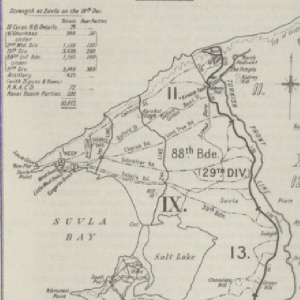
Suvla Area of Gallipoli, 19th December 1915
Following a major but ultimately unsuccessful offensive to the North / East of the bay along the Kiretch Tepe Sirt on the 12th (during which the famous Sandringham Company of the 1/5th Norfolks were wiped out, as portrayed in the film "All The Kings Men") the Allied commanders chose to mount a final major attack along the same ridge.
On the 15th August 1915, the 30th and 31st Brigades of the 10th (Irish) Division attacked along the ridge, with the 162nd Brigade of the 54th Division moving in protective support along the vulnerable right flank of the attack.
Having landed at Suvla Bay, Gallipoli 11th August, the 3 untried Battalions of the 162nd Brigade (the 1/4th Northamptons were not on the peninsular yet) were ordered into the attack on the 15th. The map below shows the Irish Divisions movements in blue and the 162nd Brigade in purple. The Bedfords had the honour of leading the Brigade, with B Company on right, A on left, C&D in support.
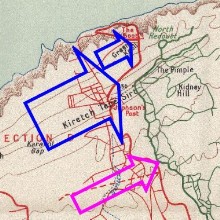
10 Division (blue) and 162 Brigade (purple) direction of attack
The 5th Battalions War Diary recorded simply; 'Battalion paraded for attack at 12.15pm with the Brigade in connection with the 10th Division. The attack arrived through with tremendous dash - hills taken & entrenched Casualties 14 Officers and 300 men.'
In addition to the 314 Bedford casualties, the other Battalions of the 162nd Brigade recorded:
1/10th London battalion; 6 officers and 260 OR's
1/11th London Battalion; 9 Officers and 350 OR's
Before the attack a young officer, Lieutenant Warren Hertslet (1/10th London Regiment), summed up in a diary letter what several thousand other men on the peninsular must have been thinking;
"I hope my regiment will make a good show. Of course it is a tremendous moment in the minds of us all. None of us know how we shall stand shell and other fire in the attack. I personally feel very doubtful about my prowess in the bayonet charge. Well, by this time tomorrow I shall know about it or shall be unconscious of that or anything else.'"
Unfortunately he, along with many thousands of other British ad Turkish troops, was killed in the following day's battle.
The first 'un-named objective'
Whilst orders were issued, the Brigade stood to in preparation for the attack, and at one o'clock on the afternoon of 15th August, the Bedfords started their advance.
"B Company, (under Captain Charles T. Baker, the son of the Rector of Dunstable) was posted on the right flank of the Battalion. Its orders were to keep in touch with the other troops taking part in the attack. A Company (under Captain Brian C. Cumberland of Luton) was extended back on the dangerous left flank which had to be most carefully watched. The Machine Gun Section (under Lt Frank S. Shoosmith of Luton, who was to lead "a charmed life" during the assault) was detailed to act in support of A Company.
"The Regimental HQ section followed in the rear of the two leading companies, while C and D Companies, (commanded by Captain Walter K. Meakin of Bedford and Captain R. Forrest of Biggleswade respectively) formed the Battalion reserve."
Captain Forrest of the Biggleswade Company was the only Company commander to survive the charge, mainly because he "opened up an old wound early in the day" so was not involved in the hottest parts of the action.
The first objective was very strongly held by the Turks and A, B and C Companies were ordered to storm the position. "They went to their work with a will and with that extraordinary verve which is so often characteristic of troops receiving their baptism of fire, and who do not as yet know the real meanings of wounds, and also, of war seasoned veterans who have seen so many wounds that they have become fatalists. Well as the leading companies attacked, however, it became obvious that after a time their strength was not sufficient for them to crown the hill and establish even a temporary position without further aid. D Company was at once flung in to support the charge. The whole line went at it again and this wave of brave, intrepid and well disciplined men, only too anxious to blood their steel, soon cleared the position at the point of the bayonet."
A Company, superbly led by Brian Cumberland had borne the brunt of the first bayonet charge, but casualties were described as "fairly light". Kidney Hill was to prove different as his company were all but shattered during the attack that followed. After a brief pause for reorganisation, the Bedfords gathered themselves and formed up for the attack on the 2nd and more difficult objective of Kidney Hill.
The 2nd Objective; Kidney Hill
As soon as the Bedfords left their trenches to form up for the second advance, they came under heavy fire. It was so bad that one company of the Bedfords (likely to be B Company) recorded that it was "led from the outset by a Private" as all Officers and NCO's became casualties "in the opening minutes of the (2nd) attack". An eyewitness from the 8th Hampshire Battalion positioned high above on the Kiretch Tepe Ridge wrote that the 5th Bedfords had to advance across a mile of open ground and were subject to heavy fire all the way with "one unfortunate soldier having an arm carried away by a shell which did not burst for another 50 yards". Watching the advance from their position "caused one company of the 8th Hampshires to refuse to move, and they were sent to the beach."
(Source; Prof Tim Travers "Gallipoli 1915" pp160)
Private Horace Manton of the 5th Bedfords wrote; 'We'd got no cover at all. One of the lieutenants was going aside of me. We were in open formation. He got shot while we were going up the hill, I said: "Do you need any help Sir?" He said: "No, carry on, don't break the line." Our commanding officer, Colonel Brighten, got through alright. He gave us the name of the Yellow Devils. We got to the top and then we got blasted by shrapnel. I saw my cousin get killed in front of me. He was crying when he got shot. It killed him anyhow; he was only sixteen. How I missed it I don't know, shrapnel was flying all the time.'" Horace Manton survived both the charge and the war.
The Brigade advanced along the broken southern slopes of the ridge towards Kidney Hill with "all the enthusiasm of inexperienced troops" and paid heavily for it. Brigadier-General de Winton (the 162nd Brigade's commander) placed himself at the head of the Bedfords and spurred them on until he was wounded himself.
Direction was soon lost due to the difficult nature of the terrain and Major JE Hill and the Adjutant Captain Harold Younghusband "performed prodigies" by moving from place to place and re-establishing contact between the separated units of the Battalion.
The Headquarters section were shelled constantly and few survived unscathed. Lt FS Shoosmith's machine Gun section was left with only one man and Major Hill, fearing that the machine guns would be knocked out completely - as Shoosmith was the only officer with knowledge on their use - dashed through the severe shrapnel and rifle fire to seek advice. The incredible Lt Shoosmith cheerily replied "oh, you just pull this and press that. It's quite simple", all the time continuously firing at the Turkish positions "as if nothing was doing".
Following the dreadful advance through difficult terrain, under constant shrapnel, enfilading machine gun, rifle and sniper fire, having already lost many of their friends and with their nerves in shreds, the furious men were finally given the order to charge …
"It was a great and glorious charge, but the position was won at terrible cost. The whole advance had been made with bayonets fixed and when the final stage was reached and the order to charge rang out the men dashed to the attack. There was no stopping these unblooded British Troops. London, Essex and Bedford Territorials charged together, but the Bedford men outstripped the Regiments on right and left and dashed into the lead, causing the line to form a crescent and sweeping everything before them. Turks went down before cold steel in hundreds, and those who were not killed turned and fled."
Amongst the many casualties were the Payne brothers of Luton, who had served as Territorial soldiers since before the war. Sergeant Ronald McCormick of the 5th Bedfords wrote; "There was only a handful of Bedfords left with Captain Baker, including myself and Albert Payne and Nathan, his brother. We were right at the front of the Battalion, and Captain Baker had just given us the order to fix bayonets when a shell shattered his left arm. Sergeant Payne bound his arm up and sent him back with Private Findon, who was wounded going back, and Captain Baker must have been hit again, as he was killed. We held on for another three hours until a party of Londons came up, and over the ridge we went like fury. The Turks did not stop to ask after our health. They ran like the devil and we shot them as they ran. We took up position … and they came back, jabbering to each other and making plenty of noise. He (Captain Cowley of the London Regiment) spoke to them in their own language but they had no answer so he gave the order to fire and they fell like corn … we were ordered to retire … but Albert and Nathan Payne must have fallen as they were on the right, and a land mine went off when we got over the ridge. If Albert had lived I think he would have got something as he was a hero. All he troubled about was his younger brother Nathan".
By that time the Battalions "show Platoon" - No 1 Platoon, A Company - was all but wiped out. As well as the soldiers mentioned above, the Battalion CO's younger brother - Lt Ralph Brighten, leader of No 1 Platoon - was reported missing after leading a bayonet charge over a blind crest. His body was found later that night, surrounded by his men. They had reached the farthest point of the advance on the North slopes of Kidney Hill, but "the nature of their wounds" confirmed they had all been killed in "furious hand to hand fighting".
Lt Harding was initially in reserve with the 1/11th London Regiment. His company was ordered to carry forward the firing line and attack Kidney Hill, although by the time he arrived, the determined Bedfords had already taken the position; "I hoped that I felt very brave and warlike. I had an alpine stick in one hand and a revolver in the other and on I went with my platoon. We went some way and then dipped down into a small low valley where there was a whole lot of troops standing around really under cover. I said to one officer: "Are you the firing line?" He said: "Well, I suppose we are." "Well you've got to come with me. My orders are to go forward to capture the hill and to carry you with me." I took my platoon on, we went over the slope and rifle fire started to knock around us. But there was no sign of the others following at all. They stayed in the valley. I was out on my own with my platoon deployed and my chaps started getting hit. I thought: "Well, I don't know about this, it's not much cop!" I halted and thought I'd better try and get a message back to my company commander to say that I'd halted, to say what the position was. I got my orderly, wrote out the message on a field service message pad and told him to go back and find company headquarters. He didn't get more than about ten or fifteen yards and he was shot down. I thought: "Well, that's not much good, I shall loose the lot if I go on like this." So I decided to stay where I was. When darkness came we decided to go back as there was nobody on our flank at all. We started to withdraw carrying our wounded and left two or three dead on the floor. We came to a line of troops who said they were the front line, they were all mixed up together and we joined forces with them. It was a mixture, a muddle, a mixture."
To the West, the 30th and 31st brigades of the 10th (Irish) Division had been through a similarly tough time. The 31st Brigade were advancing along the exposed southern part of the ridge and suffered badly. Little did they know that they were attacking a force matching their own in terms of size, with an additional 72 Machine Guns in all and well plotted artillery support; an incredible amount of firepower. After two hours of vicious fighting, little ground has been gained. During the ensuing firefight Major Jephson of the 6th Munsters was mortally wounded on the peak that had only a week earlier been named after him - Jephson's Post.
By 6.00 pm very little headway had been made until the 7th Munsters on the northern slope launched a desperate bayonet charge. The Irish Battalions were keen to use their gleaming bayonets and were disappointed that the terrified Turks fled before them. One soldier was heard to say "I don't want ta stick ya behind. Turn around and Ill stick ya belly dacent". For a time it looked like they may have taken the initiative but the unchecked concentration of Turkish fire from the surrounding hills, added to by the Turkish artillery blew huge gaps in their ranks. Eventually, exhaustion, thirst and the reformed Turkish lines put an end to the advance on the northern slope. At dusk the 5th Royal Inniskilling Fusiliers ran into heavy opposition on the southern slope, sustaining such heavy casualties that the attack had to be called off as there simply weren't enough men left. The Battalion had been shattered.
The failure of the attacks on the southern slope, coupled with the success on the northern slope left the Division in a "Z" shape along the ridge that night, as the Territorials to their left clung onto their gains on kidney Hill. The Dubliners, Munsters and Irish Fusiliers on the northern ridge found themselves fighting an unseen Turkish enemy a few yards away on the opposing side of the ridge, and a bombing battle began. Several bayonet charges over the ridge were swept away by deadly Turkish machine gun and rifle fire, so it was apparent that advancing was a hopeless task. However, staying in their meagre fox holes and being constantly bombed by an unseen enemy was causing great numbers of casualties. The Irish had run out of bombs yet the Turkish had an ample supply, and used them to great effect.
The 10th Division and the 162nd Brigade were by now exhausted and could only dig in and consolidate their gains on top of the Kiretch Tepe Ridge. Lt Colonel Brighten (commander 5th Beds) had instilled into his troops that 'What we win, we hold' as the best way to protect their fallen comrades on the field behind them, so they dug themselves in best they could and braced themselves.
That night the aftermath of battle was terrible. Private Harold Thomas of the 5th Bedfords, who was in one of the many patrols sent out that night, wrote "I remember the tremendous crash of rifle and machine-gun fire close to us and the 'thump' 'thump' of bullets and sparks flying from stones while an officer, sergeant and six of us pushed through the scrub towards the curve of a hill which showed up darkly against the night sky. Between the bursts of fire the silence was broken by agonizing cries which will always haunt me: seemingly from all about that hill there were voices crying 'Ambulance' 'Stretcher-bearers' 'Ambulance' 'Oh damn you my leg's broken' and then again 'Stretcher-bearers.' It was horrible, we would start for a voice and it would cease and another far away would begin. That hill-side was a shambles: evidently there had been a fierce hand-to-hand fighting there a few hours ago, rifles, kits, water-bottles, khaki, Turkish tunics and headgear were strewn among the scrub. While we were following a phantom-like voice we came suddenly on a half dug trench which an RAMC officer had made into a combined mortuary and first aid station; there we set furiously to work sorting out the dead from the living; there reeled among us out of the darkness an officer raving, 'My men have taken that bloody hill but they're dying of thirst.' He passed on and we continued our ghastly work."
As on Kidney Hill, attempts were made to recover the wounded left on the ground by the Irish on the Kiretch Tepe Ridge. "Second-Lieutenant Lyndon spent much of the night rescuing them in the depth of Turkish lines, to earn the first of two MCs he would gain during the war. In later years he was to say that he only got the awards 'because there was nobody else left alive to receive them'."
16th August 1915; the Turks Counter Attack.
The British troops had done well to take what ground they had. Despite massive gaps in their ranks, being low on ammunition, with no bombs available and suffering from extreme thirst, they dug in and held their ground. However, at 4am on the 16th the reinforced Turks began a vicious series of bombing and bayonet attacks. The attacks were unrelenting. The Irish and English troops held their ground with a grim determination, but without fresh troops and bombs the battalions just could not realistically hold out much longer. Desperate appeals for reinforcements and more ammunition fell on deaf ears and the surviving men "threw rocks when their meagre supply of jam tin bombs ran out".
"The beleaguered troops had no chance of attracting the full attention of their higher commanders on 16th August because the simmering row between Hamilton and Stopford with their various acolytes had finally blown up the day before." (Source; Nigel Steel & Peter Hart "Defeat at Gallipoli" pp 283)
"At this critical point in the battle, with the 10th Division fighting for its life, a sensational rumour was passed round. Its commander, Mahon, had resigned under the most unusual circumstances." (Source; Col Michael Hickey "Gallipoli" pp 301)
At this very point on 16th August, with the Irish Division and 162nd Brigade under tremendous pressure and 'fighting for its life' with no reserves, support or ammunition, it gets worse. The opinionated General Stopford is sacked, General de Lisle takes over (temporarily until General Byng arrives) and General Mahon resigns having taken offence at being asked to serve under de Lisle who was technically his junior. Mahon was commanding the 10th Division and the 162nd Brigade at that precise moment, which left the entire front without a Commander when it needed one the most.
Ignoring the atrocious conditions and determined efforts of both the Turkish Army and the British Generals, The English and Irish Brigades absolutely refused to give way and stubbornly held the ground they had won at such a terrible cost. Despite their brave efforts and "displaying a skill and tenacity any Regular unit would be proud of" the Territorials were isolated on Kidney Hill due to the Irish Division being badly mauled and held up on the ridge to their left, and were to retire that night "to straighten the line out" finishing up level with the 31st Brigade's original positions.
The Bedfords alone lost 3 Captains, 4 Lieutenants, 8 Sergeants, 3 Corporals and 49 OR's (Killed), with a further 7 Officers and over 300 OR's becoming casualties on 15th August 1915 itself, but the Irish Battalions were having an even worse time of it.
To the West, the one sided bombing and artillery battle continued overnight (15th to 16th August) and by day break the strain on the Irish soldiers was apparent. With huge gaps torn in their ranks, no hope of advancing yet no orders to - and certainly no wish to - retire being given, they clung onto their gains with a determination that is both amazing and yet heartbreaking. Their anger and fear were temporarily unleashed when a fresh charge was made over the ridge by the 7th Dublins on the morning of the 16th. Despite appalling losses, they actually made it to the Turkish trenches against all odds. Of the attacking troops, only 4 made it back over the crest to their Battalion. Similar charges were made all along the crest, with equally disastrous results. Whole Platoons were lost, never to be seen again.
Despite the complete hopelessness the men of the Irish Division must have felt, they clung on and endured. It is impossible to imagine their feelings - nowhere to go, with the corpses of the comrades all around them and being continuously bombed by their invisible enemy Nevertheless, they stayed put and waited for either orders, or death - whichever came first. Many events are recorded of this most trying of times, such as Private Wilkin of the 7th Dublins. Tired with being unable to reply to the constant bombing, he started to catch the Turkish grenades and throw them back. "Five times he performed this feat but at the sixth attempt he was blown to pieces".
Whatever they did, the Irish position was one of hopelessness.
By sunset, the 6th Royal Irish fusiliers "exposed both in front and on flank, had been practically annihilated". Their 5th Battalion came to reinforce them but shared in their fate, and could do nothing to return the constant rain of bombs falling on them. Nearly all their officers had fallen and many of the other Battalions suffered similar casualty figures, yet they were determined not to disgrace the name and honour of their Battalions and line still held.
Darkness fell and the troops hoped for relief. Although it came, it was not as expected as there were simply no troops left to relieve them. Two battalions that had suffered the previous day took over the line and suffered equally as badly until they at last received the order to retire from "this untenable position". The shattered Division had been trained for a year and destroyed in a week.
Aftermarth
The enlisted men of the 10th Irish Division and the Territorials of the 162nd Brigade withdrew to their original lines on the night of the 16th August. Over four thousand British troops and similar numbers of Turkish soldiers fell during the 2 days of fighting yet no tactical or territorial gains were made whatsoever, as would be the sad case during the rest of the Gallipoli campaign. The final lines are shown on the trench map below with Kidney Hill clearly visible near the top of the map.
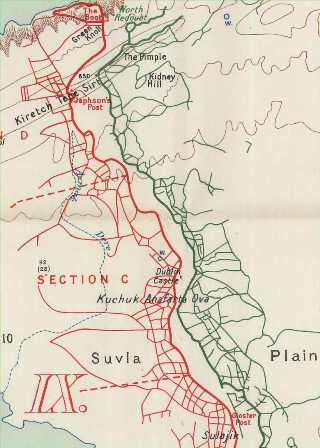
Terrain
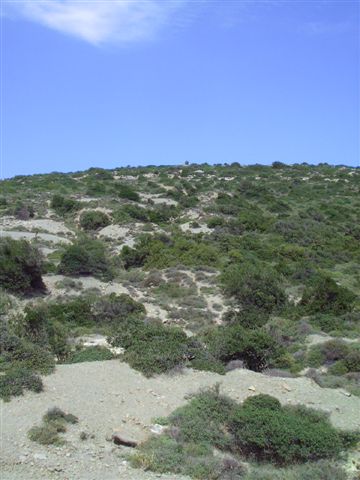
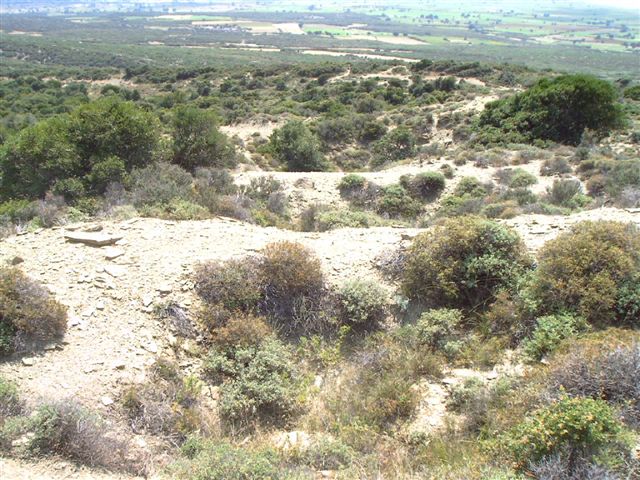
Eric Goosens has spent many years walking the peninsular and was kind enough to send me these photos amongst many others.
The first one shows a view some of the attacking troops may have had and, although scale is hard to grasp with still images, this is both a big slope and very hazardous when walking, let alone whilst charging an enemy and carrying a full pack on your back. The second one shows the view from defensive positions, illustrating just how isolated the assaulting troops were and also gives an indication of the broken nature of the ground they had to move through.
Sources
As well as quoted sources, this story draws mainly on the following sources:
"The Bedfordshire and Hertfordshire Regiment" GW Peters
"The Story of the First - Fifth Bedfords" E Rimmer, 1917
"History of the 5th Battalion, The Bedfordshire and Hertfordshire Regiment" Captain FAM Webster
Newspaper articles
My thanks also go to Liam Curran for information from the fascinating but very poignant book, "10th Irish Division in Gallipoli" and Eric Goossens who spent much time walking the hills of Kiretch Tepe to understand the areas discussed here.
Site built by Steven Fuller, 2003 to 2023