The Bedfordshire Regiment in the Great War

Colonels of the regiment 1688 to 2009
Throughout the 320 years the regiment has served the country, 44 Colonels have been at the head of the regiment, all of whom are listed below along with a brief biography. This is what I believe to be a definitive record of each Colonel of the regiment since it's formation in 1688, through every merger, change of name and amalgamation, up to the present day formation of the Royal Anglian Regiment.
Until regiments were associated to counties to stimulate recruitment and create a firmer identity in 1751, they were named after the Colonel in command, also referred to as the Colonel Commandant for a time. During the early stages of the regiment's existence, the Colonels purchased regiment which were viewed as an 'asset'; some commanded their regiment on a daily basis and quite literally from the front, which can be seen in the case of Robert Hodges who was the only Colonel of the regiment to be killed in battle at the head of his men. However, as time progressed, regiments expanded their internal structures and the Colonels became more senior in rank, titles and prestige, so the day to day command passed to subordinates. Over time, the Colonels of a regiment often became the figurehead rather than someone who would lead from the front in a hands-on manner, especially if they were also holding titles as governors of provinces that took much of their time up. Hence, the title of Colonel of the regiment is not to be confused with the individual's military rank, which you will see are often that of a Major-General or similar.
That in mind, the Lieutenant-Colonels who usually commanded individual battalions on a daily basis are not listed here, to avoid clouding the issue.
1688. Archibald Douglas was part of the powerful Douglas clan and raised the regiment in October 1688. Colonel Douglas was a veteran of many battles across several decades, in both French and British service, including Tangiers and Sedgemoor. He was trusted emphatically by Catholic King James II, having served his family loyally for decades.
After he had served in Douglas' Regiment of Foot (later Dumbarton's Regiment, the Royal Regiment, 1st Regiment of Foot, Royal Scots) for many years and risen to the rank of Lieutenant-Colonel, he was appointed to raise and raise a new regiment on the 9th October. William of Orange's forces landed in Kent 5 November and the "Glorious Revolution" overthrew the Catholic James II, who fled to France 21 December.
Colonel Douglas, a staunch supporter of James, refused to take the oath of allegiance and was replaced by Robert Hodges.
Historical Records of the British Army records that "in consequence of a mark on his countenance, he was sometimes called Spot".
Other than the fact that he did not serve the crown after 1688, information on the rest of his life has proved hard to find. It appears that he may have followed King James II to France and lived his days out there. Many of the Catholic Douglas' who did so were buried in the abbey at Saint-Germain-des-Prés although Archibald is not specifically names as such.
1688. Robert Hodges was appointed to command the 16th Foot on the 31st December 1688 having served as Captain-Lieutenant in Sir John Talbots Dragoons by 1678 and a Major in Dumbarton's Regiment (later the Royal Regiment, 1st Foot, or The Royal Scots) thereafter, eventually commanding the Grenadier Company with distinction in many battles during his career.
He was killed in action by a cannon ball on the 3rd August 1692 at the Battle of Steenkirk, at the head of his regiment where he always fought.
Coincidentally, a relative of Archibald Douglas' was also killed that day commanding what would become the Cameronian Highlanders.
1692. The Honourable James Stanley, 10th Earl of Derby, was born 3 July 1664 at Knowlsey, Lancashire. He was an officer in the Netherlands from 1685 and accompanied William of Orange in 1688, when he took over the British throne in 1688.
He became a Captain in the 1st Foot Guards in 1689 and was, by then, an active politician. He was appointed to Colonel of the 16th Foot on the 3rd August 1692, having been 2nd in command of the Foot Guards beforehand. On his succession to the Earldom of Derby in 1702 (after the death of his brother, the previous Earl) he became the Lord Lieutenant of North Wales and finally relinquished his military position in 1705. He continued serving at the highest levels of the Monarchy, holding many senior positions including carrying one of the 3 Swords of State in the 1702 and 1714 coronations.
He eventually passed away at Knowsley on 1st February 1736 and was buried at Ormskirk.
His portrait can be seen at the National Portrait Gallery here
1705. Francis Godfrey joined from the Foot Guards on the 25th May, having served in several campaigns under his Uncle the Duke of Marlborough. His parents were Colonel Charles Godfrey and Miss Arabella Churchill who, before her marriage had been one of King James II's mistress'.
He rose to Brigadier-General, sold his colonelcy in 1711 and died on the 6th October 1712.
1711. Henry Durrell was a brigadier-General who was appointed the C.O. on the 17th February, having joined from the Foot Guards.
He was appointed the Deputy Governor of Dunkirk and died there 1st December 1712.
1713. Hans Hamilton initially enrolled into the regiment as a young Ensign 15 October 1688 and served as an Officer in the 16th for many years until he gained the colonelcy of the 34th Regiment in 1705. During his career he was in numerous battles and took over the 16th Foot as a Brigadier-General on the 23rd June 1713.
He sold his Colonelcy in 1715 and died six years later.
1715. Richard Ingram, Baron Ingram and 5th Viscount Irwin served in the Life Guards, rising to Lt-Colonel. He was given the colonelcy on the 11th July whilst the regiment were in Scotland, as well as being granted the post of Governor of Hull that year. He also married Anne Howard in 1717, but the couple had no children before his death. He was promoted out of the 16th in 1717 and appointed Governor of Barbados in 1721.
He died of Smallpox on April 10th 1721 before he left for Barbados.
1717. James Cholmeley took over on the 13th December and remained in command until his death in 1724.
Historical Records of the British Army records that "he was for many years an officer of reputation in the SIXTEENTH Regiment" and was "promoted by King George I, in consideration of his service in Flanders under the Duke of Marlborough, and his excellent conduct on all occasions".
1724. Lord Henry Scott, 1st Earl of Deloraine, K.B. was born in 1676 and served in the army from the 1690's, holding senior posts from 1704 onwards and being created an Earl by Queen Anne. He obtained command of the 16th Foot on the 7th April 1724 and remained there until taking over the 7th regiment of Horse in July 1730.
He died on Christmas Day 1730 a Major-General, who held the additional titles of Baron Scott of Goldielands and Viscount Hermitage.
1730. Roger Handasyd (Handasyde) served as the regiment's colonel from 9 July 1730 until his death on 4 January 1763.
Born on 11 March 1689, he was the son of Thomas Handasyde (a Colonel of the 22nd Foot). Aged just five years, his father purchased his commission in 1694, on the same day as his two younger brothers (Thomas and Clifford). Commissions were considered an 'asset' at this stage so his young age did not mean he spent any time with the regiments he was associated to.
Roger took his first 'active' post as a twelve year old Ensign in Gibson's 28th Foot on Christmas Eve 1696. He later purchased command of the 22nd Foot from his father in April 1712. After purchasing the colonelcy of the 16th Foot in 1730, November 1935 saw him become a Brigadier General, in July 1739 he attained the rank of Major-General, rose to Lieutenant-General in March 1743 and was a full General from March 1761.
In addition, he was the Governor of Fort Philip in Minorca and later Jamaica for many years, as well as being the M.P. for Huntingdon from 1722 to 1741, and M.P. for Scarborough from 1747 to 1754. Many other short term titles crowded his career, including Governor of Berwick, C-in-C of Scotland, and many Lieutenant Governor posts (all of which paid handsome annual incomes).
General Handasyde married Elizabeth Thorneycroft in 1710, which union saw no surviving children.
He was rarely active in Parlaiment either but made a rare speech in 1751 defending the Prime Minister. He wrote to the P.M. shortly afterwards asking for a 'better regiment' but was refused. This seems to coincide with the introduction of regiments being known by their rank, although what his motivation was is unclear.
At the time to his death in London on 4 January 1763, he was one of the oldest generals in the British army. He is often referred to as among the longest serving officer in the British Army's history although he spent almost no time physically with it. Roger is buried in the Great Staughton churchyard, Cambridgeshire.
Wikipedia's entry (as at November 2022) is not particularly flattering; collating all sources of information I have come across, he appears to have been almost entirely absent from the daily running of the regiment, not present during campaigns and garrison postings throughout the 33 years as it's Colonel, rarely appeared in the Houses of Parlaiment and was described by one of his peers as a 'bitter Whig'.
1763. The Honourable Robert Brudenell was appointed to command the regiment on the 14th June from the 3rd Foot Guards. He was the third son of the Earl of Cardigan and held several senior posts until his removal to the 4th Foot two years later.
He died in October 1768 at Windsor.
1765. Sir William Draper, K.B. was born in Bristol in 1721, the son of Ingleby Draper, a Customs Officer. He went to Bristol Grammar School, Eton and King's College in Cambridge, where he got a degree in 1744, became a Fellow of the College and earned his M.A. in 1749.
Instead of taking Holy Orders as was intended, he obtained an Ensigncy in the 48th Foot (later the Northamptonshire Regiment) on 26th March 1744 and was at Colluden in April 1746. In May 1747 he was appointed as Adjutant of the 1st Foot Guards and served in that battalion until commissioned as a Lt-Colonel to raise a new regiment of foot in November 1757 - the 79th.
Serving in Madras, he distinguished himself repeatedly during the Fort George siege between 1758 and 1759, returned home ill later that year and led the assault on Manilla in 1762, who's captured standards he presented to his old college. The million pound ransom he secured from the Spanish Government was never paid and became a matter of public debate for years afterwards.
He commanded the 16th Foot as a Colonel from the 25th June 1765, his old Regiment having been disbanded. He swapped Colonelcy's with James Gisbourne after a year, became the Governor of Yarmouth and later travelled in North America following the death of his first wife in 1769.
He rose to become Lt-Governor of Minorca (1779) and achieved the rank of Lieutenant-General (1777) before his death in 1787. He was 2nd in command of Fort St. Phillip during it's famous siege and subsequent capture between 1781 and 1782.
William Draper was also involved in several very public altercations including laying charges and a Court Martial against his superior officer (Lt-General Murray) from the Fort St. Phillip siege.
He can be seen here at the National portrait gallery
1766. James Gisbourne joined from his post as Quartermaster General of Ireland on the 4th March 1766, having also commanded the 121st and 10th regiments.
He died whilst with the 16th in Florida 20th February 1778, having achieved the rank of Major-General.
1778. James Robertson was promoted to the colonelcy, having served in many posts, including as 2nd in command of the 16th Foot for many years. Much of his service was spent in America and he died in Ireland 4th March 1788, having been a Lieutenant-General and the Governor of New York in his career.
1788. The Honourable Thomas Bruce had risen to Major of the 60th Foot by 1768 and Lt-Colonel of the 65th Foot by 1770, serving in the early phase of the American War in the process.
In 1781 he was appointed Lt-Colonel of the 100th Foot and became Colonel of the 16th Foot on 25 March 1788, leading the regiment until his death in 1797.
1797. Henry Bowyer joined as an officer in the 68th Foot in 1771, gaining promotion as a Captain to the 19th in 1776, Major a year later and moving to the 66th as Lt-Colonel in 1787. He rose to Major-General in 1795 and in March 1797 he became Colonel of the 89th Foot.
He was next appointed Colonel of the 16th Foot on the 15th December 1797 and remained there, also becoming Governor of the Leeward and Windward Islands, until his death there in 1808.
1808. Sir Charles Green, Baronet entered the army as a Gentleman Cadet in the Royal Artillery in 1760, and served in many arms of the service during his career. He transferred from the York Light Infantry Volunteers to take over as colonel of the regiment between 3 September 1808 and 17 February 1814, at which time he transferred as Colonel of the 37th Foot.
Green died in 1831 as a full General.
1814. Sir George Prevost, Baronet, was born 19 May 1767 in the province of New Jersey and was given his first commission in the 60th Foot May 1779, aged just 11.
Being of a wealthy family, he purchased his positions, rapidly rising to Lieutenant-Colonel by August 1794 and Brigadier-General by just 30 years of age. He was later Lieutenant-Governor of St Lucia and Governor of Dominica before rising to Major-General and commander of the Portsmouth district in 1805, aged 37.
In 1808 he became Lieutenant-General and the Lieutenant Governor of Nova Scotia and later became the Governor in Chief of British North America.
In the war of 1812 he made enemies through his over cautiousness and was ordered back to London publicly humiliated in 1815. He was ordered to answer the criticisms levelled against him by court martial on 12 January 1816 but died from ill health a week before.
Prevost was Colonel of the regiment from 17th February 1814 until his death in January 1816.
His portrait can be seen here at the National Portrait gallery
1816. Hugh Mackay Gordon Promoted to Lieutenant-Colonel 16th Foot January 1808. Colonel of the regiment from the 8th January 1816, arriving from the York Chasseurs.
He was promoted to Lieutenant-General on 19 July 1821 and served as Colonel of the regiment until his death in the spring of 1823.
1823. William Carr, Viscount Beresford, G.C.B., G.C.H started his illustrious career in the army as an Ensign of the 6th Foot in 1785 and was a Captain in the 69th Foot five years later.
He served in numerous campaigns throughout his career, including as one of Wellington's Generals in the peninsular wars and transferred from the 69th Foot to take over the colonelcy on the 15th March 1823, becoming Viscount Beresford the same month.
He remained in the post until his death in 1854 and has many portraits at the National Portrait gallery
1854. Sir Thomas Erskine Napier, K.C.B., C.B. was born 17 May 1790 and was appointed an Ensign in the 52nd Foot in July 1805. He served in several of the Scandanavian and European battles from the period, including as a Captain in the Chasseurs Brittanniques and losing his left arm in battle, December 1813.
After spending several years on half pay and in the Adjutant-Generals office in Ireland he was awarded the C.B. in 1838, became the Officer commanding troops in Scotland and of Edinburgh Castle, rising to Lieutenant General in 1854. He took over the colonelcy of the 16th Foot from 20 June 1854 and moved to be Colonel of the 71st (Highland) Foot from May 1957.
In May 1860 he was awarded the K.C.B. and died at home near Edinburgh on 5 July 1863 whilst Colonel of the 71st Foot.
1857. Cecil Bisshopp, C.B. became a Colonel whilst in the 11th Foot in November 1841 and Major-General in November 1851.
He took over as Colonel of the 16th Foot in May 1857, being a Major-General at the time and died on 21 March 1858 whilst in command of the regiment.
1858. Sackville Hamilton Berkeley was a former Colonel of the 6th West India Regiment when he was promoted to Major-General in January 1837. He took over as Colonel of the 75th Foot 16 September 1845 and was promoted again to General in November 1846.
He was appointed as Colonel of the 16th Foot on 22 March 1858 and served as such until his death in February 1863.
1863. George MacDonald. On 27 December 1860 he took over the colonelcy of the 96th Foot, being promoted to Lt-General on 29 January 1863. He then took command as Colonel of the 16th Foot on 13 February 1863 as a Lieutenant-General.
On 25 October 1871 he was promoted to full General and by 1 October 1877 he features on the retired list.
He remained the Colonel of the Regiment until his death in 1883.
1883. Edward Stopford Claremont, C.B. was born in 1819 and was initially commissioned as an Ensign in the 1st Regiment of Foot on 9th February 1838.
On 16 July 1844 he was promoted to Lieutenant in the Royal Canadian Regiment, purchased his Captaincy on 14 November 1845 and was promoted to Major on 14 April 1854. He was next promoted to Brevet-Major in December 1854 for distinguished service in the Crimean War as the Assistant Commissioner with the French Army, which rank was made substantive in August 1855.
Claremont later became a Lieutenant-Colonel on 14 September 1855 and was awarded his C.B. in October 1855 whilst Her Majesty's Military Commissioner in Paris. On 2 October 1862 he became the Groom of the Privy Chamber in Queen Victoria's household and on 10 March 1863 was in Royal procession attending the marriage of Albert Edward, the Prince of Wales, to Princess Alexandra of Denmark, as an Usher to Queen Victoria.
Promotion to Major-General came on 6 March 1868 and on 6 November 1869 he was again posted as the military attaché of Her Majesty's Embassy in Paris.
On 21 June 1877 on duty as a Gentleman Usher at Queen Victoria's jubilee and gained promotion to Lieutenant-General on 13 August 1877. He retired on 1 July 1881 and took over the Colonelcy of the regiment 2 March 1883, following the derath of Colonel MacDonald.
Claremont remained the regiment's Colonel until his death as a Lieutenant-General in Paris 16 July 1890.
1890. Frederick Robert Elrington, C.B. took over as Colonel of the regiment 17 July 1890 and transferred to the colonelcy of the Rifle Brigade January 1892.
1892. Sir William Payn, K.C.B. was the Colonel of the regiment from 26 January 1892, until his death in 1893, at which time he was a full General.
1893. Sir John William Cox K.C.B. was the colonel of Bedfordshire regiment from 16 June 1893 until he transferred to the Colonelcy of the Somerset Light Infantry 18 May 1900.
1893. The Honourable John Thomas Dalyell commanded the regiment temporarily on two occasions, after the deaths of Sir John Cox in 1893 and William Bancroft in 1903.
On 14 May 1847 he became a Second Lieutenant in the 21st Foot, purchased his Lieutenancy 21 June 1850 and a Captaincy 23 April 1852. He was promoted to Lt-Colonel 17 April 1867 and then to Colonel from 17 April 1872.
In January 1878 he retired on half pay from the 21st Foot as Lt-Colonel, resurfacing some fifteen years later to take over the colonelcy of the Bedfordshire regiment. On 12 June 1909 he moved to become Colonel of Royal Scots Fusiliers, remaining their Colonel until his death in July 1919 after around 60 years of service to his country.
He was buried at Edinburgh with full military honours.
1900. William Charles Bancroft was born 22 June 1826 in Kingston, Jamaica. In June 1844 he was commissioned into the 3rd West India regiment, the 76th Foot in 1848 and into the 16th Foot in 1850.
His service in the regiment and the regimental district lasted until his retirement in 1887, when he was made an honorary Lieutenant-General. He took over as Colonel of the regiment 18 May 1900 and died 30 January 1903 in Farnborough, Hampshire, as a Major-General.
1903. The Honourable John Thomas Dalyell took over for the second time as Colonel between February 1903 and June 1909.
1909. Reginald Laurence Herbert Curteis was born in 1843, the son of Reginald Curteis, a former Captain of the 1st Royal Dragoons and magistrate, and Frances Mary Reynolds.
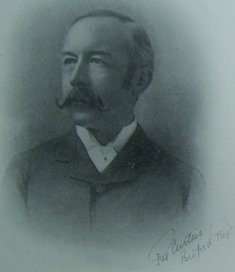 He
completed his course at the Royal Military College, Sandhurst on 5 March
1860 and was promoted from a Gentleman Cadet to an Ensign in the 16th
Foot. He was promoted to Lieutenant 22 March 1864 and purchased his Captaincy
14 September 1867.
He
completed his course at the Royal Military College, Sandhurst on 5 March
1860 and was promoted from a Gentleman Cadet to an Ensign in the 16th
Foot. He was promoted to Lieutenant 22 March 1864 and purchased his Captaincy
14 September 1867.
On 9 March 1879 he was seconded for temporary service on the Staff and promoted to Major 10 October 1879, Lt-Colonel 10 October 1884 and was appointed to command the 1st battalion 1 July 1887. A further promotion to Colonel 10 October 1888 followed and he served as Adjutant-General in India until 1 February 1899.
On 1 July 1890 he was appointed to Staff on half pay and retired as a Major-General 7 January 1903.
On 12 June 1909 he became the Colonel of the Regiment whilst holding the rank of Major-General, resigned his Colonelcy 12 April 1914 and later died in 1919.
1914. Thomas David Pilcher, C.B., T.D. was born in Harrow, Middlesex in 1858 and would be given the nickname "The Sardine" during his long career.
After schooling at Harrow, he served in the Militia as a Second Lieutenant in the Dublin City artillery from 30 August 1878 until being commissioned as a Second Lieutenant in 22nd Foot (the Cheshire regiment) on 21 June 1879. On 13 August 1879 he transferred to 5th Foot (the Northumberland Fusiliers), was promoted to Captain in February 1886 and passed Staff College in 1892.
Pilcher was seconded for service on Staff as Deputy-Assistant Adjutant General in Dublin between 21 November 1895 and October 1897 before going abroad to raise and command the 1st battalion, West African Frontier Force in Niger, Africa. He commanded expeditions to Lapai and Argeyah whilst there and was transferred into the Bedfordshire regiment on 5 July 1899 to serve during the first South African war.
On 8 July 1899 he was promoted to Lieutenant-Colonel, being given Special Service (in command of the 3rd Mounted Infantry) in the war. He was mentioned specifically in Earl Roberts' tenth despatch of 2 April 1901 and awarded his C.B. on 19 April 1901, in regards to his services in the war.
Returning home, he was an Aide-de-Camp who took part in the procession at King Edward VII's coronation in 1902, remaining his Aide-de-Camp until 18 February 1907. On 2 May 1904 he given command of 3rd Brigade, 2nd Division and later commanded the 5th Brigade, both at Aldershot. On 19 May 1907, already a Major-General, he completed his command of the 5th Infantry Brigade and moved to the Indian command, becoming a Brigade Commander on 31 December 1911. On 22 January 1912 he was promoted to command the Burma Division in India and happened to be on leave in Europe when war broke out in 1914.
Although he had his critics by this time, Pilcher was given command of the 17th (Northern) Division in January 1915 and took them to the Western Front, where he would earn more criticism. His Division were heavily engaged during the opening of the Battle of the Somme on 1 July 1916 and after he almost refused to follow orders from XV Corps and send his Division into another potentially disastrous assault across the open ground again, he was dismissed and returned to England for displaying a 'lack of push'.
He commanded the Reserve Centre at St. Albans until he retired from service 15 January 1919.
Pilcher became Colonel of the Bedfordshire regiment on 22 April 1914, whilst holding the rank of Major-General and remained so until his death on 14 December 1928.
His portrait can be seen here at the National Portrait gallery
1928. Frederick Rudolph Lambart, 10th Earl of Cavan, K.P., G.C.B., G.C.M.G., C.G.V.O., G.B.E. was born 16 October 1865 and was educated at Eton College.
His first commission was in the Grenadier Guards in 1885, he served in the second South African war and was at the coronation of King Edward VII in 1902. He rose to command the 2nd battalion of the Grenadier Guards in 1908 and retired February 1912.
In 1914 he was brought out of retirement aged 48 and given command of the 50th (Northumbrian) Division in June 1915, taking over the Guards Division in August 1915.
From January 1916 until March 1918 he commanded XIV Corps and was given command of all British Forces in Italy between March 1918 and 1919. He rose further to become the Chief of the Imperial General Staff between 1922 and 1926, also being appointed to His Majesty's Army Council on 1 October 1923.
He took over the position as Colonel of the Bedfordshire Regiment in December 1928 and was promoted to Field Marshall in 1931, being Captain of the King's bodyguard at the time. He was in the honour guard during the funeral procession of King George V on 28 January 1936, as well as being prominent at the coronation of King George VI, being the Field Marshall commanding all of the troops.
After a long and incredibly successful career he died a Lord and Field Marshall on 28 August 1946. In addition to the wealth of material written on his life, there are around 20 portraits of him at the National Gallery in London.
His portrait can be seen here at the National Portrait gallery
1935. General Sir Henry Cholmondeley Jackson, K.C.B., C.M.G., D.S.O., D.L. was born 12 August 1879. On 14 February 1898 he was commissioned as a Second Lieutenant in the 3rd battalion of the Loyal North Lancashire regiment and transferred to the Bedfordshire regiment 4 January 1899.
He gained promotion to Lieutenant on 23 February 1900, became the Adjutant on 18 April 1903 and a Captain from 2 November 1906. On 22 December 1908 he was transferred to become the Adjutant and Quartermaster at the School for Instruction of Mounted Infantry, returning to the Bedfordshire regiment 21 September 1912.
Captain Jackson went to France in the original British Expeditionary Force in December 1914 and was the officer who went into no-man's land on Christmas Day 1914 to negotiate with the Germans to bury their dead. This led to the football game played between the two opposing sides in their stretch of the waste ground.
Promotion to the rank of Major came on 3 February 1915 and to Brigade Major 24 February 1915. A posting to Staff on 22 September 1915 as a General Staff Officer 2nd grade (GSO II) was followed on 14 January 1916 by being given command of the 8th battalion of Bedfordshire regiment on the Western Front. He was wounded at Ypres in April, later becoming at Temporary Brigadier-General in August 1916.
Promotion in June 1917 to Brevet Lt-Colonel. He was in command of the 50th (Northumbrian) Division during the German Spring Offensives of March and April 1918, after which the entire division could only muster around 700 men.
In November 1918 he was awarded the French Legion d'Honneur in addition to his Distinguished Service Order from 1916 and on 27 March 1919 relinquished his temporary rank of Major-General and Brigade Commander, having also served in Russia, temporarily commanding the Murmansk Force during its withdrawal from the fighting front.
On his return, he married Dorothy Nina Seymour on 16 December 1919.
Promotion to Colonel followed as he commanded the Small Arms School until 27 August 1926.
On 28 July 1928 he became one of the King's Aides-de-Camp and was promoted to Major-General from 9 August 1930, having spent between 20 September 1926 and 22nd September 1930 serving as the Director of Military Training in India. Between 11 March 1931 and 11 March 1935 commanded 2nd Division at Aldershot.
On 30 June 1935 he was promoted to Lieutenant-General and on 16 October 1935 he became Colonel of the Bedfordshire and Hertfordshire regiment.
From 1 April 1936 until the outbreak of the Second World War he was General Officer commander in Chief of Western Command and in May 1937 was in the coronation procession of King George VI. Promotion to full General came on 30 June 1939 and he retired 12 August 1939 and relinquishes all commands other than the colonelcy of the Bedfordshire and Hertfordshire regiment.
Spending the war in Staff roles whilst he lived in Dorchester, he retired as Colonel of the regiment on 31 December 1947, having served an incredible 49 years but did not pass away until 1972.
His portrait can be seen here at the National Portrait gallery
1948. Lieutenant General, Sir Reginald Francis Stewart Denning K.C.V.O., K.B.E., C.B. was born in 1894 and would lead an extremely full life!
When the First World War broke out, he joined the army as a Private in the Queen's Westminster (16th County of London battalion), going to the Western Front in 1914 and being commissioned into the Bedfordshire regiment in 1915. He joined the 6th battalion in the field 19 December 1915. Although one source inaccurately records the event as 15 June 1915 he was severely injured during the battalion's assault on Pozieres 15 July 1916 and left for dead for 12 hours, until recovered and sent home. A metal plate was fitted into his head and after recuperation, he returned to the western front, rejoining the 6th battalion 24 April 1918. Between 27 April and 22 May he commanded a Company and in June was promoted to full Lieutenant. He also commanded a Company until July, after the battalion were merged into the 1st Hertfordshires in May 1918. In September he once again commanded a Company, having been promoted to temporary Captain in the interim but was posted as a Staff Captain in 3rd Army Headquarters following his collapse as a result of his earlier head wound and surgery.
After the war he remained in the regiment, serving as Staff Captain between 2 February 1920 and 21 January 1922.
From 12 August 1922 he was the Adjutant of the 1st battalion, Bedfordshire and Hertfordshire regiment until on 12 August 1925 he went to the Staff College at Camberley for a year's training.
Between 1926 and 1929 he became the 2nd battalions Adjutant and was promoted to Captain.
On 21 Jan 1929 Denning was restored to the Regular Army establishment on his return from India but by 24 October 1931 he was a Staff Captain in India again.
From 9 May 1933 he served as Staff Captain in the Deputy Assistant Adjutant Generals office in India and was promoted to Brevet Major from 1 July 1934.
On 24 October 1935 he left India and was once again restored to the Regular Army and on 21 November 1936 he left the regiment to start his career on Staff appointments. He was promoted to Deputy Assistant Adjutant General Northern Command that month and on 1 April 1937 Deputy Assistant Quarter Master General Northern Command, remaining in that post until 1940.
Between 1940 to 1941 he was the Assistant Adjutant & Quartermaster-General and on 24 October 1941 was seconded for duty as the Deputy Adjutant & Quartermaster-General. After his promotion to Colonel, from 11 February 1942 he became the acting Major-General and Chief Administration Officer of XI Corps on the south coast of England and from 1943 was briefly the Deputy Quartermaster-General.
Between 1943 and 1944 he became the Chief Administration Officer South-Eastern Command, where he led the advanced planning for the D-Day invasion.
His request to be demoted to Brigadier and take part in the landings was denied and he was promoted to Deputy Principal Administration Officer to Supreme Allied Commander South East Asia Command between 1944 and 1945.
Denning was promoted to Major-General from 30 April 1946 and on 24 June 1946 was awarded the KCVO. He served as Chief of Staff Eastern Command between 1947 and 1949 and from 1 January 1948 he also took over the Colonelcy of the Bedfordshire and Hertfordshire regiment and remained in post until the regiment became the 3rd East Anglian regiment in 1958.
Denning became a Lieutenant-General from 14 June 1949 and from 9 July 1949 was the General Officer Commanding Northern Ireland.
On 15 February 1952 he held a prominent place in King George VI's funeral procession and on 14 July 1952 retired from the GOC Northern Ireland post. A month later, on 13 August 1952 he retired from his military career but remained Colonel of the Bedfordshire and Hertfordshire regiment.
When the regiment merged to become the 3rd East Anglian Regiment on 2 June 1958, Denning remained their Colonel and became Chairman of the Soldiers, Sailors and Airmen's families association, between 1953 and his retirement from the post in 1974, aged 80.
On 12 June 1959 Denning was removed from Reserve of Officers list, having reached 65 years of age and the age limit of his liability for recall. He later served as the Deputy Lieutenant for Essex between 25 November 1959 and 7 May 1968.
On the formation of the Royal Anglian Regiment, Denning remained in post, retiring as a Lieutenant General in 1966.
After an extremely long and interesting life, he died in 1990, aged 96.
His portrait can be seen in the National Portrait gallery here.
1966. Lieutenant General Sir Richard Goodwin was the G.O.C. East African Command 1960-63 and Military Secretary between 1966 and 1968. He was also prominent in the Suffolk Military Band and was their band president in the 1960's, being ex-Suffolk Regiment soldier.
1971. Lieutenant General Sir Ian Henry Freeland, G.B.E., K.C.B., D.S.O., D.L. was born on the 14th September 1912 and served for 30 years, becoming the Colonel of the Regiment upon his retirement from active service. A full biography can be seen here
1976. Major General Sir Jack B. Dye, CBE, MC, DL.
1982. General Sir Timothy Creasey, K.C.B., O.B.E. was born 21st September 1923 and served in the Army for 43 years. He was the Colonel of the Regiment until his death in 1986. A full biography can be seen here
1986. General Sir John Bryan Akehurst. In March 2007, General Akehurst passed away and the Telegraph ran the following detailed obituary:
"General Sir John Akehurst, who has died aged 77, commanded the Dhofar Brigade which played a key part in defeating a 10-year insurrection against the Sultan of Oman. Dhofar province in western Oman shared a frontier with the newly independent People's Republic of South Yemen, and was almost entirely in the hands of Marxist rebels in 1970. After five years the sultan had done little to retain the allegiance of the fiercely independent Dhofari tribesmen, and his son, Sultan Qaboos, had seized power in a palace coup. When Oman's oil revenues increased sharply the new sultan expanded his forces, but he had to regain control of the province before he could start to modernise the country and win back the support of his people. The future Lieutenant-General Sir Johnny Watts of the SAS then put forward a plan to recruit firqats, bands of local fighting men who were prepared to take up arms against their former comrades. As rebels surrendered, those prepared to support the new sultan were organised by the SAS into these tribal groups. They were avaricious, unreliable and unruly. But Akehurst believed that, if their homelands could be secured and wells dug for their cattle, they would return to these areas against outside interference and persuade other insurgents that it was in their interest to change sides. The firqat leaders were enthusiastic, and the plan was implemented. The enemy quickly realised what was happening; some of the operations to secure the regions were fiercely contested, but they were successful. In November 1975, at his birthday celebrations, the sultan asked Akehurst how the war was going. "Well, Your Majesty," Akehurst replied, "I reckon you have won it!"
John Bryan Akehurst, the son of a bank manager, was born at Chatham on February 12 1930. At the age of two, his mother liked to recount, he got very drunk when his pram was parked carelessly next to some beer crates stacked with partly empty bottles.
Akehurst was educated at Cranbrook School before enlisting in the Army in 1947. After Sandhurst he was commissioned into the Northamptonshire Regiment and joined the 1st Battalion in Trieste, where he was the signals officer.
He represented his regiment at cricket and shot for his battalion at Bisley.
In 1952 he volunteered for secondment to 5th Battalion, Malay Regiment, which was involved in anti-terrorist operations during the "Emergency" and was mentioned in dispatches. After rejoining 1st Northamptons in Hong Kong Akehurst served as a transport officer and then weapons training officer.
He went to Staff College in 1961, and was posted to 12 Infantry Brigade Group in Osnabruck as brigade major. Akehurst's delight at this appointment, obtained in the face of stiff competition, was tempered by the discovery that Brigadier Philip Tower was due to take command of the brigade a few months later. Tower was an ocean-racing sailor, a fine horseman and polo player, and had a reputation for quickly getting rid of people who did not match his own high standards. When they met for dinner at Tower's club Akehurst confessed that he had never sailed or watched polo and that horses frightened him. "It is obvious," he added, "that you will sack me within minutes of us working together. Why not get it over now, sir, and we can enjoy our dinner?" "My dear boy," replied Tower, "let's be clear. I sail the boats, I ride the horses, you run 12 Brigade." And so it was. In more than two years there was scarcely a cross word between them.
The Northamptons and the Royal Lincolns amalgamated to form 2nd East Anglian Regiment, and Akehurst joined the 1st battalion in Cyprus in 1965. After a spell on the directing staff at Staff College he commanded the 2nd battalion, Royal Anglian Regiment, in 1968.
During his tour the battalion, part of the Strategic Reserve, served in Cyprus, Gibraltar, Kenya and Malaysia. Two years on the directing staff of the Royal College of Defence Studies was followed by command of the junior division of the Staff College, Warminster, and then command of the Dhofar Brigade.
On Christmas Day 1975 in Oman a helicopter in which he was flying was fired on from the ground. Eight bullets hit the helicopter, one of them narrowly missing Akehurst, and it had to make an emergency landing. A rescue helicopter arrived quickly to pick them up. His death, wounding or capture were variously reported in more than 100 newspapers around the world.
In 1976 Akehurst moved to the MoD as deputy military secretary and then commanded the 4th Armoured Division in BAOR. After being commandant of the Staff College, Camberley, he took command of the United Kingdom Field Army as Inspector General of the Territorial Army.
Akehurst's final appointment was Deputy Supreme Allied Commander Europe at the Nato headquarters at Mons.
In 1990, shortly after retiring from the Army, he appeared on Newsnight as a commentator on the Gulf war.
In retirement he enjoyed golf, fishing and travel. Akehurst was colonel of the Royal Anglian Regiment from 1986 to 1991, chairman of the Council of TA&VRAs from 1990 to 1995 and chairman of the governors of Harrow from 1991 to 1997. He was appointed CBE in 1976 and knighted in 1984.
John Akehurst died on February 20. He married, in 1955, Shirley Ann Webb, who survives him. Their son and daughter died in childhood of cystic fibrosis."
1991. Major General Patrick Phillip Dennant Stone, C.B., C.B.E.
1997. General Sir Michael Walker, Baron Walker of Aldringham, K.C.B., C.M.G., C.B.E., A.D.C., D.L. was born 7 July 1944 Sir Michael was commissioned into the Royal Anglian Regiment in 1966 and undertook Regimental and Staff duties until 1982. He was appointed Commanding Officer of 1 Royal Anglian Regiment in 1985 and went on to Command 20 Armoured Brigade from 1987 to 89. He was Chief of Staff, 1 (BR) Corps 1989 to 91; General Officer Commanding (GOC) NE District and Commander, 2nd Infantry Division, 1991-92; GOC Eastern District 1992; Assistant Chief of the General Staff, MoD, 1992-94; Commander, ACE Rapid Reaction Corps, 1994-97. He was Commander, Land Component Peace Implementation Force, Bosnia from 1995 to 1996 and Commander in Chief, Land Command, 1997 to 2000. Sir Michael was Aide de Camp General to The Queen from 1997 to April 2006 and Chief of the Defence Staff from 2003 until April 2006
2002. Major General John Sutherell C.B. C.B.E., D.L., B.A.
2007 to present. General Sir John C McColl C.B.E., D.S.O.. The current Deputy Supreme Allied Commander Europe's biography can be seen here
Sources
The list of Colonels and their biographical details have been collected, collated, verified and amended from many sources, including:
Historical Record of the Sixteenth, or Bedfordshire regiment of Foot; containing an account of the formation of the regiment in 1688 and of its subsequent services to 1848, which was compiled by Richard Canon Esq.
Sir F. Maurice's 16th Foot published in 1931.
The History of the Bedfordshire and Hertfordshire Regiment, compiled by a regimental history committee in 1986.
Dictionary of National Biography.
Hart's Annual Army List, Militia List and Imperial Yeomanry List.
The Gentleman's Magazine.
United Service Magazine.
The Annual Register.
College directories.
The Times and other regional newspapers.
London Gazettes.
The Royal Anglian Regiment, Bury St. Edmunds, Suffolk.
Site built by Steven Fuller, 2003 to 2023