The Bedfordshire Regiment in the Great War

The Bedfordshire Regiment (formerly the 16th Regiment of Foot)
During the Great War, the Bedfordshire Regiment was engaged on The Western Front, Italy, Gallipoli, Egypt and Palestine. The regiment's two 'Regular' infantry battalions, its single 'Territorial' battalion and two 'Reserve' battalions were supplemented by many 'New Army' battalions when War broke out in 1914. A total of twenty-one infantry battalions served within the regiment between 1914 and 1918, being posted at home, on the Western Front, in northern Italy, the Middle East, India and Burma during the war.
|
THIS WEBSITE WILL BE MOVING TO THIS HOME ON THE INTERNET ARCHIVE FROM MAY 2024, WHERE THE INFORMATION WILL CONTINUE TO BE AVAILABLE. I will be creating content on the Regimental YouTube channel from now on, to make the regiment's record more permanent from multiple perspectives. The Contact page has also been updated with the linked gmail address. |
The regiment's soldiers achieved incredible feats during the war and were awarded around 1,000 gallantry and bravery medals including seven Victoria Crosses. Many of the characters within the regiment went on to stand out in other ways after the war, ranging from the breaking of air speed records through authoring best-selling books, becoming famous actors and directors, to positions of importance within the military, in public life or private endeavours. Their bravery and determination was unquestionable, as was their capacity for singing and laughter even under the most extreme and adverse conditions.
Around 7,200 of them never returned home
This site is dedicated to them, their courage and their spirit, to ensure that they will never be forgotten.
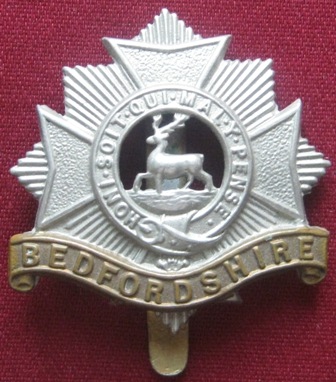
A Bedfordshire Regiment officer's cap badge (1898 to 1919)
A summary of the battalions within the regiment
Between 1914 and 1918, the following battalions served within the Bedfordshire Regiment, and their war diaries (in addition to other information, stories and photographs) can be viewed by following the links:
1st Battalion - a pre-war 'Regular' battalion dating back to 1688, and formerly titled the '16th Regiment of Foot'. Apart from a few months in Italy during the winter of 1917-1918, they served on the Western Front from August 1914 until April 1919. A detailed history of this battalion during the Great War is available here.
2nd Battalion - a pre-war 'Regular' battalion dating back to 1858, which was stationed in South Africa when war broke out. They served entirely on the Western Front from their arrival in September 1914 to their return home in April 1919.
3rd Battalion - a 'Reserve' battalion who were initially a 'Militia' battalion dating back to 1757. They served entirely around Harwich and Felixstowe in England, providing home defence and training drafts for front line units.
4th Battalion - designated as the 'Special Reserve' battalion, this was essentially the regiment's second 'Reserve' battalion, but has also been referred to as the 'Extra Special Reserve' or 'Extra Reserve' in some publications. They initially provided home defence around Harwich and Felixstowe in England, until mobilised and sent to France in July 1916. The battalion served the rest of the war on the Western Front within the renowned 63rd (Royal Naval) Division, returning home in April 1919.
5th Battalion - a 'Territorial Force' battalion initially raised as a 'Rifle Volunteer Battalion' in 1860, becoming the 5th (Territorial) Battalion in Haldane's reforms of 1908. They were embodied in August 1914 and initially provided home defence in East Anglia and on the Norfolk coast until sent abroad July 1915. The battalion served in Gallipoli, Egypt and Palestine until disembodied in June 1919 and reformed in the UK. The 2nd/5th and 3rd/5th Battalions were raised in October 1914 and June 1915 respectively and trained drafts for the front line 1st/5th Battalion.
6th Battalion - a 'Service' battalion raised specifically for the duration of the war in August 1914, as part of Lord Kitchener's K1 Army Group. The battalion served on the Western Front from August 1915 until its personnel transferred into the 1st/1st Hertfordshires in May 1918. An officer and NCO cadre trained recently arrived American units until the battalion was finally disbanded completely in August 1918.
7th Battalion - a 'Service' battalion raised specifically for the duration of the war in September 1914 as a part of Lord Kitchener's K2 Army Group. They served entirely on the Western Front until the bulk of the battalion was transferred into the 2nd Battalion in May 1918. A cadre of officers and NCO's were assigned to train American units until the battalion was completely disbanded in July 1918.
8th Battalion - a 'Service' battalion raised in October 1914 as a part of Lord Kitchener's K3 Army Group, specifically for the duration of the war. They served entirely on the Western Front between August 1915 and February 1918, at which time the battalion was disbanded. The personnel were transferred into the 2nd, 4th, 6th and 7th Battalions.
9th Battalion - a 'Service' battalion raised in October 1914 as a part of Lord Kitchener's K4 Army Group, specifically for the duration of the war. It remained in England as a 'Reserve' battalion, providing drafts for the front line units until transferred into the 28th Battalion of the Training Reserve in August 1916.
10th Battalion - a 'Service' battalion raised in December 1914 as a part of Lord Kitchener's K4 Army Group, specifically for the duration of the war. It remained in England as a 'Reserve' battalion. The battalion transferred into the 27th Battalion of the Training Reserve in September 1916, later becoming the regiment's 53rd (Young Soldiers) Battalion in October 1917. From then until the end of hostilities the battalion provided the initial three months of basic training for all young soldiers, before sending them onto the 51st and 52nd (Graduated) Battalions. In February 1919 the battalion became a 'Service' battalion once more and served in the 2nd Eastern Brigade, Eastern Division (known as the Bedfordshire Brigade) within the British Army of the Rhine (the Army of Occupation). They served alongside the 51st and 52nd Battalions until brought home in August 1919.
11th Battalion - a 'Territorial Force' battalion raised in December 1916 / January 1917 to replace the 68th Provisional Battalion. The battalion was comprised mostly men over 'active service' age or unfit for overseas duties, and provided drafts for the front line units once the soldiers had regained their 'A1' fitness categorisation. Many NCOs and men were assigned to the battalion purely on paper, serving in POW Camp units and never physically joining the battalion at its station. It was also tasked with provided general home defence on the Suffolk coast until disbanded 31 July 1919.
Transport Workers Battalions - the 12th and 13th Battalions were raised December 1916 and March 1917 respectively and disbanded in August and September 1919 respectively. Their H.Q.'s were based in Croydon and, although dressed as Infantry, they were never armed. According to a War Cabinet, Port and Transit Executive Committee document from July 1917 (National Archives reference CAB 24/21), the 12th Battalion worked in the ports of Folkestone. Rochester (including Chatham and Sittingbourne) Weymouth and Newhaven, whereas the 13th Battalion worked at Boston, Ipswich, London, Harwich and King's Lynn.
Graduated Battalions - the 51st and 52nd Battalions were raised initially as Norfolk and Suffolk Battalions respectively that provided home defence from October 1914. Following the introduction of conscription and the lowering of minimum service ages, the 53rd (Young Soldiers) Battalion (formerly the 10th Battalion) was affiliated to the Regiment in October 1917, to provide three months basic training for young recruits. After basic training they were transferred into the Graduated battalions until deemed liable for active service abroad. Along with the 53rd Battalion, the 51st and 52nd Battalions became 'Service' battalions in February 1919 and collectively formed the 2nd Eastern Brigade, Eastern Division (known as the Bedfordshire Brigade) within the British Army of the Rhine between March and August 1919, finally being disbanded in March 1920.
Garrison Battalions - the 1st Battalion was raised in December 1915 and served in India from February 1916, until disbanded in January 1920. The 2nd Battalion was raised in December 1916 and also served in India from February 1917 until disbanded in January 1920. The 3rd Battalion was raised in January 1917 and served in Burma between March 1918 and June 1919, thereafter in India from June 1919 until disbanded in January 1920.
The Bedfordshire Training Depot was opened at Ampthill Park in September 1914 as a training establishment and site for new recruits. It remained as such until October 1916, when it became the Bedfordshire Command Depot and turned its attention to treating wounded soldiers. In early 1919 the site was closed as the War Office had no further use for it, over 10,000 men having passed through the site during the war.
The 1st and 2nd Volunteer Battalions - these were citizen units formed in November 1914 by patriotic citizens for 'non-specific home defence'. Between July and September 1918 they became a 'Special Service' unit that provided defence of the coastline around Hunstanton due to the acute manpower shortage in France.
The 1st/1st Battalion, the Hertfordshire Regiment - a Territorial Force (TF) unit who were sent to France as early as November 1914 and remained on the Western Front throughout the war. They were also called the 'Hertfordshire Guards' due to serving in the 4th Guards Brigade of the veteran 2nd Division for some time, and as a result were the only regiment outside of the Guards to number their Companies numerically, as opposed to alphabetically.
The Bedfordshire Yeomanry were part time cavalrymen originally raised in 1797 as Bedfordshire Yeomanry Cavalry, disbanding after the Napoleonic Wars. Reformed briefly between 1817 and 1827, they were formed for a third period as a Bedfordshire company of Imperial Yeomanry for the South African Wars in 1899. After the Great War, they were disembodied in 1920 when it was apparent that cavalry were outdated. Reorganising as an artillery unit, they served during World War Two as such until amalgamation in 1961, becoming the 286th (Hertfordshire and Bedfordshire Yeomanry) Field Regiment, Royal Artillery. There is an external website with more information here.
Victoria Cross winners from the Bedfordshire Regiment and the Hertfordshire Regiment in the Great War
- Biography of Captain Charles Calveley Foss VC, CB, DSO, the 2nd battalion's Victoria Cross winner.
- Biography of Private 7602 Edward Warner VC, the 1st battalion's posthumous Victoria Cross winner.
- Biography of Lieutenant Tom Edwin Adlam VC, the 7th battalion's first Victoria Cross winner.
- Biography of Private 13908 Christopher Augustus Cox, V.C., the 7th battalion's second Victoria Cross winner.
- Biography of Lieutenant-Colonel John Stanhope Collings-Wells DSO, VC, the 4th battalion oommanding officer and posthumous Victoria Cross winner.
- Biography of Lieutenant Frederick William Hedges VC, the 6th battalion's Victoria Cross winner.
- Biography of Private 203329 Samuel Needham VC, the 5th battalion's Victoria Cross winner.
- Biography of Private 1665 Alfred Alexander Burt, V.C., 1st/1st battalion, the Hertfordshire Regiment.
- Biography of Second Lieutenant Frank Edward Young, V.C., 1st/1st battalion, the Hertfordshire Regimen
Site built by Steven Fuller, 2003 to 2023