The Bedfordshire Regiment in the Great War

Charles Calveley FOSS, V.C., C.B., D.S.O., D.L.
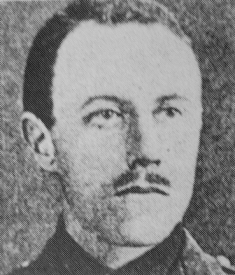
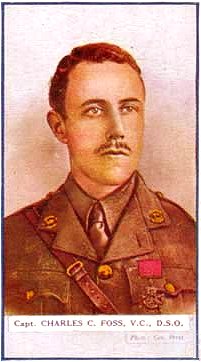
Charles was born 8th March 1885 in Kobe, Japan, the eldest son of the Right Reverend Hugh James Foss, Bishop of Osaka.
He enrolled into the Royal Military Academy at Sandhurst in 1902 and was commissioned as a Second Lieutenant in the Bedfordshire Regiment in 1904. Charles Foss was serving in the 2nd Battalion of the Bedfordshire Regiment in South Africa when the war broke out and the battalion made it to the Western Front in time for the First Battle of Ypres. He was one of only four Officers to survive the battle during which he won his D.S.O., the others being the Quartermaster, Transport Officer and Second Lieutenant Bentley Herbert Waddy.
Having miraculously survived the battle that saw many British battalions reduced to mere cadres he worked steadily through the first winter in the trenches until the opposing armies started their respective campaigning seasons again the following spring. February 1915 saw Captain Foss mentioned in Sir John French's despatches for gallantry in the field and his D.S.O. followed the same month.
The 2nd battalion spent the period until early March in the trenches around Fleurbaix before moving into reserve to train in readiness for the coming operations around Neuve Chapelle. Other British and Indian troops were to make the first attacking waves up on the 10th March 1915, with the Bedfords' Brigade moving through them to carry the lines further forwards. This in mind, at 10.30am they moved forward with their objective laying in a south-easterly direction, on the northern edge of Neuve Chapelle, headed in the direction of Pietre.
After advancing through the German barrage across open fields and passing the heavy casualties suffered by the first waves, they had cleared the old German front lines by 4.30pm. Their orders took them to support positions next to the Royal Scots Fusiliers and they settled into the new lines in an open field for the night, having lost around 60 Officers and men to the shelling that day.
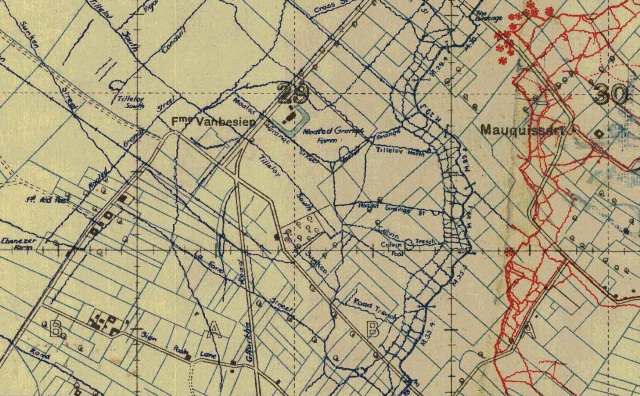
A trench map of the northern fringes of Neuve Chapelle, made in June 1916 and showing the final lines won by the British and Indian troops during the four day battle. The Bedfords advanced to the south of the 'Moated Grange Farm' (correctly named the Farm Vanbesein) and held their positions 3-400 yards south-east of the moated area. Captain Foss and his Bombing team operated 2-300 yards east of the small orchard in the middle of the map. Today, the village has sprawled and covers the area including the crossroads just north of the centre of the map. The position called 'High Trees' is one square (500 yards) directly below the writing 'Marquissart', just on the inside elbow of the road junction and the copse of tall treees are still there today (2009).
The following day was spent in the same position, manning a salient jutting into the German lines, with the British troops hugging the ground waiting for firm orders which were delayed due to a supporting Brigade not being able to make it into the alloted positions. The Bedfords simply dug in tight and watched an attack from the Northampton's halted by intense shell and rifle fire just to their right. A further thirty Officers and men fell on the 11th but no more attempts to advance were made that included them.
Overnight the two front line companies dug a new trench at right angles to their existing ones, which were being heavily enfiladed from their open southern flank, resulting in one company facing east, the other south. That night also saw a company of the Scots Fusiliers brought into the line on their right, opposite the 'High Trees', but they were rushed early in the early morning mist and driven from the trench, leaving the Bedfords cruelly exposed.
At about 7am Major Denne (second in command) was organising a counter attack to regain the lost trench when he was wounded and had to be removed from the line completely, dying as a result some two years later. Captains Cumberledge and Baird took charge and led A Company in the attack, which was disastrous. Every last Officer and man was hit, many of them falling as they left the trenches and the regimental history remarks that those who made it into no man's land lay in a straight line where they fell as a German machine gun took them in enfilade. Only a handful of Bedfords actually made it into the German trenches, being Captain Baird (wounded), Sgt 9238 Woods (wounded), Pte 7072 Wareham (wounded), Pte 9446 Coxall (wounded), Pte 9957 Day (killed), Pte 8006 Hodson (wounded), Pte 6684 Richards (killed).
Half an hour later word reached battalion HQ of the doomed assault, just as the Scots to their right started suffering badly from British shell fire. The situation was falling into confusion as the Brigadier ordered the trench to be retaken, so Major Onslow (in command) ordered the Adjutant to go forward and find out what the situation was.
Captain Foss was his Adjutant but it seems that he was not satisfied with events and took control himself. Having considered the situation he suggested one of the newly raised bombing sections should attempt the assault but neglected to add that he intended to lead them himself. In his own words, he "was rather afraid that he [the C.O.] might not countenance his Adjutant going for a 'jolly' on his own, so I did not hint that I thought of joining the bombers". Having taken one such section of Bombers from D Company, he led them from the front in a line through the trenches, intending to flank attack the German held line and placed himself at the front as the leading bayonet man.
Having moved through the 'veritable shambles' that the British trenches had become, overflowing with wounded and dying men as they were, Foss approached the end of the British territory and was faced with open ground between them and the German lines with flooded dykes running across their line of attack. As he describes in his own words:
"We then launched our attack. The words sound grand; but we felt very 'naked' and 'above ground' in the open field - at least I did. The dyke caused me some amusement - none of the bombers were inclined to get their feet wet and I thoroughly sympathised with them - wet puttees are so cold. So they 'covered' me while I ran and leapt, then I 'covered' them while they ran and leapt. What's more, we all cleared the dyke. This safely negotiated, we threw a few bombs … The bombs, the first I had seen go off in anger, frightened me with their noise and the mess they made of the local German. They also stirred the Germans into activity. They got up and crowded round us with their hands up. The bombers thoroughly enjoyed themselves, waving the bombs in their faces, making grimaces and ordering them to hold their hands higher. I had to shout to warn the bombers not to throw any more as they would blow us all up."
The tiny band of eight over zealous bombers and a single worried Officer overcame one German Officer and forty eight men in addition to those who were killed during their bombing assault. A Company moved in to take over and the salient was saved. Captain Foss' team, in the order they advanced in file, were:
Pte 9078 William Eade, DCM from Tottenham, who won the DCM and Russian Cross of St. George for his actions. He had enlisted into the Regiment in June 1907, served in Gibraltar, Bermuda and South Africa before arriving on the Western Front with the battalion on the 6th October 1914. He survived the First Battle of Ypres, Neuve Chapelle, Loos and eighteen months of trench warfare before being accidentally killed in France on the 10th June 1916. William lies in Chipilly, south east of Albert on the Somme.
Pte 4/6215 Stanley Walter Scrivener who was born in Luton to Ebenezer and Sarah Scrivener, but lived in St. Albans when he enlisted in the summer of 1909, aged 18. Stanley was in the Reserve 4th battalion when war broke out and initially served in the 1st battalion on the Western front, arriving with them on the 8th November 1914. After being wounded in the First Battle of Ypres, he recovered and moved into the 2nd battalion early in 1915. Ironically, Stanley was killed the day after his heroics that earned him a Mention in Despatches, on the 13th March 1915, along with Phillip Cogan (below). He has no known grave but is remembered on the Touret Memorial to the Missing.
Sgt 9822 William Peggs from Stratford who was awarded the Cross of St. George but who was wounded assaulting Maltz Horn Farm on the Somme 31st July 1916 and died on the 9th August 1916 at CCS No.21. This notably cheerful man's photo and bio can be seen here.
Pte 4/7270 Phillip George Cogan who was born in Collingbourne Ducis, Wilts around 1888, the son of William and Louisa Cogan. Phillip lived in Furneux Pelham, Herts when he joined up as a boy in August 1902. Phillip arrived with the 2nd battalion in France on the 11th November 1914 and was ironically killed with Stanley Scrivener (above) on the 13th March 1915. Like his comrade Stanley, he has no known grave but is remembered on the Touret Memorial.
Pte, later Acting Sgt 9878 George Freshwater, MM was born in Harrow in 1889, the son of John and Sarah Freshwater, and lived in the Willesden area of Middlesex. He enlisted around September 1911 and was with the 2nd battalion in South Africa when war was declared. Arriving on the Western Front on the 6th October 1914, he served through the First Battle of Ypres, Neuve Chapelle, Loos and the other minor actions his comrades fought in, before losing his life to the Battle of the Somme. George died of wounds on the 8th July 1916, aged 27. He lies in the St. Sever cemetery, Rouen, the site of the hospital in which he died.
Pte 4/5803 Joseph Lovett enlisted into the army at the end of June 1908. He was in the Reserve 4th battalion when war broke out and joined the battalion on the western Front 8th November 1914 as a replacement for their losses at the First Battle of Ypres. Joseph was discharged as 'time expired' in January 1916 but very probably went on to serve throughout the war in another capacity, although I have been unable to trace that information so far.
Pte 9797 Harold Barnett joined the regiment on the 1st July 1911 and was in South Africa with the 2nd battalion when war was declared. He landed in France in that battalion on the 6th October 1914 and survived the entire war.
Pte, later Sgt 16441 Frederick Brown joined the regiment on the 1st September 1914 from civilian life and may well have seen previous service before the war as he was one of the few to be posted into a Regular battalion after the most basic of training late in 1914. He landed in France two days after Christmas Day of 1914 and served in the trenches in the 2nd battalion throughout the first uncomfortable winter until the Battle of Neuve Chapelle. He won promotion to a Sergeant and went on to win a Military Medal for bombing his way along a German trench on the 12th and 13th October 1916, during the 2nd battalion's involvement in the Battle of the Somme that year. He survived the war but was discharged in January 1919 and returned to civilian life, his duty well and truly done.
Pte, later Acting Sgt 4/6477 Herbert Smith
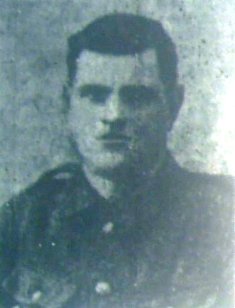 Herbert
was the son of George and Lilla Smith of Silver Street, Ashwell in Hertfordshire
and enlisted into the Special Reserves in January 1911. He was in the
4th battalion when war broke out and arrived in the same draft as Phillip
Cogan (above).
Herbert
was the son of George and Lilla Smith of Silver Street, Ashwell in Hertfordshire
and enlisted into the Special Reserves in January 1911. He was in the
4th battalion when war broke out and arrived in the same draft as Phillip
Cogan (above).
Herbert served in the 2nd battalion through nine battles from the First Battle of Ypres to Loos in the first year of the war alone and was noted as a 'distinguished bomber'.
Lance Corporal Smith was reported as enjoying a short spell of home leave in December 1915 by his local paper, having been mentioned in despatches four times by that point. Sergeant Smith appeared in the local newspapers' casualty lists on 24th November 1916 but returned to his battalion.
In one of the endless ironies of the war Sergeant Smith was due to go home for a month's leave in March 1918, having completed his term of service, as was customary for pre war soldiers. However, the German High Command had other ideas.
He was killed in action during the battalion's determined stand against the onslaught of the German Spring Offensives (the First Battles of the Somme 1918 - the Battle of St Quentin), falling on the 21st March 1918, aged 25 or 26.
As is the case with most of the fallen from that phase of the fighting, Herbert has no known grave and is remembered on the Pozieres Memorial to the Missing.
His younger brother, Harry, was killed in the 1st Hertfordshire Regiment on 16th January 1917.
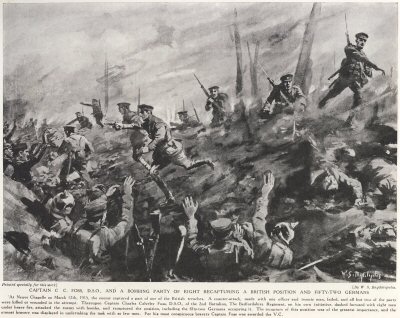
An 'artist's impression' painting of the event
Sir John French, the C in C of the British Army, heaped praise on the battalion for their actions at Neuve Chapelle, and visited them in person on 10th April whilst they were resting in Reserve. A copy of his speech was printed in the local newspapers and several decorations were handed out to the battalion for their part in the battle. Captain Foss himself was awarded the V.C. for his part in the Battle of Neuve Chapelle on the March 12, 1915. His citation reads:
"For most conspicuous bravery . . . After the enemy had captured a part of one of our trenches, and our counter-attack made with one officer and twenty men having failed (all but two of the party being killed or wounded in the attempt), Capt. Foss, on his own initiative, dashed forward with eight men, and under heavy fire attacked the enemy with bombs, and captured the position, including the fifty-two Germans occupying it. The capture of this position from the enemy was of the greatest importance, and the utmost bravery was displayed in essaying the task with so very few men."
Major Denne and Captain Cumberledge were awarded the DSO, Captain Baird the MC and several of Foss' bombers were decorated as above.
During the Battle of Festubert in May 1915 Foss once again led a team of bombers who played a vital, stubborn part in the battalion's fortunes but was moved back from the lines on the 22nd May ill. A week later he returned as the battalion's Adjutant and remained there until August, when he was appointed as a Brigade Major in the 20th Infantry Brigade.
Notification of his V.C. came at the end of August 1915, the same day that CQMS Mart's, Sgt Peggs' and Pte Eade's gallantry medals were announced. Foss' V.C. was presented to him by the King in person on the 25th November 1915 in the field, although his then former battalion were in the line at the time, so could not be present.
His leadership skills had been well proven so for the rest of his Army career Charles served in General Staff positions. In August 1915 he became a Brigade Major and by the end of 1918 he was an Honourary Lt-Colonel. By the end of 1919 Charles Foss was a Brevet Lt-Colonel who ran the Small Arms School and he even went on to serve as an aide-de-camp to King George VI.
During World War II he was Brigadier of the Bedfordshire Home Guard and ran the County's Cadet School.
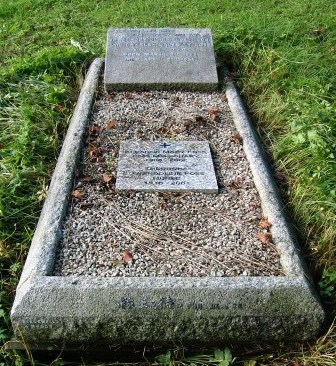
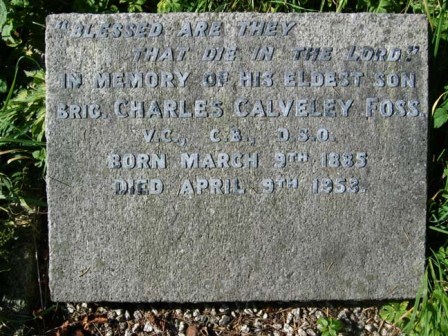
Having devoted his life to a decorated and celebrated Army career that spanned both World Wars, he passed away on the 8th April 1953, in hospital in London, aged 68. He is buried in West Hill Cemetery, Winchester, England and his medals are held by the Bedfordshire Regimental Museum in Luton.
Site built by Steven Fuller, 2003 to 2023