The Bedfordshire Regiment in the Great War

The 5th (Territorial) battalion - the 'Yellow Devils'.
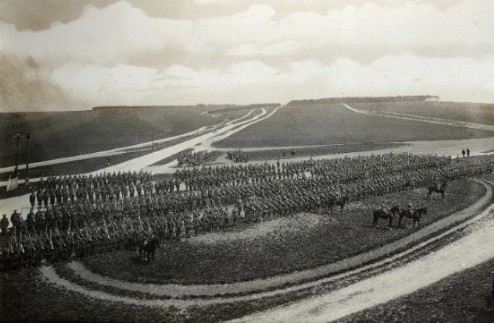
The 5th battalion on Newmarket Heath, 1915
Although the origins of what would become the Territorial Army can be traced back to the Volunteer Acts of the Eighteenth century, the unit that would directly evolve into the 5th Territorial battalion of the Bedfordshire regiment was formed in 1860 and would change with the many reorganisations to the British Army, finally becoming the 3rd battalion of the Royal Anglian Regiment in 2006. Being a unit of part time "Saturday Soldiers" as they were known, the battalion itself served entirely on home soil until the Great War, although contingents volunteered for foreign service in the 2nd battalion during the South African Wars (Boer Wars) of 1899 to 1902.
A brief history of the battalion.
In 1860 seven corps' of rifle volunteers were formed in Bedfordshire and grouped as the 1st Administrative Battalion with their HQ at Bedford. They were stationed as follows:
- 1st Bedfordshire Rifle Volunteer Corps (R.V.C.) was stationed at Bedford.
- 2nd Bedfordshire R.V.C. was stationed at Toddington.
- 3rd Bedfordshire R.V.C. was authorised to be formed at Leighton Buzzard but this was never completed.
- 4th Bedfordshire R.V.C. was stationed at Dunstable.
- 5th Bedfordshire R.V.C. was stationed at Ampthill and Silsoe.
- 6th Bedfordshire R.V.C. was stationed at Luton.
- 7th Bedfordshire R.V.C. was stationed at Biggleswade.
- 8th Bedfordshire R.V.C. was stationed at Woburn.
1864 saw the 9th Bedfordshire R.V.C. formed at Bedford and attached to the 1st Administrative Battalion, and in 1870/71 the 7th R.V.C. HQ was moved to Shefford.
In 1887 the 1st Administrative Battalion was consolidated and re-designated The 3rd (Bedfordshire) Volunteer Battalion, The Bedfordshire Regiment. The companies were renamed and assigned letters, becoming:
-
A & B Companies of Bedford - formerly the 1st & 9th B.R.V.C.
-
C Company of Toddington - formerly the 2nd B.R.V.C.
-
D Company of Dunstable - formerly the 4th B.R.V.C.
-
E Company of Ampthill - formerly the 5th B.R.V.C.
-
F & G Companies of Luton - formerly the 6th B.R.V.C.
-
H Company of Shefford - formerly the 7th B.R.V.C.
-
I Company of Woburn - formerly the 8th B.R.V.C.
In 1900, men from all volunteer Battalions of the Bedfordshire Regiment served in the "Volunteer Service (Foreign)" unit with the 2nd Regular Battalion, The Bedfordshire Regiment in The Boer Wars in South Africa. Among these volunteers was a Solicitor and rising Second Lieutenant from Luton called Edgar William Brighten who would become the Battalion C.O. and lead them throughout the Great War, later going onto command a regular battalion between the two world wars.
In April 1908 Haldene's reforms saw the formation of a Territorial Force. As a result, the East Anglia Division was one of fourteen to be formed entirely from part time, Territorial units, including the contingent from Bedfordshire. The 3rd (Bedfordshire) Volunteer Battalion was amalgamated with 4th (Huntingdonshire) Volunteer Battalion and transferred to newly established Territorial Force as the 5th (Territorial) Battalion, The Bedfordshire Regiment with:
- Battalion HQ at Bedford, offices at St Paul's Square, HQ and Orderly Room at 44 and 45 Gwynn Street and the Drill Hall at Greenhall Street. In 1910, the battalion was commanded by Lt-Colonel (Honorary Colonel) S. Jackson, D.S.O.
- A Company based at Bedford. In 1910, it was commanded by Captain Richard Ralph Orlebar, with the senior NCO and Drill Instructor being Sergeant Major Ernest Mendham.
- B Company based at Luton, with the Company HQ at Park Street.
- C Company based at Luton, with the Company HQ at Park Street and a detachment at Ampthill, whose Drill Hall was at Dunstable Street. Commanded by Lieutenant Robert Forrest, (who would go on to lead the battalion between 1923 and 1924) with Sergeant John Bunker being the senior NCO.
- D Company based at Biggleswade, with detachments at Sandy, Arlesey and St. Neots. Company HQ off Hitchin Street in Biggleswade and commanded by (in 1910) Captain C.H.F. Metcalfe, with the senior NCO being Colour Sergeant Instructor F. Merritt.
- E Company based at Ampthill, with a detachment at Olney.
- F Company based at Luton, with the Company HQ at Park Street and detachments at Dunstable and Leighton Buzzard.
- G Company based at Fletton, with a detachment at Yaxley.
- H Company based at Huntingdon, with detachments at St. Ives and Ramsey.
February 1914 saw the Huntingdonshire companies absorbed into the newly formed Huntingdon Cyclist Battalion and the remaining companies were reorganised. The battalion was commanded by Lieutenant-Colonel Francis Noel Butler, with Major Edgar William Brighten second in command. Battalion HQ remained the same but Company HQ's were now at:
- A Company at Bedford. Commanded by Captain John Wellesley Taylor with the senior NCO being Sergeant Major Ernest Mendham.
- B Company at Dunstable, with detachment at Leighton Buzzard. Company HQ still at Park Street. The Leighton Buzzard office was at the Town Hall and commanded by Major Edgar William Brighten. Captain C.H.F. Metcalfe (who went on to win a DSO in the Great War) commanded B Company in Luton.
- C Company at Luton with the Company HQ at Park Street. Commanded by Major John Clutton.
- D Company at Biggleswade. Commanded by Lieutenant Rudolf Meade Smythe, with the senior NCO being Colour Sergeant Instructor Herbert Houchins.
- E Company at Ampthill
- F Company at Luton, with the Company HQ at Park Street. Commanded by Captain Brian Clarke Cumberland, with the senior NCO and Drill Instructor being Sergeant F. Cowley.
- G Company at Luton, with the Company HQ at Park Street
- H Company at Bedford. Commanded by Captain Walter Kendrick Meakin, with the senior NCO being Sergeant Instructor H.Munson
In a letter to the county newspapers dated 20 July 1914, S.H. Whitbread, President of the Bedfordshire Territorial Force Association reported on the condition of the county's Territorial Force units:
"The normal establishment of the battalion is 28 officers and 990 rank and file. On April 1 the strength of our 6 Bedfordshire companies was 18 officers and 511 rank and file. Today the county furnishes the whole eight companies, with a strength of 27 officers and 954 rank and file, and it is certain that the stream of recruits has not yet ceased to flow. The other units of the citizen force of the county are in a very satisfactory condition, the Bedfordshire Yeomanry being actually over establishment. The county now furnishes tot eh Territorial Force practically 1 per cent of the entire population of men, women and children. The 5th Beds. Battalion, together with Hertfordshire, Cambridgeshire and Northamptonshire battalions, now form a brigade of four battalions, each of which is 95% of its full establishment."
Territorial Army Summer Camps, 1909 to 1929.
Territorial Army soldiers drilled monthly at their local Drill Halls and took part in divisional level manoeuvres every summer, usually for two weeks. The 'Summer Camps' were naturally interrupted by the Great War but below is a list of those the battalion attended between 1909 and 1929.
- 1909. Hunstanton between the 31st July and 14th August
- 1910. Ipswich between the 30th July and 13th August
- 1911. Thetford between the 29th July and 12th August
- 1912. Worthing between the 28th July and 11th August
- 1913. Shorncliffe between the 27th July and 10th August
- 1914. Ashridge Park near Dunstable
- 1920. Great Yarmouth, Norfolk.
- 1921. Eastbourne, Sussex.
- 1922. Cardington, Bedfordshire.
- 1923. Swingate Camp, Dover, Kent.
- 1924. Swingate Camp, Dover, Kent.
- 1925. Bulford, Salisbury Plains, representing the regiment during Regular Army manoeuvres in September.
- 1926. Swingate Camp, Dover, Kent.
- 1927. West Runton, Sheringham, Norfolk.
- 1928. Middlewick Camp, Colchester, Essex.
- 1929. Arundel Park, Arundel, Sussex.
The 5th Battalion's Great War service
The annual Territorial Army summer camp of 1914 finished with emergency orders for all units to return to their bases and await further instructions. At 6.15 p.m. on Tuesday 11 August 1914 orders arrived to mobilise and the entire Battalion was 'embodied' for war service with the East Anglian Division.
Officers contacted all men in their command to report by 10am Weds Weds 12 August 1914 - men to report to Bedford by 10am. "By 9.59 a.m. they were nearly all there, together with a crowd of leave-taking wives and children. A and H Companies (Bedford) formed up and marched off to billet in The Rink, whistling and singing "Fall in and follow me". Another Bedford squad were billeted in The Swan Hotel. The 56 men of D Company (Biggleswade) quartered at Park Lane Schools, where they initially slept in the great coats on the floors. Within a week of being mobilised, the East Anglian Division was at its station in and around Chelmsford in Essex, with the Bedfords being billeted at Romford, Essex.
The soldiers were asked whether they wanted to enlist for overseas duties, with a very high percentage saying 'yes' and the '5th (Reserve) Battalion' was also raised soon afterwards. Initially the Reserve battalion was a 'Home Service' battalion for those who did not wish to serve abroad, those who were over service age or medically unfit for active duty.
The battalions first death occured before training had really started in ernest. On Thursday 27 August 1914 Private 3388 Benjamin Headley Seabrook was guarding a Great Eastern railway bridge at Manningtree when, at 8.30 a.m. he was killed by an express train.
Despite preparations, the expected move abroad did not follow and in September they were dispersed throughout the East Anglia, to provide home defence and train hard in readiness for overseas duties. The 5th battalion were stationed at Bury St. Edmunds from September 1914, where Lieutenant-Colonel Edgar William Brighten, CMG, DSO, TD took command; Captain Younghusband, DSO assumed the role of Adjutant, with R.S.M Ernest Mendham as their Regimental Sergeant Major.
November 1914 saw the Companies forming the active service (1st/5th) Battalion reorganised from the pre war structure of eight Companies to four companies, called A to D:
-
A Company was formed from B and C Companies under Captain Brian Clark Cumberland, the senior N.C.O. being C.S.M. 2219 Edgar Thomas Odell
-
B Company was formed from F and G Companies under Captain John Edgar Hill, OBE, TD, the senior N.C.O. being C.S.M. 4391 Walter T. Brazier.
-
C Company was formed from A and H Companies under Captain Walter Kendrick Meakin, the senior N.C.O. being C.S.M. 2092 Alec Milton, MC, DCM, TEM and Bar, MM (France).
-
D Company was formed from D and E Companies under Lieutenant Rudolf Meade Smythe, the senior N.C.O. being C.S.M. W. Gobey.
In January 1915 the 5th Battalion was designated 'The 1st/5th Battalion' and the '5th Reserve Battalion' was re-designated as the '2nd/5th Battalion', the latter serving with the '69th (2nd East Anglian) Division' in the Home Forces until disbanded in February 1918. Later that year the '3rd/5th Battalion' was also raised as a training and draft finding battalion.
In March 1915, the 1st/5th Battalion moved from Bury to Norwich and then to St. Albans in May, where specialist training was stepped up and their formation was re-designated as the 162nd (East Midland) Brigade in the 54th (East Anglian) Division. On the 25th July hot climate uniforms were issued, the battalion were ordered to hurriedly collect all stores and equipment and they set off for the south coast on a series of trains.
The battalion left Devonport on 26 July 1915, bound for 'somewhere out East' and, after a brief stop-over in Egypt, disembarked on Gallipoli, serving there between 10 August and 4 December. During their assault against the Kiretch Tepe Sirt on 15 August 1915 an observing Staff Officer observed their progress through his binoculars and saw the battalion's metal flashes glinting yellow in the sun as they doggedly advanced. He remarked "By Jove! If only we had one or two more battalions of those yellow devils we should be across the peninsular by tommorow". With that, the battalion's nickname - the 'Yellow Devils' - was born. A pitifully small number of them remained by December 1915 and they were moved back to Egypt to be rebuilt between January and March 1916, after which a year-long posting to guard the Suez Canal followed. The battalion advanced to Gaza with the British and Commonwealth forces in March 1917, taking part in all of the actions there and during the advances through Palestine that followed. By the armistice in October 1918, they were stationed at Beirut, having spent the entire campaign in that theatre of war.
The 54th (East Anglian) Division was comprised the 161st (Essex), the 162nd (East Midland) and 163rd (Norfolk and Suffolk) Infantry Brigades, with the 162nd being composed from:
- 1st/5th Battalion, the Bedfordshire Regiment
- 1st/4th Battalion, the Northamptonshire Regiment
- 1st/1st Battalion, the Cambridgeshire Regiment [left February 1915]
- 1st/1st Battalion, the Hertfordshire Regiment [left November 1914]
- 2nd/1st Battalion, the Cambridgeshire Regiment [between February and April 1915]
- 1st/10th Battalion, the London Regiment [from April 1915]
- 1st/11th Battalion, the London Regiment [from April 1915]
Soldiers in this theatre of war suffered notably from illness, with the battalion losing considerably more men to local diseases than enemy fire. Nevertheless, over 120 gallantry medals were issued to soldiers from the 1st/5th battalion, including a Victoria Cross and the battalion were engaged in the following actions:
- The Suvla Bay campaign on Gallipoli, especially during the advance along the Kiretch Tepe Sirt 15th August 1915.
- The 1st Battle of Gaza, Palestine in March 1917.
- The 2nd Battle of Gaza, Palestine in April 1917.
- Raids against Umbrella Hill, opposite Gaza in July 1917.
- 3rd Battle of Gaza, Palestine in November 1917.
- Defensive actions during November and December 1917.
- Operations in the Jordan Valley, February to May 1918.
- Battle at Megiddo, Palestine in September 1918.
The battalion were disembodied in June 1919 whilst stationed at Beirut and reformed in February 1920 at Bedford, as a part time, Territorial battalion again.
According to Captain Webster's 1935 history of the battalion, 26 officers and 750 ranks left England in July 1915, with 231 officers and 4,939 ranks reinforcing the battalion during the war. 17 officers and 202 ranks were killed, 29 officers and 660 ranks were wounded in action, with 1 officer and 10 ranks being taken prisoner. Sickness accounted for the largest percentage of casualties by far, totalling 116 officers and 4,125 ranks.
Commanding Officers of the 5th Battalion.
Between the formation of the Territorial battalion in 1860 and the merging of the battalion into the 1st Hertfordshires in 1961, the following officers commanded the 5th battalion:
- Lieutenant-Colonel The Honourable F.C. Hastings-Russell, M.P. (later the Ninth Duke of Bedford), between the 21st August 1860 and 9th January 1872.
- Lieutenant-Colonel J.T. Green, between 10th January 1872 and 1st November 1895.
- Lieutenant-Colonel E.R. Green, V.D., between 2nd November 1895 and 2nd December 1902.
- Lieutenant-Colonel A. Lingard-Green, D.S.O., V.D., between 3rd December 1902 and 23rd December 1904.
- Lieutenant-Colonel Spenser-Jackson, T.D., D.L., between 24th December 1904 and 19th January 1912.
- Lieutenant-Colonel Francis Noel Butler, T.D., between 20th January 1912 and 25th January 1915, including the initial period of service of the 1st/5th battalion.
- Lieutenant-Colonel Edgar William Brighten, C.M.G., D.S.O., T.D., commanded the 1st/5th battalion between 26th January 1915 and 15th February 1920.
- Lieutenant-Colonel J. Clutton, T.D., between 16th February 1920 and 7th November 1923.
- (Acting Lieutenant-Colonel) Major Robert Forrest, M.B.E., T.D., 7th November 1923 to 20th March 1924.
- Lieutenant-Colonel Sir Harold Augustus Wernher, K.C.V.O., between 20th March 1924 and 20th March 1928.
- Lieutenant-Colonel Christopher Harold Miskin, M.C., from 20th March 1928 to 20th March 1938. (Acting Lieutenant-Colonel).
- Major A.D. Gaye, between 20th March 1938 and 19th December 1939.
- Honorary Colonel Douglas Rhys Thomas, M.C., O.B.E., between December 1940 and 5th August 1947.
- Lieutenant-Colonel (Honorary Colonel) Joseph Ralph Harper, O.B.E., T.D., between 1950 and 31st January 1954.
- Lieutenant-Colonel Edward Bryan Stanley Scott-Clarke, O.B.E., T.D., between 1st February 1954 and 1957.
- Lieutenant-Colonel S. W. G. B. Phipps, between 1957 and 28th August 1959.
- Lieutenant-Colonel D. Milman, M.C., between 1959 and 1961.
- Colonel the Right Honourable Lord Luke, T.D., D.L., J.P., was the Honorary Colonel between 1947 and 1961, as well as being the Honorary Colonel of 1st Bedfordshire & Hertfordshire (TA) between 1961 and 1962.
Sources: The London Gazette and captions taken from a photograph album held at the Bedford County Records Office (under X 550/6/73) which contains a collection of named photographs of some of the battalion's officers.
The 5th (Reserve) battalion was initially formed at Bedford in September 1914, under the command of Lieutenant Colonel, the Honourable Victor Russell, O.B.E. Their function was to act as the second line battalion of the Territorial element of the regiment, training all A1 medical category soldiers in readiness for providing replacement drafts to the front line battalion. At that time, the 5th battalion's soldiers who were over or under service age, who did not accept overseas service, or were unfit for active service formed the nucleus of the Reserve battalion, which was expanded to full strength with new recruits that year. Until the arrival of their firt khaki uniforms in December 1914, the battalion trained in a variety of clothes, determined by whatever the recruits could lay their hands on. In January 1915 they were moved to Newmarket and re-designated as the 2nd/5th battalion becoming part of 207th Brigade in the 69th (2nd East Anglian) Division. Here they received Japanese pattern rifles and were able to start serious weapons training, as much of their training had been spent strengthening the men to that point.
The 69th (2nd East Anglian) Division was formed from the 206th (2nd Essex), 207th (2nd East Midland) and 208th (2nd Norfolk and Suffolk) Infantry Brigades, with the 207th Brigade comprising:
- 2nd/5th Battalion, the Bedfordshire Regiment [Between January 1915 and 18th March 1918, when they were disbanded].
- 2nd/1st Battalion, the Cambridgeshire Regiment [Between December 1914 and February 1915, when they transferred into the 54th Division].
- 2nd/1st Battalion Hertfordshire Regiment [Between early 1915 and 14th March 1918, when they were disbanded].
- 2nd/4th Battalion, the Northamptonshire Regiment [Between early 1915 and 14th March 1918, when they were disbanded].
- 42nd Graduated Battalion [between summer 1917 and 27th October 1917, when they became the 51st Graduated battalion, the West Yorkshire Regiment].
- 51st Graduated Battalion, the West Yorkshire Regiment [Between 27th October 1917 and 11th November 1918].
- 52nd Graduated Battalion, the West Yorkshire Regiment [Between 23rd February 1918 and 11th November 1918].
- 51st Graduated Battalion, the Leicestershire Regiment [Between 15th January 1918 and autumn 1918, when they transferred into the 208th Brigade].
- 52nd Graduated Battalion, the Leicestershire Regiment [Between 17th January 1918 and autumn 1918, when they transferred into the 208th Brigade].
- 52nd Graduated Battalion, the Sherwood Foresters [Between 23rd February 1918 and April 1918, when they transferred into the 208th Brigade].
- 51st Graduated Battalion, the King's Own Yorkshire Light Infantry [Between May 1918 and 11th November 1918].
- 52nd Graduated Battalion, the King's Own Yorkshire Light Infantry [Between May 1918 and 11th November 1918].
- 241st Graduated Battalion [Between summer 1917 and 27th October 1917, when they became the 52nd Graduated Battalion, the Rifle Brigade].
- 52nd Graduated Battalion, the Rifle Brigade [Between 27th October 1917 and February 1918, when they transferred to the 67th Division].
On 20th June 1915, all those who were not suitable for overseas service were transferred into the 68th Provisional battalion and the relatively small nucleus left over after providing the 1st/5th battalion with their final 'top up' draft before being shipped abroad were quickly rebuilt from recruits from all over Bedfordshire. On 27th July 1915, they moved by train to Brentwood to construct a defensive position, forming a part of the London defences, but returned to the Exning area within a month. September 1915 saw them post their first Officer replacement draft overseas, following the heavy losses suffered by the 1st/5th battalion on Gallipoli in August and further drafts followed towards the end of the year, as the front line unit was rebuilt in Egypt.
Once the 3rd/5th battalion was established, the 2nd line unit's primary role became one of home defence and a reorganisation took place. To that end, home service personnel were transferred to the 2nd line unit and new active service recruits went into the 3rd line unit. The 2nd/5th battalion were posted to new 'war stations' on Killingham Moor near Harrogate in June 1916, moving from the Eastern Command to the Northern Command in the process. At around the same time, their commanding officer, Lieutenant Colonel, the Honourable Victor Russell O.B.E. went overseas on active duty. Major F.W.F. Lathom, M.C. took over temporary command and the battalion moved to Darlington in October 1916. Here, they were billeted in empty houses and schools, making a pleasant change from the sodden moor they had been encamped on north of Harrogate.
Early in 1917 Lieutenant Colonel E.G. Mercer C.M.G. assumed command and remained in post until the battalion was disbanded in 1918. In May 1917 a further move saw them stationed at Carburton Camp in the Dukeries area of Nottinghamshire and on 8th October 1917 they relocated to Clipstone Camp, near Mansfield. The process of disbanding the battalion started on New Year's Day 1918 and was completed on 18th March 1918, with those fit for overseas service moving into battalions who were training men up for replacement drafts and many of the remainder being posted to the 3rd/5th battalion, who were stationed at Crowborough.
Although the battalion was always liable to go into active service in the event of an enemy landing on home shores, the battalion served entirely in UK throughout its existence.
The 3rd/5th Battalion
Once it was apparent that the 1st line battalion was bound for overseas service, it was realised that leaving just one battalion in England was not enough to find recruits, train them in readiness for active service and provide home defence. With this in mind, the 2nd/5th (2nd line) battalion went on an intense recruiting march throughout Bedfordshire during late May 1915 and into early June under Major Richard Rouse B. Orlebar. The march gave them enough new recruits to form the nucleus of a 3rd line battalion and in June 1915 a third battalion was raised with the primary purpose of finding recruits and training them, and with a secondary purpose of providing home defence if required. The battalion was designated as the 3rd/5th battalion of the regiment and fell within the East Anglian Reserve Group. On formation, the battalion was commanded by Major Orlebar, with Captain G.P.L. Orr as the battalion Adjutant and Sergeant Major Mendham as the Regimental Sergeant Major.
They initially assembled at Bedford, but moved to Windsor Great Park in a matter of weeks, where the King, the Prince of Wales and Princess Mary all visited them. In October 1915 they moved to the Halton Park training ground near Tring.
In September 1915, a letter sent by Lieutenant Colonel Brighten of the 1st line battalion to Lieutenant Colonel Orlebar in the 3rd line battalion was published in the papers all over Bedfordshire, describing the action on Gallipoli 15th August 1915. A big recruiting rally in Luton kick started their primary role as a recruit finding unit and from early 1916 they would take over the role of sending drafts abroad from the 2nd line battalion. From around this time, wounded men in the Bedfordshire Territorials who had recovered and were classified as being fit enough for active service but who needed to be retrained were also posted into the 3rd/5th battalion, who would re-train them before sending them abroad again. Although their drafts were usually bound for the 1st/5th battalion in Gallipoli, Egypt or Palestine, many later drafts were sent to the Western Front or elsewhere, as demand dictated.
On the 8th April 1916, they were re-designated as the 5th Reserve Battalion and on the 11th July 1917 2nd/1st (Reserve) battalion of the Hertfordshire Regiment was merged into the 3rd/5th battalion. The battalion moved to Crowborough in Sussex early in the autumn of 1917, where they also absorbed the foreign service element of the 2nd/5th battalion after it was disbanded. Also, around this time Major Bassett took command over from Lieutenant Colonel Orlebar and was in turn succeeded by Lieutenant Colonel T.S. Wooloscombe from the Middlesex Regiment.
In August 1918 the battalion was moved to the St. Leonards / Hastings area of Sussex, where it remained until disbanded. At the time of the armistice in November 1918 most of the young recruits who filled the ranks of the battalion moved to Felixstowe, where many of them would go onto serve in the Army of the Rhine (the occupation force sent to Germany after the armistice). Those who were liable for demobilisation or disembodiment remained with the battalion and were gradually released from February 1919, with the remaining cadre being moved back to Bedford and finally disbanded in March 1919.
Site built by Steven Fuller, 2003 to 2023