The Bedfordshire Regiment in the Great War

The 7th battalion in German Spring offensives, March 1918
The build up to the First Battles of the Somme 1918
1917 saw the 7th Battalion strengthen their already solid reputation during their offensive operations in March, May and August of that year, as well as their constant vigilance and trench raiding which kept their counterparts unsettled. What would become their final offensive operations of the year were a series of four raids against German positions between the 8th and 12th of October, which saw them congratulated once again by several Generals and rewarded with many gallantry medals.
1917 had been a shaky year, all things considered. The French army had almost mutinied, refusing to go onto the offensive as they were tired of such massive losses of life and a small uprising even happened in the British training areas around Etaples - their only significant act of defiance during the entire war. The British army took the offensive role away from their exhausted French ally and in turn any German attentions by going into action around Arras, Cambrai and Ypres. The Third Ypres offensives finally ground to a bloody halt in the thick, cloying mud of the Passchendaele Ridge that November and the year ended with the final collapse of the Eastern Front and Russia's demise from the Alliance. In turn this released the substantial veteran German forces, buoyed by their success, to man the Western Front opposite their British and French foes.
Having spent seven gruelling months on the Ypres salient and surrounding areas, the 7th Bedfords of the 54th Brigade (along with the entire 18th Eastern Division) were ordered to take over a new section of the British line from the French. The Division were moved from the furthest northern positions of the British section of the Western Front to the furthest south, around Noyon and St. Quentin in the Aisne region of France. The move was completed on February 10th 1918 when the troops found themselves in comparatively comfortable surroundings near Salency which included dry billets in an area not devastated by shell fire. However, the enemy greeted the Bedfords the day after their arrival with an air raid which destroyed a barn billeting a platoon, killing ten and wounding eight in the process. A second bomb fell within 150 yards of the Chateau which housed the Battalion HQ, 'creating a little excitement' but causing no casualties. The same day saw almost 200 men arrive from the 8th Bedfords following their disbandment.
The next day saw the 12th Middlesex disbanded in line with the sweeping changes to the British army structure, making the renowned 54th Brigade a three battalion unit. Two days later the Brigade moved again, with the Bedfords HQ being positioned at Remigny, having moved via Caillouel. A month of hard digging and extensive training followed as the army prepared for the offensive that everyone knew would come their way as soon as the weather allowed, despite them being unsure exactly where the hammer blow would fall.
The new "elastic defence" concept was introduced, resulting in a "Forward Zone" designed to hold any attack up whilst the units behind got into position. Next came the "Battle Zone" in which the main battle would be fought and incorporated mutually supportive fields of fire. Finally came the "Rear Zone" holding those units ready for counter attacks and allowing their positioning wherever needed as the battle developed. The concept itself was sound, but in hindsight too complex for troops who had been trained specifically in other methods, and it was introduced too near to the German offensives that were coming their way to allow the men to get to grips with it. In addition, tape marked the rear areas and many of the trenches that were yet to be built and many of the main battle zone gun pits and defensive positions were incomplete.
Nevertheless, the Bedfords and their colleagues went about their rigorous business of preparing the line and training hard, especially in counter attack formation.
At the end of February, the Brigade was moved into the Divisional reserve, becoming the counter attacking Brigade and the Bedfords were posted around Rouez Camp. The entire front was noted as being incredibly quiet throughout February and March so the British troops made the most of the lull. Digging and training intensified throughout March as the British army did all they could to give themselves a fighting chance of holding against the inevitable German attack. Although no one was certain where the blow would fall, a German prisoner captured on the 19th gave his interviewers such detailed information as to the preparations of the German Army in front of St Quentin that he could not be ignored. Nevertheless, British General Staff still refused to reinforce Gough's seriously overstretched Fifth Army in their position, so General Gough could do nothing but ponder his predicament and his Fifth Army sat and waited.
Finally at 3pm on the 20th March 1918, the "Prepare for attack" message was issued as the Bedfords were in reserve at Rouez, 12km south-south west of St. Quentin. The 10,000 men of the undermanned and overstretched 18th Division set about readying themselves for what everyone knew would be a massive battle, even in Great War terms.
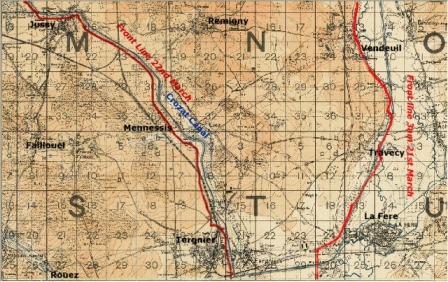
The 18th Division's operational area
"Operation Michael"; 21st March 1918.
At 1am on the 21st March, a night patrol from the 16th Manchester's, opposite St Quentin, decided it was lost in the dense fog in no mans land. They stayed in a shell crater and waited for daylight, so they could see which direction to head in. Suddenly, a thunderous, unbroken barrage opened from the German lines. For ten minutes the terrified Manchester men clung to the pulsating earth, then a Sergeant hammered on the shoulder of the Officer and said "At least we know which way to go now Sir".
"Operation Michael" opened at 0440 on 21st March 1918, with the largest concentration of artillery ever assembled (6173 guns and 3532 trench mortars) opening fire along a 50 mile front.
2nd Lt H. Crees of the 22nd Northumberland Fusiliers was a witness to the opening barrage. "I was going round inspecting the posts and just happened to be standing on the firestep with my head just over the parapet, looking out over no man's land. Then I saw this colossal flash of light. As far as I could see, from left to right was lit up by it. I heard nothing for a few seconds and, for a moment I wondered what it was. I think I just managed to hear the gunfire itself before the shells arrived all around us."
At 0915 hours, 59 divisions stormed British defences, such as they were; tape still marked many areas where defensive trenches were to be dug. The 16 badly overstretched and undermanned British divisions stubbornly held their defensive positions 'to the last' in many cases, but held nevertheless. Defensive successes varied as the 'Essigny redoubt' on the St Quentin road fell by 1200 hours and the whole garrison of the 12th Irish Rifles were destroyed to the man, yet a company of 180 men from the 3rd Rifle Brigade held 'Cookers Quarry' until 2000 hours, before the 11 wounded survivors withdrew safely.
One of the hundreds of accounts worthy of note is that of the 'Awkward Squad'; a 'rag tag' unit of around 150 disobedient and old soldiers, unskilled labourers acting as Engineers, bolstered with around 30 veterans. They were one of the 55th Brigades 'Forward Defensive' units, holding the 'Vendueil Fort' that day, near St Quentin. Captain Fine and his 'mob' held up the German advance for a 1 mile stretch of the front for 12 hours, having inflicted an 'extreme' number casualties on the assaulting battalions and German columns trying to move past their redoubt to support the main attack. The Germans were forced into concentrating on levelling the old fort before they could continue the attack in that sector. The remaining members of the Awkward Squad surrendered just before 1700 hours that day, having exhausted their ammo 50 minutes before. They were responsible for considerable German casualties and thoroughly earned their name, along with several post war decorations.
The German assault developed in strength as the day wore on with the weight of the attack in the Bedfords' area falling onto the 14th Division to the north and the 58th Division to the south. All attacks on the 18th Divisional front were repulsed but not before two of the three battalions in the 53rd Brigade who stood on the right flank of the 18th Division were effectively wiped out.
Accurate news from the front was scarce but information crept back and the Divisional commands all along the front finally began understanding where the critical areas were. That afternoon the Bedfords were moved in buses to support positions as their comrades further east continued fighting a stubborn defensive battle. By 7.30pm the 54th Brigade had been moved from a 2nd Line 'Reserve Position' to positions around Montescourt. A small counter attack was required to drive forward enemy units from Montescourt but the town was retaken with very few casualties. Once in position, the Northampton's and Fusiliers held the front lines and the Bedford's C and D Companies were in Support of the Royal Fusiliers, with A and B Companies in support of the Northampton's.
At the end of the first day, the meagre British reserves were either engaged or covering the remnants of the withdrawing Divisions and the 54th Brigade were ordered to cover the retirement of the 14th Division on their northern flank then withdraw to behind the Crozat Canal between Jussy and Mennessis by midnight. Many Battalions had already been completely destroyed and others ceased to exist as an effective fighting unit, including a whole Irish Brigade of 3 full Battalions. The British line had taken a massive hammer blow and buckled badly, but had held.
The Crozat Canal; 22nd March 1918.
British units conducted an aggressive, sometimes vicious, fighting withdrawal along the 50 mile front and carefully chose their positions at which to stop, turn towards their pursuing enemy and fight. The British 'Rear guard' units made the advancing German battalions pay dearly, but also suffered in return. The 8th Durhams are recorded as saying they killed more Germans that day than during the entire war to that point. However, the 2 companies of the 7th Leicesters (450 men) fighting one of the scores of rear guard actions, only 1 officer and 14 other ranks fell into enemy hands and none got back to their own lines. Indeed the 11th Royal Fusiliers of the 54th Brigade mustered a pitiful 2 Officers and 26 other ranks from a starting strength of over 650 by end of 23rd March. Badly outgunned British artillery fired over open sights for the first time since 1914 before being overrun by bayonets themselves, causing horrific casualties amongst their enemy yet still the juggernaut rolled towards the thing British lines. Several British and German Battalions were wiped completely from the Army Sheets in the bitter fighting over these two days.
The day's events were broken into dozens of separate, often isolated engagements as the Germans pressed forward and the British held their posts, often not knowing who was to either side of them due to the thick fog that did not burn off until early afternoon. Brigades and Battalions did not count for much that day. It was a day of stubborn and often heroic actions by platoons, sections and even individuals isolated from their comrades by the fragmented nature of the battle and lack of visibility.
A mile east of the Bedfords as dawn broke, a cook in the 53rd Brigade was busy preparing breakfast for his platoon. He could see no-one through the thick fog and hear nothing above the roar of the guns yet he carried on, knowing the smell would bring them running. Unexpectedly a group of Germans appeared from the fog but by the time he realized they were not his pals, it was too late to react. Thinking fast, he bartered with them; his bacon in exchange for his freedom. Warily, the Germans insisted on him eating some first, presumably to check it was not a trap. Having seen he was genuine, the starving German soldiers hungrily devoured the rare treat and the cook slipped away into the fog, eventually finding his unit and, after complaining that the Germans had eaten his breakfast, he joined the firing line to help beat the next attack off!
The 7th Bedfords started the second day moving into a defensive position between Mennessis on their southern flank, and the intact La Montagne Bridge on their northern flank. Despite the urgent necessity to destroy the bridge, "it couldn't be blown as we'd got no explosives" according to one bemused Private. Exploding trench mortar shells and various other ingenious methods were tried to bring the bridge down, all without success, leaving the Bedfords no option than to set their defences carefully and wait. By 7am they were in position, having spent the night marching, then digging in. They waited, peering through the thick fog which reduced visibility to between twenty and fifty yards at best, unsure what was about to be thrown at them. Visibility beyond the opposite canal bank was impossible so they lined the western bank and waited for whatever was to come at them out of the fog.
The 11th Royal Fusiliers took up position between Jussy and north of La Montagne Bridge with the 7th Bedfords holding from the bridge to the northern fringes of Mennessis, within sight of the village cemetery. The Northampton's were kept in Brigade reserve and sheltered in the woods and copses to the west as well as the cover would allow.
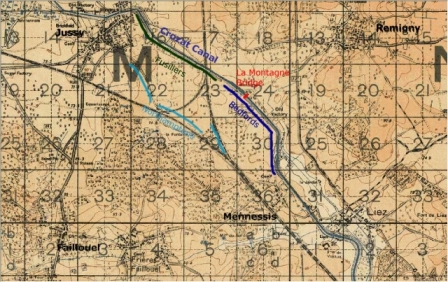
54th Brigade positions on 22nd March 1918
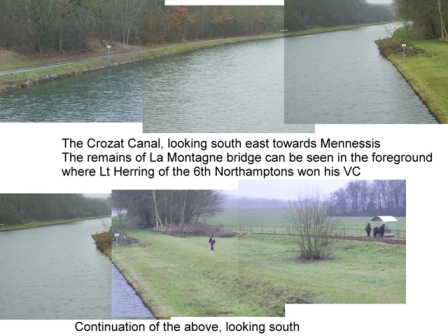
Attempts to force the bridge that day were repulsed with heavy losses inflicted on the attacking German battalions but at 5.45pm, C Company were finally pushed from Montagne Bridge by a heavy German attack. However the Brigade regained the bridge again by a counter attack 2 hours later. Several medals were won around this position, including a Victoria Cross by Second Lieutenant A.C. Herring of the Northampton's, several D.S.O.'s and Military Crosses, numerous Military Medals, and Distinguished Conduct Medals. The 54th Brigade History records:
"Captain Browning [2nd in command] of the Bedfordshire Regiment won his MC that day. The enemy attacked with large forces, crossed a bridge that had not been demolished [La Montagne Bridge], and succeeded in pushing back the left flank of the Battalion [C Company]. He was immediately counter attacked and thrown back across the canal [by C Co. and 3 Companies of Northamptons]. This was largely due to Captain Browning, who displayed magnificent leadership in collecting and organising the men and launching a counter attack at a critical moment under intense artillery and machine gun fire".
"Things had looked so bad for the Bedfordshire Regiment at one time on the afternoon of the 22nd that, with the enemy within 200 yards of Battalion HQ, Colonel Percival [Bedfords Commanding Officer] and Captain Browning [2nd in command] destroyed all maps and secret documents to prevent their falling into enemy hands".
Mennessis became the Strategic Anchor of that sector of the battle, as the determined German onslaught started taking its toll on the exhausted, badly battle worn British defenders. The remnants of British units south of that point were forced from the canal and conducted spirited fighting withdrawals, suffering further heavy losses in the process. All available units not already engaged were thrown into the gap that developed south of Mennessis, including cooks and transport drivers as the ever shrinking 54th Brigade stubbornly held the banks of the Crozat Canal.
The 54th Brigade History records: "On March 23rd [this should read the 22nd] the Germans crossed the Montagne Bridge, after severe fighting, and gained a position on the south bank of the canal. 2nd Lieutenant Herring's [Northampton's] post was cut off from the troops on both flanks and surrounded. He at once counter attacked with his post and recaptured the position, taking over 20 prisoners and 6 machine guns. The post was attacked continuously throughout the night for 11 hours, and all attacks were beaten off. This was entirely due to the splendid heroism displayed by 2nd Lieutenant Herring, who continuously visited the men personally throughout the night and cheered them up. The initiative and individual bravery of this officer were entirely responsible for holding up the German advance for 11 hours at an exceedingly critical period. The magnificent heroism and personal bravery of this officer, coupled with his initiative and skill in handling the troops, were most important factors in holding up the German advance over the Crozat Canal"
It is worthy of note that 2nd Lieutenant Herring had never been in combat before, as was the case with the entire section of men he was leading. Their counter attack and subsequent refusal to surrender was worthy of his V.C. but Herring and what was left of his post was captured on the morning of the 23rd, having held out for eleven hours without relief.
Darkness came and brought a day of hard and bitter fighting to an end yet still the canal had been held. During the night the Germans kept their attentions to sniping and bursts of machine gun fire but did not attack again, leaving the battered, surviving Bedfords to grab any rest they could in their improvised trenches and gun pits.
The 54th Brigade is prised away from the Crozat Canal; 23rd March 1918.
By the 23rd March 1918, the whole of the British 5th Army (and parts of the 3rd Army to their north and French Army to the south) were being pushed back and badly mauled, as the Germans offensive on 21st March had made breakthroughs all along the 5th Army front. The entire 5th Army was falling back rapidly yet managing to maintain cohesion.
The 54th Brigade held their ground for 36 hours of desperate, bitter fighting, but were reaching a critical point in the battle as other Allied units on their flanks had been pushed back, leaving them exposed and surrounded. The 54th Brigade History records "When day broke on the 23rd the weather still favoured the Germans. Fog was thick over the rivers, canals and little valleys, so that he could bring up fresh masses of troops unseen. Once the German commanders had made their preparations, the fog suddenly lifted as if rolled up by German staff, and low flying enemy aeroplanes appeared over the British lines, coolly examining the dispositions of their thinly spread defences.
Further attacks by massed German forces continued all that morning and the defenders were whittled away piece by piece, yet the Bedfords held their posts. By mid morning the Railway and La Montagne Bridges were clogged with wounded and dead Germans, testimony to the 32 Lewis Guns per Battalion that the British now deployed, although the dense fog had neutralised much of their effectiveness.
The Fusiliers holding the norther section of the Brigade lines near Jussy to the north were not aware that the battered 14th Division to their left had withdrawn, leaving their flank exposed. They fought on, despite being assailed from the front and side simultaneously whilst they waited for orders to withdraw.
The Northampton's had also been brought into the firing line by 10am such was the pressure being exerted on the Bedfords holding almost 2,000 yards of the Canal by themselves. The 55th Brigade to the south also withdrew with heavy losses, resulting in the Bedfords holding the village of Mennessis coming under severe attack from their now unprotected southern flank.
To the north, Brigade HQ tried to establish what was happening around Jussy as contact had been lost with the Fusiliers; "Our own patrols pushed out into the fog, and soon found that the enemy had forced a passage over the canal at Jussy and was coming in on our left flank in some force. A little handful of a mixed force was thrown at him in counter attack - a weak platoon of Fusiliers and 30 Royal Scots Greys - and he was pushed back into the village.
"A patrol was sent into Jussy, and found the place strongly held by the enemy. A detachment of Northumberland Hussars with Hotchkiss Guns, who had just reported to the Brigade as reinforcements, were pushed out to support this weak left flank. A little later the Canadian Mounted brigade sent up 4 machine guns and these were put on the same flank where they did some magnificent work.
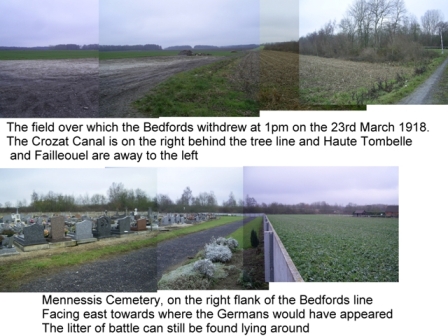
On the right flank, the picture caused more concern to Brigade HQ. "At about 11am the Bedfordshire Regiment reported the enemy across the canal in strength in the cemetery at Mennessis [on their open right flank]. Later came the news of the enemy marching down the Jussy - Faillouel road to their rear, and shortly after midday they were reported in Bois de Frieres in our rear."
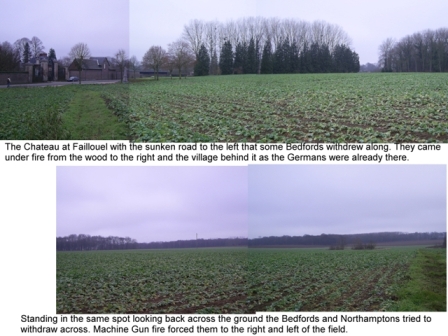
This news was the proverbial final straw and HQ ordered the entire Brigade to withdraw to a wooded ridge east of Faillouel. The Bedfords covered the Northampton's withdrawal then tried to extricate themselves from the enveloping movement of the German Stormtroopers. Those men on the left flank had to cover 800 yards of open, flat ground as the Germans fired at them over open sights whilst swarming across the two bridges that had cost them so dearly.
The orders did not reach the Fusiliers to the north who were in dire trouble. Gradually they were overwhelmed by the sheer force of numbers coming across the canal at Jussy and, by the time they decided to retire without orders, it was far too late. German machine guns had been set up on the edges of several woods en-route to Faillouel, cutting them down in swathes. Groups of helpless survivors without ammunition surrendered as they realised the situation was hopeless.
By 1pm, the remains of the Brigade were in position on the ridge and fought the advancing Germans to a standstill again, but news reached them that the Germans were in Faillouel to their rear in considerable force, and orders to withdraw again soon followed.
On their arrival at the village, they came under machine gun and rifle fire as truck loads of enemy were dismounting in the village centre. Desperate hand to hand fighting took place as the Bedfords fought their way out of encirclement and through the village. The Northamptons altered course and passed the village to the north, rendezvousing with the Bedfords on the ridge to the west of the village by 4pm. Both battalions now resembled nothing more than under strength companies but still formed another line and fought the marauding enemy to a standstill again.
To the south, the details of the Battalions that had been left out of the front line (as was the practice) were heavily engaged at Rouez Camp, with cooks, saddlers, engineers and any available non-combatants being hastily organized into defensive lines to hold back the advancing German masses. Amongst the many stories from Rouez is the one of Lt Richardson, who organized an impromptu counter attack with three sections of engineers. His attack drove the surprised Germans back so far that the engineers were forced to fight their way back as they had gone perilously deep into German positions and were almost surrounded and captured.
The Bedfords on the ridge at Failleouel had been pummelled by enemy artillery constantly all day, but when French artillery mistook them for Germans and opened up on them at 5.30pm, they decided that was quite enough and withdrew, still in good order. They were very pleased to meet a screen of Frenchmen near Villiquers-Aumont and passed through to the rear and on to Caillouel as ordered. By nightfall, the Northampton's and Bedfords could only muster 200 men each but the Fusiliers were shattered, with just 2 Officers and 26 Other Ranks left. Stragglers from many other units in the coming days were added to the ranks and the Brigade was reformed to enable it to make a stand the following day.
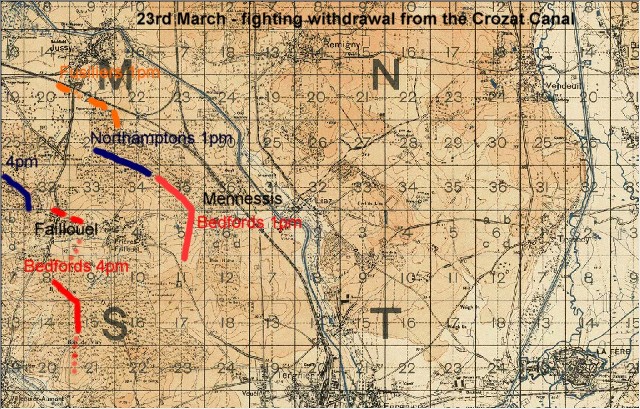
Caillouel to Crepigny; 24th March 1918
By the morning all "Battle surplus" collected at Caillouel were folded into the Fusiliers, leaving all three battalions with around 180 men, which were organized into three tiny companies per battalion.
The Brigade took up position in the wood north of Caillouel at 10am on the 24th, having refitted and reorganised themselves as well as they could. The Bedfords held the left and the Northamptons were positioned on the right with the composite Fusiliers Battalion being kept in support. The Bedford's B and D Companies held the forward positions with A in reserve. All Germans attacks that day were small and failed to dislodge the exhausted Bedfords but the French were falling back in disarray to their right, leaving their flank exposed once more. Patrols were sent out to establish where the enemy were and at 9pm one Officer took five men out but found no-one whatsoever. After two and a half miles, he retired, having unwittingly penetrated the German lines and found his way well into their rear areas.
Due to the enveloping nature of the German assaults that day and the subsequent salient they held, Brigade ordered the retirement to Crepigny at 3am on the 25th and the Battalion slipped away under cover of darkness.
Backs against the River Oise; 25th March 1918
The weight of fighting developed to their north on the 25th and the Bedfords found themselves facing no-one, but with everything going on at a great pace to their north. By 10am on the 25th their left flank was again exposed as the French around them retired so another retirement was ordered, back to Mont Du Grandu further south and away from the British Fifth Army. The Germans were still two miles to their rear, so the Brigade, along with the battered remnants of the 18th Division had no choice but to fight alongside the French. Midday saw them in a strong position but, once again, French artillery and machine guns opened fire on them, thinking they were Germans, forcing them to retire to high ground west of Grandu.
Movement that day was confused and fraught with hostile fire from all directions. German units were intent on flanking the Brigade once they realized there was an intact British unit in the area yet the men formed up into artillery formation and moved to fresh positions time and time again.
More orders were received at 3pm to move to Varesnes on the south bank of the River Oise but whilst en-route they were countermanded with surprise orders to counter attack and retake a village called Babouef. Therefore, the war worn Brigade who had been fighting and marching for four punishing days solid were about faced and moved off to the attack with an enthusiasm that is nothing short of incredible. By rights, the Brigade should have been incapable of the action yet those quoted as being there remark that it was the most memorable event of the entire rearguard action.
At 5pm, with the Fusiliers on the right, the Bedfords on the left and the Northamptons in reserve, the Brigade formed up with the Babouef to Compeigne road on their right and the southern edge of the woods above Babouef to their left.
The Germans had not expected a British counter attack, thinking there was nothing but ragged French units in their area, so were surprised at the arrival of 3 very small but determined British battalions. They put little fight up and many Germans fell in the hand to hand fighting that lasted for around 20 minutes before the village was secured and the remaining enemy - that could get away - fled. Ten machine guns and 230 German prisoners were taken with very light casualties recorded by the Brigade; an incredible feat whatever way you view it.
They dug in on the German side of the village amongst the cornfields and settled in for the night. Cooking limbers were even brought up and the idea of a quiet night gave the exhausted men a welcomed break from the extreme stress they had all been through in the past five days. Unfortunately, their rest did not last long.
Retirement to Amiens; 26th March to 2nd April 1918.
At 2am on the 26th, Germans were reported in nearby Noyon, meaning the left flank was once again exposed. The Brigade moved out again and withdrew across the canal at Varesnes and the rearguard held the crossings and watched as French and British stragglers filed across under their protection. Other than letting them know they were there, the Germans made no serious attempt to interfere with the retirement and the Bedfords themselves withdrew across the river unmolested at 3pm.
That night, following another 8 mile march, they billeted in filthy, litter strewn caves near Mesnil and called the roll-call. Fewer than 200 Bedfords were left, including those from other units they had picked up over the last few days. Over 350 men of the 7th Battalion had been killed, wounded or were missing and all bar five of those who fell in the first desperate phase of the battle have no known grave.
Until the 2nd April, the Bedfords contented themselves with orders and counter orders, marching many miles but not being involved in any serious engagements. They reorganised themselves completely and rested the men as much as they could, knowing full well that it was not likely to be over yet.
By the 1st April, they found themselves around Amiens, just west of Albert which had fallen to the Germans. Until their involvement in the defence of Amiens from the 2nd April, the worn survivors were moved, rested and refitted until they found themselves in the company of their British colleagues once again, having been under French command for the past week. The German Army had thrown almost their last roll of the dice but the thin Khaki line, despite buckling badly, had not been broken.
The photographs below cover the ground as it is today and were taken by myself. You are welcome to use them for personal reasons but please ask for permission and reference them to me in the event of any public use. Larger, more detailed photo's are available on request. There is no indication that a major engagement was ever fought there and no mention of the Victoria Cross being won on the spot we stood to take the photographs.
Sources
- War Diaries of the 7th Bedfords, 6th Northamptons and 11th Royal Fusiliers
- 54th Brigade History
- 18th Division history
- Official Histories
- "See how they ran" by William Moore
- Newspaper archives
- Trench Maps from the National Archives
- Original photographs taken by myself January 2006
Site built by Steven Fuller, 2003 to 2023