The Bedfordshire Regiment in the Great War

Officers' Photographs and Biographies from the 1st Battalion (1)
Charles Richard Jebb GRIFFITH, CB, CMG, DSO
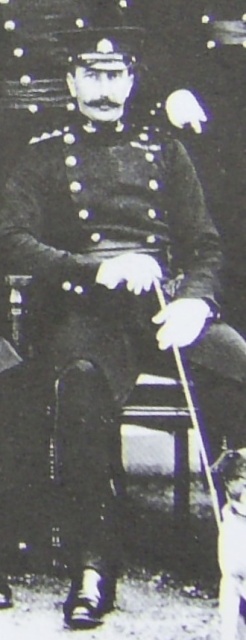 Charles
Richard Jebb Griffith was born 4 October 1867 at Castlerea, Ireland, the
son of Colonel Richard and Frances Griffith. His parents were both born
in Ireland, his father rising to a post on the Indian Army Staff Corps
as a Colonel.
Charles
Richard Jebb Griffith was born 4 October 1867 at Castlerea, Ireland, the
son of Colonel Richard and Frances Griffith. His parents were both born
in Ireland, his father rising to a post on the Indian Army Staff Corps
as a Colonel.
After education at Clifton College, Oundle, he entered the Royal Military College at Sandhurst as a Gentleman Cadet, and was commissioned as a Second Lieutenant in the Bedfordshire Regiment 14 September 1887. Spending his early career in the 2nd Battalion, Charles earned his Lieutenancy on 10 April 1889, became a Captain 3 June 1895, in addition to serving as the Adjutant between 16 December 1895 and 5 December 1902.
Captain Griffith fought in the South African Wars, specifically during the Orange River operations, the action at Wittebergen, the Cape Colony operations, and at Colesberg. He was mentioned in despatches 10 September 1901, and awarded the D.S.O. (gazetted 27 September 1901) in addition to his campaign medals with two clasps.
On 2 April 1906 Charles was promoted to Major and sailed back to England from South Africa on 14 July 1913, becoming Lieutenant-Colonel of the 1st Battalion on 16 October 1913. He took the battalion to the Western Front in August 1914, landing in the first wave of the original British Expeditionary Force and fighting in every single early engagement from Mons onwards.
After a remarkably charmed life, despite quite literally leading his battalion from the front, Lieutenant-Colonel Griffith became Brigadier of the 108th Infantry Brigade in the 36th (Ulster) Division from 4 December 1915, who had arrived in France that October. He led them during the opening day of the infamous Battle of the Somme, when the division conducted a valiant but costly assault against the Schwaben Redoubt and surrounds. Losing over 5,000 men that day, they were one of the few to secure both their objectives and a name for themselves before being withdrawn and rebuilt on 2 July.
After the Somme campaign of 1916, he led the brigade through the battles of Arras and Third Ypres in 1917.
During the "Operation Michael" phase of the German 1918 Spring Offensives, the 36th Division were part of XVIII Corps within the Brtish Fifth Army so suffered enormous casualties during the first week of battle, effectively ceasing to exist by 28th March 1918. During the fighting, Brigadier-General Griffith saw hardly any sleep along with his men and was wounded late on 26th March when the Brigade Headquarters was overrun by German troops after dark although he managed to fight his way out and reported the breakthrough to the 30th Division who were nearby. His wound did not stop him from carrying on and he continued commanding what remained of his brigade for a further 7 weeks.
The 36th (Ulster) Division came in for some harsh criticism following their heavy engagement in the 1918 German Spring Offensives. Accusations of poorly built or non-existent defensive positions, poor morale and poor leadership were levelled at them, although it is unclear with hindsight whether they could have done more given the circumstances they found themselves facing from early 1918 and the overall nature of the battle, or whether they were simply among the long list of Fifth Army scapegoats blamed for the losses sustained. Nevertheless, to put their involvement into a context, after 7 days of fighting the 108th Brigade war diary records that on 28 March 1918, their strength was "14 Officers [and] 321 Other Ranks, mostly transport and employed men", from a starting strength of 3,526.
During the fall out, the Fifth Army - who had borne the brunt of the onslaught - were evaluted with a very heavy hand from the top down. Within the Ulster Division, the division's 107th Brigade commander was relieved on 30 April, with the divisional G.O.C. following suit on 6 May.
Brigadier Griffith was posted for a "6 months tour of home duty" on 21 May 1918 according to the Brigade War Diary. He was posted to command the 20th Training Reserve Brigade in the UK, later renamed to the 1st Training Brigade of the Machine Gun Corps, who trained recruits for the Machine Gun Corps. Whether this was linked to the criticism levelled at the division, or as a result of his wound, war fatigue or similar, is not recorded. Whatever the real reason, given that he had served continuously on the front lines since the opening shots at Mons in August 1914, the rest was well earned.
By the time his 6 month tour was up the Armistice had been signed so there was no further need for operational duties and a War Office posting onto the Standing Committee of Enquiry into Prisoners of War followed from 1 January to 1 November 1919, after which the 52 year old Colonel (Hon. Brigadier-General) Griffith with 32 years of service behind him was placed on the retired pay list.
By the end of his Great War service, Brigadier-General Griffith had been mentioned in despatches eight times, had been created a C.M.G. in 1915, a C.B. in 1918 and was awarded the French Légion d'honneur. He was also awarded the Silver War Badge, so did not come through the war entirely unscathed,.
Brigadier Griffith moved to his family home, Snowden in Shanklin on the Isle of Wight, where he lived until his death in 1948. He was a Trustee of, and actively involved in the organisation of the regimental memorial in Kemptson and within the regimental association itself, but otherwise does not appear to have been involved in any high profile, public duties from this point onwards. As his service record does not appear to be held by the National Archives, I am unable to add further information from his time in retirement.
Charles died 4 August 1948 at the Cottage Hospital in Shanklin on the Isle of Wight, aged 80 - 34 years to the day after the British Empire joined the Great War and just two months before the 2nd Bedfs & Hertfs were disbanded and merged into the 1st Battalion.
He is shown above in 1904, part of the 2nd Battalion officer group photograph on page 388 of the 'regimental history' [The History Committee, the Royal Anglian Regiment (Bedfordshire and Hertfordshire): Lieutenant Colonel T. J. Barrow, DSO, Major V.A. French and J. Seabrook Esq. (1986), The Story of the Bedfordshire and Hertfordshire Regiment (The 16th Regiment of Foot). Volume II. 1914 to 1958]
Benjamin was born in Cork on 3 February 1865, the son of Thomas and Anne Roche (nee Mayne).
He was promoted to Lieutenant in the 9th Battalion of the King's Royal Rifle Corps on 1 August 1883 and transferred into the Bedfordshire Regiment 28 April 1886. After service during the Isazi Expedition in 1892, promotion to Captain came on 9 August 1894 and Major from 22 July 1906. On the 1911 census Major Roche was living in Aldershot and was married to Emma Blanche Roche (nee Jones) from Oxford, the couple having been married less than a year when the census was taken.
During the Great War, Major Roche joined the 1st Battalion in the field on 2 December 1914 and is recorded as rejoining on 3 May 1915, although what removed him from the battalion is not included. Two months later he was in hospital suffering with a fever but returned and commanded the 1st Battalion between 6 December 1915 and 1 February 1916.
Lieutenant Colonel Roche returned to England in February 1916 to command reserve battalion of the Duke of Cambridge's Own (Middlesex) Regiment, later commanding the 6th (Reserve) Battalion of the Worcestershire Regiments, before servcing as the Lieutenant Colonel of the 5th (Reserve) Battalion from 4 December 1918.
In September 1919, Lieutenant Colonel Roche retired and died in Chelsea in 1939, aged 74.
His service record does not appear to be held by the National Archives, so he may have served beyond the end of the war, with his record still being in the hands of the Ministry of Defence.
Cranley Charlton ONSLOW, CMG, CBE, DSO
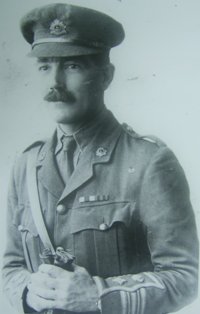 Cranley
Onslow was born in 1869, the son of Hamilton Cranley Onslow (born 1836)
and Henrietta Fanny Onslow (nee Musgrove).
Cranley
Onslow was born in 1869, the son of Hamilton Cranley Onslow (born 1836)
and Henrietta Fanny Onslow (nee Musgrove).
He attended Dover College before joining the Royal Military College at Sandhurst in 1889, passing out and becoming a Second Lieutenant in the Bedfordshire Regiment on the 8th November 1889. On the 11th August 1891 Cranley was promoted to full Lieutenant and served in the Isaza Expedition in 1892 and at Chitral on the Northwest Frontier, where the 1st Battalion stormed the Malakand Pass in 1895.
In 1904 Cranley married Sydney Alice Hastings Franklin and they had the following children - Cranley Cedric Franklin Onslow (born and died in 1906), Denzil Richard Cranley Onslow (1909 to 1963), Geoffrey Harold Onslow (1912 to 1940), Doreen May Onslow (died 1982), Margaret Vivien Onslow, Jocelyn Anne Sydney Onslow.
Captain Onslow became a Major from the 8th June 1910 and was with the Depot when orders arrived on the 2nd August 1914 that returned him to the battalion in Ireland. He mobilised with the 1st battalion, sailed with them to France, fought at the battles of Mons, Le Cateau and the Marne in 1914, picking up a few bullet grazes along the way but nothing serious. However, he was wounded in the thigh by a German sniper on the 15th September 1914 during the battle of the Aisne. Four days later he left St Nazaire on the hospital ship SS Carisbrooke Castle for England at midnight and, following brief treatment at Netley hospital, his wife and friend collected him and returned him home to recover from his wound.
On the 12th January 1915, Major Onslow was back in France, joining the 2nd battalion as their temporary commanding officer. He led them at the Battle of Neuve Chapelle in March 1915 before standing down as CO on the 20th March. Major Onslow was awarded the DSO in addition to the CMG in the 1915 King's birthday honours list for his handling of the battalion and led the battalion again from May 1915, through the battle of Festubert in May and the second action at Givenchy in June.
He was commanding the battalion during the Battle of Loos when he was wounded again and removed from the front lines. Cranley returned to them on the 24th January 1916, becoming the Commanding Officer a day later. However, within a week he was moved to command the 1st battalion, joining them on the 1st February 1916. Promotion to full Lieutenant-Colonel came on the 17th February 1916 and he temporarily commanded the 15th Brigade in March and June 1916, before moving to command the 57th Brigade from the 14th June. On the 31st August 1916 he was gazetted a Temporary Brigadier General and led the 7th Brigade during the Battle of Messines in 1917.
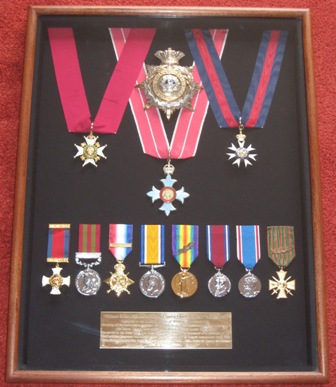
In addition to his campaign medals, the Distinguished Service Order and his C.M.G., Brigadier-General Onslow also won the Croix de Guerre and was mentioned in despatches three times during the Great War. In December 1922 Colonel Onslow was awarded the CB whilst in command of the Staffordshire Infantry Brigade and was on the Dover Town Council in 1926.
Cranley Charlton Onslow died at home (Henry VIII Gateway, Windsor Castle) on the 17th December 1940.
A few months earlier had also seen another family tragedy. Cranley's second surviving son, Geoffrey Harold Onslow (number 67120), was a temporary Captain in the 2nd battalion of the Bedfordshire and Hertfordshire Regiment. He was with the battalion during the 'Phoney War' and fought in the retreat to Dunkirk in 1940 when he died in action on 1st June 1940. Whilst bringing up the rear of his Company that day, he was badly wounded in the head by shrapnel and moved to the beach from which the army were being evacuated. Sadly, he was hit again by a strafing German aircraft whilst being tended by medics and killed instantly. Captain Onslow was 28 years old and is buried at the De Panne Communal Cemetery in Belgium.
The Imperial War Museum hold Cranley's short, hand written memoirs under reference 4717 (86/9/1) and a photograph of him. They cover the period from early August to the 19th of September 1914 and make for interesting reading.
As a lovely additional touch to his story, his grandaughter - Jane Dobner - got in touch in 2010 and kindly offered a photograph of his medals which make for an impressive display from a man with a career in the British Army behind him.
 Walter
was born in Paddington around 25 October 1875, the son of Alfred (a Marine
Officer) and Elizabeth Allason of Middlesex. By the time of the 1891 census,
Walter was a scholar at Bourne Hill School and was reading for the Army
Exam.
Walter
was born in Paddington around 25 October 1875, the son of Alfred (a Marine
Officer) and Elizabeth Allason of Middlesex. By the time of the 1891 census,
Walter was a scholar at Bourne Hill School and was reading for the Army
Exam.
He passed out of RMC Sandhurst as a Gentleman Cadet and was commissioned as a Second Lieutenant in the 4th (Reserve) Manchesters on 23 July 1894, gaining his Lieutenancy two years later.
Walter was transferred into the Bedfordshire Regiment on 9 December 1896, initially dropping to the rank of a Second Lieutenant, but returning to full Lieutenant on 1 July 1898.
He was a strong swimmer who won the 'plunging championships of England' in the 1896 and 1897 seasons, in addition to 1902, 1908, 1909 and 1922 championships.
Lieutenant Allason served in the South African Wars and on 22 January 1902, was seconded for service in the Foreign Office.
On 18 August 1908, the then Captain Allason married Katharine Hamilton Poland of Clapham.
Promotion to Major came on 16 October 1913 and he was second in command of the 1st Battalion when they were posted to France on 16 August 1914.
Walter served with the battalion through the early battles and won the Distinguished Service Order during the 1914 campaign. After recovering from his first wound, Walter was again wounded on Hill 60 in April 1915. After recovering again, he was posted to command the 8th Bedfordshires, but rejoined the 1st Battalion during the Somme battles of 1916.
A Bar to his DSO was won during the Somme offensives, probably during the battalion's assault on Falfemont Farm in September, the citation reading:
Maj. (temp. Lt.-Col.) Walter Allason, D.S.O., Bedf. R. For conspicuous gallantry in action. He executed an attack with the greatest initiative and resource, thereby enabling a strong enemy position to be captured. He handled his battalion with great skill throughout the operations.
Lieutenant Colonel Allason recieved his third wound under unusual circumstances in December 1916. While touring his front line trenches in the dark with his Adjutant, Lieutenant Colonel Allason was accidentally shot by a young, nervous Subaltern, whose section had been put on a high state of alert following several hostile raids over the previous days.
The bullet wound was not fatal, but was enough to see him removed from duty; although he returned to command the 1st Battalion after the war, that was the last his men would see of him for some years.
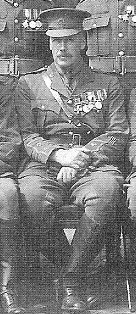
His photograph shows him with his Sergeants in August 1922, sporting o less than four wound stripes.
Walter was promoted to Brigadier General, and was later placed on the retired list on 25 October 1925, when he reached the compulsory age limit for officers of 50 years old.
In 1940, his book 'Military mapping and reports' was published and made it to a sixth edition by the time of his death.
Brigadier General Walter Allason died in London, January 1960, aged 84. His service record is not apparent at the National Archives, with his Long Service Number suggesting it is still under the care of the Ministry of Defence.
Percy Reginald WORRALL, CBE, DSO, MC
Percy Worrall was born in Whalley Range, Manchester on 2 May 1880, the third of seven sons of William Houlton Worrall (a paper mill owner) and Mary Worrall.
After education at Haileybury College (1893-1898) and Keeble College Oxford (1899-1901), Percy was commissioned as an officer into the Devonshire Regiment on 4 December 1901.
Service in the South African Wars was rewarded with the Queens South Africa Medal with 4 clasps and on 24 August 1907 Percy was seconded for duties in the Colonial Office. On 10 April 1909 he was appointed the Adjutant and Temporary Captain of the 6th Devonshires (TF) and he married Agnes Margaret Mostyn (daughter of Pyers Mostyn, 9th Baronet) on 3 October 1911.
By the time war broke out, Percy was a Captain and landed in France with the 1st Devonshires 21 August 1914. He appears to have been wounded during the 1914 fighting, and later served on Gallipoli (1915).
On 4 December 1916 he gained promotion to Major from a post of Brigade Major (GSO2) on the General Staff. Acting Lieutenant Colonel Worrall commanded the 1st Bedfordshires between 1 April 1917 and 5 February 1918, at which point he moved to command of the 1st Devonshires, where he appears to have served the rest of the war.
In 1919, Percy wrote the 'Smoke Tactics' book, having lectured on the subject several times during his war service and from 1929 served as the commanding officer of the King's Own Malta Regiment. While in Malta, he also took the voluntary post of the island's Commissioner for Boy Scouts, promoting both the regiment's resurrection and the Boy Scout movement tirelessly.
1934 saw him awarded the CBE in recognition of his efforts raising the Maltese Boy Scouts movement from a few hundred to over 3,000, retiring from military life two years later.
In spite of recurring ill health from his retirement, when the Second World War broke out, Percy took command of the Aldernay garrison of the Channel Islands until it was evacuated in June 1940.
Aged just 70, Colonel Worrall died after a short illness in the Warneford Hospital, Leamington, on 29 November 1950. He lies in St. Josephs (Roman Catholic) churchyard, Avon Dassett, his funeral being attended by an array of Colonels bearing the name Worrall, presumably his brothers and other relatives.
There does not appear to be a service record at the National Archives, so it is presumably still in the care of the MOD.
Edward Ivan de Sausmarez THORPE, CMG, DSO
Edward was born around 1872 in Madras, India and after training at RMC Sandhurst, on 20 February 1892 he was commissioned into the Bedfordshire Regiment as a Second Lieutenant.
Recorded as being a Lieutenant in the 2nd Bedfordshires, he married Mary Elizabeth Want in November 1896 and the same month Edward was seconded for 'special extra regimental employment'. As he served in the Niger Expedition of 1897, it appears this was related to his attachment.
Their daughter, Beryl, was born in 1899, in Punjab India, so he would presumably have transferred into the 1st Bedfordshires by then.
Two years later, Edward and his family were recorded as living in Kensington and by the time of the next census (1911) he was a Captain in the Regular Army (1st Bedfordshires), and living in Hertford.
On 21 September 1912, Edward was promoted to Major and was in command of B Company, 1st Bedfordshires, when war was declared.
He landed with his battalion in France 16 August 1914, fought during the early battles of the war and became a Brevet Lieutenant Colonel in February 1915, although in which unit is unclear. Local papers reported him leaving the 3rd Bedfordshires for the front in the late winter; Major Thorpe joined the 2nd Bedfordshires in April 1915, commanding B Company through the Battle of Festubert the following month.
A promotion to command the 2nd Borders came in May 1915, although promotion to substantive Lieutenant Colonel waited until 16 October 1917.
Two months later he rejoined the 2nd Bedfordshires, having previously commanded the 1st/6th Lancashire Fusiliers, moving to assume command of the 1st Bedfordshires in January 1918.
Three months later Lieutenant Colonel Thorpe assumed command of the 197th (Ulster) Brigade within the 36th (Ulster) Division and was wounded during the allied offensives of the late summer.
What happened in the interim is unclear, but Edward died on 16 January 1942, at 49 Castle Street, Kirkcudbright in Scotland.
There does not appear to be a service record with the National Archives, so it is presumably still held by the MOD.
Montague was born in Kensington Gardens, Middlesex, on 1 February 1891, the son of Augustus and Ada Halford. By 1901 his mother had died although his family lived comfortably in Holland Park, Kensington, along with their seven domestic servants.
Montague enlisted as an officer cadet and was posted to the Gloucestershire Regiment. When war broke out, he landed with the 1st Gloucestershires on 16 August 1914 and did not join the 1st Bedfordshires until September 1916.
Serving as the battalion's Adjutant and second in command, Major Halford ran the battalion temporarily on several occasions between 1916 and 1918, finally becoming the Lieutenant Colonel from 16 April to 18 June 1918.
Although there does not appear to be any trace of a service record at the National Archives, and it appears that his documents are still with the MOD, it seems that Lieutenant Colonel Halford went on to an attachment to the Hampshire Regiment and later served in the Indian army, although where, when and why is unknown.
Montague married Jean Pirrie (1906 to 1958) in Marylebone in 1934 and his death was registered in the Falmouth district, 1955.
Charles Edward Gowran SHEARMAN, CBE, DSO, MC
Charles was born in 1889 and was educated at Westminster School, London.
He was commissioned as a Second Lieutenant in the Bedfordshire Regt in 1909. Two years later he became a Lieutenant and was a Captain in 1914.
Lieutenant Shearman landed in France with the 1st Bedfordshires on 16 August 1914, being the battalion Scout Officer and among C Company's officers. He fought during the Battle of Mons and, following an eventful night's scouting after the opening day of battle, was responsible for identifying and plugging a dangerous gap in the British lines by breaking into the local train station and convincing a French telephone operator to put him through to his commanders some miles away. During the following day's fighting, as the battalion provided the rearguard behind which the bulk of the British army could escape, he was wounded in the wrist. Ignoring it and continuing fighting with a discarded rifle, he was soon wounded in the shoulder during the intense fire fight.
An extract from 1st Bedfordshires. Part One; Mons to the Somme reads how "Private Arthur Chandler from Spaldwick, wrote home that Shearman 'was as cool an officer as you could find. He was first wounded in the wrist. He bound it up and then went into the firing line again with a wounded fellow's rifle and had another go at them until he got wounded in the shoulder. He then had to come out of it and he said to us "I'm finished fighting boys; do your best and good luck to you. Rub it up the Germans well."'
Although finished with the front line for some months, he was presented with the new decoration, the Military Cross, on the first list of recipients and was the first regimental officer to receive the award.
Stints in the 2nd Bedfordshires and Staff Officer postings followed, including GSO III and Brigade Major, before Charles rejoined the 1st Bedfordshires as their commanding officer on 14 October 1918, having added a DSO to his medal collection. Nine days later, in what would be their penultimate assault of the war, Charles was wounded again as he organised a fresh attack one the main movements had ground to a halt.
After recovering, a posting as Staff Captain in the Irish Command followed (1920-21), in addition to a tour with the Eastern Command (1922-24). He attended Staff College at Camberley in 1926 and spent time in RAF Operations at Aldershot (1928-30), including in Hing King and Shanghai. Once a tour in the Western Command was complete, he became the Lieutenant Colonel of the 1st Battalion, Bedfordshire and Hertfordshire Regiment (1933-37), serving in India and North Africa, thereafter being promoted to Assistant Quartermaster General of the Northern Command until World War Two broke out. During his second war, Charles served in Kenya (1940-42) and retired from military service in 1945, his duty well and truly done.
Brigadier Shearman died in 1968, aged 79.
Joseph Afford, M.C., D.C.M. Private, later WOII 8939, 2nd and 1st Battalions the Bedfordshire regiment Lieutenant, later Temporary Captain, Yorkshire Regiment
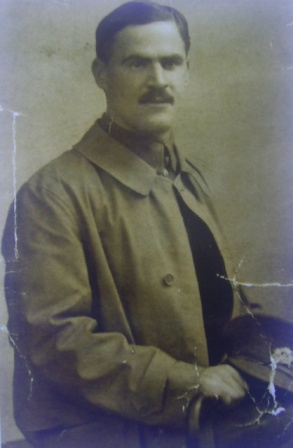 Joe
was born in Offord D'Arcy in Huntingdonshire on 18 April 1888, the son
of Charles and Jane Afford.
Joe
was born in Offord D'Arcy in Huntingdonshire on 18 April 1888, the son
of Charles and Jane Afford.
The 18 year old Labourer enlisted into the Bedfordshire Regiment on the 18th February 1907 having served in the of the 4th Volunteer (Huntingdonshire) Company of the Bedfords beforehand. After training he was posted to Gibraltar as Private 8939 and served there between August 1907 and January 1910, after which time he went to Bermuda until January 1912. Whilst in the Caribbean Joe was reprimanded for falling asleep on another Privates bed and caught selling Ration biscuits without permission! Joe and the battalion moved to South Africa in January 1912 and were there until September 1914 when they were recalled to fight in the European war. Whilst there, the army found Joe gambling twice and he was busted down from Corporal to Private!
Private Afford set foot in France on the 6th October 1914 as part of the 2nd battalion and fought in the fast and furious First Battle of Ypres. After a week of constant fighting, on the 26th October the battalion supported the Guards' attack on Becelaere, east of Polygon Wood. Both the Guards and the Bedfords were held to within 50 yards of their trenches by intense rifle and MG fire which stalled the attack immediately. Joe was one of dozens of men who were missing that day but turned up several days later at No.5 CCS with a gunshot wound to his foot. He spent six months recovering and being retrained until arriving back in France on the 13th May 1915, to continue his service with the 1st battalion.
Joe served with the battalion in the defence of Hill 60 near Ypres and helped to hold the position despite German mining, raids and the constant, unwanted attentions of enemy snipers. At the end of July Joe was a Lance Corporal and the battalion were moved from the front line as the New Army started to arrive in force. They found themselves in a new stretch of the line in the region called the Somme, where they would remain until February 1916. Other than the deadly usual routines of raiding, patrols, barrages and sniping Joe and the battalion settled into a 'relatively peaceful' spell of trench warfare and Joe was promoted to Corporal in December 1915. February 1916 saw a move to the Arras sector and several mines and localised attacks kept them on their toes. They remained near Arras until moved back to near Albert on the Somme again in June, at which time Joe became a Sergeant.
Joe and his comrades were spared the carnage of the early phases of the Battle of the Somme and were committed to their first frontal assault against Longueval on the 27th July. In a brutal but determined assault with a horrific barrage raining down on them throughout, the battalion took the village at a cost of over 300 Officers and men, a third of whom were killed outright. During the chaos Joe's Company Commander was wounded so he carried him back to the Regimental Aid post, through the intense artillery and MG fire. Joe himself was shocked through being buried by the shell fire but carried on. Once his Officer was safe, he rushed back to the lines and resumed command of the remnants of the Company as all their Officers were down. Sending messages back constantly and organising the survivors, Joe helped considerably in holding their hard won positions. That night the battalion were relieved but called back later the next day to help repel the stream of German counter attacks that fell on the village and Delville Wood. Two more long days of intense fighting followed, costing the battalion a further 200 casualties. On their relief and unknown to the battalion, small pockets of men remained in the village, clinging to their posts for two more days, such was the determination of the battalion to hold their ground.
Joe won a well earned D.C.M. for his actions at Longueval and was promoted to Company Sergeant Major at the end of July and then to WOII on the 11th September 1916. His DCM citation in the London Gazette, dated 22nd September 1916 reads:
"8939 Sjt. J. Afford, Bedf. R. For conspicuous gallantry during operations. When his Company Commander was brought in wounded, he carried him back under heavy shell and machine gun fire. Believing that all his company officers had become casualties he took charge, and sent in a good report of the situation though suffering from shock, after being wounded and buried."
Joe was wounded again at Morval in September 1916 and earned an additional 'Mention in Despatches' for his conduct there.
C.S.M. Afford was granted a Commission for service in the field on the 3rd February 1917 and went on to serve as an Officer in the Yorkshire regiment. His promotion was recorded in the London Gazette's 6th March 1917 issue: "York. R. - Co. Serjt.-Maj. Joseph Afford, from Bedf. R. 3rd Feb. 1917."
Between July and September 1917 Joe fought in the Third Battle of Ypres, including operations at the White House that August, which saw him rise to Temporary Captain, and in October 1917 he was awarded the Military Cross to go with his D.C.M. His Military cross citation in the London Gazette, dated 7th March 1918 reads: "Lt. (A./Capt. Joseph Afford, York. R. For conspicuous gallantry and devotion to duty in successfully carrying out their task -allotted to his company of capturing a house under heavy fire."
On the 1st December 1917 Joe was granted a Permanent Commission in the 6th Yorkshires, where he served the remainder of the war out.
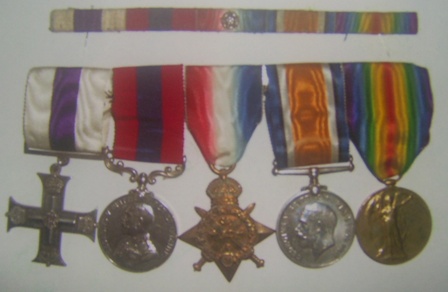
During his eventful service, Joe Afford was Mentioned in Despatches three times, commissioned, won the Military Cross, Distinguished Conduct Medal, and was also issued with the 1914 Star (with Clasp and Roses), plus the Victory and British War Medals.
Amongst his fellow Officers in the Bedfords and later the Yorkshire's, he was known as 'Joe Afford of Offord' and was also specifically and personally congratulated by one of his Generals whilst serving. Joe would have known RSM Bartlett too, who was killed at Morval, when Joe himself was wounded.
After the war Joe had 3 sons, the eldest of which was born in 1926 and died in 2011. It appears that after 1918 Joe, as many of his comrades, struggled coming to terms with life, having seen and done so much during the war years. Joe and his wife Constance parted company and the boys, although having fairly regular contact with their father, did not know all that much about him. When the second war broke out Joe appears to have still been in the Reserve of Officers and served as Captain 139285 when the 12th Battalion of the Green Howard's were formed in 1940, until they were amalgamated as the 161st Reconnaisance Regiment, the Green Howards, Royal Armoured Corps.
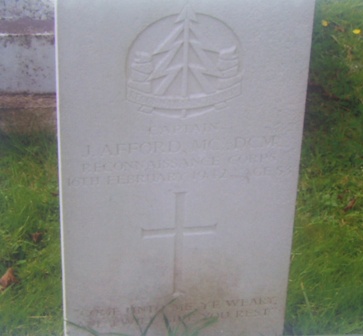
Following what can only be described as an eventful an eventful life, Joe Afford, M.C., D.C.M. died in Edinburgh Castle on the 16th February 1942, aged just 53. He is buried in Graveley Road, near St. Peters Church in Offord D'Arcy and St. Peters Church in Offord D'Arcy inaccurately lists Joe as killed in the Great War.
Some interesting, additional family information:
Joe was one of 7 sons of Charles Afford of Offord D'Arcy Hunts., 5 of which served in the Colours. Joe was not the only brother to win the coveted D.C.M. with the four other Afford servicemen being:
Ebenezer Afford was in the Police Force in August 1914 near Warboys as well as a Coldstream Guards Reservist. He rejoined the Guards and fought as Private 582 in the early battles, quickly gaining promotion to Quarter Master Sergeant. He served throughout the war, including as an Instructor for the Canadian Officers' training School in France to help train the newly arrived men.
William Hine Afford, D.C.M. was also a Policeman before the war in the Northamptonshire Borough Force. He joined up when war was declared as Private 20048 and quickly rose to C.S.M. in the Northamptonshire regiment. On the 31st July 1916 he won the D.C.M. Although all his Officers were down he took command of the Company and refused to give an inch of ground despite being overwhelmed by the enemy.
Edward William Afford was born around May 1880 in Offord Cluny, Hunts. He served in the South African wars and later in India before the Great War broke out. Having gained the rank of Sergeant he was invalided out of the army as a result of wounds received.
Ernest Afford was born around 1883 and ran a business in Shrewsbury before the war. He enlisted and served as Gunner 362842 in the Royal Garrison Artillery.
[With thanks to, and in memory of Joe's grandson Phillip Afford, with whom I produced the fascinating service summary, but who died in 2010]
Site built by Steven Fuller, 2003 to 2023