The Bedfordshire Regiment in the Great War

'Other Ranks' Photographs and Biographies from the 1st Battalion (1)
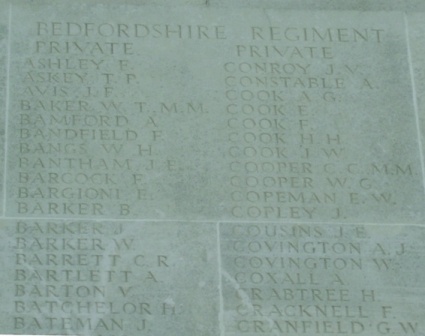
Acting R.S.M. and W.O. Class II, 5710 William Franklin BARTLETT
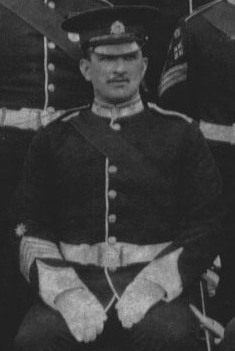 William's
Grandson, Chris Barrett, was kind enough to share these lovely photo's
with me of one of the battalion's key NCO's from the war who anyone passing
through the battalion at the time would certainly have known of, if not
come across in person.
William's
Grandson, Chris Barrett, was kind enough to share these lovely photo's
with me of one of the battalion's key NCO's from the war who anyone passing
through the battalion at the time would certainly have known of, if not
come across in person.
William Franklin Bartlett was born in Lambeth, enlisted into the Bedfordshire Regiment from London and was a resident of Kennington in Surrey when the Great War broke out in August 1914. He is another superb example of an 'Old Contemptible' who managed to survive until mid way through the war, despite the odds against it.
R.S.M. 5710 Bartlett was serving in the 1st Battalion in Ireland on the 4th August when war was declared and landed with them in France on the 16th August 1914. He fought in the early engagements of the war (Mons, Le Cateau, the Marne, the Aisne, La Bassee and the First Ypres) before winter set in and put a halt to proceedings. Having survived those battles as well as the desperate defence of Hill 60 and Ypres in the spring of 1915, William was in the thick of things again on the Somme in 1916.
R.S.M. Bartlett survived the Longueval assault of July 1916, the Battle of Guillemont early September and the Battle of Flers-Courcelette in the middle of the month until finally killed during the Battle of Morval at the end of the month. During the battles from which William survived, the battalion suffered almost 800 casualties yet still managed to secure their objectives and once again prove themselves to be a formidable unit when handed a tough nut to crack.
RSM William Bartlett was killed in action in the 1st Battalion on the 25th September 1916. His body was not recovered, or was lost in the fighting that continued in the area, and he has no known grave but is remembered on the Thiepval Memorial to the missing.
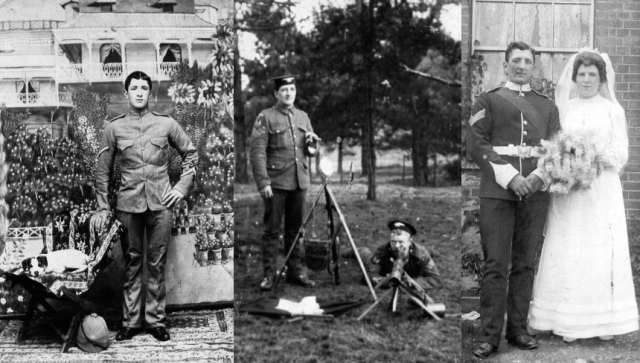
The fantastic photos below show William at various stages of his career, as detailed from left to right:
Left; Lance Corporal Bartlett, complete with his marksman's proficiency badge and a two years good conduct badge on the left sleeve whilst serving in India.
Middle; dated 14th April 1905, William appears to be sporting a Sergeant Major Instructor (Signals) badge and the Sergeant lying down seems to be the gent shown 'larking around' in the next set of photos.
Right; now wearing the star of a Regimental Quartermaster Sergeant on his right cuff, William is pictured getting married in 1908 at Tidworth in Hampshire.
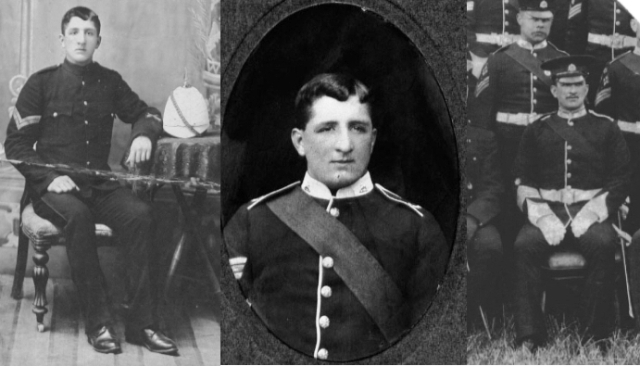
This next set of photographs shows William progressing through the ranks:
Left; still in India as a full Corporal with his Marksman's badge.
Middle; although there are no discernable badges as such, it is reasonable to assume that William is the Battalion's RQMS here, judging by the accompanying information 'Tidworth 1911'.
Right; amongst his peers, William is seated in a place of honour at the front of the Battalion's Sergeants, still sporting his Regimental Sergeant Major's Star above the right cuff. The Sergeant behind him would seem to be the same man who features in other photographs so they may well have been good friends.
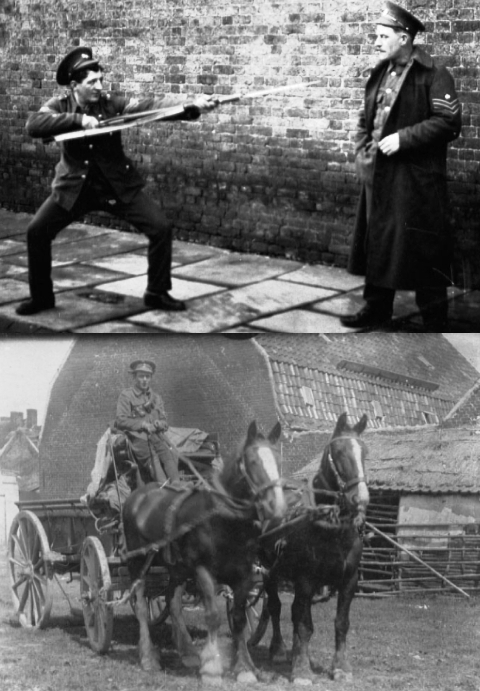
The final two photos are slightly less formal:
Top; the two usually official looking chums larking around. William's pal looks very non-plussed despite having a bayonet thrust towards his face doesn't he?! Lovely photo!
Bottom; All that accompanies this is the caption stating that the man was with William throughout the war. He appears to be one of William's Transport section from his time as RQMS, so would have been one of the Old Contemptibles of the 1st Battalion, although no clues can be seen by his uniform.
|
Private 14759 William Russell Castle
William was born around 1895 in Layston, Hertfordshire, to John and Katherine Castle. He lived with his widowed mother in Buntingford when war broke out, at River Green. William travelled to Royston to enlist and from his service number, we know that he enlisted on the 4th September 1914. After training, William was sent to France and served only briefly in the 1st battalion, arriving in France on the 27th April 1915. Three days later he was with them in the front lines, opposite the bitterly contested Hill 60, south-east of Ypres. William, along with many of the 300 young men who arrived with him as replacements on the 30th April was wounded in the early gas attacks of the war within days of arriving. During a particularly determined German assault to take control of the hill, during which Edward Warner won a Victoria Cross in William's battalion and Captain Gledstanes and a further 300 of his comrades fell, William was wounded. He died of his wounds on the 7th May 1915 aged just 20. Sadly, as is the case with many of the early war deaths, William's grave was lost in the fighting that raged there for a further three and a half years, so he is remembered on the Menin Gate Memorial to the missing in Ypres. |
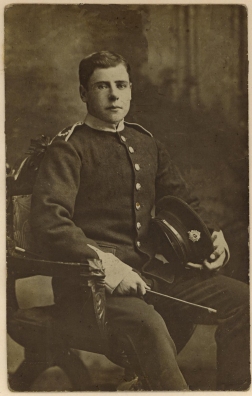 Gordon
Gilby got in touch to ask for and share information on this man,
William Castle, his mother's brother.
Gordon
Gilby got in touch to ask for and share information on this man,
William Castle, his mother's brother. |
Private 6730 Arthur Holton He fought in the South African Wars (Boer War), attached to the 2nd Battalion from the 4th. Private Holton was awarded the Queen's South Africa Medal with Clasps for the Cape Colony and the Transvaal, and the King's South Africa Medal with the 1901 and 1902 Clasps, both of which can be seen in his photograph. After South Africa he transferred into the 1st Battalion and was posted to Jhansi in India. Arthur married Ellen Biggs in 1912, and they had two daughters, Marge and Phyllis. Sadly, Phyllis was born in the January 1915, after Arthur was killed, so he never knew about his second daughter. He was probably serving in the regiment's reserves when war broke out as he arrived in France on the 19th of September 1914, in the second wave of reinforcements bound for the 1st Battalion after their losses at the battles of Mons, Le Cateau, the Marne and the Aisne. He would have served through the heavy fighting at Givenchy throughout the battle of La Bassée before facing the Prussian Guards' assault during the First Battle of Ypres. Arthur was killed when the German Army threw a massive series of assaults at the British east of Ypres, intent on breaking their lines and finishing the British involvement in the war once and for all. By this stage in the war, the British lines were very thin with no reserves left so their defence was a desperate affair, the result of which could have easily gone either way. During this battle, the 1st Bedfordshires were holding the line in a wood south of Inverness Copse, in front of Herentage Chateau. They were engaged in heavy, close quarters fighting which saw them conduct several counter attacks and lose hundreds of men, but keep their lines intact. Private Arthur Holton was killed on the 7th of November 1914 during the First Battle of Ypres. He has no known grave but he is commemorated on the Le Touret memorial in France and on his wife's grave in Kings Walden churchyard. (With thanks to Andy Lancefield for the photograph) |
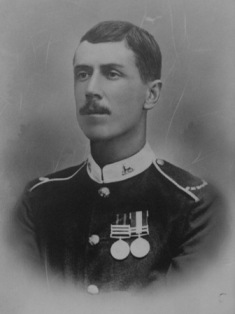 Arthur
Holton was born in Kings Walden, Hertfordshire in 1881 and he enlisted
into the Bedfordshire Regiment at Hitchin around February 1900,
having possibly served in the Militia beforehand.
Arthur
Holton was born in Kings Walden, Hertfordshire in 1881 and he enlisted
into the Bedfordshire Regiment at Hitchin around February 1900,
having possibly served in the Militia beforehand. Arthur Edwin Clement
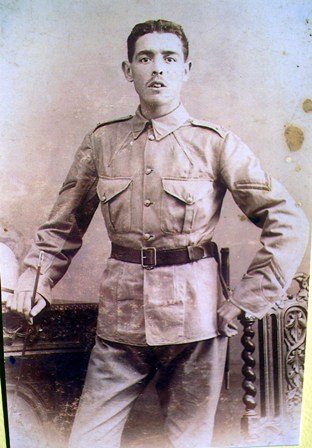
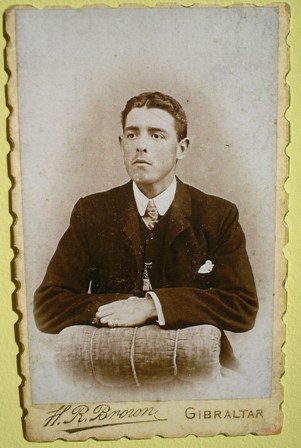
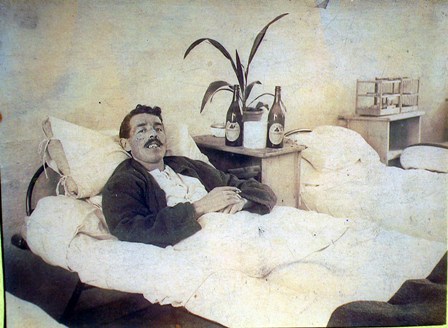
Linda Fox contacted me to share her Grandfathers service and photographs with the site. This is Arthur Clement who was born in Station Road in Tottenham, London on 20th September 1888 and enlisted into the Regiment around October 1906 as Private 8613.
He served in the 2nd battalion before the war, seeing Gibraltar (1907 - 10), Bermuda (1910 - 12) and South Africa (1912 - 13). After South Africa he joined the regiment in England, having completed his seven years with the colours, going into one of the Reserve battalions until recalled to the colours when war broke out in August 1914. Arthur landed in France on the 16th August with his fellow Old Contemptibles of the 1st battalion and served during the battles of Mons (23rd August 1914), Le Cateau (26th August 1914), Crepy en Valois and Meaux during the Battles of the Marne, the Battle of the Aisne and at Missy, La Bassee, Givenchy and Rougers.
Arthur was probably wounded in the spring 1915 engagements as in November 1915 he was transferred to the 5th Royal Irish Fusiliers as Private 22254, who were recovering from their ordeal on Gallipoli. He spent the rest of his service during the war with them in Salonika, which was when the photo below was taken as he recovered in hospital from an illness he picked up whilst there.
Either one of the recurring illnesses associated with service on Salonika or another wound resulted in Arthur being in the Hope Ancillary Hospital in Salford by 1918, where he met his future wife. Ironically they married in Salford on 11th day of the 11th month 1918!
Arthur was discharged from the army in 1919 and was one of the numerous veterans who 'died early', passing away in 1935 in Tottenham. He caught a cold which, because his lungs had been weakened, turned to pneumonia and then to septicaemia. He is buried in the Tottenham Cemetery.
| Private 33588 Arthur George ALLEN
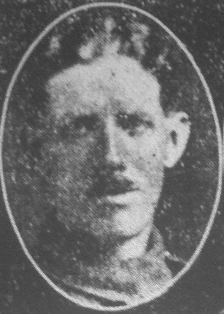
Initially he served as Trooper 2512 in the Bedfordshire Yeomanry before being transferred into the regular 1st Battalion, probably on recovering from wounds received whilst in the Yeomanry. Interestingly, his service number is only 4 away from Joseph Bugby who also initially served in the Yeomanry but who fell in the 8th Battalion in October 1917. This suggests the two are likely to have known each other and probably enlisted together. Arthur was posted as missing but was eventually accepted as being killed in action on the 23rd April 1917 when the Battalion attacked La Coulotte during the Battle at Arras and lost almost 350 men. |
|
Private 8055 William John CLIFFORD
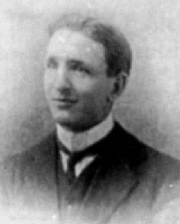
He was born in Upper Slaughter, the son of John and Emily Clifford who lived at the above address in 1914. Before the war he had been a railway guard at Tondu Glamorgan but later he enlisted as a regular soldier in September 1904, giving an address in Upper Slaughter. He was serving as a regular in Ireland when war was declared and landed with the 1st Battalion in France 16th August 1914. Having survived the battles at Mons, Le Cateau and the rearguard actions in September, William was killed in action during the defence of Givenchy at the Battle of La Bassee on 13th October 1914, aged 29 and is commemorated on the Le Touret Memorial. The 1st Battalion suffered around 150 casualties during the fighting that day - including 23 who were killed. He left a widow Charlotte Winifred (known as Winnie) Clifford (nee Bond) who lived at 1 Moreton Place, Brookway Road, Charlton Kings. (My thanks to John Hamblin for the pre-war bio and his photo) |
|
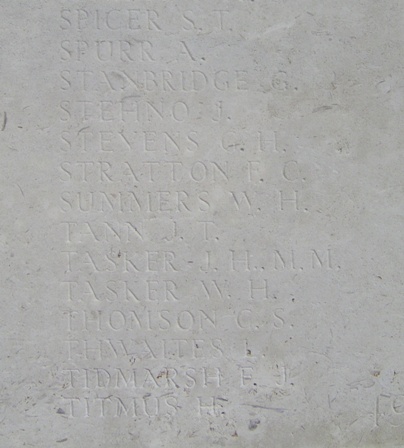
Private 29549 Samuel Thomas SPICER
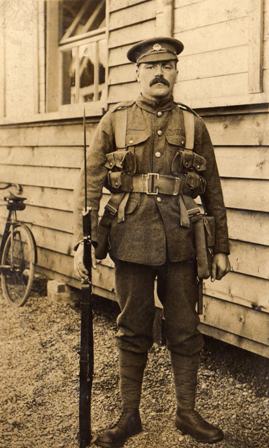
Samuel was born in Hoddesdon during the last quarter of 1886, the son of Jane Spicer of Hatfield. His mother married William Dowton, who seems to have raised Samuel as his own son. Samuel lived in Hertford during the 1891, 1901 and 1911 census returns, working as a 14 years old Carman for a timber yard during the 1901 census and as a coal dealer's Carman by the time of the 1911 census. Aged 26, Samuel married Elizabeth Wilkinson in November 1913 at Hoddesden in Hertfordshire. He was living in Hertford when war broke out, but his occupation (a Drayman) presumably excluded him from service initially. Samuel's service number suggests he enlisted into the army between January and June 1916 and, after basic training, joined the 1st Bedfordshires in the field around January 1917. Although it is not known whether he came through completely unscathed, Samuel's battalion were heavily engaged during the Battle of Arras (23 April 1917), their capture of Oppy Wood (28 June 1917), the Battle of Broodseinde (4 October 1917), and the Battle of Poelcapelle (9 October 1917). After a brief rest from the horrors of the mud in the Ypres salient, Samuel and his battalion were providing carrying parties for the units in the front lines, before they returned to the trenches to resume offensive actions. Exhausted, filthy and seriously overworked, his battalion lost dozens of men to probing German shell fire; among them being Samuel. Private Spicer was among the long list of men whose final resting place was lost in the fighting east of Ypres that autumn and as a result, he is remembered on the Tyne Cot Memorial to the missing. Although Samuel died far too young, his wife, Elizabeth, lived until Christmas Day 1952 and his daughter lived into her 90's, dying as recently as 2009; she was cremated on what would have been her 94th birthday. [With thanks to Derek Lawman, Samuel's Grandson, for his photograph] |
|
Private 3/7387 Ernest COOK
Ernest was born in Soham, Cambridgeshire on 19 December 1897, one of eleven children born to William and Emma Cook. He enlisted into the British Army at Ely, between late 1913 (aged 15), or early 1914 (aged 16), becoming Private 3/7387 in the Bedfordshire Regiment. His mother died in March 1913, which may have been an influence in his decision to join the army. Ernest's service record has not survived, but his Medal Index Card shows he arrived in France in January 1915 (aged just 17). Private 3/7387 Cook came through the horrors of Hill 60 in April and May 1915, and served in the Somme and Arras sectors before his battalion were rotated into the line to take part in the Battle of the Somme (1916). Surviving a short spell opposite the infamous High Wood, Ernest went forward with his battalion as the 15th Brigade assaulted the village of Longueval on 27 July 1916. Later known by those present for it's unparalleled barrage (labelled the Longueval Barrage), the Bedfordshires and Norfolks captured the heavily defended village which had already seen weeks of costly fighting. Ernest Cook was among the battalion's long casualty list from the day's fighting. Like so many of his comrades who fell that day, the 18 years old veteran with over two years in the regiment has no known grave, so is commemorated on the Thiepval Memorial to the missing in France, and the war memorial in Soham. [With thanks to Paul Cook for the copy of Ernest's photograph] Private / Drummer 8216, later 5942053 Hubert George CHAPPELL
Years of home service followed and on 9 January 1912 Hubert married Mary Anne Russell (b. 18 April 1896, d. 1976) at the parish church in Kempston. They had eight children in all, being Julia Constance (b. Kempston 24 July 1912, d. 1986), George William (b. Kempston 2 June 1914, d. 1989), Herbert Frederick (b. Kempston 27 Jan 1916, d. 27 December 1988), Ernest Edward (b. Kempston 28 Feb 1919, d. 30 Aug 1990), Elsie Joyce (b. Bedford 18 Sept. 1921, married a G.I. and d. in America 14 Apr 2001), Ivor Walter (b. Kempston Barracks 25 Oct 1924, d. 8 Jun 2014, as Cherry Chappell and others were piecing Hubert's story together) and Doreen Mary (b. Kempston Barracks 26 Sept 1926, d. 1988), Colin Leslie (b. Kempston 3 Sept 1930, d. 1997). His home service continued as a Drummer and later the depot bugler until war broke out, when he was posted to the 3rd Battalion at Landguard. On 7 March 1916 Hubert was transferred into 62 Machine Gun Corps where he served as Private 26222 until 2 April 1919. The portrait photograph shows Hubert during or after his wartime service, sporting three long service stripes and three overseas chevrons.
Despite fourteen years of service to that point, Hubert also volunteered for the North Russian Expeditionary Force in which he served from 13 May 1919 to 26 September 1919. He returned to England on 7 October 1919 and transferred back into the Bedfordshire and Hertfordshire Regiment on 3 February 1920, becoming Private 5942053. His service from this point onwards appears to have been based at the Kempston barracks. After the war, Hubert was issued with British War and Victory medals to complement his long service chevrons, and in 1923 he was awarded a Long Service and Good Conduct medal (with gratuity) for his eighteen years of service. With 22 years of service to King and country behind him, Hubert was discharged on 1 March 1927, his conduct being reported as 'exemplary'. Although his time in the Regulars was over, Hubert re-enlisted into the Territorial Force at Bedford on 29 June 1927, aged 41, where he remained until 28 June 1933. Four and a half years at RAF Cardington followed, where he worked as a cook in the Officers Mess and Sergeant's Mess. During the Second World War his age denied any chance of military service so he took charge of the cooks at the ordnance factory, moving on to run the kitchen at the Bovril factory in Ampthill after the war. On 1 April 1950 Hubert came full circle when returned to the Kempston depot as their Officers and Sergeants Mess cook, where he remained until his retirement. Late in 1955, with 50 years of military and civil service behind him (much of it spent in and around the regiment) Hubert, of 26 Bedford Road in Kempston, retired. His retirement was marked by him attending the Sergeants Mess annual Christmas dinner as their guest of honour. On Christmas Day 1956,Hubert died at 26 Bedford Road, aged 71. His last surviving child, Ivor Chappell, died in June 2014, as Cherry Chappell and others were piecing his father's story together and preparing this biography.
Hubert Chappell when he retired [With thanks to Cherry Chappell for the photographs and service history details] Private 15474 George Rayner George enlisted on 7 September 1914, 'after the harvest was in' and joined the Regulars or Reserves instead of Kitchener's New Army. He was trained in the 3rd Battalion at Landguard Fort until being passed for active service and landed in France in a large draft, on 27 April 1915. His draft - many of whom had been civilians until a few months earlier - were rushed to the 1st Battalion who had taken heavy losses capturing and holding the notorious Hill 60 which had earned the nickname 'Murder Hill' among the troops fighting there. Within days, the Germans launched their latest massed attack to regain the hill on the heels of their new-fangled weapon - gas. The British troops on the hill lost heavily in the fighting that followed, with George's new comrade - Ted Warner - being among those who won the Victoria Cross. Young George was among the hundreds of men from the 1st Battalion lost on the hill. Reports suggest that he was listed as missing and that he had died from his wounds but he was recorded as having died on 6 May 1915. Although unconfirmed, it is possible that he was among Captain Gledstanes' company who had spent days surrounded on the hill, fighting for survival against repeated waves of assaults on their positions. As is the case with most of those lost around the hill at the time, George is remembered on the Ypres (Menin Gate) Memorial to the missing. He is alsolisted on a wall plaque at the All Saints Church cemetery in Wendy, Herts, and is remembered on his sister Violet's gravestone in the Wendy churchyard, who died in the influenza pandemic of 1918/19 and is buried next to her parents who lived until the 1940's. George's 'Trio' of medals are still with the family and are shown below.
[With thanks to Jeremy Rayner for the photographs and personal background information on George] |
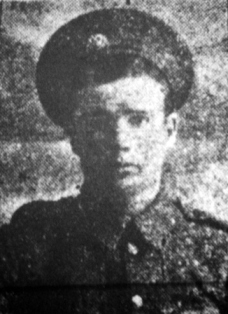
 Hubert
was born on 29 September 1885 in Manuden, Bishops Stortford and
was a farm labourer when he enlisted into the Bedfordshire Regiment
on 2 March 1905, aged 19 years and 5 months. After training, he
sailed to India and joined the 1st Battalion on 8 November , returning
with them to England via a posting in Aden on 23 December 1908.
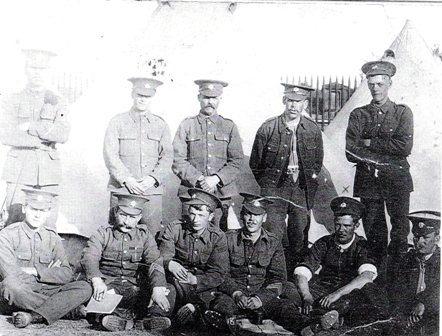
He can be seen in the group photgraph, second from the right in
the front row .
Hubert
was born on 29 September 1885 in Manuden, Bishops Stortford and
was a farm labourer when he enlisted into the Bedfordshire Regiment
on 2 March 1905, aged 19 years and 5 months. After training, he
sailed to India and joined the 1st Battalion on 8 November , returning
with them to England via a posting in Aden on 23 December 1908.
He can be seen in the group photgraph, second from the right in
the front row .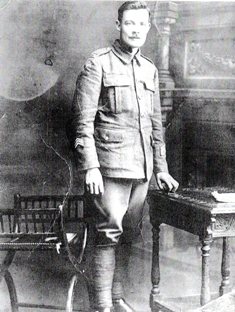 He
landed in France on 11 May 1916 and, remarkably, there is no apparent
record of him being wounded despite serving in what was nicknamed
the 'Suicide Squad'. However, his portrait photograph shows him
sporting three overseas service chevrons, which suggests that something
saw him returning to England twice during the war
He
landed in France on 11 May 1916 and, remarkably, there is no apparent
record of him being wounded despite serving in what was nicknamed
the 'Suicide Squad'. However, his portrait photograph shows him
sporting three overseas service chevrons, which suggests that something
saw him returning to England twice during the war 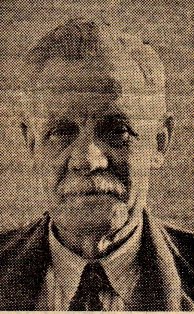
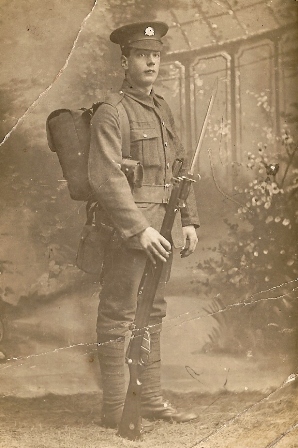 George
Rayner was born in Shingay, Cambridgeshire but by the time war broke
out he lived in the neighbouring village of Wendy.
George
Rayner was born in Shingay, Cambridgeshire but by the time war broke
out he lived in the neighbouring village of Wendy. 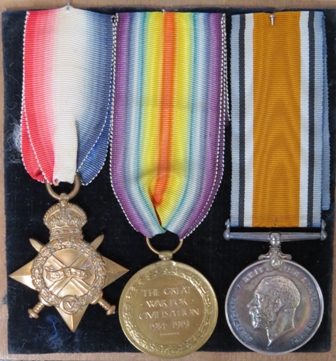
Site built by Steven Fuller, 2003 to 2023