The Bedfordshire Regiment in the Great War

Photographs and Biographies from the 8th Battalion
Officers in March / April 1916
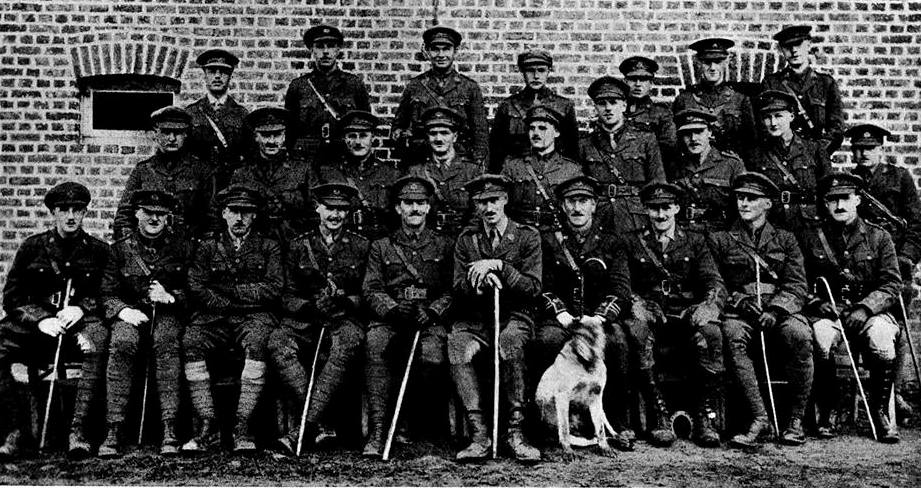
Here are 26 of the battalion's officers, taken between 16 March 1916 and 14 April 1916, behind the lines around Ypres. (I have narrowed the period of the photograph down by reviewing the officers present - 2/Lt Charles did not join the battalion until sometime after landing in France 13 March and Lt-Colonel Jackson was wounded 17 April - and considering the periods when the battalion were not in the trenches for this to have been taken).
Sadly, five of them would be killed days later, during the battalion's defence against a German bombardment and raid on 19 April.
Back Row:
Second Lieutenant Walter HEATH
Lieutenant Rennie Alexander AIRTH
Lieutenant Pierre STEYN, DSO
Lieutenant Edwin Roland Watts DRAISEY
Second Lieutenant Leslie Croom TELFER
Second Lieutenant Robert Reginald MARTIN
Second Lieutenant John LODGE
Middle row:
Second Lieutenant Alan McKinsty FLEMING
Second Lieutenant Charles CARTWRIGHT
Second Lieutenant Reginald Herbert BLACKBURN
Second Lieutenant Douglas William McMICHAEL
Second Lieutenant Honoratus Leigh Murron THOMAS
Second Lieutenant William M. SPEIGHT [comment; attached from the West Yorkshire Regiment]
Second Lieutenant Sidney James VIPOND
Lieutenant Gordon David BREWSTER
Second Lieutenant Harry Anderton SQUIER
Front row:
Second Lieutenant William Eugene CHARLES
Lieutenant Augustus John JESSOPP
Captain William Thomas PARES
Captain Robert Bernard Lawson HATCH
Lieutenant and Adjutant Herbert Frank STEVENS [comment; attached from the East Kent Regiment]
Lieutenant Colonel Henry Cholmondeley JACKSON, DSO
Major Donald McLeod HAWKINS
Second Lieutenant Harry Charles WESTON
Lieutenant Aubrey A. O'CONNOR, RAMC [comment; Battalion Medical Officer]
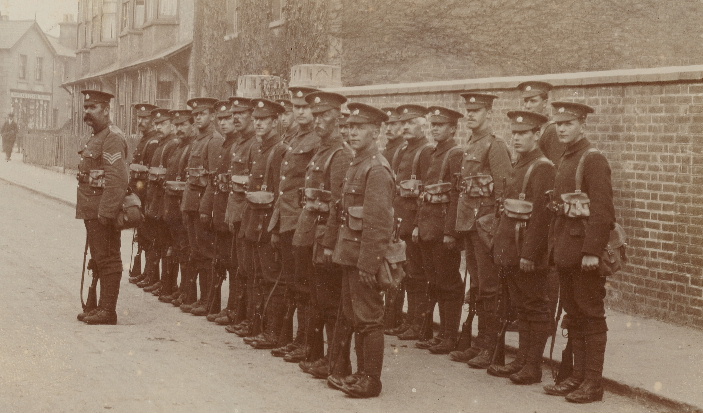
Here is a squad of the 8th Battalion in Brighton during their training in 1915, led by one of the Regular Sergeants who formed the nucleus of the battalion when it was originally formed. This was taken before the Battalion were shipped to France, so many of the faces you see were completely naive of what they were about to experience with many of them not making it back to their families at all.
In the front row, farthest left, stands Private 19632 Henry James Ellis, who would be killed just before Christmas 1915 when the battalions trenches were attacked in a huge raid. He lies in the Lijssenthoek Military cemetery Belgium.
Private 15788 Ernest Clarence Jason CLEMENTS (known as 'Clarry') and Private 15519 Albert James CLEMENTS (known as 'Bert')
Clarry and Bert Clements, Fred Hawken and two others from the 8th battalion

In July 2007 I was contacted by Derek Wisbey who has been a resident in Standon, Hertfordshire for over four decades. One of the village's even longer standing residents was Arthur Clements whose family lived there during the war. He had two elder brothers, both of whom fell in the Regiment during the war. Arthur himself was born in 1910 so was too young to serve during the war and passed away in 2004, at the ripe old age of 94, having served as a Gunner in WW2. His father Ernest senior was a Blacksmith who moved to Standon around 1900 and lived in the house next to a single storey building that was later known as the Forge. Along with his sister Muriel - a Spinster - Arthur lived in the same house his entire life. When he died, Arthur was a proud man who had no direct descendants left and lived alone, so he passed the letters sent between his brothers and mother onto Derek for safe keeping. Between the information contained in the letters and what basic information I have in my database, we can establish some of their service.
Ernest Clarence Jason Clements, the eldest, was known as Clarry and Albert James Clements was known as Bert. This is their story, one which could easily be applied to countless families around the country at the time.
By analysing their service numbers, we can see that Clarry and Bert enlisted into the army together on the 7th September 1914, both men travelling the ten miles to Hertford to do so. Clarry was born around 1892 in Worcester and Bert around 1894 in Standon, where both men lived at the time of their enlistment. They were the sons of Ernest and Marion Clements from the village, and were both single in 1914.
In the first few weeks of their service, several 'new armies' were raised and the brothers became part of the 8th (Service) battalion of the Regiment when they were formed in October 1914. After a spell in Brighton early in 1915, the next seven months of their training was spent around Woking in Surrey until they left Dover late in August, arriving in Boulogne early on the 30th August 1915. After three weeks of concentrating the Division, moving towards the front lines and constant training and working fatigues, the brothers found themselves marching up and down the front line opposite Lens until the 25th September - the night before the Battle of Loos opened.
The brothers' first taste of battle was a confusing affair to say the least. After a week of marching fruitlessly up and down the lines without going into the trenches at all, the entire Division were still 'green' and completely untried in any type of warfare. One of the Brigades were used to assault the fortified village of Hulluch as several Regular Divisions launched their grim assaults around them, with the Bedfords' Brigade being sent into support their sister Brigade. In a thick mist, made worse by the smoke form the raging battle, the brothers advanced towards the sound of the guns from their positions in reserve. Before making any real headway their CO was wounded by an enemy sniper and an hour later touch had been lost with the battalions to their front. Unsure of what to do, the Brigade waited where they were and endured constant shelling without so much as threatening the front lines where the battle raged. They had reached a crossroads due west of Hulluch but the trenches were crammed with other troops, resulting in them being moved back towards where they had come from in the first place. That evening the Brigade was withdrawn and so ended their baptism of fire. The only enemy they had seen were prisoners moving back past them and they had suffered a relatively small handful of casualties despite none of them firing their weapons 'in anger'.
Whilst they were being trained and experiencing warfare on the Western Front, their family at home were all busy helping in whatever way they could. Their father, Ernest senior, got a job re-shoeing horses for one of the Hampshire battalions who camped in the Lordship Meadow in Standon, their sister Marion worked in the munitions factory in Barwick near Standon and their other sister Muriel knitted scarves for the Russians! Victor, a younger brother, tried to enlist into the 3rd/4th East Anglian Field Ambulance in 1915 as a letter dated 8th November contests. The Captain from the unit wrote to his parents rejecting his enlistment as he was under 19 years old but Victor was later accepted and served in Egypt. In 1919 Victor wrote home enclosing 4 eucalyptus leaves, which Derek still has to this day!
Clarry, Bert and their battalion were transferred into the veteran 6th Division in October, who were to spend many months in the trenches around Weiltje, north east of Ypres. In a letter home dated New Years Eve, Clarry describes an uncomfortable Christmas day carrying rations back and forth between a ruined village and the front line trenches whilst eating bread and butter for his meals all day, drinking tea without milk and having a spot of jam with his bread for dinner. He remarks on being upset at one of his friends called 'Punch' being killed a few days earlier. Punch was Private 15306 Francis William Oakley from Standon, who enlisted the same day and at the same place as the brothers; Francis was killed on the 20th December.
Until April 1916 the brothers spent a quiet, if uncomfortable time in the trenches and both survived a well executed German raid on the 19th April that saw around 200 casualties inflicted on them in a ferocious hand to hand fight in the dark. Many medals were awarded to the battalion for their stubborn resistance against superior numbers that night and the brothers settled back into trench warfare until their involvement in the Somme campaign in September. Although Clarry would see some of the bloodiest fighting the battalion tasted in the war, Bert was removed from the lines suffering from a fever in August, so was spared the carnage of the Somme.
On the 22nd August 1916 Clary wrote to their mother about Bert having a temperature whilst in the trenches, attributing it to trench fever. Three days later he wrote that Bert was hospitalised. He stayed in the 20th General Hospital, Camiers, which was 5km north of Etaples on the coast. By early September Bert was in Napsbury War Hospital in St Albans. Although 350 of the 1,600 beds were known to be allocated to 'mental cases', the balance were usually for tropical fevers and the like, which is why Bert would have found himself there. On the 27th September their mother wrote to Clarry, who was fighting on the Somme, that " He [Bert] still has his label tied to his bedstead & as you know what the letters on it mean P.U.O (Pyrexia of Unknown Origin)". Sadly the letters stop for a while as, unknown to their mother at the time, Clarry (Ernest) was killed two days before his mother wrote that letter. During Bert's stay at Napsbury, six year old brother Arthur who passed the letters onto Derek, recalled visiting him. The only thing that stood out in his memory of the visit after all those years before was that the floors were so highly polished he went "a**e over head"!
Whilst Bert was being moved back through the medical system in September 1916, his brother and former comrades trained hard for the Division's involvement in the battle of the Somme. On the 15th September 1916, whilst Bert was sweating uncomfortably in Napsbury, the battle of Flers-Courcelette (the sixth phase of the Somme offensives) opened. Two days earlier B Company had cooperated with an assault against a position called 'The Quadrilateral' in preparation for the coming assault against the German lines that included the bloody High Wood. When the battle opened, the supporting tanks being used for the first time travelled a little way before getting bogged down, British artillery fell short onto the attacking waves of the Brigade and the wire was found to be uncut along their portion of the line. After a gallant but disastrous attempt to get through the uncut wire and wall of machine gun bullets coming from High Wood, the entire Brigade was ordered back to their starting lines. 13 of the 16 Officers as well as almost 400 of the 600 'Other Ranks' who advanced were casualties by the day's end. All told, the Division suffered an incredible 7,000 casualties during their brief tour on the Somme before being rotated back out of the battle to resume holding the lines and rebuilding after their ordeal.
On the 25th September 1916 the 6th the Division were engaged again at the Battle of Morval which saw Clarry and the Bedfords in reserve after their huge casualty list a week earlier. Despite being in reserve, the battalion provided carrying parties for those in the front lines and suffered from shelling. The battalion lost almost 30 killed and twice as many wounded, most from C Company and one of which was Clarry. He is recorded as having been killed in action that day, with the battalion Medal Rolls saying he died of wounds. Whichever is the case, his body was either not recovered or was lost in later fighting and as a result, Bert is remembered on the Thiepval Memorial to the missing of the Somme battles that year.
As mentioned, the letters stop for some time after Clarry is killed. We can only assume this is due to Bert and his mother speaking in person during hospital visits before Bert is moved back home to complete his recovery and resuming training. However, on the 28th December 1916 Bert wrote to his mother from the 3rd battalion at Landguard Camp in Felixstowe, letting her know he had 'arrived safe, got back around 8 o'clock'. This is presumably from a spell of Christmas leave as referring to getting back implies he had been there already. Later, on the 14th February 1917 he writes that he has not been in the trenches yet, referring to being in the 3rd Entrenching battalion in France, who I have seen as supplying drafts to various battalions of the Regiment in the front line.
Bert moved into 4th battalion late in February 1917, who were a part of the 63rd Royal Naval Division - an 'assault' Division of the British Army who defended their claim of being the best British Division with a passion. He would have arrived as a replacement for the casualties suffered during their operations on the Ancre that month and found himself on fatigue duties and in intensive training that prepared them for their involvement in the coming Arras offensives in April and May - the battle with the highest daily casualty rate the British Army experienced in the Great War. Letters confirm he arrived with them between the 15th and 27th. A letter from Bert to his mother dated 28th February 1917 records that "We are in a different Batt now, the 4th Batt Beds Regt B. Coy 7 Platoon. Me and B May are in the same platoon together." B. May seems to be Bert May who presumably lived in Standon as the letter from Mr. Deacon (see below) mentions.
|
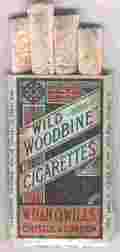
One of the packets sent to Bert in 1917
|
Bert's Medal Roll and other records all reflect that he died of his wounds. He was probably wounded whilst the battalion moved forward into their positions ready for their now famous assault against Gavrelle on the 23rd April, and he lies in the Duisans British cemetery, Etrun. This cemetery is 9km west of Arras and was home to the 8th Casualty Clearing Station at the time of his death, which was where he would have passed from his wounds.
Amongst the letters Derek has is one from a Mr Deacon, the landlord of the Star pub in Standon. In itself it is innocent but both amusing and sadly ironic. He seems to have had difficulty in getting Bert's address to write to him but was apparently pleased to finally be able to do so. He remarks on the rising price of beer that has reached 5d per pint, with Stout and Bitter reaching the heady heights of 7d. He writes "Anyhow old boy, cheer up & make light of things & look on the bright side of things. Let nothing worry you … return home with all the honours." He continues "I enclose the usual …", which turned out to be 2 packets of 5 Woodbine cigarettes, adding that he is happy to send "… any other cigs you prefer …" if he can get them.
In a sad twist, his letter is dated 22nd April 1917, the day after Bert died near Arras unbeknown to Mr Deacon who was so happy to have written to his "old friend" at last. It, along with the packets of Woodbines were returned to Mr Deacon stamped "location uncertain", all of which have been kept as they were sent all those decades ago. Even the Woodbines remain unopened to this day!
The photograph above shows the brothers and three other Bedfords. Top left is Bert and bottom left is Clarry. Fred Hawken is bottom right and the others are unfortunately unknown. Fred Hawken was Private 15521 who served in the same battalion and survived the war. Interestingly, Private 15675 Horace Hawken from Standon was killed the same day as Clarry in the same battalion, perhaps in the same event for all we know as he too has no known grave and is on the Thiepval memorial. He also enlisted the same day, at the same place, into the same battalion as the brothers, so is presumably one of the men in the picture.
We can only claim to be able to vaguely imagine the impact of the death of her two sons on Marion, their mother. Within seven months both Clarry and Bert had fallen, leaving just the young Arthur and his other siblings, who would have hardly known his brothers, yet would always remember them to some degree. Although their mother by no means suffered the greatest losses in terms of numbers, considering the sacrifice of the men like the Clements brothers and their mother's grief reinforces the need to remember those who suffered during and after the war, so that we may live how we do today.
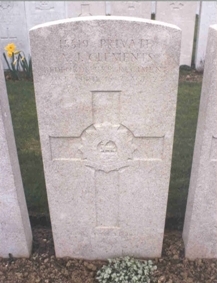
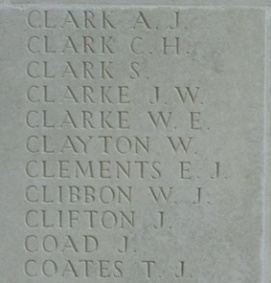
Berts grave and Clarry's entry on the Thiepval Memorial
|
Private 26547 John William COOK
The Battalion were in support between Morval and Lesboeufs during an assault on German positions during the rolling offensives of the Somme battles and moved up into the original German front line once it had been taken. Private Cook was probably in C Company who were providing carrying parties that night and suffered from the effects of the German barrage. He was initially posted as missing on the 25th September 1916 but his death was finally accepted in July 1917. He has no known grave but is remembered on the pier and face 2C of the Thiepval Memorial to the missing. |
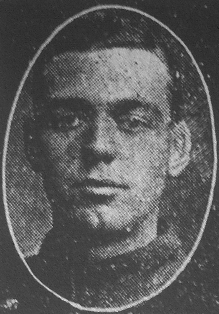
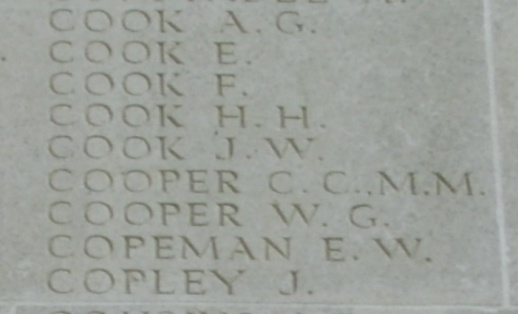 John
was born in and lived in Northampton, but enlisted from Wellingborough
in February 1916.
John
was born in and lived in Northampton, but enlisted from Wellingborough
in February 1916. |
Private 33597 Joseph Edmund BUGBY
His Yeomanry service number is only 4 away from Arthur Allen who fell in the 1st Battalion in April 1917, so they are likely to have enlisted together. Joseph was killed in action on the 4th October 1917, aged 24, as the Battalion held the trenches south east of Cite St Edouard, near Lens. At 7pm an intense German barrage obliterated the front line, killing and wounding almost 30 of the Bedfords, including Joseph. He is remembered on the Memorial Scroll in the Lowick Parish Church and was the son of Joseph and Elizabeth Bugby of The Round House, Sudborough, Thrapston, Northants. Joseph is buried in grave XX.A.25. of the Loos British Cemetery. |
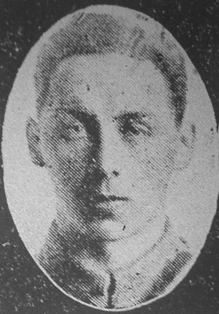 Joseph
was born in Ribberhall, Warwickshire, lived in Lowick, Northamptonshire
and enlisted from Bedford, initially into the Bedfordshire Yeomanry
as Private 2508.
Joseph
was born in Ribberhall, Warwickshire, lived in Lowick, Northamptonshire
and enlisted from Bedford, initially into the Bedfordshire Yeomanry
as Private 2508. |
Private 16605 Alfred William Evenett Died of wounds 25th October 1915
Aged 19, he enlisted into the Bedfordshire regiment in the first week of September 1914 and entered the war in France with the 8th Battalion on the 30th August 1915. He survived their unsuccessful attack against German positions around Hulluch a month later (during the Battle of Loos) and was moved to the infamous Ypres salient a few days after their baptism of fire. During their first tour in the trenches, Alfred was wounded and sent to the British casualty Clearing Station near Poperinge, to the west of Ypres, where he died from his wounds on the 25th October 1915. The battalion Chaplain wrote to his parents; "I understand Alfred did excellent service and was well spoken of by his comrades for his pluck and manliness". Alfred was the 3rd man from his small village to lose his life and the 20th man to fall in the Battalion. He was buried in the grounds of the CCS, where his grave can still be seen today. |
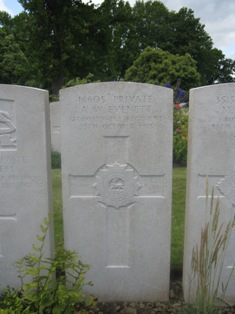 Alfred
was born around 1895 and lived his life in Great Chishill until
the outbreak of The Great War.
Alfred
was born around 1895 and lived his life in Great Chishill until
the outbreak of The Great War. |
Private 19857 Charles LAY, MM
Charles was born 22nd April 1889 in Findeon, Northamptonshire and was a butcher before war broke out. He enlisted into the army at the end of February 1915 and joined the 8th battalion in France on the 23rd August. Towards the end of 1916 Charles won the Military Medal which was gazetted on the 19th December. Although unconfirmed he probably won the medal for rescuing comrades under fire, although it is not known what action this may have taken place during. Private Lay was wounded three times but survived the war and was finally discharged from the army on the 20th January 1919. He settled down and ran his own wet fish and vegetable business after the war, living his life around Turvey, Bedfordshire, where Dave's mother was born. Sadly Charles died in his 50's in Granborough, Buckinghamshire in May or June 1943. |
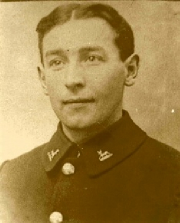 Charles
was Dave Percival's Grandfather, who sent the photograph opposite
and family details in to me.
Charles
was Dave Percival's Grandfather, who sent the photograph opposite
and family details in to me.|
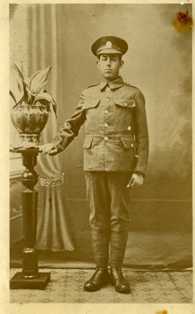
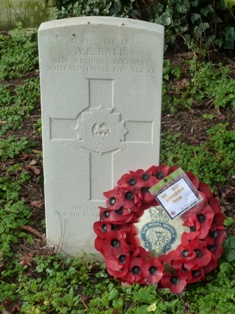
Private 17081 Arthur Edward BALL Died of wounds 20th September 1916, aged 22
After being posted to the 9th Battalion, he sailed to France with them on 30 August 1915. Private Ball saw his first action at the Battle of Loos, before any of his battalion had so much as seen a front line trench, and on 11 November 1915, his friend Charles Street was killed in action. Arthur also survived the costly Phosgene gas attack just before Christmas 1915, and the heavy German bombardment and raid in April 1916, both of which saw over 200 of his comrades lost. However, he was mortally wounded on the Somme, during the Battle of Flers-Courcelette which saw his battalion assault the formidable Quadrilateral Redoubt on 15 September 1916. He was moved to No.26 General Hospital in Étaples on 16 September, and was shipped home to Colchester Military Hospital, where he died from wounds to his neck and jaw on 20 September 1916. Arthur was interred at St Margaret's Church in Upton, where he lies today. [My thanks to Arthur's descendant Mike Brock, who shared the photographs with this site] |
Site built by Steven Fuller, 2003 to 2023