The Bedfordshire Regiment in the Great War

Officers who died serving in the 2nd Battalion
(This roll of honour is in chronological order)
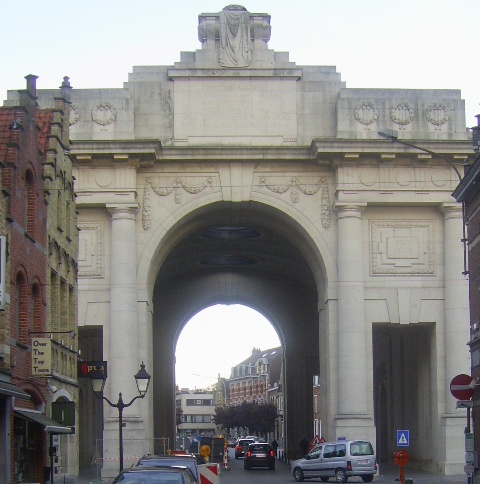
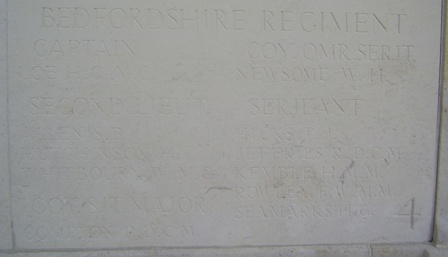
The Ypres (Menin Gate) Memorial to the Missing
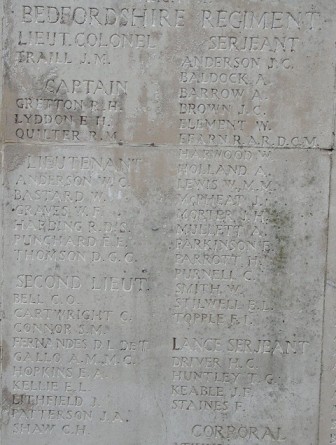
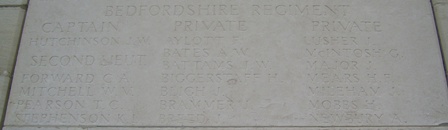
The section from the Ypres (Menin Gate) Memorial showing the officers from the regiment whose final resting places are unknown.
The battalion were heavily engaged during the First Battle of Ypres, which saw their baptism of fire.
Twelve infantry battalions comprised the 7th Division; the Bedfords lost 29 officers and 550 men, with only the Gordon Highlanders losing fewer men from the entire division. Over 9,300 (more than 70%) of the division were lost in the fighting east of Ypres which rendered the division incapable of any significant actions for some months.
Of the 29 officer casualties from the battalion, the following thirteen officers lost their lives:
.jpg) Charles
was born at Grimsby in 1891, the son of Alfred Frederick and Sarah
Susanna Bell. He was educated at Alford Grammar School in Lincolnshire
and initially enlisted as a Private into the South Staffordshire
Regiment in late 1909 or early 1910. His prominent leadership abilities
resulted in him being commissioned as a Second Lieutenant in the
Bedfordshire Regiment on the 20th May 1914 and he was believed to
be the first soldier to be promoted under the regulations introduced
in 1914.
Charles
was born at Grimsby in 1891, the son of Alfred Frederick and Sarah
Susanna Bell. He was educated at Alford Grammar School in Lincolnshire
and initially enlisted as a Private into the South Staffordshire
Regiment in late 1909 or early 1910. His prominent leadership abilities
resulted in him being commissioned as a Second Lieutenant in the
Bedfordshire Regiment on the 20th May 1914 and he was believed to
be the first soldier to be promoted under the regulations introduced
in 1914. 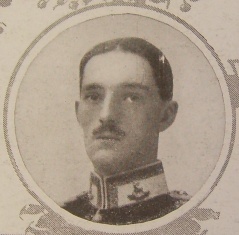
|
Killed in action 26th October 1914, aged 34. D Company. He gained promotion to Lieutenant in 1900, rising to Captain in 1906 and serving as the Depot's Adjutant from 1909. Captain Hall was posted to the 2nd Battalion in Gibraltar, moving with them to Bermuda, South Africa, then to northern Europe when war was declared in 1914. An extract from a letter shared by his widowed mother tells of his death; "He was waiting with his company, in support at the time, having just come down from the chateau close by, and had sent junior officers to the rear to ask for his orders of the day. While looking through his glasses for snipers he was himself shot by one of them through the neck and fell at once without any pain." Captain Hall was mentioned in despatches for his gallantry during the fighting at Ypres and although initially buried on the battlefield, was later moved and now lies in the Perth Cemetery (China Wall), 3km east of Ypres centre. A photograph of his gravestone can be seen here. (Image courtesy of the Imperial War Museum, taken from the Bond of Sacrifice, reference HU 122692) |
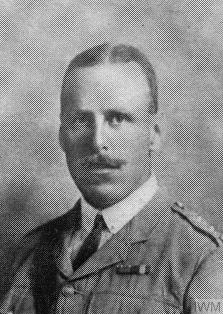 Arthur
was born 20 November 1914 in Mysore, India, the son of Edward Hall
(a coffee planter) and Anna Hall. Education at Bradfield School
in Berkshire followed and in 1899 he joined the Militia, moving
into the Bedfordshire Regiment soon after. Second Lieutenant Hall
served in the Mounted Infantry during the 1899 to 1902 South Afrcan
Wars and was mentioned in despatches for gallantry (London Gazette
10/9/1901).
Arthur
was born 20 November 1914 in Mysore, India, the son of Edward Hall
(a coffee planter) and Anna Hall. Education at Bradfield School
in Berkshire followed and in 1899 he joined the Militia, moving
into the Bedfordshire Regiment soon after. Second Lieutenant Hall
served in the Mounted Infantry during the 1899 to 1902 South Afrcan
Wars and was mentioned in despatches for gallantry (London Gazette
10/9/1901).|
Killed in action 26th October 1914, aged 23.
He was commissioned as a Second Lieutenant in the Bedfordshire Regiment on the 19th January 1912 and promoted to a full Lieutenant on the 22nd January 1913. William was serving with the battalion in South Africa when war was declared and arrived in France with them on the 6th October 1914. During the First Battle of Ypres, as the battalion held their lines around Becelaere, he was directing his platoon's fire in support of another regiment's assault when he was shot and killed by a German sniper or machine gunner (depending on the source). Lieutenant Bastard was buried by a fellow officer at the foot of Becelaere hill that evening. His mother received a condolence letter from the battalion C.O. stating that "from the day he joined I recognised that your son was one of the best types of officers; very keen on his work, thoroughly sensible and willing to take responsibility. I always had him in my eye as being well fitted for the Adjutancy role later on. He was very popular with both officers and men and I can assure you his loss to the battalion is very, very great." He was also mentioned for his gallantry in Sir John French's despatch of 14th January 1915. At the time of his death, his mother lived in Oakhill, Slapton, Devon. Amongst the correspondence within his service record is a letter from his mother thanking the Army Council for letting her know where her son had been buried. In it she politely apologies for troubling them with such questions concerning his burial - despite the heartbreak she must have felt at the time. Sadly, his grave was later lost as he is now remembered on the Ypres (Menin Gate) Memorial to the missing (above). His service record is held by the National Archives under reference WO339/9208 and he can be seen in the group photograph here. |
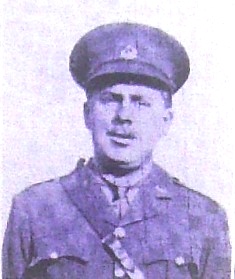 William
was born on the 20th April 1891 at Higher Coltscombe, Slapton in
Devon, the son of William and Helen Bastard (nee Atkins). His father
was a farmer by trade and he was the nephew of Devon's Medical Officer,
Dr. Atkins. William was educated at Blundell's School in Tiverton
before gaining a degree from Exeter College, Oxford.
William
was born on the 20th April 1891 at Higher Coltscombe, Slapton in
Devon, the son of William and Helen Bastard (nee Atkins). His father
was a farmer by trade and he was the nephew of Devon's Medical Officer,
Dr. Atkins. William was educated at Blundell's School in Tiverton
before gaining a degree from Exeter College, Oxford.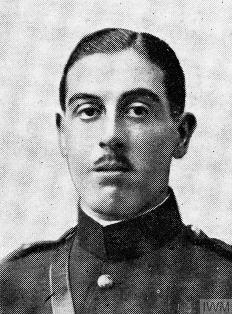 Edmund
was born on 21 October 1890, at Christ Church Vicarige in Luton,
the son of Elgood George Punchard (formerly the Vicar of Linslade,
then Christ Church in Luton, later the Canon of St. Mary's in Ely)
and Catherine Mary Punchard.
Edmund
was born on 21 October 1890, at Christ Church Vicarige in Luton,
the son of Elgood George Punchard (formerly the Vicar of Linslade,
then Christ Church in Luton, later the Canon of St. Mary's in Ely)
and Catherine Mary Punchard.|
Lieutenant-Colonel John Murray TRAILL Killed in action 30th October 1914, aged 49
He was initially commissioned into the Militia, joined the Bedfordshire Regiment in 1887 and served in the Isaza campaign of 1892. In July 1889 he was promoted to Lieutenant, becoming a Captain in February 1896. From that July until August 1904 Captain Traill served as the Adjutant to the 1st (Volunteer) Battalion, Essex Regiment, becoming a Major on 8 December 1906. John was the battalion's second in command in South Africa in August 1914 and had been mentioned by the C-in-C for his handling of native uprisings in South Africa earlier that year. When the 2nd Battalion landed in Hampshire September 1914. Lieutenant Colonel Coates (the 2nd Battalion C.O.) was categorised as being medically unfit for combat service, so Major Traill became the battalion's commanding officer when they mobilised and arrived in France. Lieutenant Colonel Traill was killed on his 49th birthday in the vicious hand to hand fighting east of Ypres, along with his second in command (below) and was mentioned in despatched for his gallantry during the battle. John was the son of James Christie Traill of Hobbister, Rattar, Caithness, and of Julia Traill (nee Lambarde). His final resting place was lost and he is remembered on the Ypres (Menin Gate) Memorial to the missing. His name on the memorial panel can be seen here. (Image from 1905, taken as he led his company during the march, Aldershot) |
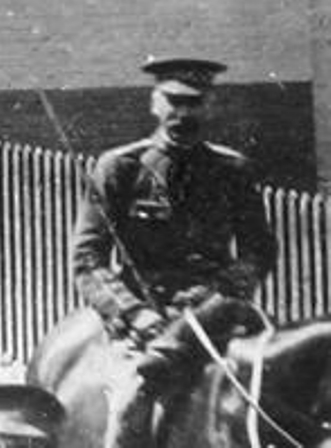 John
was born 30th October 1865 and was educated at Trinity Hall, Cambridge.
John
was born 30th October 1865 and was educated at Trinity Hall, Cambridge.
|
Killed in action 30th October 1914, aged 47 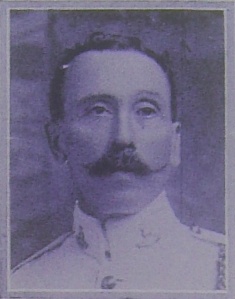
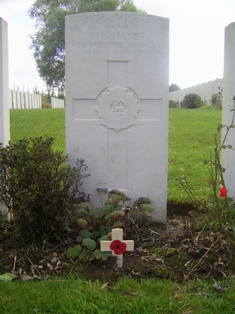
Robert was born 22nd November 1866 and educated at Weymouth College before continuing his education overseas. He was gazetted into the Bedfordshire Militia in November 1888, gaining his Lieutenancy two years later. Also serving in the Isazi expedition of 1892 along with John Traill (above), Robert also served with the 1st Battalion during the Chitral campaign of 1895 and was engaged during the storming of the Malakand Pass as well as during the action near Khat and the Swat Valley. Between May 1892 and April 1896 he served as the battalion Adjutant, becoming Captain in October 1896. Between August 1896 and May 1900 Captain Stares served as an Adjutant of Indian Voluneers, serving in expeditions on the North-Western frontier; he was also the Brigade Transport Officer during the Tirah expedition between November 1897 and April 1898. Between January 1907 and January 1911 he served as Brigade Major, then D.A.A.G. in India, being promoted to Major In October 1908. Major Stares was posted as the battalion's second in command when they were mobilised and fell alongside the commanding officer (above) during the desperate, close quarters fighting that day. He was shot and killed at close range, being mentioned in Sir John French's January 1915 despatches for gallantry. Robert was noted for his fondness of polo, hunting and fishing, remaining unmarried throughout his life. He was the son of John Twynam Stares from Manor House, Upham in Hampshire and lies in the Perth Cemetery (China Wall), 3km east of Ypres centre. During Major Stares' long service, he was awarded the Indian Medal with four clasps in addition to his Great War campaign medals. He can also be seen in the 1st Battalion 1893 group photograph here seated in the middle of the front row, alongside Lieutenant Colonel A.M. Paterson (CO 1st Battalion), in addition to the group photograph here. |
|
Lieutenant Wilfred Cruttenden ANDERSON Killed in action 30th October 1914, aged 22 Wilfred was born 14th August 1892 at 16 Augusta Road, Ramsgate, the only son of Wilfred Turner Anderson (a retired Colonel of the 2nd battalion, 80th Foot, later the South Staffordshire Regiment) and Elizabeth Regis Anderson (late Cox, formerly Mahon). He was educated at Portsmouth Grammar School from 1906 and later at St Laurence College where he was a Private in their Officer Cadet Corps prior to being accepted to the Royal Military College, Sandhurst in March 1910. Second Lieutenant Anderson joined the 2nd Battalion of the Bedfordshire regiment and was promoted to Lieutenant on the 1st April 1913. He served with them in South Africa, returning to Europe with them when war broke out. He can be seen in the group photograph here. Lieutenant Anderson was in No.3 platoon, A Company during the First Battle of Ypres when he was mortally wounded alongside Captain Ernest Lyddon (below) during the battalion's ferocious stand against an overwhelming German assault from three sides. He was initially reported as being wounded and missing on 30th October 1914 and enquiries into his fate revealed nothing. Several witness statements are still within his service record including those of two Privates in his platoon. Private 9373 Herbert Seekings wrote from No.13 Stationary Hospital in Boulogne two weeks later that "I was with Lt Anderson during the retirement at the First Battle of Ypres on about the 24th or 25th October 1914. I saw him just before we were ordered to retire and he was not wounded then. The Germans came upon us suddenly and seemed to come from all sides of us in the morning and we had to get away as best we could. Almost all his Company believe he is a prisoner but I do not think he has been heard from. One thing I do know is that no-one saw him shot. He was extremely well liked by everyone in the battalion." Private 9484 Charles Alfred Robinson wrote from a hospital bed in Le Treport, December 1915 that "At 5 o'clock that day we were compelled by superior numbers to evacuate the position … I did not see Mr Anderson hit but as I ran along the top of the trench I saw him lying in the bottom of it. He was wounded I think, in the body or the head, but at any rate badly. Three or four yards away Capt. Lyddon was lying also wounded. I don't know what sort of wound he had but it prevented him getting away." His sister, Alicia Anderson of 8 Cavendish Rd., Southsea, continued to write to the Missing Officers Enquiry Department of the War Office. Although it was accepted that he had died a year later, even as late as April 1919, enquiries were still being made as to his fate, despite the fact that no evidence had been forthcoming over the preceding four years. Wilfred's body was never found so he is remembered on the Ypres (Menin Gate) Memorial to the missing (shown above), along with many of his comrades who fell during the battle. His record is held at the National Archives under WO339/8257. As a nice touch which illustrates his personal taste a little more, in amongst the papers is a bill from one of his chosen Saville Row outfitters which includes lounge suits, dress suits and a golfing suit. |
|
Second Lieutenant John Agar PATERSON [PATTERSON] Killed in action 30th October 1914 (CWGC incorrectly records the date as 30th November)
He was educated at Dulwich College and Sandhurst before being gazetted a 2nd Lieutenant in Bedfordshire Regiment on the 17th September 1913. John was with the battalion in South Africa when war broke out, and can be seen in the group photograph here. Second Lieutenant Paterson was killed in the fierce fighting during the Prussian Guards attack and has no known grave but is remembered in the Ypres (Menin Gate) Memorial to the missing. |
|
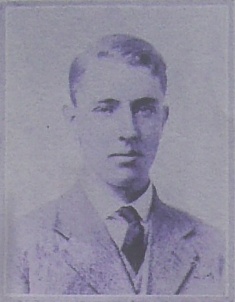
Killed in action 31st October 1914, aged 27
He applied for a postion at the Sandhurst Royal Military Academy 4th September 1905 at which time he lived at 22 College Road in Bristol. On 16 October 1913 he was made a Captain and was with the 2nd Bedfordshires in South Africa when war was declared in August 1914 and can be seen in the group photograph here. Captain Lyddon was in command of A Company when the Germans launched their massed assault against British positions east of Ypres that day. Captain Lyddon was reported as being wounded and missing during the desperate fighting 31st October 1914. He was later mentioned as being within yards of Lieutenant Anderson in Private Seekings' letter (above). Private 10101 William Henry Laws added to this in a letter he penned from an Etaples Convalescent Camp 15th December 1914, saying "He was my Company Commander and I was close to him when he was wounded by shrapnel in the side, I think. We were entrenching and had to retire and leave him, but he said 'I shall be all right, boys' and he must have been taken. It was on the Menin Road". Although enquiries continued for over a year, it was finally accepted that Captain Lyddon died from his wounds that day. Ernest has no known grave, so and is remembered on the Ypres (Menin Gate) Memorial to the missing. (Image courtesy of the Imperial War Museum, reference HU 124419) |
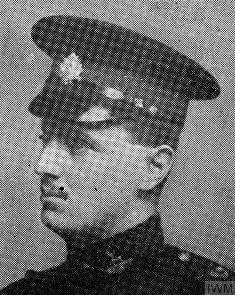 Ernest
was born 14th May 1887 at 10 All Saints Terrace in Cheltenham, the
son of Frederick Strickland Lyddon (a Bank Clerk) and Jane Woolcon
Lyddon (formerly Elbrow). From 1899 to 1902 he was educated at Stubbington
House in Hampshire, then at Weymouth College until 1904.
Ernest
was born 14th May 1887 at 10 All Saints Terrace in Cheltenham, the
son of Frederick Strickland Lyddon (a Bank Clerk) and Jane Woolcon
Lyddon (formerly Elbrow). From 1899 to 1902 he was educated at Stubbington
House in Hampshire, then at Weymouth College until 1904.|
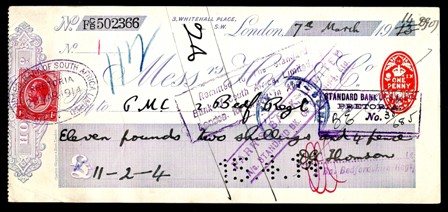
Lieutenant Donald Godrid Campbell THOMSON Killed in action 31st October 1914, aged 21 At the time he applied to become an officer cadet at RMC Sandhurst on 12 October 1910, he lived with his parents in Lark Hall, Penrith. By the time war broke out, his home was given as Croft House in Penrith, although he was physically serving with the 2nd Bedfordshires in South Africa. Lieutenant Thomson was commissioned into the Bedfordshire Regiment on 19 January 1914 and joined the 2nd Battalion who were stationed in South Africa at the time. He landed in France with a small reinforcement draft almost three weeks after the bulk of his comrades had landed, on 26 October, and was killed within days. Donald was last seen wounded in the hand and head, lying in the bottom of a trench held by his battalion during their stubborn defence that day. Once the order to retire reached the troops around him, the manoeuvre had to be conducted with such urgency that Donald and those around him could not be collected and carried back to the new line being established further west. Despite years of enquiries from his then widowed mother, Lieutenant Thomson's body was never found and he is remembered on the Ypres (Menin Gate) Memorial to the missing. He can be seen in the 1914 group photograph here. In 2014, Trevor Jones made contact as he was producing an article for the local Penrith newspaper telling the story of how two of the three brothers who enlisted were killed during the war. As a nice personal addition to his story, in Trevor's possession was this cheque, tendered by Donald in March 1914 while stationed in South Africa. Given that Donald had only recently been commissioned, he must have presented it not long after his arrival with the battalion.
|
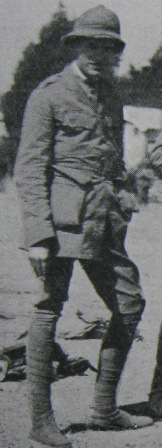
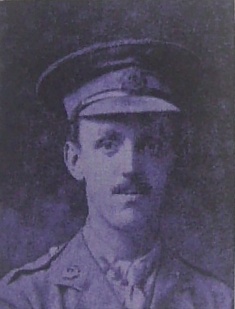 Charles
was born at home (187 Drake Street, Rochdale) on the 5th October
1887, the son of Charles Ramsey Garnett-Botfield and Ida Mary Botfield
(nee Aldersey). At the time of his birth his father was a Clerk
of the Holy Orders. Charles was educated at Elleray Park, Wallasey
between 1898 and 1902, then at Rossall School until 1906.
Charles
was born at home (187 Drake Street, Rochdale) on the 5th October
1887, the son of Charles Ramsey Garnett-Botfield and Ida Mary Botfield
(nee Aldersey). At the time of his birth his father was a Clerk
of the Holy Orders. Charles was educated at Elleray Park, Wallasey
between 1898 and 1902, then at Rossall School until 1906. The following four officers fell during the battalion's involvement in the Battle of Festubert:
|
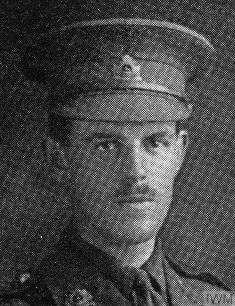
Captain Harold Edward HUNTRISS Killed in action 17th May 1915, aged 24 He was gazetted into the Bedfordshire Regiment in April 1910 and promoted to Lieutenant on 3rd May 1911. Lieutenant Huntriss joined the 2nd Battalion as they refitted for European operations in the New Forest and sailed with them to France 6th October 1914. Lieutenant Huntriss was hit by shrapnel in the left thigh on the 29th or 30th October, during intense fighting east of Ypres and returned to England to recover after an operation. Harold returned to the 2nd Battalion in April or May 1915 but was killed at the head of his Company as they advanced to the second German trench line, Major MacKenzie and Lieutenant Hutton-Williams being killed close by. All three were buried together despite the difficulties their men had recovering their bodies after the battle. At the time of his death, he lived at Harlsen House, Belvedere Road in Scarborough, his widowed mother being his next of kin (resident at 116 Wheelwright Road, Gravelly Hill in Birmingham). There also seems to be a link to Huntriss and Huntriss Solicitors in Halifax who handled his mother's affairs, his brother William seemingly being a partner within the firm. Lieutenant Huntriss is buried in the Guards Cemetery, Windy Corner, Cuinchy, 7km east of Bethune. A photograph of his gravestone can be seen here. |
 Harold
was born 23rd May 1890 in East Markham, Nottinghamshire, the son
of William Huntriss, J.P. and Charlotte Elizabeth Huntriss. He was
educated at Uppingham between 1904 and 1908, after which Harold
applied to the Sandhurst Royal Military Academy on 29 September
1908, giving his address as Mattersey Hall, Bawtry, Yorkshire.
Harold
was born 23rd May 1890 in East Markham, Nottinghamshire, the son
of William Huntriss, J.P. and Charlotte Elizabeth Huntriss. He was
educated at Uppingham between 1904 and 1908, after which Harold
applied to the Sandhurst Royal Military Academy on 29 September
1908, giving his address as Mattersey Hall, Bawtry, Yorkshire. |
Major John Henry MACKENZIE, V.C., D.C.M. Killed in action 17th May 1915, aged 44 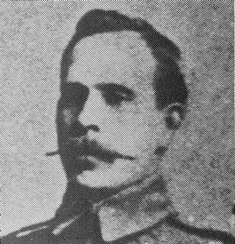
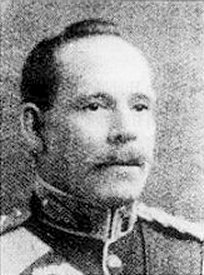
Major Mackenzie was from the 1st battalion, but attached to the 2nd when he was killed and had served in the army as far back as the 19th century. Starting his career as a Private, he won both his Distinguished Conduct Medal and Victoria Cross as a Sergeant in the Seaforth Highlanders and served King and Country across three decades, on several continents and during many wars. His DCM was won whilst serving in the Highlanders in the Niger Territories in the Autumn of 1899 and was recorded in the London Gazette 9th January 1900. Page 1 of the London Gazette 2nd January 1900 includes an element of the dispatch from Lt-Colonel James Willcocks which refers to Sergeant Mackenzie's distinguished service: "I have also to specially mention the good service rendered in September and October 1898, by Sergeant John MacKenzie, Seaforth Highlanders and West African Frontier Force." Within a year whilst serving in Ashanti (Ghana) in June 1900, John Mackenzie had become a Colour Sergeant and won the coveted Victoria Cross. An extract taken from the London Gazette dated 15th January 1901 records the following: "On the 6th June, 1900, at Dompoassi, in Ashanti, Sergeant Mackenzie, after working two Maxim guns under a hot fire, and being wounded while doing so, volunteered to clear the stockades of the enemy which he did in the most gallant manner, leading the charge himself and driving the enemy headlong into the bush." On page 11 of the London Gazette 4th December 1900, the dispatches written by Colonel Sir James Willcocks, K.C.M.G., D S.O., Commanding Ashanti Field Force, to the Secretary of State for the Colonies shows Colour Sergeant Mackenzie's actions in some more detail: "On 6th June Lieutenant-Colonel Carter and Major (local Lieutenant-Colonel) Wilkinson, Gold Coast Constabulary, with three hundred and eighty men, left Kwissa to join hands with Hall at Bekwai. I reached Prahsu on the 8th June, and the following day received a despatch from Lieutenant-Colonel Carter, stating that he had been opposed by the Adansis at Dompoassi, and had been obliged to return to Kwissa. The enemy had built five stockades about two hundred yards, long and nearly parallel to the road at a distance of only thirty yards from it; lying perfectly still behind the ordinary thick bush, which remained untouched between the stockade and the path, they waited until the advance guard was just opposite, and then opened a terrific fire which staggered our men they also fired from the surrounding trees. The guns and Maxims came into action at once, and a regular duel took place, our men falling fast; no one knew then, as we do now that the enemy were probably behind strong stockades, and there was no indication of it; the officers believed the enemy were firing from the thick bush, and thus swaying backwards and forwards the fight went on for two and a-half hours, by which time Lieutenant-Colonel Carter had received a severe wound, which incapacitated him from command. Lieutenant-Colonel Wilkinson then took command and was himself slightly wounded; Captain Roupell, 3rd West African Frontier Force, was dangerously wounded in several places; Lieutenant Edwards, R.A., West African Frontier Force, received two severe wounds, but continued to work the guns till the entire gun detachment were disabled. It was at this stage that it was found the enemy were posted behind breastworks, as the bush had become partially cut away by the fire. Lieutenant O'Malley, 2nd West African Frontier Force, was severely wounded while working the Maxim, nearly the whole detachment being disabled; Dr. Fletcher, Medical Officer, and Colour-Sergeant Mackenzie (Seaforth Highlanders), 1st West African Frontier Force, were also wounded, a total of seven Europeans hit out of eleven' present; three men were killed and eighty-nine wounded (some of whom have since died). Lieutenant-Colonel Wilkinson, seeing that the gun and Maxims were by this time out of-action, that his ammunition was running short, and the enemy's fire did not slacken, determined to retire, But Colour Sergeant Mackenzie came up to him and volunteered "to carry the stockade with, the bayonet" if his own company (Yoruba Company, 1st. West African Frontier Force) was placed at his disposal. Wilkinson at once ordered the Company, which was to the rear of the column, and on the arrival of the first two sections without hesitation, Mackenzie, charged at their head followed splendidly by his own men and all others in the vicinity, their officers of course leading them. The enemy did not wait the rush, but fled in confusion, and never rallied, and it is perhaps not too much to say a disaster to our arms was thus averted, for a retirement under the circumstances might have ended in a panic. For this act of distinguished bravery I consider Colour-Sergeant Mackenzie is deserving of the highest reward a soldier can receive, and am making a recommendation accordingly. It was only last year that Colour-Sergeant Mackenzie earned the medal for distinguished service in the field on the Niger. The column then returned to Kwissa, being unable to advance owing to the numbers of wounded." Colour Sergeant Mackenzie was commissioned as a Second Lieutenant in the Black Watch the year he won his VC, presumably in recognition of his bravery and obvious leadership abilities. On the 29th November 1900 he was given the local rank of Lieutenant whilst serving in the West African Force and went on to become a Captain in the Royal Scots 22nd January 1904, later serving in the Northern Nigeria Regiment. He was mentioned in dispatches 12th September 1902 for his involvement during the Aro Expedition in the Anglo-Aro War of 1901 to 1902, his activities in the Kano-Sokoto Expedition of 1903 and again during 1906 when he was staff officer of the Munster Field Force. He also appears in the London Gazette under the following dates: 3rd May 1910 "Captain John Mackenzie, V.C., is seconded for service as an Adjutant of Indian Volunteers. Dated 8th April, 1910." 18th September 1908 "The Royal Scots (Lothian Regiment), Captain John Mackenzie, V.C., is placed on temporary half-pay on account of ill-health. Dated 18th September, 1908." 29th December 1908 "The Royal Scots ''(Lothian Regiment}, Supernumerary Captain John Mackenzie, V.C., to be Captain, vice G.W.G. Neill, deceased. Dated 16th December, 1908." 4th August 1911 "To be Brigade-Majors. Captain J. H. Mackenzie, 1st Battalion, The Royal Scots, vice Captain L. Hume-Spry, D.S.O., West Yorkshire Regiment. Dated 6th June, 1911." On the outbreak of war, Major Mackenzie was mobilised once again and arrived on the Western Front 23rd November 1914, initially serving in the 1st Battalion. He moved to command the 2nd battalion on the 20th March 1915 as a replacement officer for the battalion's losses during the Battle of Neuve Chapelle and remained in charge until the 17th April. During the opening day of the Battle of Festubert (16th May 1915), he led D Company superbly throughout bitter fighting and until the battalion were relieved and given a few hours rest in support positions. The following evening saw the battalion launch an assault in the dark against well defended German lines. Major Mackenzie put himself at the front of his Company and led their charge but as soon as they appeared from their trenches, the entire line was met by a wall of bullets and artillery fire. After an incredible career serving King and Country on many continents, Major John Mackenzie, V.C., D.C.M. was killed at the head of his men, where he had always been. Eight days later a party of three Bedfords returned to the area he fell and recovered his body under cover of night, so that he would receive a burial deserving of one who gave so much. At the time he was buried with his fallen comrades in front of the Old British Line, 250 yards east of Festubert East Keep and 200 yards west of Yellow Road which ran north from La Plantin. After the war, during the concentration of burial sites into the beautiful CWGC cemeteries we are so familiar with today, his remains were moved and he now lies in the Guards Cemetery, Windy Corner, Cuinchy, 7km east of Bethune. A photograph of his gravestone can be seen here. His Victoria Cross can be seen in the Regimental Museum of Queens Own Highlanders at Fort George in Scotland and his pipe banner is on display at the Edinburgh Castle Museum in Scotland. |
|
Died of wounds 18th May 1915, aged 20 Alfred was gazetted a Second Lieutenant 17th September 1913 and arrived in France from South Africa with the 2nd Battalion on the 6th October 1914. He was wounded 29th to 30th October 1914 and returned to the battalion 12th March 1915, having recovered and been promoted to a Lieutenant. Alfred was mortally wounded during the Festubert assault, dying from his wounds on the 18th May. He was the son of Alfred and Marie Kuhn (later renamed to Kean) of 75A Lansdowne Place, Hove in Brighton and is buried in Bethune Town Cemetery. Second Lieutenant Kuhn can be seen in the 1914 group photograph here and a photograph of his gravestone can be seen here. |
|
Lieutenant William HUTTON-WILLIAMS Killed in action 18th May 1915, aged 40. Lieutenant Williams initially enlisted as Private 3513 in the East Surreys before being commissioned as an officer. He embarked in France on the 2nd November 1914 and arrived in battalion 19th December 1914, being attached from the 3rd East Surreys. William was killed leading his Company as they advanced to the second German trench line, Major MacKenzie and Captain Huntriss being killed close by. All three were buried together despite the difficulties their men had recovering their bodies after the battle. William was the son of Alfred and M. A. Hutton Williams, the husband of Violet Woodfall Hutton Williams of Holcombe, Caterham Valley, Surrey and is buried in the Guards cemetery, Windy Corner, Cuinchy, 7km east of Bethune. A photograph of his gravestone can be seen here. |
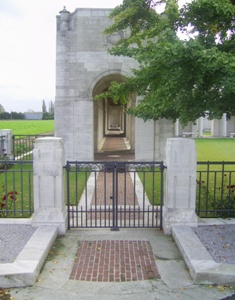
Le Touret Memorial to the missing
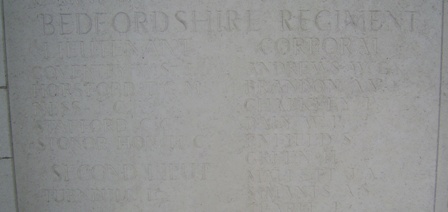
The battalion were next engaged during the Second Action at Givenchy, losing almost 150 men in the battle. The following five officers were those who were killed during the assault:
|
Lieutenant Thomas Gavin Moor HORSFORD Killed in action 16th June 1915, aged 22 After education at Beaumont College in Old Windsor, Thomas became an Army Student at Wimbledon College before being commissioned into the 3rd (Reserve) Bedfordshires in March 1913. Promotion to Lieutenant followed in May 1914 and he was transferred into the Regulars in August 1914, being posted to the 2nd Battalion when they returned from service in South Africa and going with them to France in October 1914. He was invalided home with a wounds in October 1914, returning to the battalion in France the following May. Lieutenant Horsford was killed during the Second Action at Givenchy on 16 June 1915; his Officer Commanding wrote: "We had gone up to the trenches previously to an attack and your son and another officer were in the trenches talking, when the Germans started shelling the trenches and your boy and the other officer, Lieutenant Fix, were killed outright by the same shell … your son and Lieutenant Fox were buried side by side behind the trench they were in" Lieutenant Horsford's grave was lost in the fighting and he is remembered in the Le Touret Memorial to the missing. A photograph of the panel bearing his name can be seen here. |
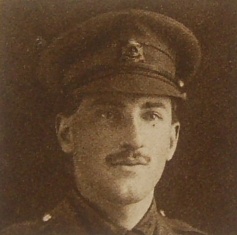 Thomas
was born 2 August 1892 in Penryn, Cornwall, the son of Colonel T.M.A.
Hosrford who was the commanding officer of the Cornwall and Devon
Miners' Royal garrison Artillery for 34 years.
Thomas
was born 2 August 1892 in Penryn, Cornwall, the son of Colonel T.M.A.
Hosrford who was the commanding officer of the Cornwall and Devon
Miners' Royal garrison Artillery for 34 years. |
Killed in action 16th June 1915, aged 20.
After gaining a commission in the South Staffordshire Regiment, he was transferred to the 2nd Bedfordshires, arriving with them in the field on 28 May 1915, bringing a draft of 90 men with him. Two weeks later, during his first battle, Walter was standing in a trench holding a discussion with Thomas Horsford (above) when they were killed by the same shell. Lieutenant Fox's final resting place was not identified and he is remembered on the Le Touret Memorial to the missing. What remains of his service record is held by the National Archives, reference WO 339/23579. (Image courtesy of the Imperial War Museum, reference HU 122343) |
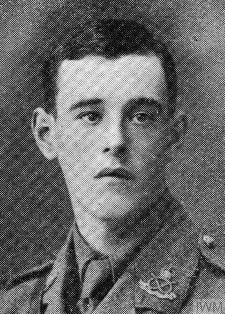 Walter
was born in Walsall on 13 November 1895, the son of Dr. George Martin
Fox and Emily Fox (formerly Vaughan).
Walter
was born in Walsall on 13 November 1895, the son of Dr. George Martin
Fox and Emily Fox (formerly Vaughan). |
Second Lieutenant Laurence TURNBULL Killed in action 16th June 1915, aged 29.
Laurence applied for an commission in the Special Reserve of Officers on 21st November 1914, specifying his preference as the 3rd (Reserve) Battalion of the Bedfordshire Regiment, being an Electrical Engineer at the time. Lord Ampthill accompanied his application with a personal letter, including the remark that he "has given up a very good position in America in order to offer his services", which was in the Westinghouse Electric and Manufacturing Company in Pittsburg, America. Second Lieutenant Turnbull joined the 2nd Battalion on 5th June 1915, being attached from the 3rd Battalion but was killed eleven days later. He has no known grave but is remembered in the Le Touret Memorial to the missing. A photograph of the panel with his name on can be seen here. At the time of his death, his widowed mother was the next of kin, living at 17 Goldington Road in Bedford as did his surviving brother, Denis. (Image courtesy of the Imperial War Museum, reference HU 119357) |
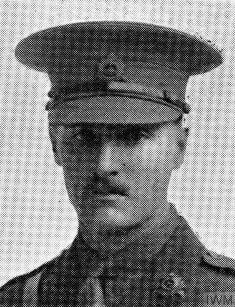 Laurence
was born 1st March 1886 at 7 Summerhill, Sunderland, the son of
Henry Bishop Turnbull (an Insurance Agent) and Agnes Moir Turnbull.
He was educated in the Stevens Preparatory School, New Jersey, before
continuing his education in the Stevens Instiute of Technology until
1907, at which time he graduated with a degree in Mechanical Engineering.
Laurence
was born 1st March 1886 at 7 Summerhill, Sunderland, the son of
Henry Bishop Turnbull (an Insurance Agent) and Agnes Moir Turnbull.
He was educated in the Stevens Preparatory School, New Jersey, before
continuing his education in the Stevens Instiute of Technology until
1907, at which time he graduated with a degree in Mechanical Engineering.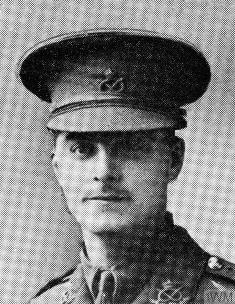 Killed
in action 16th June 1915
Killed
in action 16th June 1915|
Lieutenant (Acting Captain) James Charles Alexander NESS Killed in action 27th June 1915, aged 19.
After a spell recovering in England, he was promoted to Lieutenant and posted to France. Lieutenant Ness was killed within hours of his arrival with the 2nd Battalion as he went out on patrol and did not return. Enquiries continued for many years as no noises had been heard from the patrol so his parents hoped he had become a POW, but his death was later accepted. He was the son of Major James Alexander Ness and Winifred Isobel Ness of Kinkell in Woking, Surrey and is remembered in the Le Touret Memorial to the missing. His name can be seen on the memorial panel here. |
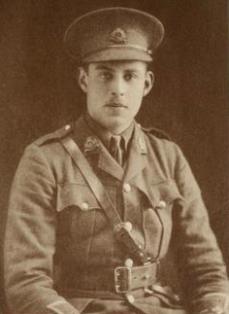 James
applied for a commission on 4 January 1914, giving his address as
The Old Manor House, Chilworth in Surrey. He initially served in
the 1st Battalion and was lightly gassed at Hill 60 in April 1915,
having arrived in France on 12 April 1915.
James
applied for a commission on 4 January 1914, giving his address as
The Old Manor House, Chilworth in Surrey. He initially served in
the 1st Battalion and was lightly gassed at Hill 60 in April 1915,
having arrived in France on 12 April 1915.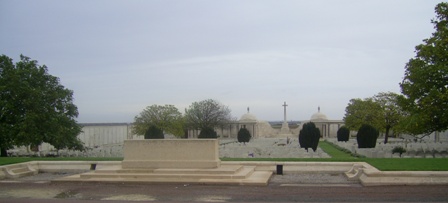
The Loos Memorial to the missing, within Dud Corner cemetery
The battalion were engaged during the Battle of Loos, when they lost over 350 men in the opening phase alone. Included in the casualty toll were the following five officers:
|
Second Lieutenant Charles Arthur FORWARD Killed in action 25th September 1915, aged 19 He was gazetted a Second Lieutenant on the 17th April 1915 and arrived in France on the 22nd June, joining the 2nd battalion in the field on the 11th July 1915. Charles was appointed Grenade Officer in August and served as such during the Battle of Loos the following month. During the battalion's assault on the opening day of the Battle of Loos Charles led his men over open ground and came under heavy fire from German positions on two sides. Despite the heavy casualties, they continued to advance but Second Lieutenant Forward was killed as he led the platoon. Private 15513 Hitchen testified from his hospital bed that "first of all he was shot in the leg during the German attack at Zonnebeke. He stopped for a short time then went forward until he was shot dead in the head. As we did not hold the ground he was not buried by our men but may have been buried later on as the ground was regained" In the event, his body was not recovered and he is recorded on the Loos Memorial to the missing (photograph of the panel can be seen here). His service record is held by the National Archives under reference WO339/43285. |
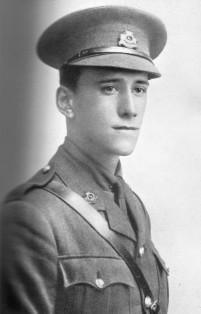 Charles
was born in Calcutta on Christmas Day 1895, the son of Arthur and
Ellen Gertrude Forward.
Charles
was born in Calcutta on Christmas Day 1895, the son of Arthur and
Ellen Gertrude Forward. 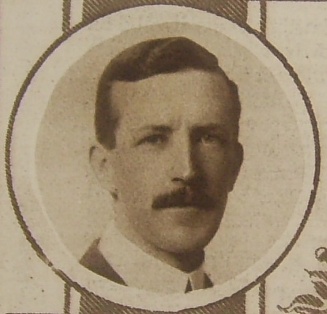
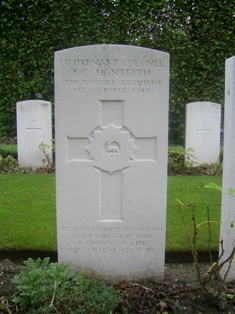 John
became Captain from 5th January 1910 and initially went to France
with the 1st Bedfordshires, landing in the first wave of British
Troops 16th August 1914. He commanded D Company through the Battles
of Mons and Le Cateau.
John
became Captain from 5th January 1910 and initially went to France
with the 1st Bedfordshires, landing in the first wave of British
Troops 16th August 1914. He commanded D Company through the Battles
of Mons and Le Cateau. 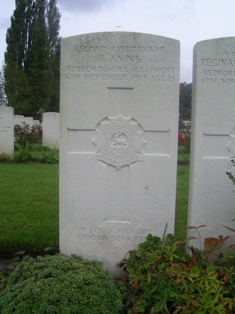
|
Second Lieutenant Evelyn Ernest Arnold COLLISSON Killed in action 23rd February 1916, aged 22 Second Lieutenant Collisson was an officer from the Bedfordshire Training Depot and can be seen here in the Officers group photograph from the Training Depot in July 1915. However, he was attached to A Company of the 2nd battalion early in November 1915 and joined the 2nd battalion in the field on the 24th November 1915. After only a few months in the trenches Second Lieutenant Collisson was killed during a "very quiet", cold, snowy day in the front line, by a sniper. He was originally buried in the Maricourt cemetery but appears to have been moved during the concentrations of the 1920's and now lies in the Cerisy-Gailly Military cemetery, Cerisy, 10km south-west of Albert. His service record is held by the National Archives, under reference WO339/38053. In amongst the effects returned to his parents after his death were the usual letter cases, whistle and chain, cheque books and tobacco pouch but also the rather poignant "Touchwood" lucky charm. |
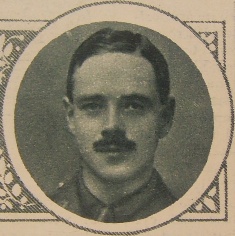 Evelyn
was the only son of the Reverend Thomas Collisson (the Rector of
the Gravenhurst Rectory, Ampthill, Beds) and Florence Collisson.
Evelyn
was the only son of the Reverend Thomas Collisson (the Rector of
the Gravenhurst Rectory, Ampthill, Beds) and Florence Collisson.
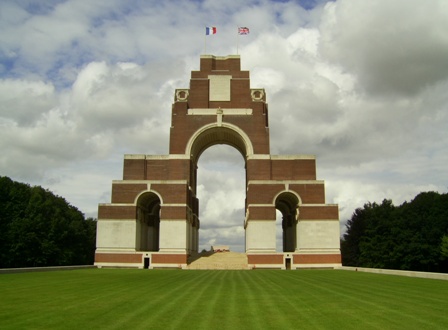
The Thiepval Memorial to the Missing
During the battalion's assault against German positions within the infamous Trones Wood, the following three officers were killed and a further 240 men were killed, wounded or posted as missing:
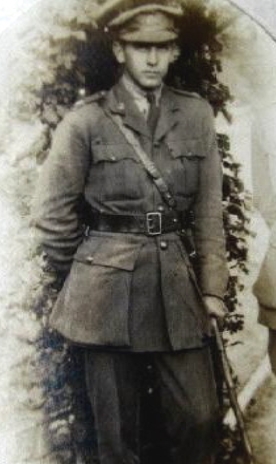 Robert
Gibson was born 8th January 1895 at 139 Downshire Hill in Hampstead,
the son of the Reverend Thomas William Gibson of Cranham Rectory,
Upminster. His mother was Frances Georgina Gibson, nee Currey. Robert
was baptised at St Sepulchre's, Holborn, March 25th 1895 and confirmed
at St Giles, Oxford, April 15th 1908 by the Bishop of Oxford. His
education started at the Oxford Preparatory School (Lynam's) between
1904 and 1908, after which he attended the Winchester College from
September 17th 1908. In 1913 he won a scholarship at New College
Oxford. Whilst at Oxford, Robert had double pneumonia, which was
when the photograph of him in bed (below) was taken.
Robert
Gibson was born 8th January 1895 at 139 Downshire Hill in Hampstead,
the son of the Reverend Thomas William Gibson of Cranham Rectory,
Upminster. His mother was Frances Georgina Gibson, nee Currey. Robert
was baptised at St Sepulchre's, Holborn, March 25th 1895 and confirmed
at St Giles, Oxford, April 15th 1908 by the Bishop of Oxford. His
education started at the Oxford Preparatory School (Lynam's) between
1904 and 1908, after which he attended the Winchester College from
September 17th 1908. In 1913 he won a scholarship at New College
Oxford. Whilst at Oxford, Robert had double pneumonia, which was
when the photograph of him in bed (below) was taken. 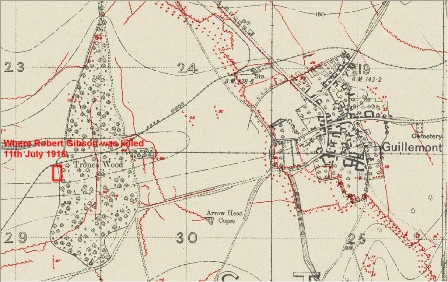 Robert
Gibson fell in the area shown on the trench map to the left, just
as his platoon entered the wood. Most of his men were killed or
wounded in the burst of machine gun fire that claimed his life,
with very few of them making it into the wood itself.
Robert
Gibson fell in the area shown on the trench map to the left, just
as his platoon entered the wood. Most of his men were killed or
wounded in the burst of machine gun fire that claimed his life,
with very few of them making it into the wood itself. 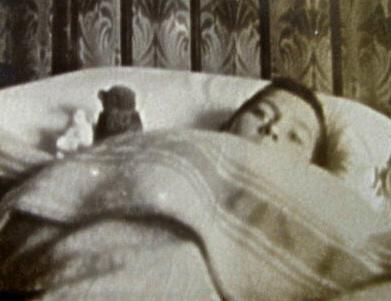
|
Second Lieutenant Robert Francis Cooper BALLARD Killed in action 30th July 1916, aged 20.
He was one of the more unusual enlisters, joining the 28th London Regiment (the "Artist's Rifles") on the very first day of war - 4 August 1914. He became Private 1394, conveniently giving his age as exactly 18 years old. Private Ballard went to France with the battalion on 26 October 1914 and on 3 June 1915, lost his Lance Corporal stripe because of misconduct. Nevertheless, Robert was gazetted as a Temporary Second Lieutenant on 28 November 1915. Following a short spell of leave, Second Lieutenant Ballard joined the 2nd Bedfordshires on 7 December 1915 and other than another period of leave in February and leaving briefly in March due to illness, he served with the battalion until his death. Second Lieutenant Ballard was amongst the 192 casualties lost when their brigade assaulted the area around Maltz Horn Farm, defended by 11 fresh Bavarian battalions. Robert was the son of George Robert and Ada Louisa Ballard of Lyndale, Surbiton in Surrey and is remembered on the Thiepval memorial to the missing. |
 Following
education at Oundle School, Robert Ballard was an Insurance Clerk
from Lyndale, Balaclava Road, Surbiton in Surrey when war broke
out.
Following
education at Oundle School, Robert Ballard was an Insurance Clerk
from Lyndale, Balaclava Road, Surbiton in Surrey when war broke
out. |
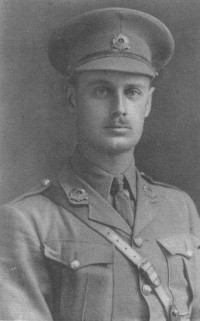
Lieutenant Harold Ashcombe CHAMEN Died of wounds 1st August 1916, aged 22
After 3 years spent in the Lancing Officer Training Corps (Junior Division) whilst at Reading University, Harold applied for a commission in the Special Officers Reserve on 6th August 1914. He was a very fit and 5 feet, 11 inches tall. Although his preference was the Dorsets, then Gloucestershire and finally the Somerset Light Infantry, Harold was posted to the South Wales Borderers on 21st September 1914, whilst he trained at Sandhurst until his commission was confirmed in May 1915 and he was transferred into the Bedfords. On the 8th July 1915 Harold arrived in France, finally joining the 2nd Battalion in the field on the 21st July. 10 days later Harold was returning to a trench in the dark, stumbled and accidentally impaled his right thigh on a bayonet. He was admitted to No. 2 General Hospital in Le Havre 4th August and shipped home on the troop ship "Oxfordshire", landing at Dublin on the 7th August. His father reported that he had written to him, saying he had "met with a slight accident in which he got wounded in the thigh with a bayonet. He described it as a mere scratch and nothing serious". Harold was posted to the 4th Bedfordshires, joining them on 2nd Octoebr 1915. By 1916 Harold was fit again and rejoined the 2nd Battalion on 7th February 1916. 5 days later he was posted to the 3rd Entrenching battalion and rejoined the 2nd Bedfords on 4th June. He was in reserve during the 1st July Somme offensives and became commander of B Company when Captain Pearse sprained his ankle on the 10th July, just in time for the attack on the infamous Trones Wood the following day. The morning of the 11th saw him lead B Company to take the north east section of the wood, but all Companies were later withdrawn to the southern end of the wood and over 300 casualties were inflicted on them by the galling German Machine Gun fire during their attack. On the 30th July, the Battalion was ordered to take the German Second Line positions at Guillemont. Two hours into the attack Harold was mortally wounded, one of over 200 men of the battalion who became casualties. Harold was moved to No. 5 Casualty clearing Station in Corbie. Sadly, he died from his wounds on the 1st August 1916, aged just 22. He was the son of William Ashcombe and Marion Mabel Chamen of 23 Victoria Square, Penarth, Glamorganshire. He is buried at Corbie cemetery on the Somme. (My thanks to John Hamblin for the pre-war bio from Lancing College and his photo) |
 Harold
was born 2nd March 1894 at Harlesden in London. He was educated
at The Wells House, Malvern Wells in Worcestershire, then Lancing
College in Shoreham and finally at the University College in Reading
as an Agricultural Scholar.
Harold
was born 2nd March 1894 at Harlesden in London. He was educated
at The Wells House, Malvern Wells in Worcestershire, then Lancing
College in Shoreham and finally at the University College in Reading
as an Agricultural Scholar. The following six officers were among the ten officers and 242 men from the 2nd Battalion who were lost in the Battle of Le Transloy, 11th to 12th October 1916.
|
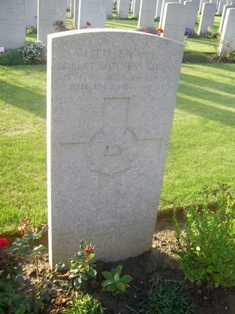
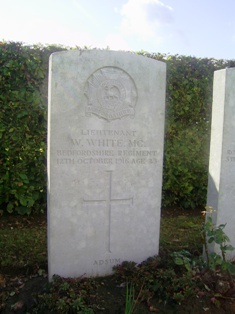
Second Lieutenant Thomas Joceline Gordon REYNOLDS Died of wounds 11th (12th) October 1916 Thomas Reynolds was born 23 November 1892, and educated at Eagle House College in Camberley. A Rubber Planter in Canada when war broke out, Thomas joined the 15th Alberta Light Horse and rose to the rank of Sergeant before returning to England on 10 February 1912. He applied for a commission on 3 January 1915, was gazetted a Second Lieutenant on 13 January 1915 and was posted to the 4th Battalion for training. On 29 January 1916 Second Lieutenant Reynolds landed in France and was attached to the 2nd Battalion, although he must have enjoyed a spell of leave as he married Florence Helen Boughton Dickenson in Essex on 27 May 1916. The battalion war diary records that he was wounded at 2 p.m. on 12 October, dying from his wounds at XV Corps dressing station later that day. Today, Thomas lies in the Thistle Dump cemetery, High Wood on the Somme. A photograph of his gravestone can be seen here. At the time of his death, his widow lived with his parents (Major and Mrs Reynolds) at Greys, Kelvedon in Essex. The date of his death being 12 October is supported by telegrams and other such papers within his service record. In contrast, the CWGC records his death as 11 October; at the time of writing, the matter is with the CWGC for their decision. |
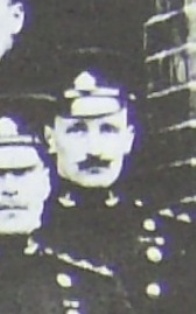
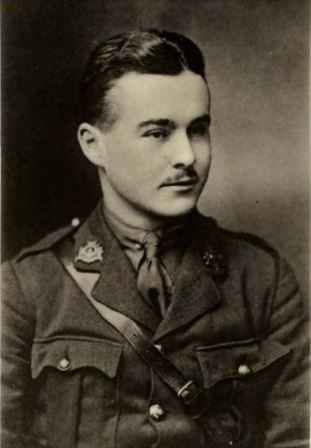
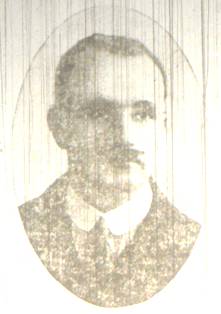 William
Denne was born in 1876 and enlisted into the regiment in 1897. He
served as a Lieutenant in the Mounted Infantry during the South
African Wars, earning five clasps to his Kings and Queens medals
as well as being mentioned in despatches. He then served as Adjutant
in the 2nd Battalion between 1905 and 1908, moving to a Staff post
in the Eastern Command between 1912 and October 1914, when he was
also promoted to Major.
William
Denne was born in 1876 and enlisted into the regiment in 1897. He
served as a Lieutenant in the Mounted Infantry during the South
African Wars, earning five clasps to his Kings and Queens medals
as well as being mentioned in despatches. He then served as Adjutant
in the 2nd Battalion between 1905 and 1908, moving to a Staff post
in the Eastern Command between 1912 and October 1914, when he was
also promoted to Major. |
Second Lieutenant Robert Henry HOSE Killed in action 18th March 1917, aged 29 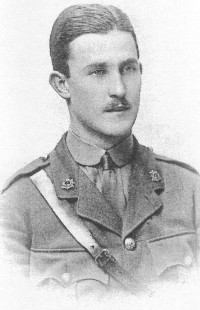
Robert was born in 1887 and educated at Forest School. On leaving school he joined the firm of John Gibbs and Son and Smith and became a member of the Stock Exchange in 1910. Early in 1915 he joined the Royal Naval Aircraft Corps as a despatch rider. That October he transferred to the 3rd/5th Bedfordshire Regiment in which he was given a commission. He was appointed adjutant the following March and remained with his battalion on East Coast Defence duty until January 1917, when he volunteered for foreign service and joined the 2nd Battalion in France. Robert arrived with them on the 15th March 1917. Three short days later, he lost his life to a booby trap during the operations against the Hindenburg Line. The Germans had vacated their former trenches and retreated to the Hindenburg Line. As the British advanced to take over the positions on the 18th March, Robert HOSE and Private 21111 Thomas PEARSON of Ilkeston were killed by the same bomb trap. Robert was buried in the Agny Military cemetery, 5km south-west of the Arras railway station. He was the son of Robert John Hose of Bromley in Kent and left a widow and one son. A photogtaph of his gravestone can be seen here. (My thanks to John Hamblin for his pre war bio and photograph) |
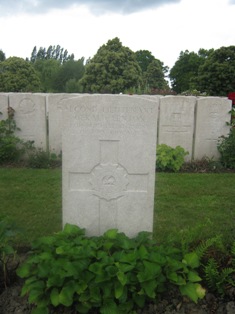 Gerald
joined the battalion in the field on 18 February 1917 and survived
the Battle of Arras and subsequent operations that year but was
mortally wounded during a localised trench raid on 26 July 1917.
Gerald
joined the battalion in the field on 18 February 1917 and survived
the Battle of Arras and subsequent operations that year but was
mortally wounded during a localised trench raid on 26 July 1917.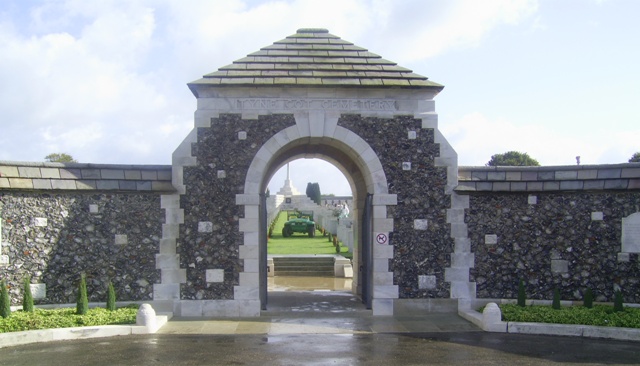
The Tyne Cot Memorial to the Missing
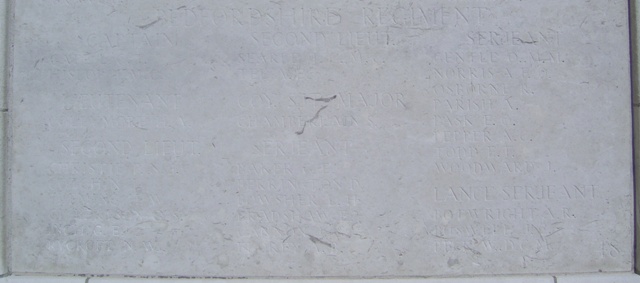
The section from the Tyne Cot Memorial showing the officers from the Regiment who's final resting places are unknown.
|
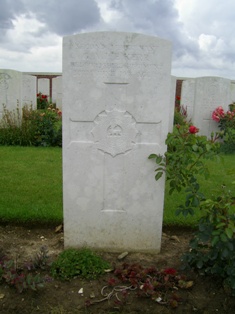
Second Lieutenant (Acting Captain) Lawrence Alexander Lewis FINK, M.C. Born 10 August 1891 in Lucknow, India, Lawrence was the son of Major George Herbert Fink (a Surgeon Captain in the Indian Medical Service) and Edith Louisa Fink. After schooling at St Paul's School in West Kensington, he became a Rubber Planter until war was declared and returned to England to apply for a commission. Appointed to the Special Reserve of Officers on 26 April 1915, Second Lieutenant Fink was posted to the 3rd Bedfordshires for training and attached to the 2nd Battalion on his arrival in France on 23 March 1916. Surviving several phases of the Battle of the Somme, Second Lieutenant Fink won the Military Cross for bravery on 12 October 1916, his citation reading: "For conspicuous gallantry in action. He led his company forward with great courage and determination under intense fire, and succeeded in capturing about 200 yards of the enemy's trench" On 15 November 1916 he was promoted to Lieutenant, when he was already in command of C Company, and January 1917 saw him recommended and approved for a permanent commission in the Regulars. On 5 October 1917, while the 2nd Battalion were in the line, Lieutenant Fink was killed. No further casualties are mentioned so it is possible that he was killed by a sniper or stray shell. He was recovered and buried in the Kemmel Chateau cemetery, 8km south of Ypres centre; a photograph of his headstone can be seen here. By 1918, his father was a 'Criminal Lunatic' and an inmate at the Broadmoor Criminal Lunatic Asylum so Lawrence's medals and estate were issued to his mother, who was in the process of arranging to move to Australia and live with her married daughter. At the time, his mother lived at 46 Mountfield Road, Church End, Finchley and later of 38 Onslow Gardens, Muswell Hill, London. Lieutenant Fink can be seen here in the 3rd Battalion officers' group photograph from 1915. |
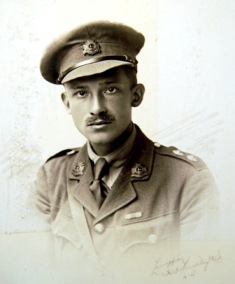
 Killed
in action 5th October 1917, aged 26
Killed
in action 5th October 1917, aged 26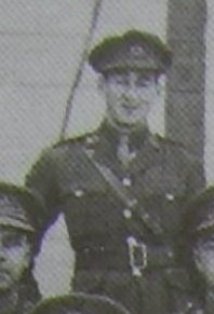
 George
was born in 36 Gloucester Gardens, Paddington on the 14th November
1898, the son of George William Kerr (a Clerk in Holy Orders who
had been born in Ireland) and Frances Isabella Kerr (nee L'Estrange).
Following private education until the age of 11, George was educated
at Merchant Taylor's School in London and then at St. John's College
in Oxford. During his education he spent three years as a Sergeant
in the Officer Training Corps and was a Prefect.
George
was born in 36 Gloucester Gardens, Paddington on the 14th November
1898, the son of George William Kerr (a Clerk in Holy Orders who
had been born in Ireland) and Frances Isabella Kerr (nee L'Estrange).
Following private education until the age of 11, George was educated
at Merchant Taylor's School in London and then at St. John's College
in Oxford. During his education he spent three years as a Sergeant
in the Officer Training Corps and was a Prefect. 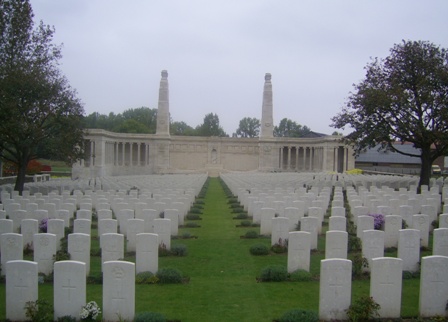
The Vis en Artois Memorial to the Missing
The officers of the Regiment shown on the memorial whose final resting place is unknown.
|
Killed in action 2nd or 3rd July 1918, aged 29 Originally in the ranks of the Honourable Artillery Company in France from 1914, John was commissioned into the Bedfordshire Regiment on 12 August 1915, intially training in the 10th Battalion before his overseas posting to the 8th Battalion. Reaching the post of Adjutant in the 8th Battalion, he was transferred to the 2nd Battalion in 1918, where he was killed in the fighting on 2 July 1918. Although unconfirmed, it appears likely that he was mortally wounded and died in the dressing station on the site of the CWGC cemetery in which he lies. He was not relocated from a battlefield burial and the cemetery is a few miles from the battle site, which suggests he was moved from the front for treatment. This would also account for the battalion diary recording his death on 2 July (the day of battle) and the CWGC citing 3 July (the day after the fighting). John was the son of C. J. and R. E. M. Ash of 48 Cromwell Avenue, Highgate, London and the husband of Frederica Gertrude (Freda) Ash, of 13 Holdenhurst Road in Bournemouth. His brother, Charles Duncan Ash, also served as an Officer in one of the regiment's regular battalions and was among the many officers and men to have suffered briefly from shell shock before being discharged in 1919. He lies in the Warloy-Baillon Communal cemetery, 21km north-east of Amiens |
Within the "100 Days" offensives that led to he end of the war, the 2nd Battalion were initially engaged in the The Battle of Albert which saw the following four officers killed
|
Died of wounds 23rd August 1918 Guy was born in North Kensington on 29 October 1887, the son of Eugene Ernest Baron Reed. At the time he enlisted on 2 September 1914, Guy was a Solicitor in his father's firm and lived in North Kensington. He became Private 5511 of the 18th Royal Fusiliers but was discharged to a commission in the 10th Bedfordshires on 4 February 1915. Following training, he was sent to France on 17 April 1916, joining the 8th Battalion of the Bedfordshire Regiment on the 23rd. However, soon afterwards he entered a protracted spell of illness; on 20 June he was admitted to 16 Field Ambulance with NYD Pyrexia ('Trench Fever') for three days, but left the battalion on 1 July suffering from the same condition. Three weeks later he rejoined the 8th Bedfordshires but on 8 September he started a third, and ultimately longer spell of illness. Admitted to Rouen General Hospital the following day, Guy was returned to England on the 14th and sent to No.2 Stationary Hospital in Bristol. By now his symptoms were reported as headaches, exhaustion after exertion, sleeplessness, malaise, skin pains, debilitated, under weight, and ultimately unfit for all service, so he was leave granted. In November 1916 he applied for home service employment but the following month was back in hospital suffering from a return of fever and an attack of influenza. The New Year saw him confined to bed with jaundice, and on 20 February 1917 he was finally passed as fit for light duties, joining the 3rd Bedfordshires the next day. By the end of July 1917 he was declared fit for duty and joined the 3rd Battalion to retrain in readiness for active service again. 14 April 1918 saw him sign his formal will which suggests he was about to be shipped to France again but the first mention of him in the 2nd Battalion war diary is on 16 July, when he was in an advanced billeting party. Lieutenant Reed was wounded in the head on 22 August 1918 and although he was moved to No.53 Casualty Clearing Station, he died from his wounds at 8.45 a.m. the following day. He is buried in the Daours Communal cemetery extension, 10km east of Amiens. A letter in his service record dated Nov 1916 says that he had three brothers who were commissioned; one was a Second Lieutenant in the Middlesex Regiment who lost a leg on Gallipoli, another was killed on the Somme in August 1916 in the Middlesex Regiment, and the third in Army Ordnance Department. At the time of his death, his father lived at Pencoyd, 2 The Drive in Wimbledon. |
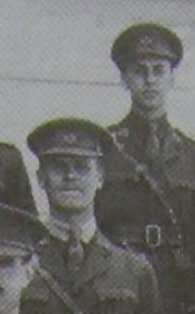
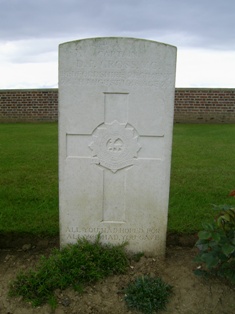 Dennis
was born in Rio de Janeiro on 19 September 1891, the son of Thomas
George Cross and Evelyn Ford Cross (nee Wyatt). His father was a
Merchant at the time, later becoming a Partner in coffee merchants
Print & Co.
Dennis
was born in Rio de Janeiro on 19 September 1891, the son of Thomas
George Cross and Evelyn Ford Cross (nee Wyatt). His father was a
Merchant at the time, later becoming a Partner in coffee merchants
Print & Co.As the offensives continued, the battalion were next engaged in The Second Battle of Bapaume, that cost the battalion a further officer.
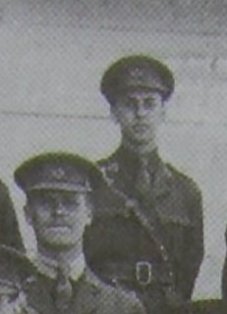
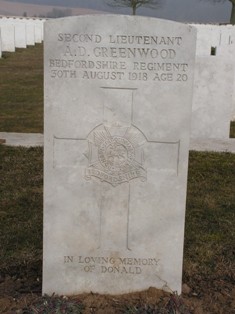
|
Second Lieutenant William HUGHES, M.C. Died of wounds 14th September 1918, aged 38 William was born on 18 December 1879 in Leatherhead, Surrey, the son of Henry and Frances Hughes. After schooling at Dulwich College, he became a Solicitor and lived in Shortlands, Kent at the time he joined up. During the Derby Scheme, William enlisted on 7 December 1915, becoming Private 5850 in the 2nd/28th Artist's Rifles. Following training, he was posted to France and joined the 1st/28th Artist's Rifles in the field on 27 April 1916. 17 July 1917 saw him apply for a commission, for which he was accepted on 1 August. Training completed, he returned to France and joined the 8th Bedfordshires as a Second Lieutenant on 20 November 1917 When the 8th Battalion were disbanded, Second Lieutenant Hughes was transferred to the 7th Battalion, joining them on 8 February 1918. From the start of the German Spring Offensives in March, the 7th Battalion were heavily engaged, with just 200 of them remaining by the end of 23 March 1918. During the sequence of battles that week, William won the Military Cross for bravery. On 25 April 1918, the London Gazette published the citation which explained more about the events surrounding the award: "For conspicuous gallantry and devotion to duty during an intense hostile bombardment. Whole stretches of trench had been levelled, and although all his platoon except four men were at one time either wounded or buried, he kept the Lewis gun manned. Hearing that there was .a gap on his left, he personally got into touch with the next post and covered the gap." Second Lieutenant Hughes was wounded in the right arm during the operations on Bouzincourt Ridge on 2 July 1918. He was moved to No.41 Casualty Clearing Station the onto No.2 Red Cross Hospital in Rouen, where his right arm was amputated due to the severity of his injuries. Retuning to England once he was stable enough, William was moved to Lady Ridley's Hospital on Carlton House Terrace, but contracted acute nephritis. The combination of the extent of his wounds and subsequent illness lead to his death at 10 a.m., 14 September 1918 He was interred in the Shirley (St. John) churchyard, where he lies today. |
|
Lieutenant Sydney George HAGUE, M.C. Died of wounds 21st September 1918, aged 31
He applied for a commission on 26 May 1915, giving his address as Roebuck Park, Carron, Falkirk, being his father's address. After officer training and UK service, on 12 April 1917 Second Lieutenant Hague landed in France and joined the 2nd Bedfordshires. Promotion to Lieutenant followed on 1 July 1917 and he survived the battalion's involvement in the Third Battle of Ypres. Remarkably, he was also among the few officers to survive the battalion's determined defence during the German Spring Offensives and became the Adjutant that spring. In May 1918, he was awarded with the Military Cross for bravery during the battalion's stand against an overwhelming German attack. The citation read: 'For excellent work in the battle zone near Savy on March 21st and 22nd. This officer was in charge of one of the forward companies, and although his position was being continuously attacked by the enemy, he set a fine example to all by his coolness and energy. He also kept battalion HQ well informed of the situation and sent in excellent reports. He organised several small counter-attacks, and ejected the enemy from small portions of his position. He greatly helped the company on his right by directing the fire of a heavy trench mortar on to a quarry, into which the enemy had penetrated. He held on to his position until late in the afternoon of the 22nd, and ultimately withdrew when he was practically surrounded by large numbers of the enemy and he had lost nearly all his men.' As the battalion were in support to the 16th Manchesters, the quarry referred to in the citation was likely to be the one Elstob's Manchesters were overwhelmed in during their famous last stand, in which Lieutenant-Colonel Elstob won the posthumous Victoria Cross. Lieutenant Hague was among those who lost their his entire kit during the March 1918 retreat and during a trip home in July 1918, he was forced to buy a full replacement uniform, totalling over £20 at the time. His father, a Works Manager at the time, was still corresponding with the War Office to claim the money back as late as 1920. After also surviving their part in repelling the next phase of German attacks during the Battle of the Lys in Apri, while the battalion was rebuilt, Sydney was promoted to Acting Captain while commanding a company between 5 April and 15 July 1918. During a localised British attack on 7 August 1918 that saw the 2nd Bedfordshires support the two other battalions in their brigade, Lieutenant Hague was lightly wounded during German shelling but remained at his station. He also came through the Battle of Albert and the Second Battle of Bapaume in August, as well as the Battle of Epehy in September. Lieutenant Hague's luck finally ran out during operations around Ronssoy between 18 and 22 September that saw almost 250 more men from the already small battalion become casualties. Lieutenant Hague was wounded on 21 September, dying from his wounds the same day at No.55 Casualty Clearing Station in Doingt. Today he lies in the Doingt cemetery, Peronne and is remembered on the Larbert war memorial. Among the effects returned to his parents was a wrist watch, noted as having broken glass, possibly from the time of his mortal wound. A larger copy of the original full photo this was taken from (which includes those 2nd Battalion officers who came through the March 1918 fighting) is available from BLARS (formerly the Bedford County Records Office). [My thanks to Russell MacGillivray for the pre war biographical details and copy of the portrait photo from Falkirk Herald, 29 September 1918] |
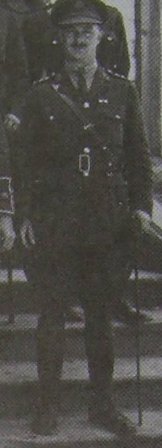
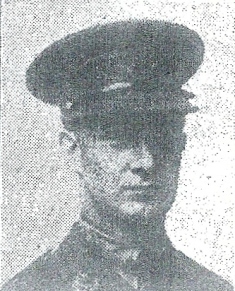
|
Captain Wilfrid Gilbert SAMUEL Killed in action 21st September 1918, aged 28. He was the son of Gilbert and Dame Louise Gilbert Samuel, of London and had been educated at Ipswich Grammar School and Balliol College, Oxford. He enlisted on 2 September 1914, becoming Private 2029 in the 18th Royal Fusiliers. At the time he joined up, Wilfrid was an Articled Clerk and lived in Bayswater in London, and gave his religion as Jewish. On 18 May 1915, he was discharged to commission, becoming a Second Lieutenant in the 1st/6th (Cyclists) Battalion of the Suffolk Regiment based out of Ipswich. He was promoted to Adjutant from 1 October 1916, while based at Saxmundham, but remained in England during his time in that unit. Lieutenant (Acting Captain) Samuel was posted abroad in August 1918 and attached to the 2nd Battalion of the Bedfordshire Regiment on 19 August 1918. Just a month later he was among the battalion's 250 casualties during the Battle of Épehy (part of the Battles of the Hindenburg Line). After the battle, he was buried 200 yards east of Z Copse, 1000 yards ENE of Ronssoy. On 22 September 1919, his remains were found and moved into a concentration cemetery. Today Captain Samuel lies in the Unicorn Cemetery, Vendhuile, 19km north of St Quentin. He is also recorded in the 2015 edition of the Wisden Cricketer's Almanac, having played for the Ipswich Grammar and Balliol XI. |
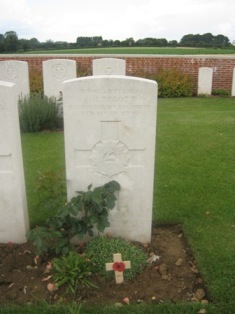 Sidney
Herbert Abbott was born in Woolwich on 8 May 1888, the son of Joseph
and Sarah Abbott. After education at Godmanchester Grammar School
in Huntingdonshire, Sidney became a printer and later a publisher.
Sidney
Herbert Abbott was born in Woolwich on 8 May 1888, the son of Joseph
and Sarah Abbott. After education at Godmanchester Grammar School
in Huntingdonshire, Sidney became a printer and later a publisher.
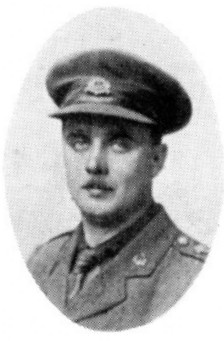 John
was born on the 1st of September 1888, the son of John and Emily
Norton Ferguson of Belmore House School, Bath Road, Cheltenham.
He attended Cheltenham College between 1901 and 1907 from where
he went to Emmanuel College Cambridge gaining a 2nd class Mathematics
degree in 1909. John Ferguson was a School Master at Stewart of
Rannoch School in Sacred Music and was a former member of the East
Gloucester hockey and cricket teams.
John
was born on the 1st of September 1888, the son of John and Emily
Norton Ferguson of Belmore House School, Bath Road, Cheltenham.
He attended Cheltenham College between 1901 and 1907 from where
he went to Emmanuel College Cambridge gaining a 2nd class Mathematics
degree in 1909. John Ferguson was a School Master at Stewart of
Rannoch School in Sacred Music and was a former member of the East
Gloucester hockey and cricket teams. 
Site built by Steven Fuller, 2003 to 2023